Gaslighting, authentic, polarization, surreal, feminism, justice.
What do these all have in common? They’re recent words of the year from Merriam-Webster. And for 2025, that word is “slop.”
“We like to think that we are a mirror for people,” Merriam-Webster President Greg Barlow told the Associated Press, about their practice of choosing a word to represent each year. The pick reflects terms which have risen fast in usage and search but also reflect the events of the year.
Slop, which in this context refers to “digital content of low quality that is produced usually in quantity by means of artificial intelligence,” has surged into usage as AI content of all kinds (and quality levels) has become fully mainstream. (It beat out “6-7,” “performative,” and “touch grass” to win.)
It was also good timing, as one of the stories that broke in December centered on AI taking over academic manuscript reviews. Reporting in Nature covered a controversy that erupted when 21% of all the reviews for a major AI conference were found to be fully AI-written.
And while these maybe weren’t slop, the practice gives a new spin on the meaning of peer-review. Unless, of course, the papers were also all written by AI.
Today we’re back for our AI industry roundup for December 2025, covering the events of the last month. This time out we look at breaking innovations and predictions, cover the AI impact on talent demand and skills, check in on chips and data centers (and power constraints and water), and look at regulatory and national updates.
But first, we look at where AI stands as one year comes to a close and a new one begins.
Eying the State of Artificial Intelligence at Year End
At PTP, we’re proudly AI-first, with our own proprietary solutions, consulting for AI implementations, and our long history of supplying quality AI talent.
We’ve also written all year long about the state of AI. Our Founder and CEO ran a piece just last week on the changing nature of conversation intelligence, as it shifts to AI execution.
Here we spotlight a few other takes from the end of the year.
The Information’s Amir Efrati profiled dueling narratives they’re seeing with intense (but varied) reactions coming from business leaders and software engineers.
Specifically, they pointed to the following positives at the end of 2025:
- AI-related hardware and chip growth continue to surge and can’t keep up with demand.
- Big AI firms like OpenAI and Anthropic are also rapidly increasing revenue(but not profits) from subscriptions and APIs via customers like GitHub Copilot and Cursor.
- The cloud hyperscalers (Amazon, Microsoft, and Google) are growing faster than ever, powered by spending from AI developers on Nvidia-powered servers.
- Some 20 AI startups (including Cursor and Cognition) are doing more than $100 million in annualized revenue, with much of it in the coding space.
- More complex benchmarks keep getting introduced and mastered by new versions of LLMs.
- Researchers continue to say LLMs are rapidly accelerating scientific work across disciplines (see below), from energy research to solving novel math proofs.
- Some real-world enterprise AI use cases have seen big gains, from Novo Nordisk’s writing first drafts of regulatory filings with Anthropic to IT services company Kyndryl halving their cybersecurity incident response needs with AI.
But on the other hand:
- Investors are also showing growing impatience with companies relying on the promise of future windfalls from companies like OpenAI. This was especially true for Oracle, which saw its earlier gains vanish and then some at the tail end of the year.
- According to AI experts, most chatbot users still don’t know how to use them effectively for work. This includes Microsoft’s AI-infused Copilot, where the company is going so far as to offer free training for enterprises that buy a certain number of licenses to improve the quality and pace of adoption.
- As profiled by us last time out, success with benchmarks isn’t matching success in the real world for AI agents on complex tasks.
- Major AI pioneers like Yann LeCun (see below), Ilya Sutskever, and Andrej Karpathy have all come down on LLMs ability to generalize of late, joining a growing chorus of researchers who suggest new approaches will be needed to pair with scaling LLMs to get to the next stage of more effective and reliable AI.
- This accompanies numerous AGI timelines moving back, even as superintelligence continues to be discussed almost as counterpoint.
- 2025 wasn’t the “Year of the Agent” as had been predicted by a number of leaders in the field. While there was a lot of talk early in the year about PhD-level AI agents being hired for tens of thousands of dollars a month, instead it’s been far more modest, with more practical, simpler use cases with tighter loops being the ones that have thrived thus far.
- Plenty of enterprise adoptions of AI have failed to deliver the AI productivity gains and ROI expected, as illustrated by a number of high-profile studies.
- Lessons overall from AI adoption in enterprises? Smart deployment, experience, and support matter in a big way.
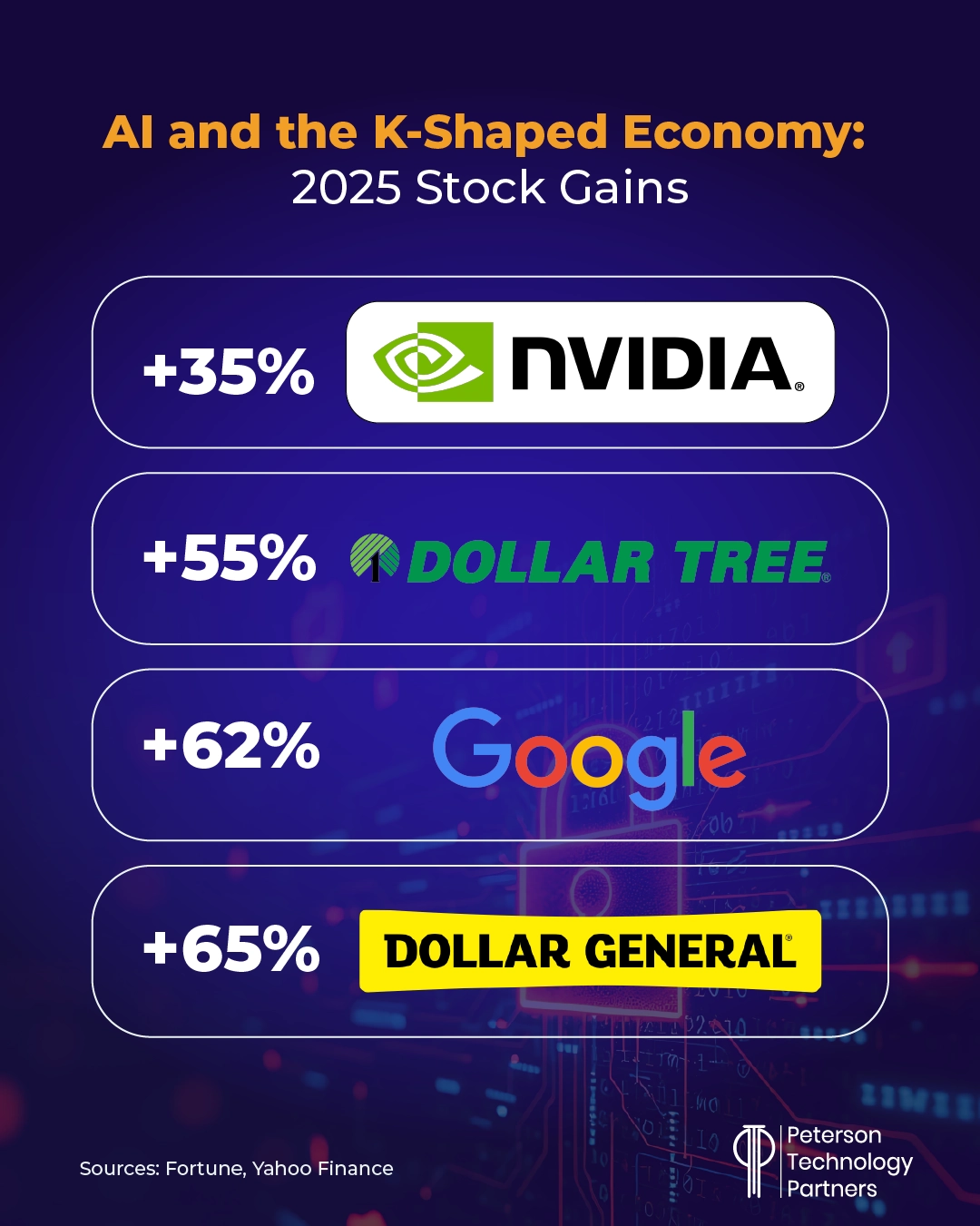
This split accompanies the emergence of extensive discussion about our “K-shaped economy” overall, which has seen discount stores Dollar Tree and Dollar General surprisingly outperform even AI powers like Nvidia in the market.
Co-founder and former head of Google Brain and renowned AI educator Andrew Ng offered his own take on the state of play at the end of 2025 in his newsletter the Batch:
- LLMs are both amazing and limited at present. They’re not a route to AGI in a few years but still have the capacity for real value.
- They bring a more general kind of intelligence than we’re used to from technology but are still far less general than human capacity.
- Progress has slowed because all the open information on the web’s been used. Now labs have to find or generate domain-specific data for improving capacity on a given task or create reinforcement learning environments to let an algorithm practice.
- Humans do far more generalization with far less knowledge, through continuous learning feedback loops, better representation of non-text input, and other processes we still don’t fully understand.
- Today we use a piecemeal approach to advancing models in a data-centric way that still requires a lot of manual decisions.
- He believes breakthroughs will continue to come fast, but that the work is nowhere near done.
- He encourages young people that their insight and expertise is still badly needed in AI and will be for decades to come.
To put some numbers to this from December, Anthropic partnered with research firm Material to survey technical leaders from varying size companies and across industries to get a better read on enterprise AI adoption reality. This is what they found:
- 57% of organizations deploy agents for multi-stage workflows
- 16% use cross-functional processesacross teams
- Codingleads adoption, with 90% of organizations using AI to assist development and 86% using agents for production code
- The primary challenges continue to be:
Integration with existing systems (46%)Data access and quality (42%)Change management (39%)
- Beyond engineering, the highest impact use cases are data analysis and report generation (60%), and internal process automation (48%)
Innovations and Predictions on the AI Outlook for 2026
Year end is also time for predictions, and AI is front and center on the 2026 predictions everywhere.
Some of the most common include:
- One of the “Godfathers of AI,” Geoffrey Hinton, told CNN that AI is moving even faster than he expected when he left Google in 2023. And while he has been working to warn about potential risks, in December his focus was on job displacement. Hinton believes 2026 will see “many, many” jobs displaced by AI (see below for more on this).
- Numerous prognosticators have suggested that 2025 reached, as cognitive scientist Gary Marcus termed it, “peak bubble,” and that 2026 will see increased scrutiny and demand for return on AI investments. More practical AI, less experiment, pilot, and throwing it at problems, in other words.
- The singular focus on LLM scaling is being abandoned, with alternate approaches like neurosymbolic and world models being added to the mix.
- In education, AI majors will continue to grow in disciplines other than technology, like USC’s joint AI and business degree, Purdue’s liberal arts AI major, and SCAD’s Bachelor’s of Design in Applied AI. MIT’s “artificial intelligence and decision-making” program is already the school’s second-most-popular undergrad major, after CS.
- AI may also be at “peak deregulation,” with predictions abounding on new regulations coming in the US and abroad, some fired by mental health concerns which grew substantially in 2025.
- LinkedIn is among outlets (including us at PTP) predicting AI in recruiting will surge in 2026, with jobseekers starting to warm to the benefits it brings them. A University of Chicago study recently found more than three-quarters of applicants chose AI over a human, finding the AI “less intimidating and more efficient.” Among 70,000 applicants across several industries, AI interviews with human decision-making also led to:
12% more job offers18% more job starters16% higher retention ratesAI-assisted decision making leading to the strongest matches
Science Signals Shaping the Future of AI
A “scientist-turned-technologist,” Sam Rodriques, is the head of nonprofit FutureHouse and also behind the science-focused agent Kosmos, released by Edison Scientific.
A single prompt on Kosmos costs $200 (which is already subsidized, per Rodriques) but takes around 12 hours to run (executing some 42,000 lines of code and reading some 1500 research papers). It also returns an estimated six-months of research work in less than a single day.
And while this may not be the $20,000-a-month PhD agents OpenAI dangled at the start of the year, it’s something that is moving very much in this direction.
In an interview with the Hardfork podcast (also released as an article in the New York Times), Rodriques shared his own outlook for where we are with AI in science at the end of the year:
- The bottleneck of clinical trials isn’t going anywhere, making predictions of AI curing diseases in 10 years wildly optimistic and probably impossible.
- Nevertheless, AI is already transforming science and scientific research, by working on data we already have but don’t have the people to analyze. It’s also optimizing clinical trials, unlocking coding for scientists (another huge bottleneck), and parsing scientific literature at scale.
- While verification of results remains essential, this is already true with human research, making it an effective area for AI acceleration.
- In 2026, Rodriques believes agents will “see an explosion,” with agents infiltrating most everything.
He also tells his interviewers that regardless of when the results come, with the AI results he’s seeing in science, “the future is going to be awesome.”
New Agentic AI Standards and Frameworks
A new open-source organization called the Agentic AI Foundation (AAIF) also made news in December.
Created by OpenAI, Anthropic, and Block under the Linux Foundation, the AAIF is being given ownership of widely used agentic frameworks like Anthropic’s Model Context Protocol (MCP), OpenAI’s Agents md, and Block’s Goose.
The goal is to encourage open interoperability, so agents from various providers can work more safely, consistently, and effectively across companies.
Just as open standards were critical to the web taking off, the goal with the AAIF is to do the same for agents.
The AI Hiring Landscape at Year End
As mentioned above, Geoffrey Hinton is predicting AI will be ready to take more jobs in 2026.
This position is also shared by some companies like HP, with CEO Enrique Lores telling Yahoo Finance’s Brian Sozzi that AI is increasingly doing things faster and better than they’ve done them in the past.
As part of a broader restructuring, it’s leading the company to eliminate some 4,000–6,000 jobs with an estimated $1 billion in savings by fiscal 2028.
But not everyone is in agreement.
CEO of Amazon Web Services (AWS) Matt Garman told Wired’s Katie Drummond that replacing coders with AI is “a nonstarter for anyone who’s trying to build a long-term company.”
While intense demand for generative AI is reshaping AWS’s business, he views getting rid of junior engineers as an enormous mistake, saying that, “If you have no talent pipeline that you’re building and no junior people that you’re mentoring and bringing up through the company,” the situation “explodes on itself,” adding that, “we often find that’s where we get some of the best ideas.”
Still, if there’s one thing he promises, it’s that “the way you did your job four years ago is not how you’re going to be doing your job next year.”
“I’m very confident in the medium to longer term that AI will definitely create more jobs than it removes at first.”
An AI Godfather’s Advice for Students and Early Careers
Another AI godfather, Yann LeCun, was in the news at the end of 2025 as he moves on from running Meta’s AI program to launching his own startup, Advanced Machine Intelligence (AMI) Labs. It will be focused on world models.
In December, LeCun also dispensed advice for young people wanting to go into AI. He still teaches computer science at NYU, and in an email to Business Insider recommended students:
- Don’t avoid studying computer science overall
- Focus on fundamentals, like math, physics, or EE courses
- Learn things that can be connected to reality, which preserves their long-term value
- Study engineering which exposes students to things like control theory and signals processing, which are useful for AI
And despite the increasing power of AI to aid with programming, LeCun notes “you must know how to do this” to succeed. In short, avoid the latest trends in favor of the foundations.
AI Hardware and Infrastructure Updates
2025 may ultimately be remembered as the year the AI data center push kicked into high gear.
Updates from this space from December included:
- AI data center dealmaking eclipsed last year’s total, hitting more than $62 billion worldwide, according to S&P Global, amid a “global construction frenzy.”
- Wired reported in December that the AI drive is also hammering existing data centers built for the cloud and web workloads and now struggling to meet new demands. With added power, cooling, and reliability concerns, operators are having to retrofit or relocate these facilities, potentially increasing the AI compute bottleneck.
- We’ve covered Google’s 2025 AI ascension previously, but December saw the role that their proprietary chips are playing in this surge. Bloomberg spotlighted how this part of Alphabet’s business could be worth nearly $1 trillion dollars. While less broadly functional than Nvidia’s offerings, Google’s TPUs are also cheaper, and saw sizable deals announced with Anthropic and Meta.
- Google’s parent Alphabet acquired clean energy developer Intersect Power for nearly $5 billion in the continued push to secure enough energy for its data center drive and partnered with NextEra Energy. NextEra is also partnered with Meta and has committed some 2.5 gigawatts of capacity, or enough to power 2 million homes. It aims to build to15 gigawatts of capacity within the decade.
- One positive for people concerned about the environmental impact of data centers: the water demands for cooling data centers appear to have been greatly exaggerated. Reporting by both the New York Times and Wired spotlighted the role played by effective altruism organizer (and former high school physics teacher) Andy Masley. An amateur environmentalist, Masley grew frustrated with what he saw as a flawed narrative around AI’s water needs. Journalist Karen Hao posted that her book, Empire of AI, was off by a magnitude of 1000 on real water needs for data centers in Chile and credited Masley for the correction, thanks to a post on his blog.
An AI Regulations Crackdown in the US and Global Updates
In the US, state AI regulations have been coming fast. In 2025 alone, 38 states have adopted around 100 regulations on AI, according to the National Conference of State Legislatures, with the White House saying more than 1,000 AI bills have been introduced.
But US regulations entered a new phase in December when President Trump signed an executive order written with the goal of limiting state-level AI restrictions, telling reporters “We want to have one central source of approval.”
The order uses state-level broadband funding as a lever and empowers the attorney general to sue states and overturn AI laws. White House advisor David Sacks said the administration wouldn’t push back on laws around child safety.
And while the plan remains to work with Congress in the near-term on a single, federal set of AI regulations, it remains to be seen both if the ban is enforceable, and if federal regulations can get passed in a way that satisfies the states.
International updates in the news included:
- In January 2025, the Chinese company DeepSeek sent shockwaves through the industry by releasing open-source models reportedly trained at a fraction of the cost of US leading edge models, built on inferior chips, and running on far less power. As the year comes to close, their V3.2 model brought agentic capacity to bear, performing on par across many benchmarks with leading models like GPT-5 and Gemini 3.0 Pro.
- The company also made news in December over reports it was using smuggled Nvidia Blackwell chips in an upcoming model, a charge the chip giant denied. Nvidia’s investigations turned up no evidence of “phantom data centers,” though the company says they pursue any tip they receive.
- The US, meanwhile, modified their policy to allow export of Nvidia’s second-best chip, the H200, to China in December, with the country taking a 25% of each sale. The Commerce Department also adapted the policy to apply to other companies, such as AMD and Intel.
- Amazon, meanwhile, joins the AI companies investing in India, announcing in December an additional $35 billion, to bring its total investment to $75 billion by 2030. This money will go to enabling AI access for up to 15 million small businesses and is expected to create a million jobs of varying types (direct, indirect, seasonal). This follows Microsoft’s commitment of $17.5 billion in India by 2029 and Google’s $15 billion going for data center infrastructure and an AI hub.
- OpenAI, meanwhile, announced in December it was hiring an ex-UK chancellor, George Osborne, to lead the company’s “OpenAI for Countries” program as it follows other AI companies in expanding its international presence. This program is geared to work with governments around the world, as the US and UK continue conversation over a broader tech deal.
Conclusion: OpenAI’s Up and Down Year
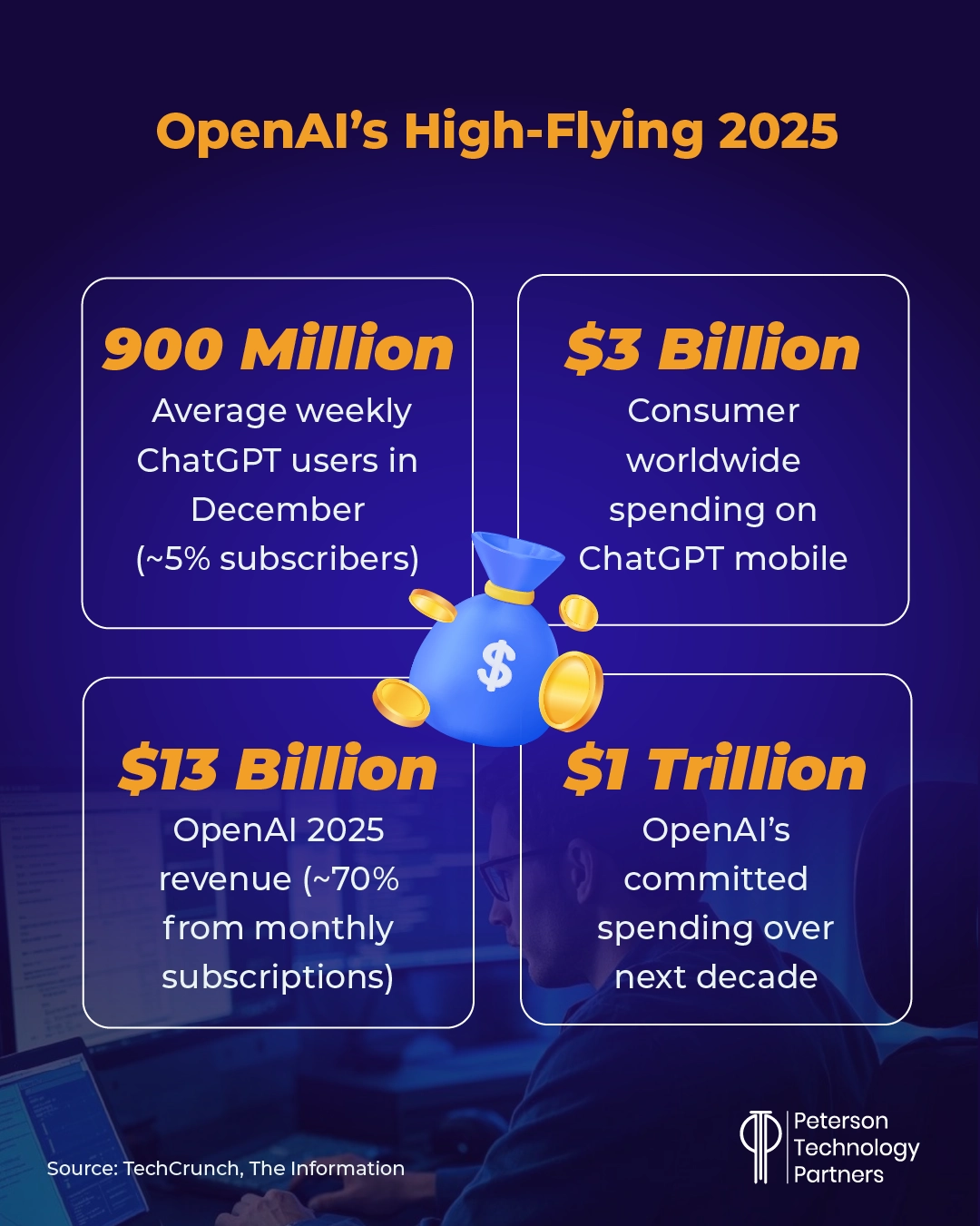
From top of the mountain to issuing a (widely reported and “leaked”) “Code Red” over Google’s successes, it’s been another head-spinning year for the nonprofit-turned-for-profit OpenAI.
Also in December: they added Slack CEO Denise Dresser to be their chief revenue officer, made a $1 billion deal with Disney to let the company use its characters in limited capacity (and give Disney access to models), added Adobe apps to ChatGPT (following rivals Canva and Figma), inked a reported $1.4 trillion (yes, trillion) in deals over the next eight years, is working on a $10 billion deal with Amazon, and announced the $20 billion acquisition of chip startup Groq (it’s largest yet).
Oh, and they released GPT-5.2.
If any single company represents the 2025 AI story with all its mad pace, impressive highs, frustrating lows, extreme risks, and continuous swings, it must surely be OpenAI.
And if you need to catch up on any of the AI story from the year to date, you can check out our prior roundups below:
References
Merriam-Webster’s 2025 word of the year is ‘slop’, The Associated Press
Major AI conference flooded by peer reviews written fully by AI, Nature
Applied AI: Why Our Story on Salesforce’s Declining Trust in LLMs Hit a Nerve, The Information
Why these 2 stocks have shockingly blown away Nvidia and HP is betting $1 billion on AI — even if it means cutting thousands of jobs, says CEO, Yahoo Finance
issue 332, The Batch
‘Godfather of AI’ Geoffrey Hinton predicts 2026 will see the technology get even better and gain the ability to ‘replace many other jobs’, Fortune
Six (or seven) predictions for AI 2026 from a Generative AI realist, Marcus on AI
25 Big Ideas that will define 2026, LinkedIn
Where Is All the A.I.-Driven Scientific Progress?, The New York Times
OpenAI, Anthropic, and Block Are Teaming Up to Make AI Agents Play Nice, AWS CEO Matt Garman Doesn’t Think AI Should Replace Junior Devs, and Billion-Dollar Data Centers Are Taking Over the World, Wired
Yann LeCun’s advice for young students wanting to go into AI, Business Insider
Alphabet’s AI Chips Are a Potential $900 Billion ‘Secret Sauce’, Bloomberg
Trump’s order targeting state AI laws faces political and legal hurdles and US to allow Nvidia H200 chip shipments to China, Trump says, Reuters
Nvidia responds to report that China’s DeepSeek is using its banned Blackwell AI chips, CNBC
Amazon to invest additional $35B in India by 2030, taking total planned spending to $75B, Tech Crunch
Former chancellor George Osborne joins OpenAI, BBC