A Look at the Open Standards and Software Innovations Bringing Agents to Life
Once the internet was all about connecting documents together.
The hyperlink let us jump from one to the next, breaking barriers, allowing interactivity, and spurring all the worldwide interconnection that would follow.
But initially it was ugly, awkward, inconsistent, and mostly text, or text-based command line applications. From DARPA to TCP/IP (which beat out the slower moving, internationally supported and better-funded Open Systems Interconnection, or OSI), the World Wide Web as we know it exploded thanks in part to collaborations across universities, companies, and nations.
From acceptable use policies (AUP) to the Commercial Internet Exchange (or CIX, major ISPs agreeing to let traffic flow) to HTML and CSS, HTTP and TLS, open standards enabled the internet as we know it to exist. Built by millions and working as a reasonably coherent whole.
With AI, we’ve not yet made these leaps, but no doubt they’re coming.
At Davos, AI agents are all the rage, with CEOs like ServiceNow’s Bill McDermott telling Fortune’s Alyson Shontell that he believes agents are now good enough now to significantly assist humans and even take over tasks. They’re using agentic AI to automate their IT department, though he remains focused on repurposing staff instead of layoffs. In his view of agentic capacity, he’s not alone.
Google’s Demis Hassabis believes Gemini 3 has crossed the threshold for real agentic impact, and Anthropic’s Claude Code has become so popular even beyond coding that the company launched another version, called Cowork, for non-coding use cases.
Today we look at what’s causing this belief in the newfound capabilities, from the AI agent protocols enabling cross-vendor interoperability to software layer breakthroughs greatly extending what LLMs alone can handle.
2025 wasn’t the year AI agents took over enterprise.
Will it be 2026 instead?
Prospect with Some Peril: The State of Play for Autonomous AI Agents in Enterprise
Many agent pilots over the past year have struggled too much with reliability to see major adoption at enterprise scale.
And academic research on agent reliability by former SAP CTO (also former CEO of Infosys and AI expert) Vishal Sikka and his son Varin from last year back this up. Titled Hallucination Stations: On Some Basic Limitations of Transformer-Based Language Models, their work applied sophisticated math to prove that LLMs may be doomed to fail when performing tasks beyond a certain level of complexity.
Not that they fail sometimes or throw too many hallucinations, but that they are incapable of success in these critical situations and thus will always fabricate results.
And while reasoning innovations can help, they found that these, too, failed to overcome these limitations alone, according to Sikka.
So how are companies like Google managing to boast at Davos about reducing hallucinations?
“Our paper is saying that a pure LLM has this inherent limitation—but at the same time it is true that you can build components around LLMs that overcome those limitations,” Sikka told Wired’s Steven Levy.
One startup working on this is Harmonic. By also applying formal methods of mathematical reasoning, they are encoding agent outputs in the Lean programming language as a means of verifying correctness.
And so far, it appears to be working, as their coding solutions top benchmarks for reliability, at least within their narrow focus.
While Harmonic’s engineers believe hallucinations are the roadblock slowing corporate adoption and will likely always be present with GenAI, their work aims to coexist with them effectively, by filtering out chaff from the wheat produced by these systems.
Tudor Achim, a Stanford-trained mathematician and cofounder of Harmonic, told Levy, “I think hallucinations are intrinsic to LLMs and also necessary for going beyond human intelligence.”
He also believes they’re essential for systems to learn, but that systems like theirs are getting better at filtering the unwanted out.
What the AI Agent Software Layer Brings to the Table
Claude Code is arguably the AI agent architecture that’s broken through the most to date.
While AI coding solutions initially were mostly autocomplete systems, vibe coding solutions like Cursor and Claude Code aimed to move past this, bringing agents and reasoning into the mix to deliver more.
And while initial efforts were prone to failure loops, with Opus 4.5, Claude Code appeared to take a big step forward.
Much has been made of the product hitting a reported $1 billion in recurring annual revenue in November (less than a year after launch), but it’s this improved reliability that has driven its surge and helped it stand out from the pack.
Agents like Claude are not chatbots. They use tools, work with system files, and interact with third-party apps like Slack.
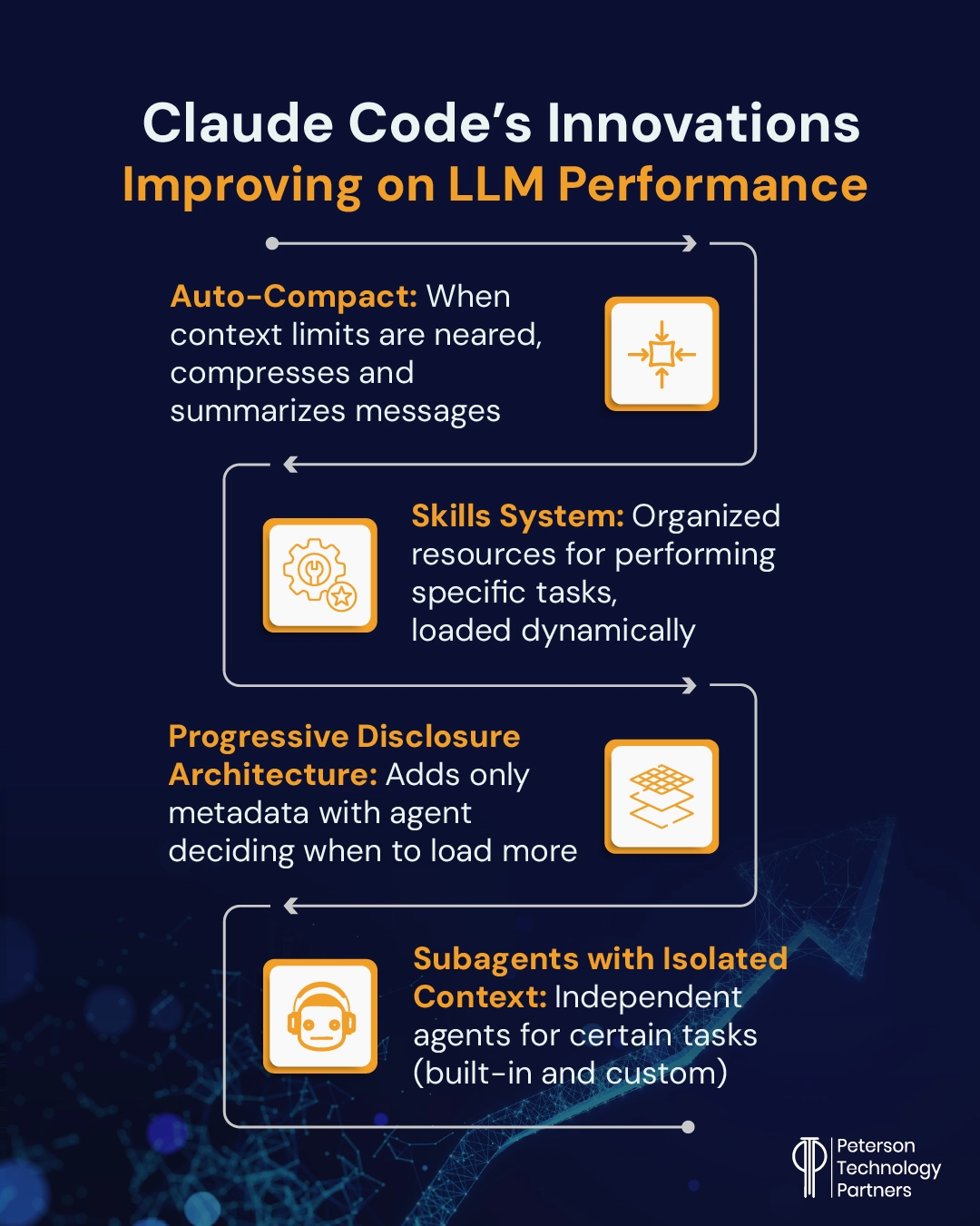
These solutions implement what many providers call agentic harnesses to manage how agents run and offset LLM shortcomings mentioned above.
They improve context shortages by compressing messages and documenting what’s come before to help clear space, make use of pre-built resourceswhich can come by default (ala Claude’s Skills) or be added for specific deployments, load only metadatafor extras unless the agent deems it necessary for more, and even work as multi-agent systems, spawning additional agents on need with highly specific purposes, permissions, and context.
And while we’ve featured Claude Code here on account of its proven effectiveness in our own work, rivals like OpenAI are also implementing agentic harnesses that bring similar benefits.
OpenAI’s Codex CLI unveiled many similar features in a blog post from last week.
Why Model Context Protocol (MCP) Matters Here
Software layer innovations are helping solve many of the issues that hampered agents in 2025, but success is also coming with adoption of open AI agent frameworks like MCP to expand reach and access.
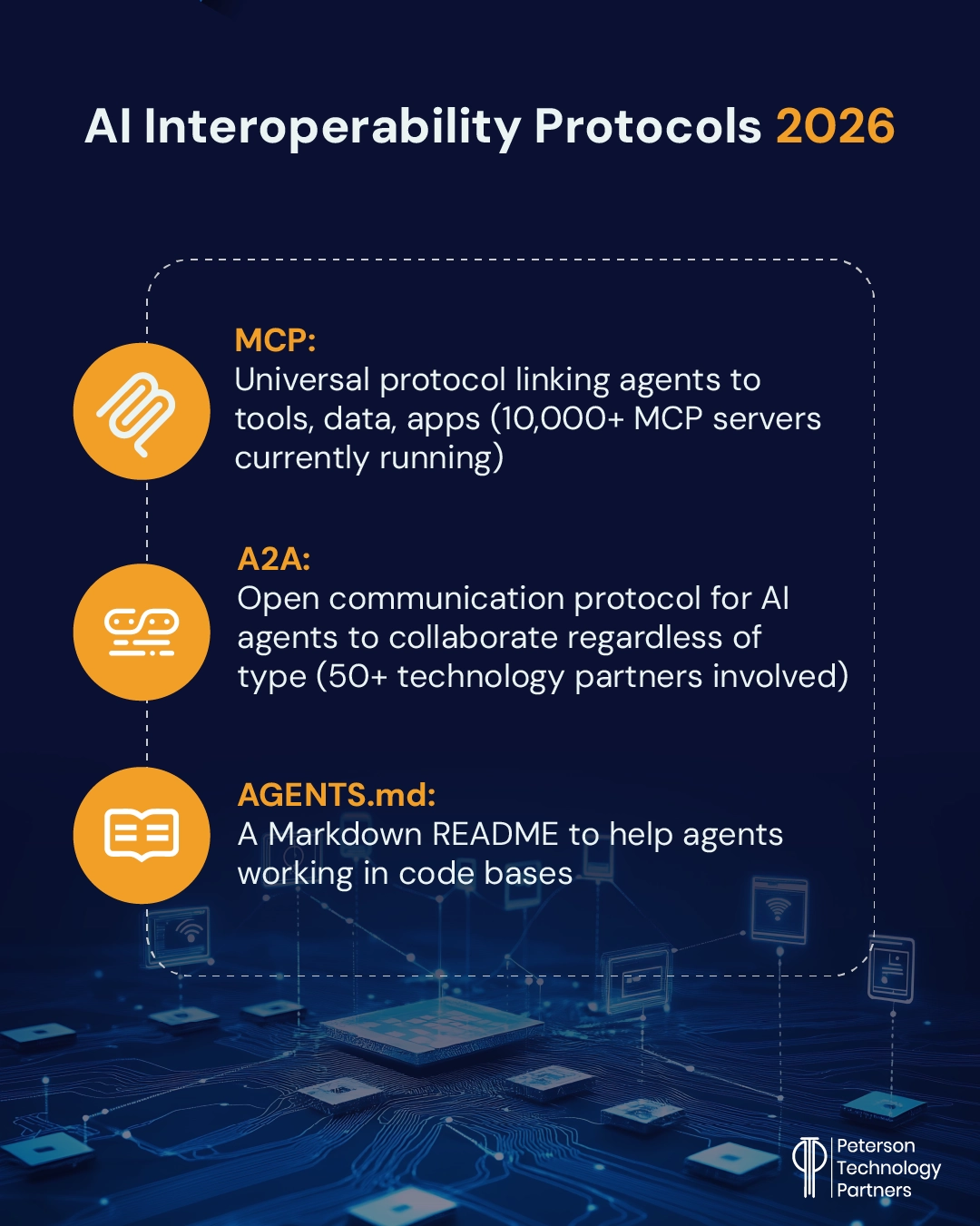
MCP is a widely adopted open-source set of standards released by Anthropic in November 2024. It standardizes the way LLMs share data and gives a universal interface for reading files and handling prompts. Anthropic also maintains an open-source repository of MCP server implementations to assist with adoption.
OpenAI, Google DeepMind, Cursor, Microsoft Copilot, and VS Code have all adopted MCP, and with more than 10,000 servers published overall, it’s rapidly become a universal standard for connecting LLMs to applications and data.
The AAIF: AI Open Standards Centralized
In December, Anthropic donated MCP to the newly formed Agentic AI Foundation (AAIF) under the management of the Linux Foundation. Along with co-founders Block and OpenAI—and with support from Amazon, Bloomberg, Cloudflare, Google, and Microsoft—the AAIF exists to create a neutral foundation with the goal of doing for AI what open standards did for the internet.
So far it has charge of MCP, Block’s open-source AI agent goose, and OpenAI’s AGENTS markdown.
For Multi-Agent Meetups: Agent-to-Agent (A2A) Communication
MCP may standardize how agents connect to tools and allow for swapping between models without rearchitecting, but another standard addresses how agents work with each other.
With the Agent2Agent (A2A) protocol, Google’s aimed to provide the solution for this arena.
Also open and vendor-neutral, A2A was built with contribution of numerous tech partners, including Atlassian, Cohere, Intuit, Langchain, MongoDB, PayPal, Salesforce, SAP, ServiceNow, and Workday, with service providers including major firms like Accenture, BCG, Deloitte, KPMG, McKinsey, PwC, and TCS.
Its goal is to aid independent AI agents in discovery, negotiation, task management, collaboration, and overall communication without risking code or proprietary data.
A2A uses existing standards like HTTP, SSE, and JSON-RPC, is complementary to MCP by design, and supports enterprise-level authentication and authorization.
And like MCP, it is also now managed by the Linux Foundation.
Enterprise AI Agents Ready to Take Flight
In our last PTP Report, we profiled how AI vulnerabilities have become the top cyber risk for many leaders across industries.
There are security concerns (like data leaking and prompt injection) and also quality concerns, from hallucinations to failures due to context overload. There are also cost concerns, from successfully tracked metrics to token or inference costs that are hard to predict or exceed expectations.
Where we see AI agents truly succeed, these concerns are being managed. This includes effective governance with clear policies, and tight oversight loops.
It also means control over agentic permissions and limiting exposure as with sandboxing, with audit logs and active monitoring.
An effective software layer that uses best-of-breed models for cost and helps manage context can also greatly improve effectiveness, reduce cost, and manage the impact of hallucinations.
Ultimately, strong partnerships can also be critical in this space, and PTP helps companies implement AI effective solutions from automated software testing to voice AI for sales to recruiting automation.
We’re focused on practical, secure AI implementations that bring real value, and to this end, we help you get on your feet, see ROI fast, and implement in a sustainable, scalable, complaint fashion.
Conclusion: AI Agent Interoperability Is Critical to Success
If AI agents are really meant to complete tasks autonomously, it’s inevitable that they must work with not only other tech solutions, but also with each other safely and effectively.
At the start of 2025, the excitement over what agents could do got ahead of many of these capabilities.
This year that story is changing fast. With improved understanding of LLM limitations, stronger frontier models, and lowering costs, agentic harnesses are helping companies manage agents far more effectively.
And with wider adoption of open standards that aspire to work like HTML for AI agents, these solutions are able to better leverage the same tools and data, as well as each other, more interchangeably.
There were numerous solutions that helped the internet truly thrive, and while MCP and A2A are starts in this direction, it’s certain that more will be needed. Ultimately, these adoptions may move the isolated and at times ugly solutions of today towards the greater AI ecosystem that many are already imagining.
References
Before the Web: the Internet in 1991, ZDNet
CEOs at Davos are buying into the agentic AI hype, Fortune
Hallucination Stations: On Some Basic Limitations of Transformer-Based Language Models, arXiv:2507.07505 [cs. CL]
The Math on AI Agents Doesn’t Add Up and How Claude Code Is Reshaping Software—and Anthropic, Wired
Linux Foundation Announces the Formation of the Agentic AI Foundation (AAIF), Anchored by New Project Contributions Including Model Context Protocol (MCP), goose and AGENTS.md, The Linux Foundation
How Claude Code Got Better by Protecting More Context, Hyperdev
How Anthropic’s ‘Skills’ make Claude faster, cheaper, and more consistent for business workflows, VentureBeat
FAQs
Why are AI agents getting much better if the underlying models don’t seem much changed?
For chatbot users, it may be true that the new releases don’t appear to show the same massive leaps forward that earlier updates did. But for Claude Code, Opus 4.5 meant a major step forward in capability. As Stanford AI lecturer Kian Katanforoosh told Wired, the only model where he “saw a step-function improvement in coding abilities recently has been Claude Opus 4.5.” Software innovations or agentic harnesses like the ones discussed in this article are also making an enormous difference, along with the increasing spread of open standards that are making it easier for agents of different vendors to accomplish real tasks.
Is there really an agent breakthrough happening, or is this still just AI hype?
Visible breakthroughs in certain areas are very real, like coding and voice AI. Agents are also all the rage at Davos, with CEOs from numerous (even non-AI) firms saying they will make major impacts this year across industries. At the same time, factors like interoperability, security, and governance are continuing struggles for organizations and can keep these solutions from having greater impact.
How do these initial AI standards compare to what open web standards did for the internet?
Shared protocols and agreement opened up the flow of web traffic and made software compatible across vendors. They turned isolated, unique solutions into an entire ecosystem where innovation from across industries and around the globe could not only co-exist, but even compound. For AI, we’re in the early stages of this process, but the rapid adoption of MCP to help agents use what they need certainly looks like a part of this process.