It’s January AI roundup time and where else could we start than Moltbot?
Originally called Clawdbot (no connection to Anthropic’s Claude), then Moltbot, and now OpenClaw, this open-source AI assistant went viral in January for a number of reasons:
- Early adopters have embraced it as an agentic personal assistant (aka “Molt”)
- It has nearly 150,000 stars on GitHub and is seeing massive adoption
- Examples of OpenClaw uses have blown up on social media
- Some users detail buying a machine just to run OpenClaw, separate from their main
- Some uses pose extreme security risks, with a surprisingly large number of people ignoring them (like giving it credit card information, full access to calendars, emails, accounts, etc.)
- A social media extension, called Moltbook (or “Facebook for your Molt”), shows Molts posting on things they are doing (and appearing to converse about their owners and experiences)
Created by Austrian coder Peter Steinberger, OpenClaw began as a hobby to keep sharp with AI but has quickly turned into an international phenomenon.
The Moltbook social media page appears to show AI agents learning and sharing information. And though many of the posts involve posturing and user manipulation, it’s still pretty incredible. Check out the “todayIlearned” thread for yourself.
And for more on this trend, AI agents having their own social media, and the security risks, check out this post from British programmer, researcher, and co-creator of the Django Web framework (and great AI blogger) Simon Willison.
Aside from Molts, today’s PTP Report covers the top AI news and generative AI trends from January 2026, moving from the impact on jobs to international news and regulations to AI innovations.
The AI Jobs News Report from January 2026
AI job impacts continue to be closely watched and debated.
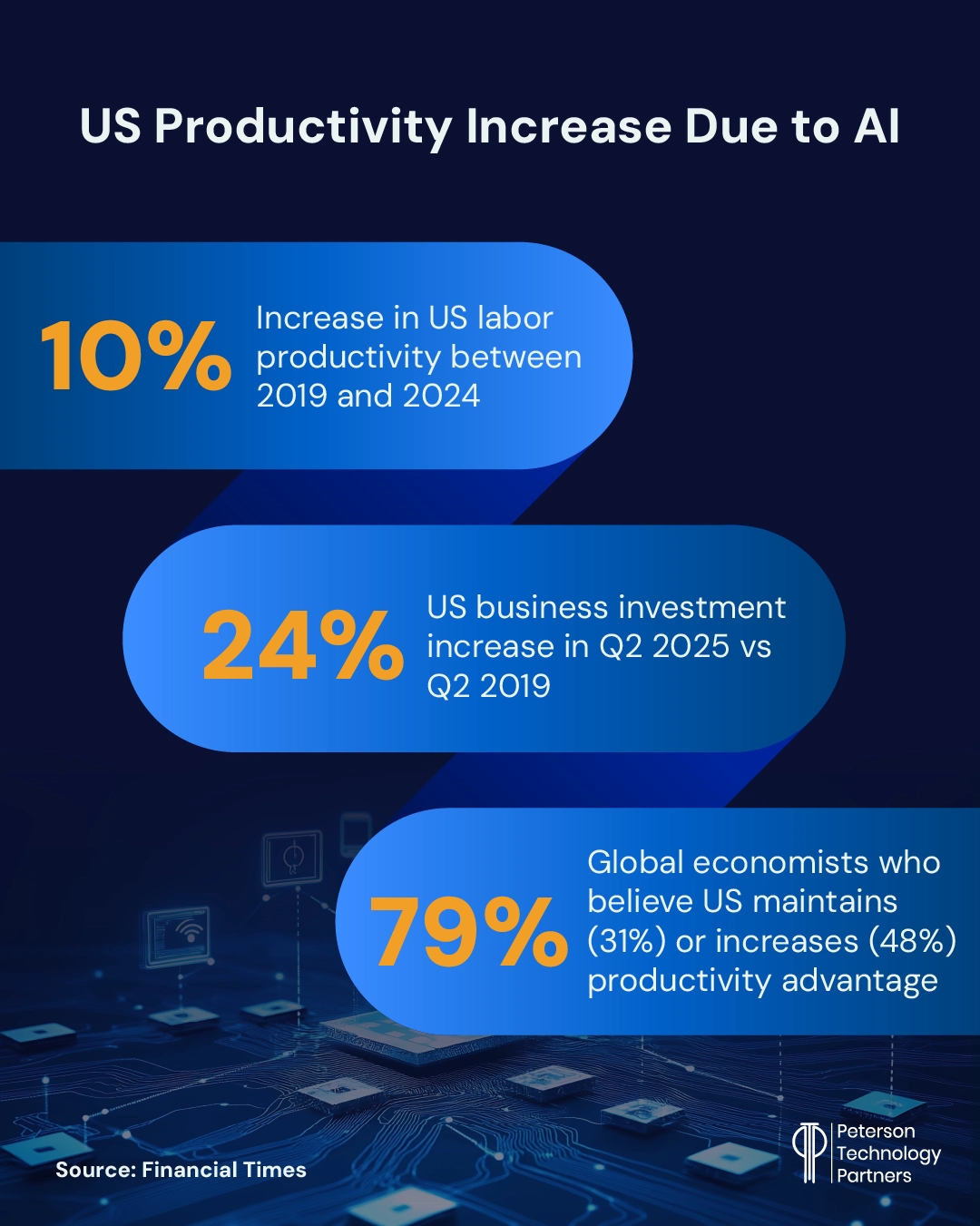
While there were far more new jobs created in 2024 than 2025 (down from two million to 584,000, per the Bureau of Labor Statistics), GDP is growing (up from 3.8% in the second quarter 2025 to 4.4% in the third quarter).
This growth rate is much higher than normal, but how much of it is coming from AI?
A large survey released in late January by recruiting firm Randstad showed that four-of-five workers believe AI will impact their daily tasks. It also revealed:
- Nearly half of surveyed workers (27,000 across 35 markets) believe AI will benefit corporations morethan the workforce
- While 95% of employers (1,225 surveyed) believe AI will increase growth this year, only 51% of the workforce agreed
- Gen Z workers were the most concerned, with Boomers the least
An AI Talent Shortage
Meanwhile, the AI talent race just continues to heat up. Included among January’s news:
- The Information reports OpenAI is reserving $50 billion in stock grants and using highly inventive contract offerings for top AI researchers. They hired at least seven away from AI coding startup Cline.
- OpenAI has also continued poaching talent from other AI companies, with TechCrunch reporting OpenAI “acqui-hired” Convogo, a platform for automating leadership assessments and feedback. The move didn’t include IP or tech but was focused on landing three of Convogo’s co-founders. This makes it OpenAI’s ninth acquisition in the past year.
- OpenAI also hired (or rehired in several cases) as many as five researchers from Mira Murati’s Thinking Machines Lab.
- Google, meanwhile, snagged the CEO and several additional engineers from voice AI startup Hume AI in its own acqui-hire. TechCrunch reported that Google also gained a non-exclusive right to their technology and that the company will continue, demonstrating the increasing draw for voice AI for small, medium, and large players alike.
The Greatest Job Growth Is Also in AI
Nvidia CEO Jensen Huang is among the business leaders touting the AI-driven surge in demand for electricians, plumbers, and HVAC technicians. Salaries for these positions are also on the rise, according to Huang, due to what he called at Davos (see below) the “largest infrastructure buildout in human history.”
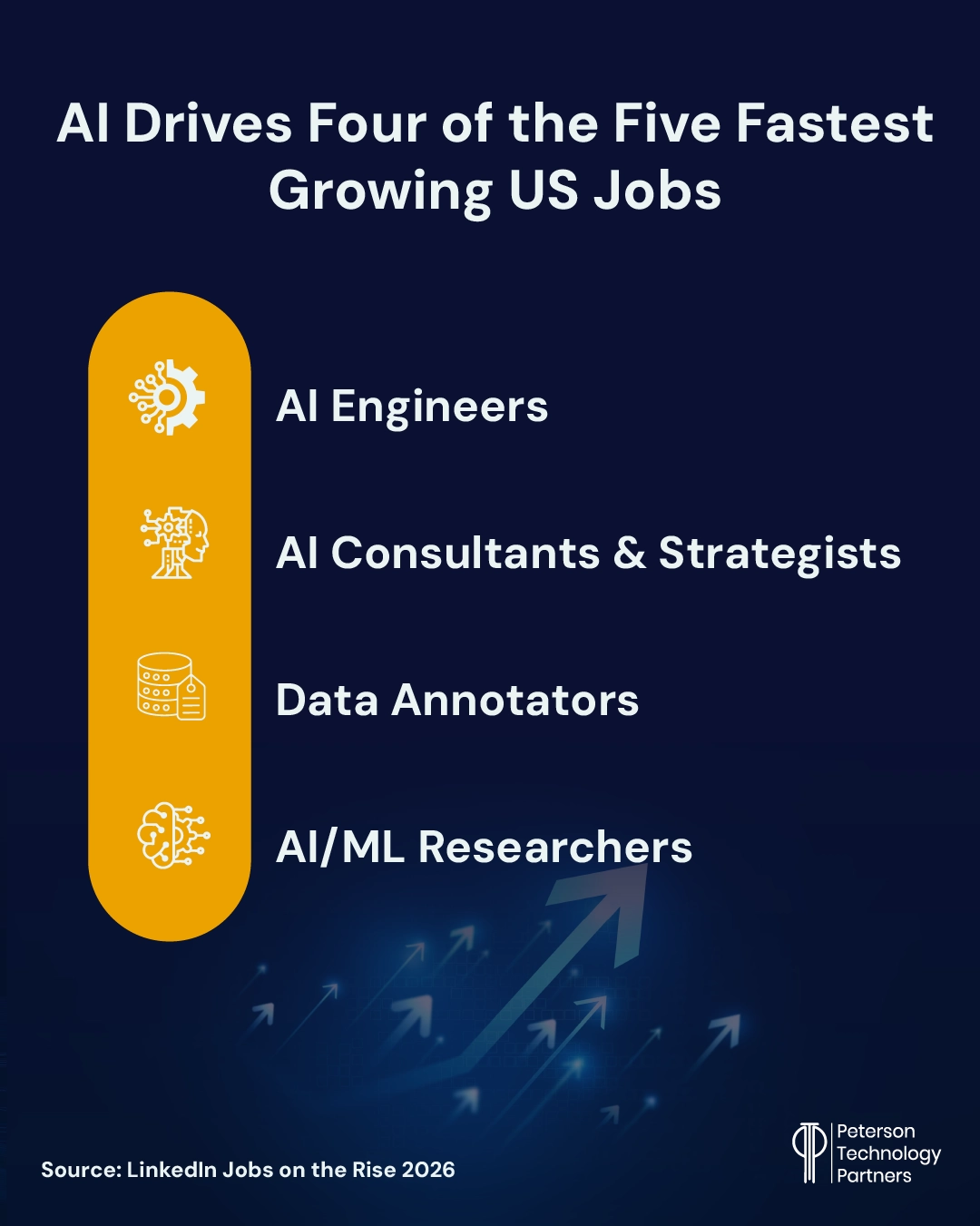
Jobs requiring “AI agent” skills have surged 1,587%, according to Randstad, and four of LinkedIn’s five fastest growing roles in the US also relate to AI.
The AI Automation Impact on Other Jobs
On the flip side, January also brought a rash of layoffs. Included in this news:
- While 2/3 of US teens use chatbots (per research from Pew), fears abound in high schools and colleges about how AI will impact the job market of the future. “A lot of people are really stressed on campus about whether or not the field they’re going into is going to still be a field,” UC Berkeley student Abigail Kaufman told Wired.
- JPMorgan is replacing external proxy advisors with a custom AI platform called Proxy IQ to manage votes and analyze company meetings, per the Wall Street Journal.
- January job cuts were the worst since the Great Recession, with 108,435 (almost half from Amazon, UPS, and Dow), a nearly 120% increase year-over-year with hiring intentions falling 13% (their lowest since 2009) per Bloomberg. And while some of these reductions are in response to a post-pandemic hiring surge, Goldman Sachs economist David Mericle told the Financial Times that companies are “eager to use artificial intelligence to reduce labor costs.”
- Business Insider reports that Amazon’s moves also include giving managers new metrics to measure time in office, according to reporting by Business Insider, and asking more from them in performance reviews. Employees are expected to show the impact of their work, give examples of accomplishments, and detail continued growth.
- Pinterest in January announced it would reduce office space and lay off 15% of its workforce and noted this to support “transformation initiatives” led by AI.
- Overall, unemployment crept up, but it remains historically low at 4.4% in what appears to be a “low-hire, low-fire” climate.
- Palantir announced record earnings in Q4 (70% year-over-year increase), but its CEO, Alex Karp, earned a spot in this roundup for saying at Davos that he believes AI’s job impact will make it “hard to imagine why we should have large-scale immigration unless you have a very specialized skill.” While he added “there will be more than enough jobs for the citizens of your nation,” he also noted white collar jobs will be cut.
Davos and CES 2026 AI Highlights
This brings us to the annual meeting of the World Economic Forum in Davos, which seems to be more AI-focused each year.
Meta and Salesforce even took over storefronts on the main promenade, and Davos AI discussions among leadership centered on where AI is heading (see below), AI bubbles popping, the quality of agents, new AI devices, and robots.
But the most pressing topics were about the AI job market impact.
Some of these included:
- Blackrock CEO Larry Fink warned that AI could soon replace analyst positions in areas like law and finance, and suggested we need a “credible plan” if white-collar jobs face an impact like blue-collar jobs did with globalization.
- JPMorgan CEO Jamie Dimon also suggested governments put plans in place to prevent mass AI-driven layoffs, using self-driving trucks as one example.
- Anthropic CEO Dario Amodei said the tech industry is only “six to 12 months” away from AI systems capable of doing nearly all the job functions of a software engineer.
- DeepMind CEO Demis Hassabis said he believes we’ll see AI impact internships, along with entry-level and junior-level jobs this year.
- Managing Director of the International Monetary Fund Kristalina Georgieva said she believes countries aren’t ready and likened the AI impact to a “tsunami.” She added: “On average 40% of jobs are touched by AI, either enhanced or scrapped, or changed quite significantly without implications for better pay.”
- Of course, there were also many looking on the bright side (as noted from both Jensen Huang and Alex Karp above), focused on the surge in demand for other roles from technicians to support chip and data center build outs to AI-driven roles.
The year’s largest tech event—CES 2026—also took place in January in Las Vegas, profiling emerging devices and innovations for work and home.
Once again it was all AI, along with robotics and chips. Exhibitors hit hard on physical AI, or systems that work in the real world like robots and autonomous driving vehicles (and yes, AI toilets).
Chipmakers also rolled out the latest and best, like Nvidia’s Vera Rubin, with five times more training power than their Blackwell chips.
Regulations, National, and International AI Highlights
Last time out we looked at the US executive order attempting to limit state AI regulations. With no national AI legislation underway, the fight here is escalating, as profiled in the MIT Technology Review in January. Areas likely to see increased regulations are child safety and data centers, where concerns over power, land, labor, and costs are rising.
Dean Ball was one of the primary voices behind the administration’s AI action plan and a former senior policy advisor for the White House Office of Science and Technology Policy. He’s also known for his Hyperdimensional newsletter, which detailed the state AI regulations at the start of 2026.
He sees “substantive state AI bills floating around covering liability, algorithmic pricing, transparency, companion chatbots, child safety, occupational licensing, and more.”
He charts the categories of enforcement generally falling into:
- Transparency
- Child safety
- Algorithmic pricing
- Algorithmic discrimination
A bipartisan group of at least 37 attorneys general took action in January against xAI’s Grok after a surge of some three million sexualized images were posted to X using the model since December 29.
And while investigations and suits are underway, it’s also led to new AI legislation being introduced in several states as a result.
Other January AI topics in this arena include:
- China has approved the sale of hundreds of thousands of Nvidia H200 chips within the country. Companies like ByteDance, Alibaba, and Tencent have also been approved for limited purchases, but the Chinese government will still control volume to ensure demand for domestic Huawei chips.
- A Wired examination of 5,000 research papers published last month found that collaboration continues between top AI researchers in the US and China. As George Washington University professor Jeffrey Ding noted, “Whether policymakers on both sides like it or not, the US and Chinese AI ecosystems are inextricably enmeshed—and both benefit from the arrangement.”
Spotlight on AI Innovations
OpenAI CFO Sarah Friar noted at Davos, and in a blog from January, that her company is exploring pricing models that may include taking a cut of discoveries made by their AI systems. This could include “licensing, IP-based agreements, and outcome-based pricing” to share in value created.
Enormous Focus on AIs Training AI
One continued obstacle for many genAI systems is their lack of persistence. Google DeepMind is among the labs attacking this with self-learning AI systems. Their goal, CEO Hassabis told Axios at Davos, is for them to “continue to learn out in the wild after you finish training them.”
These techniques are being put into place by academic researchers as well, such as with:
- The Self-Distillation Fine-Tuning (SDFT) approach released in research from MIT, which uses a “demonstration-conditioned model as its own teacher.”
- The Absolute Zero Reasoner (AZR) from Tsinghua University, the Beijing Institute for General Artificial Intelligence, and Penn State’s approach, which involves AI generating its own problems, then solving them, while continuing to rachet up difficulty.
Then there’s Recursive and Ricursive. These two companies are chasing the same goal (but with different spelling). The latter, founded by ex-Google researchers, aims to build AI that can improve the design of its own chips. The hope is that through this, they will advance to better AI systems, too.
OpenAI is also building its own “automated AI researcher,” similar to the work of Recursive (with an “e”) AI. Founded by the ex-head of Salesforce’s AI research, Recursive is valued at a reported $4 billion but hasn’t yet been publicly announced.
January’s Agentic AI Corner
AI agents are getting better. Fast. We just wrote a PTP Report on this topic, but it’s also been front and center in the AI news for January, with Claude Code leading the way.
Stories include:
- AI researcher, pioneer, and developer Andrej Karpathy posted on X in January that Claude Code has gotten so good that he’s going from 80% manual/autocomplete with 20% agents to the reverse; 80% agent coding with 20% edits and touchups. He added “This is easily the biggest change to my basic coding workflow in ~2 decadesof programming and it happened over the course of a few weeks.”
- Dean Ball listed the things he built with coding agents in one month: automated invoices, scientifically realistic simulations of hydrological systems, automated research (still needing humans), an ML model for predicting US corn yields, automated prediction market agent, and more. He wrote that, to him, coding agents have reached AGI levels.
- The New York Times ran its own list of interesting things people are building with Claude Code, including: organizing family laundry (with image recognition for which item belongs to which person), gamifying morning routines for kids, building a website with an interactive map of NYC in a day, developing a mechanism for sending mass emergency texts, simulating stock trading for students, and coordinating between calendar, Google Sheets, and Gmail using an AI personal assistant.
- The Register profiled open-source developer Geoff Huntley, who uses a bash script to feed work generated by his coding agent back into it so that it can also evaluate the work and try again if unsuccessful. The results have enabled him to reverse engineer commercial software with surprising success.
- The Sonar Developer Survey report noted that 72% of professional developers who have tried AI now use it at least every day, with 96% not fully trusting the results, and 61% saying AI can produce code that looks much better than it is.
AI World Models and Physical AI Innovations Hit the Spotlight
Physical AI took over CES 2026, and it’s also behind a surge of world model prototypes that were released in January. This includes Overworld (formerly Wayfarer Labs) targeting researchers and engineers, and Google’s Genie 3, with impressive demos dominating social media by the end of the month.
Both allow creation of fully custom virtual worlds, virtual characters, and user-driven navigation in minutes.
Also at work in this field is Yann LeCun.
Former head of Meta’s AI and a Turing Award winner as one of the Godfathers of AI, he’s long been skeptical of how far LLMs will take us. While they’re great at predicting language, the world, he says, “is unpredictable.”
His own startup—Advanced Machine Intelligence (AMI)—remains focused on building an open-source platform around world models, trained on video, audio, and sensor data instead of primarily text.
The goal is to create holistic models of real-world things where we already have thousands of sensors, like engines, factories, and processing plants.
LeCun also recently joined the board of startup Logical Intelligence, which has created an alternative to the LLM called the EBM(energy-based reasoning model).
The EBM doesn’t predict, but works off rules, and their model (Kona 1.0) can solve sudoku puzzles, for example, far faster than leading LLMs. And it runs on just a single Nvidia H100 GPU.
Paired with AMI Labs (which are focused on world models), the goal is to solve problems that cannot tolerate errors, and where language has no real involvement. It’s also able to self-correct, and is trained on sparse data, for specific tasks.
CEO Eve Bodnia told Wired they plan to use EBMs as part of a layered system to reach AGI, pairing:
- LLMs to interface with humans in natural language
- EBMs for reasoning tasks
- World models for understanding and taking action in 3D space
AI Spending, Returns, and Business Updates for January 2026
Some business highlights from period:
- Bloomberg reported on how Oracle’s value has been cut in half from its 2025 peak, showcasing this as a “prove it” time for AI.
- Alphabet surged past Apple for the first time in six years, making it the world’s second-largest company. Its Gemini models have effectively cornered the smartphone market, pairing partnerships with Samsung and Apple.
- Apple nevertheless had an outstanding quarter, largely from profits on iPhones. The company acquired Q AI (product secretive but related to audio, per CNBC) alongside announcing it will use Google Gemini models and cloud tech in its revamped Siri.
- Microsoft’s results disappointed despite revealing they have 15 million paying AI subscribers. This makes them the second-largest seller of AI apps to ChatGPT (35 million as of last July) and puts Microsoft on track to generate billions (per The Information).
- Meta exceeded revenue expectations and announced they are doubling their capital expenditure on AI, per Bloomberg, to as much as $135 billion. CEO Mark Zuckerberg said there’s “a major AI acceleration” on the horizon.
- Anthropic, riding the Claude Code success, both raised its revenue forecast by 20% and delayed when it would be positive on cash flow, with reports on high operating costs.
- The company also released a 30,000-word Claude Constitution used in training their models. Including content that addresses the ideas behind behavioral rules and LLM wellbeing, it’s uncertain how much is hype versus innovative techniques that actually improve model behavior.
- Also discussed in January (but announced in February): Elon Musk–led rocket and satellite company SpaceX acquired the Musk-led xAI (which had previously acquired the Musk-led X) to create the world’s most valuable private company. “Space-based AI is obviously the only way to scale,” Musk wrote on the SpaceX website. “It is always sunny in space!”
- We discussed data-center–driven memory shortages previously, though more RAMifications played out in January, from rising costs to techniques to speed up production to the rising value of companies like Sandisk.
- OpenAI, meanwhile, is embracing two kinds of advertising: one that puts a pop-up below the chat (but does not influence the output), and another that enables you to chat with a listed service directly to ask questions. (Anthropic said their chatbots won’t use ads, as did Google DeepMind, though it’s worth noting Google’s AI Overviews already do contain ads.)
Conclusion
The Oracle of Omaha, former Berkshire Hathaway CEO Warren Buffett, has retired, but he shared his take on AI in an interview that ran in January on CNBC.
“Even the people that are smartest about it say they don’t know where it’s going.”
Adding that the “genie is out of the bottle,” he compared blindness to AI technology to Albert Einstein’s commentary on the atomic bomb: “This changes everything in the world except how people think.”
Buffett also repeated his take that it has “enormous potential for good and enormous potential for harm.”
We hope our monthly roundups help you keep your own AI knowledge up to date. If you’re in need of AI partnership—be it implementing solutions from automated testing to voice AI to contract lifecycle management—or top AI talent, talk to us. PTP is proudly AI-first, with more than 28 years of experience providing top talent and tech solutions to companies of all sizes.
And if you need to catch up on AI stories from the year to date, you can check out our prior roundups below:
References
Young workers most worried about AI affecting jobs, Randstad survey shows, Reuters
Nvidia’s Jensen Huang says it’s a good time to be a plumber — and not just because it’s an AI-proof job, Business Insider
Teens, Social Media and AI Chatbots 2025, Pew Research Center
Big US companies set to lay off at least 52,000 workers as job market cools, Financial Times
Amazon gives managers a new way to spot who’s barely coming into the office and Amazon wants to know what every corporate employee accomplished last year, Business Insider
Palantir CEO on AI, immigration: Karp says the quiet part out loud, The Street
Pinterest will lay off 15% of its workforce as the platform pivots resources to AI, AP
How did Davos turn into a tech conference?, TechCrunch
At Davos, fears about AI-driven job loss take center stage and Warren Buffett compares AI risks to those posed by nuclear weapons: ‘The genie is out of the bottle’, Yahoo Finance
China Approves Purchases of Nvidia’s H200 Chip, Easing Tension With U.S., The Wall Street Journal
Silicon Valley Wants to Build A.I. That Can Improve A.I. on Its Own and This A.I. Tool Is Going Viral. Five Ways People Are Using It., The New York Times
Yann LeCun’s new venture is a contrarian bet against large language models, MIT Technology Review
‘Space-based AI is obviously the only way to scale’: Elon Musk hatches grand plan as he merges SpaceX and xAI, Fortune
A business that scales with the value of intelligence, OpenAI
Self-Distillation Enables Continual Learning, arXiv:2601.19897 [cs. LG]
Where Tech Leaders and Students Really Think AI Is Going, A Yann LeCun–Linked Startup Charts a New Path to AGI, The State-Led Crackdown on Grok and xAI Has Begun, AI Models Are Starting to Learn by Asking Themselves Questions, and The US and China Are Collaborating More Closely on AI Than You Think, Wired
‘Ralph Wiggum’ loop prompts Claude to vibe-clone commercial software for $10 an hour, The Register
Zuckerberg, Musk Vie for AI Primacy With $155 Billion Spree, Bloomberg
Apple acquires Israeli startup Q.ai, CNBC