It’s true today and will be true tomorrow: there can only be so many experts.
We define expertise as having authoritative knowledge in a skill or arena. Such individuals lead the pack. They set the standard, whether by experience, deep education, uniquely fertile creativity, or natural physical or mental capabilities.
So what happens when AI enables these experts to enhance their abilities? And what happens when it assists anyone else (as is the case today) to accomplish tasks, with a far below expert-level result?
Software development gives us an early example. Our most recent AI news roundup discussed how Spotify’s top developers no longer write code at all, and how OpenClaw’s creator (and new OpenAI employee) Peter Steinberger barely looks at the code underpinning his creations.
For him, AI coding agents like Codex and Claude Code are already providing what’s been promised: they’re like running a team of developers. He noted that managing other developers taught him not to be a perfectionist, and he pairs that experience with a focus on architecture and system design as being the skills most essential for the next wave of developers.
This is where I begin today’s article, which is about a future of hiring that sees the rise of specialists and Talent-as-a-Service (TaaS).
Tomorrow’s Specialized Staffing Solutions
You don’t need me to tell you that the workforce is undergoing a dramatic transformation. It’s in the news several times a week.
Consider:
- Goldman Sachs saying that 2026 will see rising unemployment from AI impact
- Citrini Research’s scary fictional exercise on a 2028 where unemployment has doubled and the stock market cut by a third
- Resumes continuing to pile up, packed with keywords and AI-perfected cover letters that give conventional applications a challenging sameness
- The ManpowerGroup’s 2025 Talent Shortage Survey finding nearly three-in-four global companies still can’t get the skills they need (and at nearly double 2015’s percentage)
All combined, it’s clear: the demand for key skills and specialist knowledge is only continuing to dwarf the supply. Even as AI capacity improves at exponential speed (see below).
And competition for these skills leaves companies in an even more challenging position. How will they attract this ever-rarer talent?
I believe it will become less about attraction or more about access and deployment.
The fastest growing areas of today’s staffing market are already increasingly specialized. Fields like architecture and engineering occupations will continue to grow much faster through 2034 (per the Bureau of Labor Statistics).
Key skills needs—whether technological, scientific, medical, pragmatic, or creative—aren’t getting easier to come by or cheaper.
Simply put, the companies that can find and engage the professionals they need will outperform rivals who can’t.
Getting On-Demand Expert Talent
Expertise is critical and increasingly quantifiable. Here I mean professionals with knowledge, capability, or experience that’s demonstrably rare and needle-moving.
With 65% of hiring managers already valuing skills over education or experience (per Resume Genius survey) and skills-first approaches proving 107% more effective for placing top talent (Deloitte), the shift is on for results and capabilities over pre-set markers.
And expertise can be identified using several effective methods:
Proven Achievement and/or Recognition
A track record of real-world achievement is clear and obvious, such as:
- Having patents or commercially validated innovations
- Being award-winners and industry-recognized pioneers
- Published authors, keynote speakers, or renowned thought leaders
- Entrepreneurs with prior, measured outcomes alongside successful exits
Creative or Physical Mastery
What about people who have demonstrated unique capabilities? In this case, it can be similarly easy to prove. Consider:
- Portfolios that mark them as elite designers, architects, composers, or artists
- Athletes or performance specialists with demonstrable (repeatable) excellence
- Craftspeople with rare technical or artistic skills evidenced by working constructions
Cross-Disciplinary with Emerging Talent
Then there are those with capabilities that successfully bridge common divides and carry utility for the age of AI. Here I mean:
- Professionals who create unique value by spanning two or more disciplines
- Experts pairing deep domain expertise in a given industry with technology skills
- Researchers at the intersection of AI, science, or emerging business concerns
Rare Experience and/or Institutional Knowledge
Maybe they have been there and done it before. This could mean coordinating with institutions or tackling unique areas that call for a certain kind of expertise. These experts could have:
- Irreplaceable domain knowledge, such as cultural or generational
- Leaders who have had to make high-stakes decisions under unique pressure and have done so successfully
- Proven leadership through technological or political or environmental change
- Experience navigating key institutions with quality relationships or ways of working
Specialized Credentials or Academic Achievement
Unique or high-level academic accomplishment carries as much value as ever and can bring new ways of thinking or experience from experimental environments freed from corporate pressures. This includes:
- Post-doctoral researchers and scholars working at the frontier
- Professors who bring communication and educating skills, research ability, and/or institutional experience to the private sector
- Graduate students or those with specialized licensing working on advanced studies with leading experts, using experimental methods or technologies
What unites all of these? Rarity.
These are candidates who are not likely to reply to a job posting but rather already have proven success in a trade.
Acquiring such expertise requires unique access. But as demand increases, so too will their ability to extend.
AI Hiring Agents and Talent Managers
We’ve seen a parallel to this for some time in entertainment and sports.
Using the latter as an example, only so many people in the world are able to run at a certain speed, execute specific maneuvers, or have the unique skills to repeat certain physical behaviors with elite consistency.
With demand far exceeding supply, multiple professions have sprung up to manage compensation and access to athletes.
Agents, for example, represent all those working at the highest levels. They know the market, stay abreast of new opportunities, have personal relationships with key people in the field, negotiate contracts, and ensure the athlete’s brand.
I believe specialists across the workforce may soon follow this same pattern. In the near-term, human agents, embedded within top staffing firms, will be able to act as advocates and managers for such specialists, across engagements.
And using digital twin technology, for example, enhanced by agentic AI, will allow experts to extend their reach further. In the same sense, AI agents in recruitment will interface with agents from firms seeking access to such talent.
AI agents in this sense would monitor the talent market, identify and verify engagements, communicate on the expert’s behalf, and guide them through any necessary onboarding, problem presentation, or organizational alignment.
In such a case, you can easily imagine AI agents working as advocates for their clients.
In his keynote speech at the 2025 CES, Nvidia CEO Jensen Huang made waves by saying, “The IT department of every company is going to be the HR department of AI agents in the future.”
With stories today about AI agents writing their own blogs to advocate for their positions, we see the earliest steps of this already underway.
In this arena, I see intelligent AI agents able to continuously monitor and market for their experts, much as human agents do for athletes and entertainers today.
In such a world, why would talent firms still be needed?
If an expert is able to use AI to extend their reach, couldn’t they also just spin up their own private AI managers?
The answer is yes. But so could everyone else.
More than Just AI-Powered Recruitment: Elite Firms for Elite Talent
Ultimately, the talent firms that will hold sway in this area will perform a function similar to the talent agencies for stars. This and the role recognized critics (as for food, films, arts, books) perform today.
As a market for specialized expertise intensifies and agentic AI proliferates, how will businesses, or the talent itself, continue to ensure quality and authenticity?
Key talent, as today, will know that sustaining a career depends on maintaining a strong reputation. This comes in part from when recognized arbiters of quality are willing to advocate on their behalf (or deploy their verified AI to this end).
Here, human relationships will absolutely remain critical. Agencies that have strong track records and reputations of supporting effective expertise in any given field will be in a unique position to act as such gatekeepers.
AI in Hiring Takes Us Past Resumes
I’ve written before about the death of old hiring models.
As companies are overloaded with resumes that are AI-perfected, with cover letters so uniform as to lose meaning—as communication channels are broken by volume and a growing percentage of candidates are fake—AI recruitment solutions become increasingly necessary.
But as both sides automate and expertise is increasingly valued for its uniqueness, certifying a capable candidate will go beyond objective verifications. Hiring (or marketing) expertise requires far more than a few pages of text and a headshot or a series of short interviews.
Such specialists will need to demonstrate relevant media and evidence, which can come in various shapes and sizes but need to be protected and verified. Here I picture far more dimensions than is typical for today’s hiring.
Such “talent proofs” might include:
- Work simulations that demonstrate problem-solving
- Recorded lectures or talks providing thought leadership
- Intellectual properties such as publications and developed project samples
- References from industry leaders or specialist peers
- Assessments, yes, but also human verification
- Case studies and market data from prior work
Even as we see AI-powered talent acquisition transforming today’s hiring landscape, the importance of human relationships and judgment in this arena aren’t going anywhere. The firms that will thrive in such a specialist’s market will be the ones that can successfully process, verify, market, and maintain the relationships necessary to connect specialist talent with a wide variety of clients in need.
Here I envision a hiring model that works less like a job board and more like a guarantor of quality and certifier of real results.
Full-Stack Talent across Disciplines
So we’ve established that skill shortages are going nowhere, and in fact the most specialized owners of needed skills will only become more valuable. As discussed, they’ll also be able to extend or offer their talent on demand (with AI and using a handful of prestige firms that thrive in this market).
I also want to consider how AI is changing what such experts may bring to organizations in need. Here I see the full-stack engineer giving way to a field of full-stack workers.
Yes, this may be a buzzy concept at the moment, but I see the real-world development here not being far off. With jobs and workflows changing, it’s easy to imagine employees able to contribute far more than just an isolated stage in a process.
Imagine, instead starting off with an idea, developing and designing it as a practical solution, building it with the help of systems, testing and deploying it, and then knowing how to observe, refine, and monitor (or establish the monitoring) of it, too.
In such a world, the specialist’s value still remains high. They would be called on to break (or build initial) molds, find new ground, or establish architectures that such full-stack workers can be released to work within.
“End-to-end” in such a world becomes the norm. So many aspects of coordination become automated, and things we think of today as discrete layers get absorbed into the process of what’s simply work.
Here, full-stack workers would cover the weekly breadth, while experts would bring unique instances of great depth.
The Rise of Talent-as-a-Service: Bringing It All Together
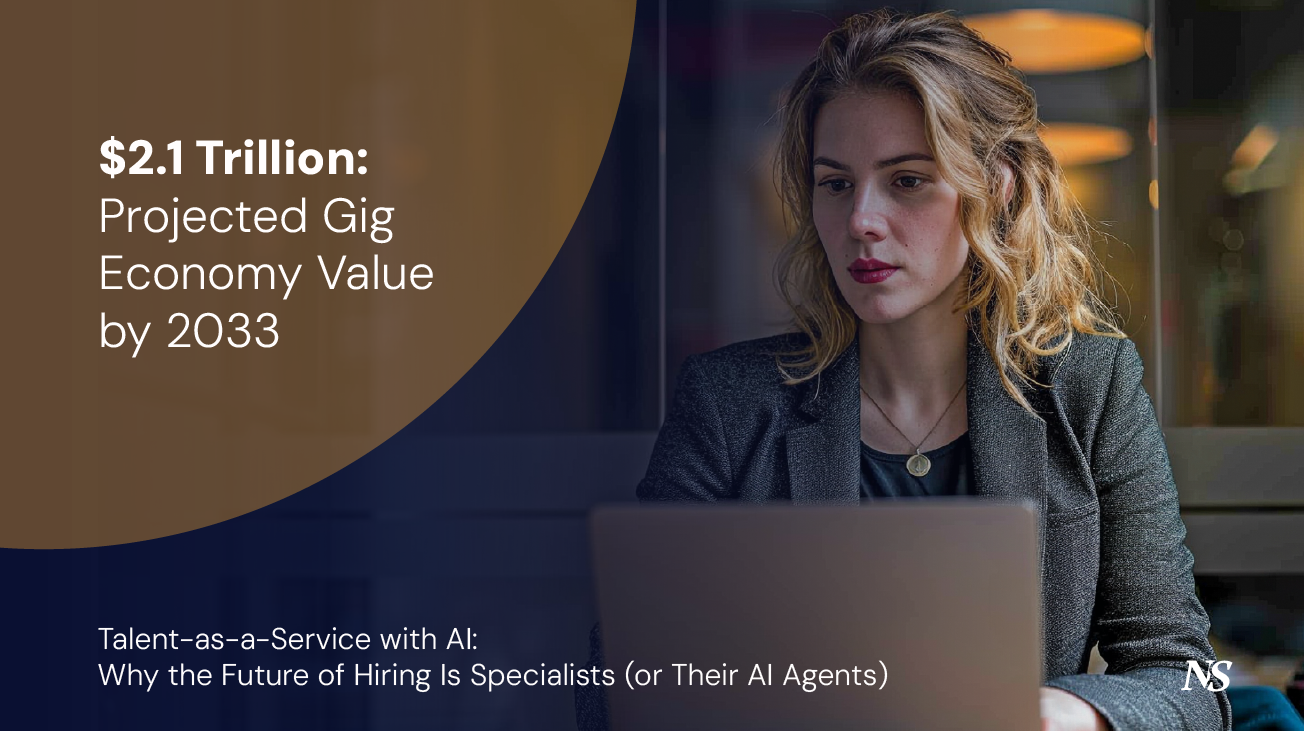
Talent-as-a-Service (TaaS) isn’t a new concept. In fact, you could argue it’s at the heart of the current gig economy. Here I mean TaaS as the process of getting talent on demand rather than in the form of traditional staff. We’ve seen this in technology for years, under a variety of names and approaches.
At PTP, we’ve had great success in this vein with nearshore staffing, where companies manage to reach expanded talent pools that are nevertheless in matching or close time zones, and with a lot of cultural affinity. Nearshore approaches have given enterprises access to the talent they need (often in software development) more quickly and cost effectively, without going through the delays and pain of onsite and onshore searches.
Ultimately, TaaS is often about flexibility as much as anything, with companies able to scale and get what they need fast and with minimal disruption.
With more advanced AI driving the need for human expertise, such a TaaS model serves another purpose. It allows access to talent that is too costly or rare to acquire in any kind of permanent basis.
Here, like cloud services, expertise can be bought by engagement, or skills purchased by need.
In such a future of hiring (as soon as 2030), I believe it’s plausible to picture AI systems anticipating impending skills gaps before they arise.
These then get communicated and searched, and when upskilling (or acquiring AI skills) is ruled out, vetted human specialists can get easily accessed through specialty firms.
With minimal human intervention, contracts and onboarding are managed, and the specialist arrives (physically or by extension), having had time to digest and consider the problem and potential solutions.
They hit the ground running and help companies meet their needs faster than ever.
This specialist brings the necessary human judgment, creativity, and ultimately the heft and accountability necessary.
Conclusion: An Evolution Past How AI Is Transforming Hiring
AI progress is advancing faster than most people recognize. In a prior article I included a snapshot of the METR study showing how AI capabilities in software engineering are improving at exponential speed.
That chart shows AI capacity in terms of the length of human tasks it can manage 50% of the time, and it’s moved from nine seconds in 2020 to four minutes in 2023 to 40 minutes in 2024. It had just hit six hours when the article was released (February 19).
Last week it jumped to 14.5 hours with Claude Opus 4.6.
The kind of human expertise I discuss here is on the opposite side of this climb. With skills gaps continuing to remain unclosed and key skills harder to get than ever before, I see TaaS being one way organizations will take advantage of pairing human expertise with improving agentic AI to accomplish what they need.
AI-driven screening and assessment will continue to accelerate the time-to-hire, but again this is more about highly specialized and unique talent, and in that arena the picture will be, and remain, unique.
Here I see technology enabling the finding and use of specialized talent to close skills gaps in ways never before realized.
References
Gig Economy Market Overview, Business Research Insights
Goldman Sachs warns AI-fueled layoffs could raise the unemployment rate this year: Chart, Yahoo Finance
2025 US Talent Shortage Survey, Manpower Group