You’ve probably heard this one before: A big jump is coming in AI.
A Morgan Stanley report released Friday the 13th predicts another huge surge in what AI can do coming in the first half of this year. They say the world isn’t ready for it.
Is this hype?
That kind of prediction doesn’t do much to aid an investment bank if it ends up being wrong. And it also backs up what AI companies are saying to investors (according to Fortune) that a big “shock” is just around the corner.
So why am I opening with this?
Because we’ve had our own “shock” at PTP. Our AI-powered recruiting solutions have recently leveled up in a massive way.
Two weeks ago, we started putting everything that comes in through our AI agent, Rebecca. That means every single submission. It also means by the time it reaches our recruiters it’s already cleared numerous hurdles.
These candidates have now had, in most cases, multiple rounds of contact with us and also know where they stand. From the easy first application, to SMS, to initial call—all the way through our full, rigorous screening—our AI recruitment platform is leading an internal revolution.
Best of all, the quality is unchanged and the speed cannot be beat.
What is AI recruitment?
Our AI hiring automation—Rebecca is the agent’s name—has a straightforward workflow. Our AI hiring agents:
- Draw from the ATS or CRM
- Reach out immediately via SMS, voice, and e-mail
- Capture consent for AI calling
- Do initial quick Q&A calls
- Evaluate and route
- Schedule next steps directly
- Write back updates to the ATS/CRM
- Conduct rigorous AI interviews
- Update the dashboards and keep full transcripts
This is way more than just AI resume screening, though that’s a part of the platform, too.
What are the benefits of AI in recruitment?
Rebecca resolves off-hours silence, massive resume stacks, fragmented tools, and delays in communication and scheduling. She also fixes blind spots the pipeline’s developed that we may not even be seeing yet.
Best of all, she’s FAST.
She acts where manual steps mean natural delay. She’s reducing no-shows and drag where the door’s gotten opened to competitors, and all but eliminates candidate ghosting.
How much faster is our hiring process with AI?
PTP’s Founder and CEO Nick Shah posted the numbers on LinkedIn after the first week:
- 1,114 processed
- 578 passed screening conversations
- 473 found unqualified for requirements
- 564 automated calls triggered
- 137 interviews scheduled
- 50 interviews done
Since then to the day I’m writing this, here are our total numbers:
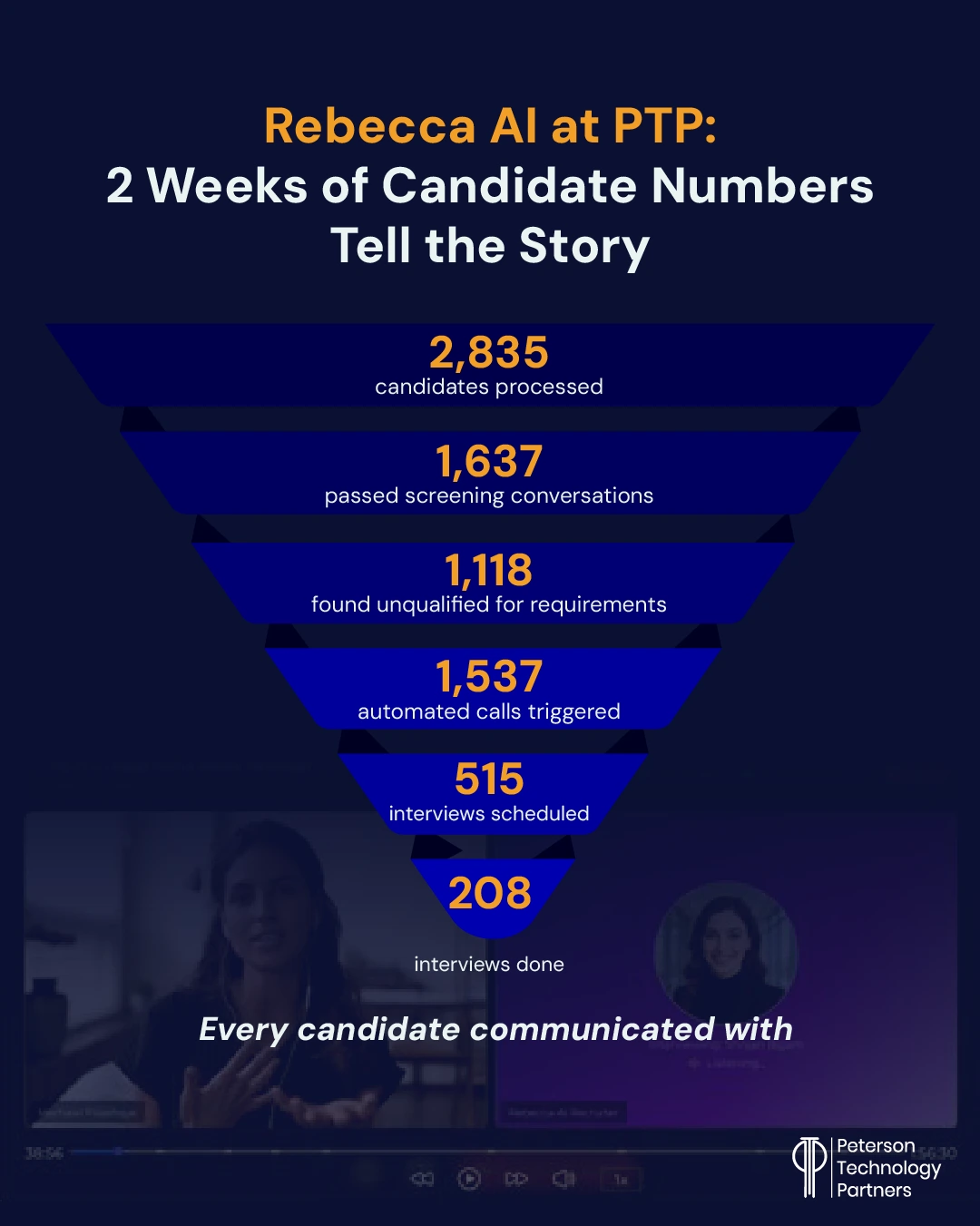
The gap you see above between automated calls and passed screening (100 candidates) is due to phone numbers we’re given either not being right or not immediately available.
In every other case, our AI agents reach out right away by SMS, getting approval and consent. Then they qualify with a quick call and Q&A, evaluate and schedule AI interviews, conduct interviews while filtering out fraudulent candidates, and pass the results to the recruiters with evaluations and full transcripts.
By the time our experienced recruiters get involved, they’re able to make faster decisions and work with candidates who are real, interested, and qualified.
How does AI speed up the hiring process?
Putting automated candidate screening at the front door is completely changing the game for us.
With our resume volume rising constantly and the materials looking more and more similar, even AI recruiter tools that take a first pass on resumes aren’t enough to keep up.
There’s also a ton of coordinating between our people on facts and evaluations that’s getting simplified and streamlined.
Then there’s just the practical elements that are repeated drags: constant coms, scheduling, follow-ups, handling no-shows and reschedules.
The amount of time that’s getting wasted on candidates that aren’t qualified for a given position (in some cases even AI-submitted) is cut to near zero.
We have several people on my team who first interviewed by Rebecca, and despite initial reservations about AI in some cases, every single one has come away impressed. They praise the transparency and efficiency of the entire thing, with gaps closed and everything kept moving.
The bottom line: our AI hiring automation is faster, more effective, and cleaner.
How do companies use AI to hire candidates faster?
We’ve seen major acceleration, and we pass that along to our customers.
For candidates, it’s faster because it can begin with Easy Apply: mobile-friendly, with a couple fields to populate and place to submit their resume.
They get to explore jobs and review details, and once they submit, get immediate confirmation of success.
An SMS is next, with compliance-friendly messaging moving them forward and keeping the momentum going.
Rebecca gives a quick pre-qualifying AI call and keeps the updates coming automatically.
To here I’ve been covering the early phases, but one of our bread-and-butter uses for Rebecca is conducting full, structured interviews, even for technical positions.
She uses a rigorous rubric, responds fluidly and effectively to candidate comments, and keeps full transcripts as well as consistent scoring.
But what about AI bias?
Can AI really reduce bias in hiring?
Here’s another point that I love to share: the right AI system can really reduce hiring bias.
Stats come and go on this all over the map, but that’s because solutions themselves do, too.
A recent study from the University of Washington revealed what I think are really telling facts about AI and bias.
Namely, if your AI tools are biased, they can pass that bias on to recruiters. Even with recruiters checking results for themselves.
The researchers were surprised to find that biased AI systems could influence recruiters in multiple directions, but they also found that “neutral” systems saw recruiters making decisions without any discernible bias.
With HR professionals getting burned out and many even leaving the field, leveraging AI in talent acquisition is needed to lighten the load. It also brings more consistency to these processes.
But studies like this show that you have to get it right. Solutions that are tuned to address bias can be needed for compliance in some cases, but even beyond this they actually help to reduce natural human hiring bias.
Those that aren’t can have the opposite effect.
As this study also showed, participants who started the study by testing for their own bias were 13% less likely to then exhibit it.
So the bottom line is this: yes, AI can help reduce bias. But only if you’re using the right systems.
This is very important to us at PTP, and we work to ensure that our systems are tuned to be as neutral as possible.
From “shock” to the norm
At PTP we know you can reduce time-to-hire with AI, and you reduce the cost-to-hire. But I suspect that quickly this will become the standard.
At least for those that are changing and adapting. It won’t solve every part of recruiting, but at PTP, we’ve built AI systems to address our pain points and have been pleased at how many of our problems it HAS solved.
From dropping time-to-hire to fixing broken communications to catching fraudulent candidates, we stand by Rebecca as our new front-line in recruiting, helping our human recruiters do their jobs better than ever.
And AI or not, with PTP, you know you’re getting quality, safety, and security. We stand by the rigor and thoroughness of our process, as ever.
Contact us to see for yourself. We’d love to show you what we can do for you.
FAQs
How does AI screen resumes automatically?
It begins with comparing a candidate’s info against the requirements for an open role. This means things like skills, experience, certifications, location, and availability. In our case at PTP, it keeps rolling with outreach, asking screening questions, having phone conversations, updating dashboards as well as ATS/CRM, retaining full metrics and transcripts, scheduling next steps and interviews, and even conducting interviews.
What are AI recruiting agents and how do they work?
AI recruiting agents are systems which include software and GenAI LLMs that handle parts of the hiring process that used to be totally manual and repetitive (and often lead to delays). This depends on what agents you’re using, but it can include reviewing applications, communicating with candidates, conducting initial screening conversations, scheduling interviews, sending updates, getting consent, and moving candidates on through the flow with regular updates all the way.
What is an example of AI in recruitment?
The most common uses take on the repetitive, manual steps that slow down the process. They keep momentum going by reviewing every incoming resume, starting the screening conversation with candidates that match, ensuring interest, and automatically moving on to next steps like scheduling, job matching, and even interviews.
Can AI reduce time-to-hire for companies?
That’s one of its main benefits. With resume volumes up, the majority of recruiting firms have turned to AI to keep up. But AI can do far more than just that. By moving immediately through the early recruitment steps, Rebecca AI removes gaps that have long bogged down the process.