This is the fastest pace of tech-based change I’ve witnessed in my three-decade career in the tech industry.
Companies that aren’t already thinking a year out may find themselves suddenly behind, if they aren’t already.
We’ve seen this very dynamic playing out in the markets repeatedly over the past few years: an AI company debuts a new capability, and immediately the industry leader for that service is seeing headlines that they’ve become extinct.
The version making the news as I write this is SaaS, with many of the world’s top providers feeling the heat.
But in this case, as illustrated by the Information’s Amir Efrati, both the world’s largest bank and Anthropic aren’t moving off these SaaS cornerstones. JPMorgan’s internal IT unit is actually increasing their spend on the major SaaS providers that are investing in AI, and they have no plans to shift those use cases (despite an $18 billion annual tech budget). And Anthropic, as Efrati points out, uses these SaaS solutions itself, and continues to hire for people with experience in Workday and Salesforce.
That is to say, appearances can be deceiving.
In this climate, it’s never been more essential to stay on your toes. And with every year of AI appearing to escalate exponentially, if irregularly, in capability and speed, that’s not an easy thing to do.
In today’s newsletter, I consider this rapidly shifting AI transformation roadmap: evidence for how fast things are changing, what it means for businesses, and what, as leaders, we must do about it.
On the Clock: AI-Driven Business Transformation Is Accelerating
To understand the AI rate of change, start by looking at one example:
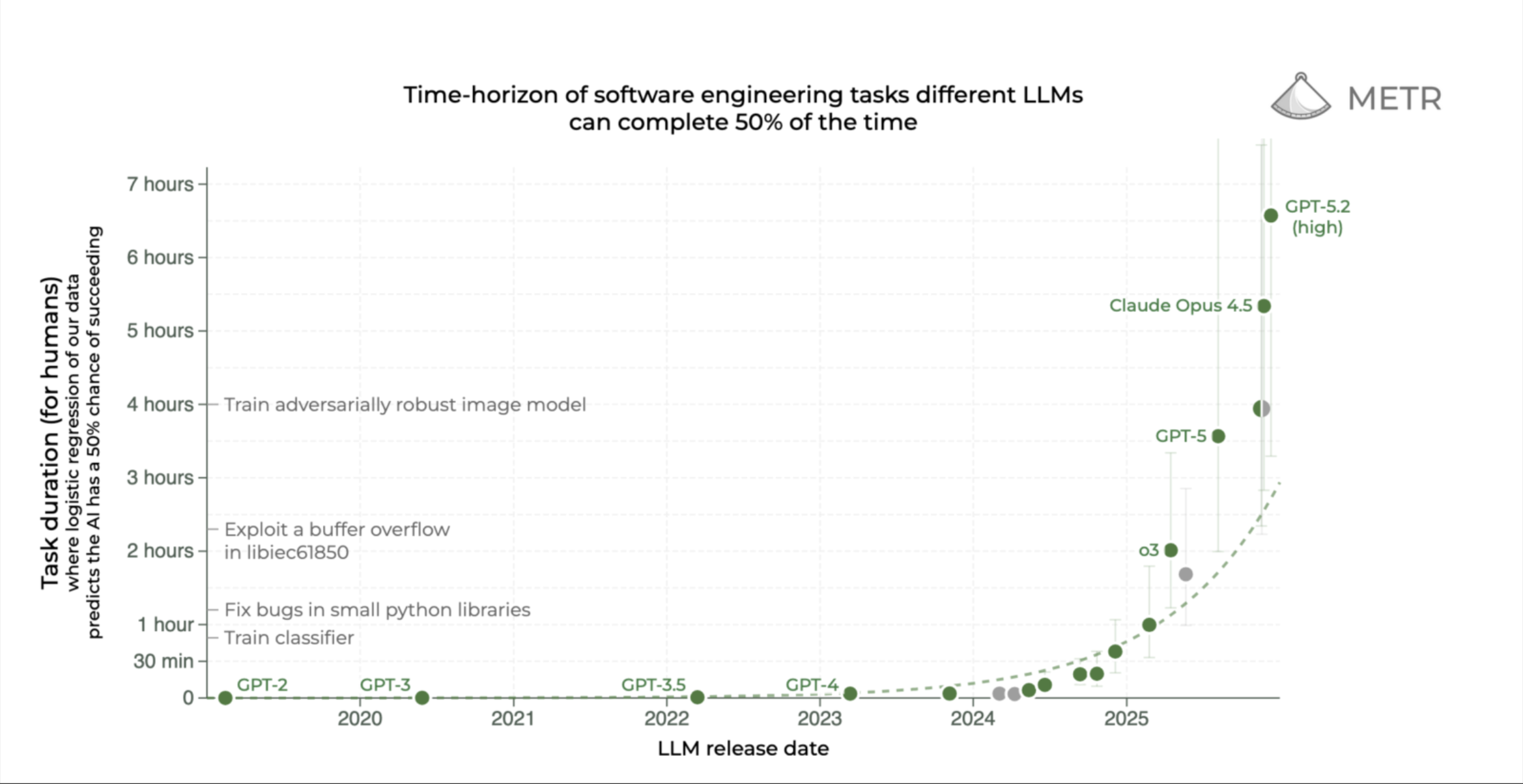
This particular measurement from the AI research nonprofit METR— Model Evaluation & Threat Research—is very popular (and important to AI companies), even though it prompted a recent MIT Technology Review article to explain why it’s always being misread.
(Note:People often think the y-axis represents how long AI models can now work on tasks, but it really represents how long it takes humans to do tasks that AI can accomplish at least 50% of the time.)
For our purposes here, that is less relevant. What it does show at a glance is how fast progress is accelerating.
To quote from the article by Grace Huckins:
“Every seven-ish months, the time horizon doubled, which means that the most advanced models could complete tasks that took humans nine seconds in mid 2020, four minutes in early 2023, and 40 minutes in late 2024. ‘I can do all the theorizing I want about whether or not it makes sense, but the trend is there,’ [Sydney Von Arx, a member of METR’s technical staff] says.”
Except that today, the top models are tackling some tasks that take us over six hours.
Menlo Ventures charted the investment side of this in December, showing that enterprise AI is scaling faster than any software category in history. AI spending at these companies moved from $1.7 billion in 2023 to $11.5 billion in 2024 to $37 billion last year.
The largest share of it, $19 billion, went to user-facing products and software that’s using the AI models.
AI is challenging leaders around the world not only because it’s hitting so fast, without time to establish a tried and tested rollout plan, but also that it’s spreading unevenly, then leaping forward again.
This speed of change is charted in all kinds of ways, from Microsoft and LinkedIn’s Work Trend Index (82% of leaders said they’ll use “digital labor” to expand workforce in 12–18 months, with 80% of the global workforce saying they lack enough time or energy to do their work) to Stanford’s AI Index (organizations using AI use jumped to 78% a year ago from less than 55%).
And the technology is improving monthly if not faster. New models with added capabilities, yes (Claude Opus 4.6 released as I am writing this), but also at the application layer, where the AI lifecycle acceleration is even faster.
Rapidly Improving Agents are Shifting the AI Adoption Strategy
We recently ran a PTP Report that looked at the improvement AI agents are showing just this year. I won’t repeat the details of that here but instead want to highlight some relevant points on this topic:
- Application-layer improvements are now much better at helping AI agents manage their limited context windows. Not only can these now compress history within an effective bandwidth, but they also spawn other specialty sub-agents and import ready skills on demand.
- Andrej Karpathy was openly critical of AI agents late last year, as we documented in our report on 2025 AI hype. But he’s now done an about-face, posting: “I’ve never felt this much behind as a programmer. The profession is being dramatically refactored,” and: “This is easily the biggest change to my basic coding workflow in ~2 decadesof programming and it happened over the course of a few weeks.”
- Stanford AI lecturer Kian Katanforoosh told Wired he “saw a step-function improvement in coding abilities” with the move to the Claude Opus 4.5 generation of models.
- As Ethan Mollick wrote in his post on the Claude Code breakthrough: “Don’t let the awkwardness of the current Claude Code or its specialization for coding fool you. New harnesses that make AI work for other knowledge tasks are coming in the near future, and so are the changes that they will bring.”
And this has already happened, with tools like Cowork and even the open-source OpenClaw creating a sensation not only for the speed and scale of their adoption, but also by the kinds of things they can do.
This is a very public, broad example of what we’re experiencing firsthand at PTP.
I predict 2026 will be a very unusual year, and chief among the reasons is the pace of AI acceleration.
Shadow AI Governance and Other Risks That Have Already Arrived
So, yes, change is happening, and the speed is accelerating.
And regardless of whether a company is keeping pace or taking advantage of the transformative gains that are possible, they’re still being exposed to many of the risks.
High on this list is shadow AI. Your employees are most likely using AI, whether it’s in the form of company-provided solutions, or within company guidelines and effectively governed or not.
An MIT study from last summer found shadow AI at 90% of organizations, and at the time many were hiding their use from IT for fear of restriction or punishment.
The risks here come from unmanaged data sharing as well as unregulated outputs, and they can expose organizations to risks of which they may be completely ignorant.
Another, of course, is trust.
LLMs accelerate the pace of work, but they also make mistakes. This means that it is essential leadership takes verifying their work beyond the informal not only to protect company data but also for compliance and reputation.
AI agents can introduce significant risks in absorbing inputs, sending messages, changing data, and writing code. They must be properly documented, verified, trained, and restricted so they’re only accessing what’s necessary.
But this also goes beyond prompt injection, regulation, and data leakage.
Trust in AI also begins at the top.
In a panel on scaling AI at this year’s World Economic Forum, leaders from across industries talked about the lessons they’ve learned over the past year.
All agreed on the same point that AI must be ledeffectively. As Julie Sweet, Chair and CEO of Accenture and Ryan McInerney, CEO of Visa, pointed out from their experiences, it must be “human in the lead,” not “human in the loop.”
Adoption is as critical as development, and McInerney shared Visa’s story: despite all their training, tools, and emphasis on democratization, they only saw real AI breakthrough when they got their top 300 people in a room and forced them to go hands-on, building agents, and developing AI solutions to their own problems.
In this way, trust also comes from breaking through barriers that stand between AI as one of several tools and AI as a core component of how work gets done.
Ultimately, it’s impossible to trust what you do not understand.
Good AI Leadership Strategy Includes Human‑AI Workflow Redesign
A recent Accenture study found that 78% of C-suite leaders saw AI helping more with growththan productivity.
At PTP we’ve seen both—with growth often leading the way. Voice agents have increased customer acquisition 1.5 times, expanded upselling and cross-selling by more than 20%, and grown portfolio values more than 35% with follow-ups and customer reactivation. This stems from growth: these agents make calls that humans can’t. They increase outbound contact from averages of 40 calls per rep to thousands in a day.
And while systems like these can be a no-brainer for extending capacity and providing near-immediate response across contacts, getting game-changing productivity from AI often means doing some difficult work first. It begins with understanding where you are, and how this technology is changing your business right now.
Data is critical for maximizing return on AI, as we’re always saying (and have written about numerous times, like this piece on getting your data ready for AI from early last year, or this one on the value of customer segmentation). Yet for most, so much of the work that companies need to do in this area remains to be done.
It doesn’t have to be an all-or-nothing consideration. Businesses should begin with their most essential areas first: as AI automation and innovation changes the market, what are your critical arenas? Starting in the areas where you must keep pace can help you get your house in order incrementally, ensuring that you’re also scaling AI right for your business.
We’ve been utilizing AI in recruiting at PTP for many years, but we’ve seen our own step-change over the past 12 months. This has come from many of these things in concert: trust, technological advances, hands-on experience feeding back to the application layer, spanning organizational gaps, and yes, through human-led AI. Ultimately, this is all together what we mean by effective AI understanding and implementation.
And aside from data readiness and finding critical use cases, measuring real ROI with practical success metrics is fundamental.
We talk a lot about truly redesigning workflows, and this is easier said than done. It often means changing our own notions of established, foundational structure to embrace this more continuous state of change.
Conclusion
With the incredible rate of change we’re witnessing, it’s no surprise enterprises are shifting to buy over build to keep up. 76% of AI use cases were met through buying in 2025 over internal construction, per the Menlo study from December I referenced above.
This report also found that AI buyers are converting at nearly twice the rate of traditional software procurement. It makes sense: by the time you’ve seen and understood the status quo, it’s already changed.
And of course, AI talent acquisition and retention are no longer optional.
Everywhere, extremely talented software engineers are experiencing something akin to disorientation. They’re having experiences with tools like Claude Code that are really surprising. Both depressing and tremendously exciting at once. And the limits and issues are still there, of course. But understand this: they are not nearly the same as they were this time last year.
This same rate of change is occurring in other areas, too. AI talent is no longer something that’s confined to a specific part of the organization.
It’s an increasingly critical skill for all of us.
References
Docusign CEO says OpenAI’s speed of development is forcing companies to move faster, Yahoo Finance
Anthropic and JPMorgan Seem to Agree That AI Isn’t Demolishing Legacy SaaS Apps, The Information: Applied AI
This is the most misunderstood graph in AI, MIT Technology Review
2025: The State of Generative AI in the Enterprise, Menlo Ventures
Work Trend Index Annual Report, Microsoft Worklab
Claude Code and What Comes Next, One Useful Thing
Scaling AI: Now Comes the Hard Part and Here are four ways AI and talent trends could reshape jobs by 2030, World Economic Forum