“There isn’t a natural stopping point for this technology.
It’s going to keep getting better and the changes it brings are going to keep compounding with the rest of society.”
So said Anthropic Co-Founder Jack Clark in conversation with The New York Times’s Ezra Klein on the subject of how AI differs from other tech innovations.
Or, in simpler terms, the genie is out of the bottle.
But in the case of Anthropic, it’s more than just a genie.
March has been a crazier month than most for them, with spiking revenue, ongoing conflict with the Pentagon, and the reveal at months end that some 500,000 lines of their Claude Code source code leaked online.
The company has attributed human error and not a breach, with the code included by mistake in a public npm registry Tuesday morning. In hours, it had been widely mirrored across GitHub, allowing thorough analysis.
With 80% of Claude Code’s $2.5 billion in annual revenue coming from enterprise adoption, this leak is not only a security risk, but also a big chance for rivals to catch up.
(Among the reveals, a “Self-Healing Memory” system, the autonomous “KAIROS” background agent, and “Undercover Mode,” which appears to be used to submit to open-source repositories without admitting that it’s coming from Claude.)
And according to the Pragmatic Engineer’s Gergely Orosz, some repositories had even rewritten the code entirely in Python within the day in a bid to stay online (longer at least), showing the new ways AI changes even software copyright enforcement.
What else happened in AI in March 2026?
We dedicate the rest of this roundup to exactly that. Read on for the leadership impacts, use cases, regulations, our monthly look at the AI jobs impact, and a sweep through updates from the big AI companies.
If you need to catch up on 2026’s AI news to date, you can check out our last three roundups below:
AI Innovation and Use Case Trends for March 2026
Morgan Stanley released a report in early March warning that a transformative leap is coming very soon in AI (the first half of this year) and that most of the world isn’t ready for it.
Stories like this bubbled up throughout the month, though many came from the AI firms themselves promising shock and awe, while Morgan Stanley pointed to a US power constraint by 2028 that will see us 12–25% short of what’s needed.
Enterprise AI Leadership Trends
Meanwhile, AI impacts are being felt all over the workforce, and that includes the C-suite. Last time out we reported on the increase in CEO turnover, and that continued in March, with transitions at Coca-Cola, Walmart, and Adobe all referencing AI change as factors (though for different reasons).
Alibaba’s Qwen AI team lost one of their most visible leaders after the rollout of its new 3.5 models (one of world’s most popular open-weight LLMs), as Okta CEO Todd McKinnon told Yahoo Finance that companies now need to change some 40% of what they do each year to avoid falling out of the race.
Innovation: How Are Companies Using AI Today?
Research released in March from the Federal Reserve, Goethe University Frankfurt, Vanderbilt, the Berlin Social Science Center, and Harvard University compared average American worker AI use against other analyzed countries.
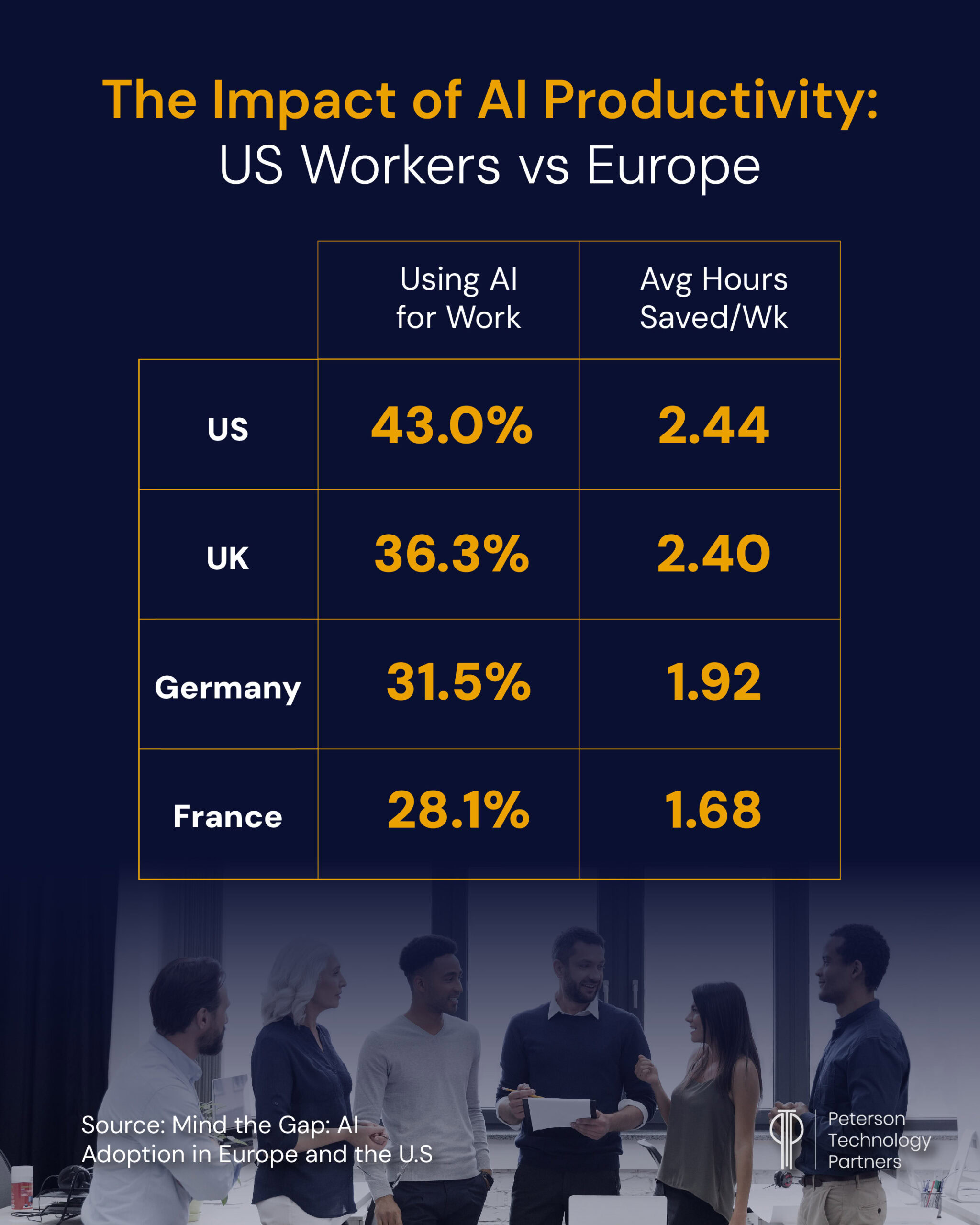
The authors partly attribute US success to management. (Note that this research also predates Claude Code’s breakthrough in December 2025.)
Among novel use case stories from March:
- Burger King is testing AI-powered headsets (called “Patty”) at US restaurants. The system is for live service coaching but can also recite recipes and flag inventory issues.
- Telecoms are also testing AI in on-call situations with human agents. Deutsche Telekom worked with ElevenLabs on their assistant, which can be awoken while on call with a spoken command. It enables help like live translation (up to 50 languages in the next year), calendar lookup, and map-based recommendations.
- Fundraising has become a surprisingly effective use for voice AI, which has no qualms about asking for money. GoFundMe reported its AI-enabled tools have already been used more than 80 million times, boosting donations by $125 million this year, per Yahoo Finance.
AI Coding Agents Trends
AI coding agents continue to surge, as “token anxiety” became a buzz phrase in March. It refers to concern over how many AI tokens software developers are spending, as some companies push for more.
Several startups (and big AI firms) made news by supporting token leaderboards. With software developers now supervising and reviewing agent work as much as writing new code by hand, the push is on to keep AI coding agents as busy as possible.
StrongDM provides an access management platform and is one firm leading this coding automation charge. Their “Software Factory” approach explicitly disallows humans writing or even reviewing code, using human developers instead to make roadmaps. AI agents do all the coding, testing, and even feedback until a final product is done and ultimately tested by people.
They also use what they call a Digital Twin Universe to clone existing third-party services for high-volume evaluations.
The Information’s Laura Bratton profiled similar “guardian” apps: cloud applications that connect to other agents in use via API or MCP. These are given instructions on how target agents should behave. The guardian agents then alert for aberrations, enabling employees to adjust behavior and/or stop an offending target agent.
As Tatyana Mamut, a former executive of Amazon Web Services and Salesforce told Bratton: “You can’t have humans actually supervising [AI agents’] work because human brains don’t work fast enough.”
What Does the Latest AI Regulation News Mean for Businesses?
The White House released a National Policy Framework for Artificial Intelligence in March to act as recommendations for Congress in drafting a unified federal AI policy.
It is organized around seven areas, including: child safety, community guidelines, IP handling, anti-censorship, accelerating AI innovation, workforce training, and focused heavily on pre-empting state laws for a single framework.
California Governor Gavin Newsom responded with his own state executive order, requiring firms that contract with the state to demonstrate their AI safety policies and how they’re avoiding bias.
It also specifies that California will designate a state-level review of supply-chain risk designations.
Speaking of which, the largest dose of AI drama in March may have come from the fight between Anthropic and the Pentagon.
We covered the start of this last month, so in the interest of efficiency, here are March’s key events:
- After failing to agree to terms by the deadline, the US government announced they’d replace all Claude use within six months and officially declared Anthropic a supply-chain risk.
- OpenAI made—then revised—a new deal with the Pentagon, suffering public backlash and prominent defections in the process.
- Anthropic immediately filed suit, drawing support from various AI companies, but by month’s end a federal district judge had blocked the supply-chain risk designation as the case moves forward.
All reports indicate that Anthropic, like OpenAI, is still aiming to go public in 2026.
How Is AI Impacting Jobs Right Now?
Anthropic released their workforce impact study in March (along with one from Goldman Sachs), finding that workplace implementation is only a fragment of what is possible.
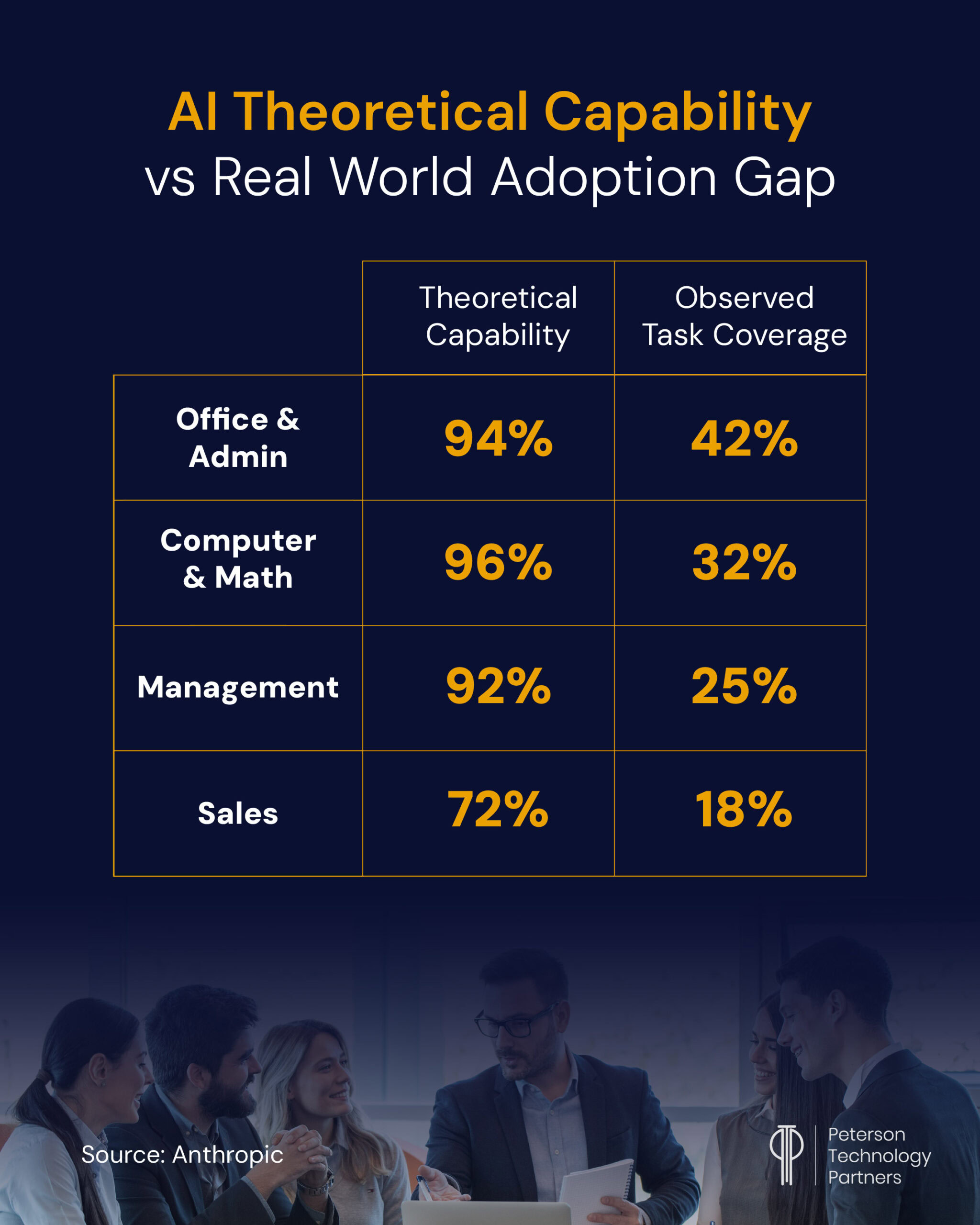
Anthropic’s report anticipated the most exposed positions in the workforce to belong to older, female (working 86% of the most vulnerable positions per the Brookings Institution), more educated, and higher-paid workers.
On the impact of AI on jobs lost, some major tech layoffs made news:
- Jack Dorsey–run Block laid off 40% of their workforce (around 4,000), saying they will aim to move faster with “highly talented teams using AI to automate more work” (Block CFO Amrita Ahuja, per CNBC).
- Morgan Stanley cut 2,500 jobs (around 3% of their workforce) across units, per Business Insider.
- Atlassian laid off 1,600 workers globally (10% of its workforce), with Co-Founder Mike Cannon-Brookes writing in a note to staff that the “bar for what ‘great’ looks like for software companies—on growth, on profitability, on speed, on value creation, has gone up.”
- Dell, for the second year in a row, reduced their staff by 10% (11,000 employees) in March.
- Reuters also estimated 60 Silicon Valley tech companies have laid off more than 38,000 employees so far in 2026 and anticipated Meta layoffs, which could impact 20% of their workforce. (Several hundred workers were laid off by Meta at the end of the month.)
- Oracle opened April with layoffs, per Business Insider, and—though at the time of this writing, the exact numbers were not yet known—estimates have put the number between 10,000–30,000.
Despite cuts, the debate on both the future and present AI impact on jobs rages on. ADP’s private payroll data from early April showed 62,000 new roles added in March (40,000 more than expected).
With a “low hire, low fire” pattern holding steady, companies like Microsoft are freezing hiring in major groups like cloud (The Information), as some claim CEOs are tying many layoffs to AI is an excuse, or “AI washing.”
Fitness band maker Whoop is expanding their own staff by 75%, with Founder and CEO Will Ahmed telling Bloomberg:
“There’s a lot of companies that are doing layoffs right now and blaming it on AI. But they’re actually doing layoffs because the businesses aren’t performing particularly well. And it’s a convenient excuse.”
Count OpenAI among companies that are hiring, with The Information reporting the leading AI firm is looking to nearly double its headcount(4,500 to 8,000) by the end of 2026.
Others, like Circle Co-Founder and CEO Jeremy Allaire, see AI agents soon replacing a “huge percentage of work that’s currently performed by humans on a massive scale” (Yahoo Finance interview from March).
BlackRock CEO Larry Fink noted in his annual letter to shareholders that AI is leading to “K-shaped” results for companies, too, with leading firms surging while lagging firms struggle.
This same trend, he argues, is firing economic anxiety throughout the world and pairs with reports of high worker unease over job security.
Skills Impact on AI Layoffs and Job Creation
So what skills do we all need for the era of AI agents?
“You have to be very open-minded, curious, and willing to try whatever the newest thing is. The value of that sort of person is going up exponentially, because the value they can create, by extension, is going up exponentially.”
This is productivity startup Notion Co-Founder Simon Last, talking with Wired’s Maxwell Zeff. His firm sees “agency” as, ironically, the most important skill needed for humans working with AI.
While agents take on more of the actual work, the most prized skills involve exercizing judgment, taste, communication, and flexibility.
[We profiled the rise in such orchestration positions in a prior PTP Report.]
AI Industry Updates
We could fill roundups entirely with big AI company news, so here we hit on key topics of interest.
It’s been a turbulent time in the markets. As of April 1, the Magnificent Seven AI stocks are down regardless of earnings, with Nvidia down 8%, Google parent Alphabet down 9%, Amazon 8%, Meta 12%, and Microsoft 22%.
Funding, however, has remained high, with AI companies taking in an estimated $297 billion in funding in Q1, per Crunchbase. This includes a record-setting funding round by OpenAI ($122 billion) now taking the currently private company to $852 billion as it shifts plans to develop a unified AI “superapp.”
Among AI business trends: Q1 2026 had more large corporate deals than any on record, with 22 transactions totaling more than $10 billion, per the Wall Street Journal.
Latest AI Product News
Here are some of the big releases from the month:
- Google continued its image generation lead, releasing Nano Banana 2 at the close of February. It boasts Flash speed, more image consistency, and better text rendering. It also released Gemini 3.1 Flash-Lite for high-volume tasks.
- OpenAI reportedly started building its own GitHub rival (Reuters), but its main releases came in GPT-5.3 Instant and their newest frontier model, GPT-5.4 (Thinking and Pro, with one million context token capacity).
- At Nvidia’s GTC 2026, CEO Jensen Huang put a number on the skyrocketing demand for his company’s products ($1 trillion through 2027), saying they would only be able to fulfill it in 2028.
- Nvidia also praised OpenClaw’s success, releasing NemoClaw, an open-source stack to bring privacy and security controls to the popular agent.
- In addition to leaking code, Anthropic also leaked a post about its own new model, Claude Mythos, which will be, in their words, “by far the most powerful model” they’ve released, and a “step change” (Mashable). According to The Information, they’ve given early access to cybersecurity researchers.
- OpenAI shut down their Sora video-generation tools just six months after launching it with its own social media platform. While it enjoyed a brief moment in the spotlight, the tool was a big money loser for OpenAI and drag on compute (TechCrunch).
- Axios reported on Microsoft’s 365 Copilot Researcher, which uses a “Critique” layer using Claude to review answers from OpenAI’s model. The company claims 13.8% higher scores on the DRACO benchmark from Harvard and Perplexity for reliability.
Conclusion
AI “brain fry” research from the Boston Consulting Group (BCG) was released in March. They found that moving too fast with AI—considering too many decisions, across too many apps, and feeling spread too thin—is a rising problem in US workplaces. But they also found it increased rapidly when using more than three AI tools at once (with productivity also dropping).
Leadership-provided training and support saw brain fry decrease.
We hope our monthly roundups of recent developments in AI help you feel less overwhelmed.
If your business is in need of assistance keeping up with AI, whether through AI-first consulting, solutions, or top AI talent, contact PTP.
References
Claude Code’s source code appears to have leaked: here’s what we know, Venture Beat
Morgan Stanley warns an AI breakthrough Is coming in 2026 — and most of the world isn’t ready and Larry Fink says today’s economic anxiety stems from people increasingly feeling like capitalism isn’t working for them, Fortune
Applied AI: ‘Guardian’ Apps Aim to Stop AI Agents From Going Rogue, The Information
ChatGPT uninstalls surged by 295% after DoD deal, TechCrunch
Major outgoing CEOs are citing AI as a factor in their decisions to step down and Anthropic wins preliminary injunction in DOD fight as judge cites ‘First Amendment retaliation’, CNBC
Big Tech’s $635 billion AI spending faces energy shock test, S&P Global says and Dell workforce drops 10% in fiscal 2026, filing shows, Reuters
How Will AI Affect the US Labor Market?, Goldman Sachs
Labor market impacts of AI:A new measure and early evidence, Anthropic
First came the AI ‘teammates’, then the layoffs: the new reality for Atlassian staff now looking for work, The Guardian
Whoop to Expand Staff by 75% to Spur Growth Ahead of Likely IPO, Bloomberg
Circle CEO: AI agents will replace work performed by humans ‘on a massive scale’ and Okta CEO: AI is moving so quickly, companies must change 40% of what they are doing every year, Yahoo Finance
Mexico City Built a Chatbot to Help World Cup Tourists Navigate the City and Summon This AI Agent by Speaking Its Wake Word Mid-Phone Call and Are You ‘Agentic’ Enough for the AI Era?, Wired
Worried You Might Have AI Brain Fry? 2 New Studies Might Help, Inc.
Meet Claude Mythos: Leaked Anthropic post reveals the powerful upcoming model, Mashable