


There’s no shortage of excitement around quantum computing.
By last year, global governments had pledged at least $55 billion to quantum technologies, as the UN named 2025 the “International Year of Quantum Science and Technology” (also the 100th anniversary of quantum mechanics).
Major tech companies have continued to trickle out breakthroughs and investment announcements, from Microsoft’s Majorana 1 and Google’s Willow chips to Nvidia’s launch of the Accelerated Quantum Research Center (NVAQC).
And in November, Alphabet and Google CEO Sundar Pichai told the BBC: “The progress is so exciting. I would say quantum is there where maybe AI was five years ago.”
Earlier this year, IBM announced a $10 billion quantum investment over the next five years, the US government updated its policies and announced its own $2 billion investment in nine companies (including IBM), and the security concerns around cryptocurrency systems and the large-scale harvesting of encrypted data have only continued to intensify.
With McKinsey projecting up to $2.7 trillion in quantum computing value coming by 2035 (for five industries first, see below), companies and some communities alike are ramping up their investments in a bid to not miss out on what’s seen as the next emerging tech boom.
But is it really this close?
In today’s PTP Report, we look at the state(s) of quantum computing today.
Why are so many companies investing, what are the short-term gains being targeted, and why are the near-term security risks being intensified?
The National Quantum Computing Push in 2026
In 2025, private funding surpassed academic and public funding in quantum computing for the first time.
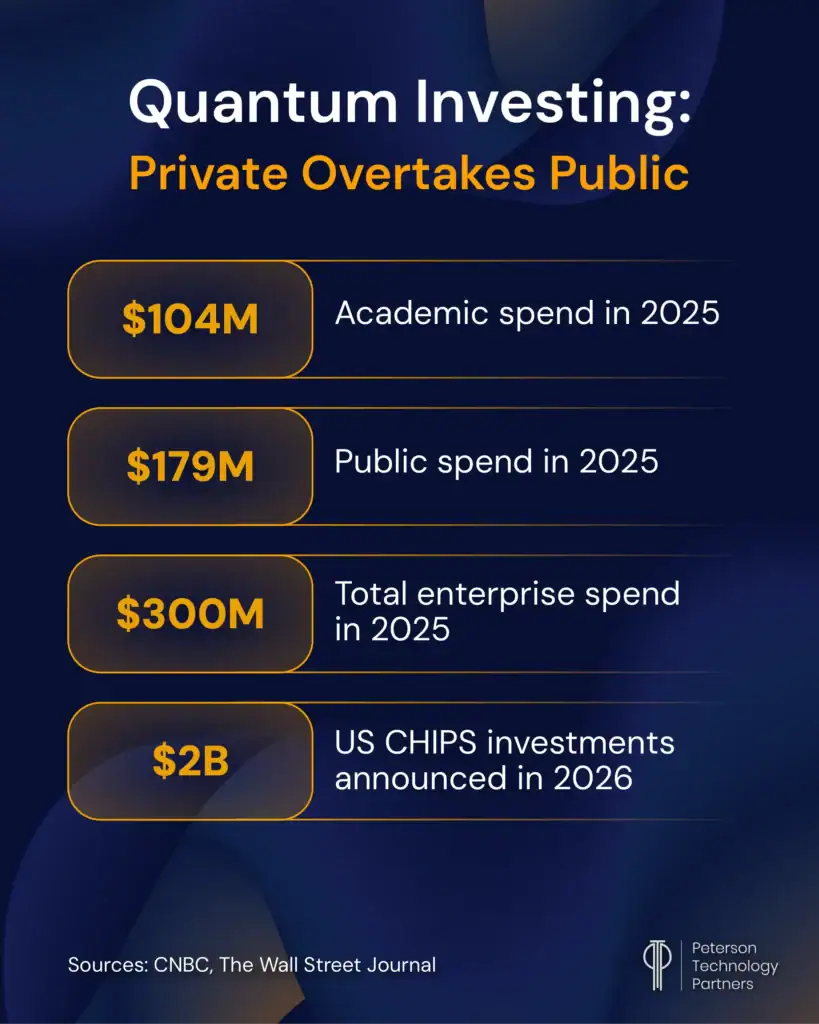
The US government responded by increasing the public spend in May, with the Commerce Department earmarking more than $2 billion from the CHIPS and Science Act for quantum computing. This will go to nine companies, with $1 billion directed to IBM as part of their domestic superconducting quantum foundry.
This was followed up in June with two executive orders.
The first proposes updates to the National Quantum Strategy (to be officially delivered within 180 days), aiming for the US to lead the world in quantum information science and technology (QIST) research and to encourage its commercialization. It calls for more industry partnerships, workforce programs, international supply-chain partnerships, national security tools, and several quantum sensor projects across departments.
It also tasks the government with creating a national quantum computer “at a scale intended to initiate the era of quantum-enabled scientific discovery,” to be housed at a Department of Energy facility.
The second order is focused on quantum computing’s cybersecurity impact. It accelerates the federal shift to post-quantum cryptography (PQC), noting that adversaries are already harvesting encrypted data they hope will still be relevant when quantum computers are ready. This accelerated timeline requires high-value government systems to be migrated to PQC by the end of 2030, with digital signatures by the following year (2031).
Notable for businesses, this directs updates to ensure federal contractors are also meeting NIST cryptographic standards by 2030.
Investing Continues to Climb for Quantum Computing in Business
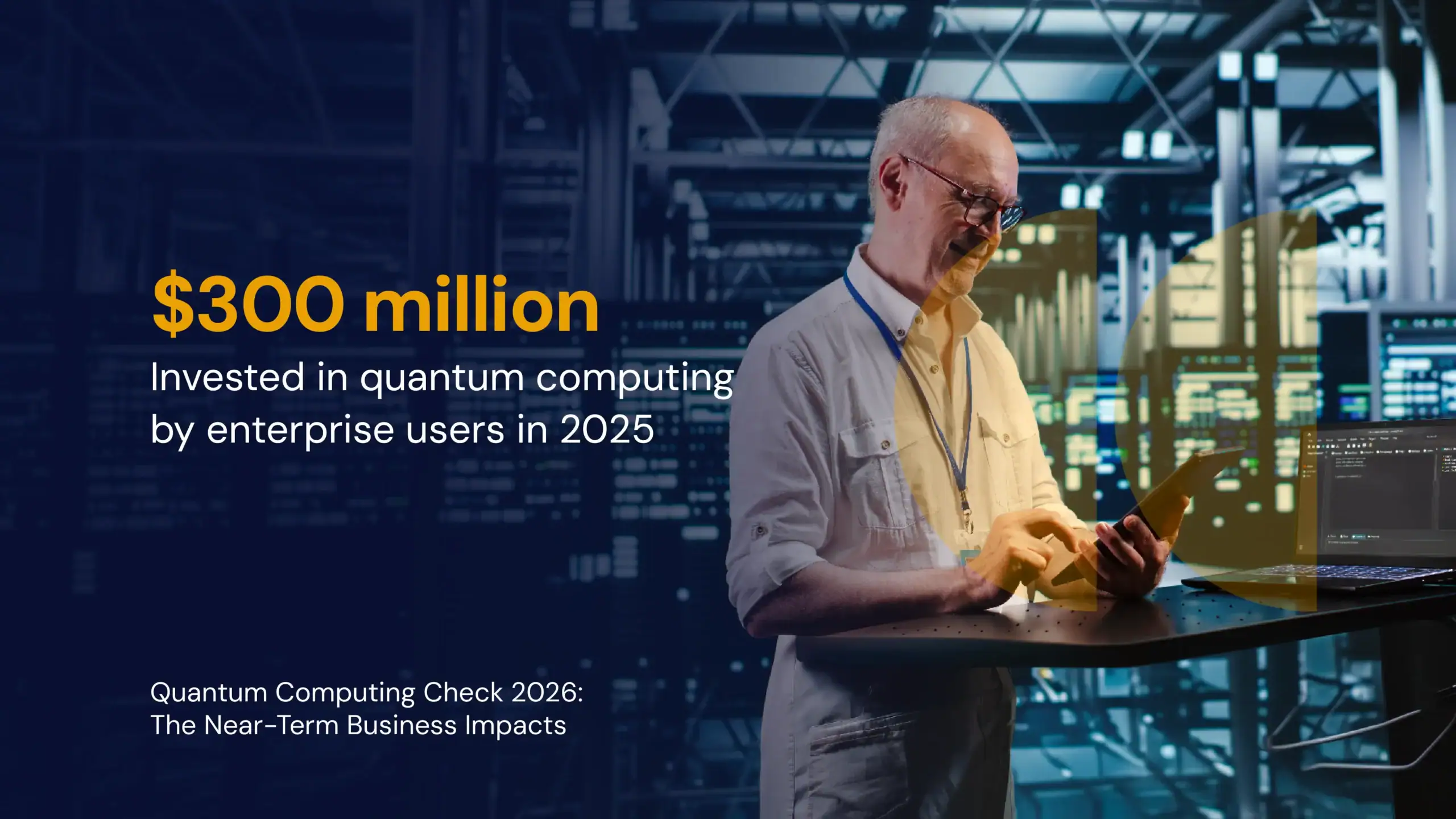
McKinsey reports that over 300 organizations in 2026 are actively collaborating with quantum computing companies to solve business problems, with the leaders already moving from pilots to applications that are embedded in full workflows.
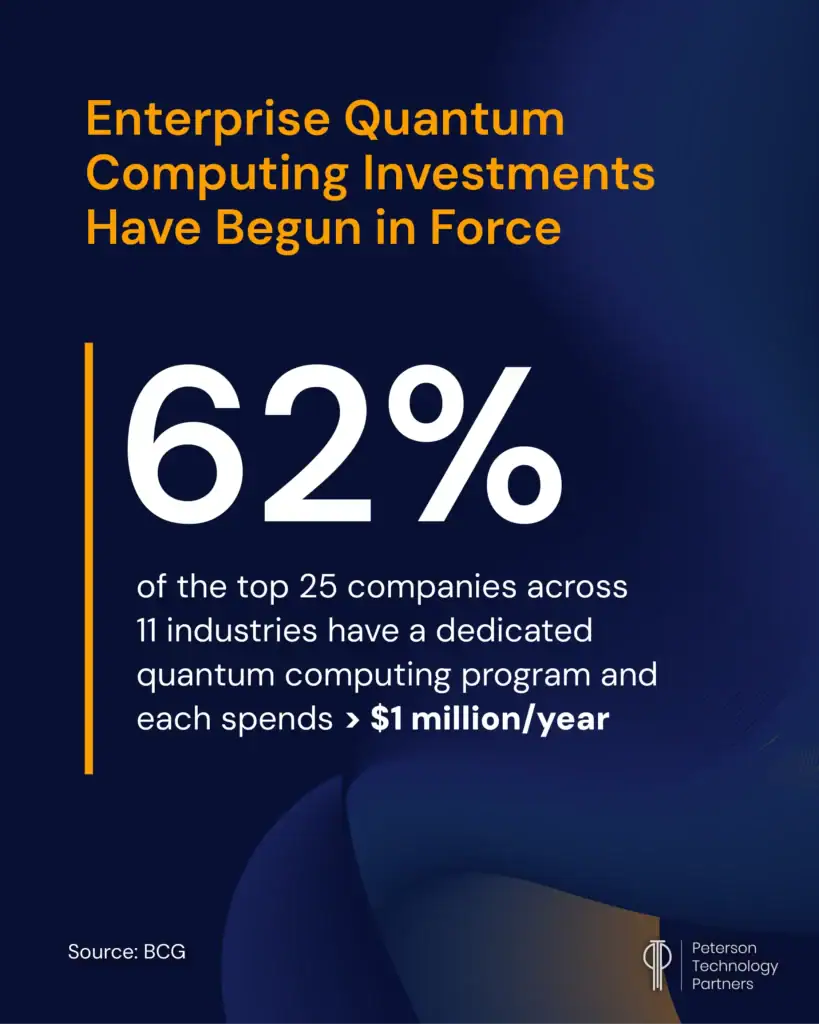
And a report from the Boston Consulting Group (BCG) noted that most of the top 25 global companies by market cap now have dedicated quantum computing programs in-house.
And while use cases and specific objectives vary, one commonality is a desire to not miss out on a technological opportunity that’s being accelerated in several ways by AI.
American insurance company Allstate is expanding their own 10-person quantum team. The company Chair, President, and CEO Tom Wilson sees quantum as a disruptive technology he believes will yield Allstate a competitive advantage.
Wilson told the Wall Street Journal’s Isabelle Bousquette it: “will solve problems that traditional compute takes too long to do. And that AI can’t really do.”
And while he was careful to point out that it’s not “AI 2.0” and currently has “nowhere close to the usability” of AI, he’s a firm believer in its inevitability and transformative power. They are currently exploring uses to optimize insurance problems like enabling more precise pricing calculation related to highly complex risk models.
The drive to not miss out on the next tech boom is also influencing communities worldwide.
One example is Chicago, which has committed some $500 million to create one of the world’s largest quantum computing sites: the Illinois Quantum and Microelectronics Park (IQMP).
This 128-acre development project repurposes an old US Steel site on the city’s South Side and has already attracted billions in corporate partnerships. It will house one of the world’s biggest quantum computers (built by PsiQuantum), and an IBM quantum computer (Quantum System 2) and research team as part of the National Quantum Algorithm Center (NQAC).
Chicago’s campus also seeks to draw on a rich source of local talent from the Universities of Chicago and Illinois Urbana-Champaign, as well as the nearby Argonne National Laboratory.
As the project’s CEO and U of I engineering professor Harley Johnson told the Wall Street Journal: “Right now we export a huge number of scientists and engineers to the coasts,” and their goal is “to create an industry that retains all that talent.”
What are the most practical quantum computing use cases for businesses?
PsiQuantum is an American quantum computing company that’s now a decade old. They were one of the firms getting funding by executive order and recently signed a $125 million pact with DARPA.
They’re currently working with Fortune 500-scale companies like Boehringer Ingelheim, Mercedes Benz, and Mitsubishi Chemical on scientific advances aimed at designing new drugs, materials, and fuels.
Among the industries expected to tap some $2 trillion in projected gains by 2035: mobility, chemicals, telecom and tech, life sciences, and financial services.
British-based financial services company HSBC has its own team of quantum researchers distributed globally (London, India, and Singapore), and their work in finance (with IBM) has already shown promising flashes, like a 34% improvement for predicting if bonds will be filled at quoted prices.
And while they’re still working to scale this practically into production, the company’s main focus is on cybersecurity, where concerns continue to grow (see below).
Most companies use the machines as QaaS (quantum-as-a-servce) through the cloud, where Google, Microsoft, Amazon, and IBM provide access to their own or third-party quantum systems.
But as one of the Big Four service firms, EY an interest in getting hands-on experience driven by client demand. They’ve acquired their own quantum computer (as part of a $3 billion frontier tech commitment), with a dedicated team working on developing scalable use cases.
And while this first-hand experience may give them an edge, the work is still in a learning phase.
What’s slowing near-term quantum computing business impact?
Quantum computing’s capacity for superposition (occupying multiple states until measured) and entanglement (linked even when separated by great distance) has already demonstrated flashes of computational ability exponentially beyond what classical computers are capable of, even with AI.
But the problem is that it remains extremely difficult to use.
It’s both delicate, easily disturbed, hard to control (without disturbing it), and thus nowhere near the scale needed for most business use cases.
It also must be kept extremely cold, and faces structural challenges that AI didn’t, in the need for its own industrial infrastructure.
And while it’s true that many companies (including both PsiQuantum and IBM) are still projecting 2029 for systems with enough fault tolerance to create real value, much remains to be solved.
Nvidia CEO Jensen Huang is a big backer, but in January of 2025 sent shockwaves through the market when he said it would be 15-to-30 years before we’d see widespread practical use. (He later walked this back at Nvidia’s own “Quantum Day” event.)
And like AI, quantum computing also has a labor shortage, with not enough researchers available to serve the surging demand. IBM is among the companies attempting to address this with AI, using LLM assistance, for example, to program quantum computers.
Turing Award-winning computer scientist and mathematician Jack Dongarra told Wired last year that while quantum is a fascinating area of research, he believes it’s “been oversold,” and that there is much still to be resolved with the fragility, adding that he doesn’t believe there will be a quantum laptop, for example, his lifetime.
He also pointed to the need for quantum algorithms, as so few of the ones we have can be run on quantum machines, and suggested early achievements may come in supercomputers that combine AI and quantum technologies.
Why Post-Quantum Cryptography (PQC) Matters Now
In March, Google released research projecting that quantum computers could break the elliptic curve cryptography protecting cryptocurrency much sooner than expected (shifting their migration timeline to 2029).
The company engaged the government and has recommended to industries that blockchain networks should begin migrating their cryptography ASAP.
But while this added fuel to the fire, the push to improve our defenses to be quantum-proof has been underway for years. Most current encryption relies on mathematical problems which could be easily solved by quantum computers running Peter Shor’s algorithm, for example.
The fear of “Q-Day,” when quantum systems will be able to crack most traditional encryption, led NIST to develop post-quantum cryptographic (PQC) standards through a multi-year international competition spanning industry, academia, and the public sector.
Three quantum-proof algorithms for PQC were released in 2024, along with the recommendation that companies begin migrating to quantum-resistant cryptography ASAP.
Quantum defense was also honored by the 2025 Turing Award, with Charles Bennett (an IBM researcher) and Gilles Brassard (professor at the University of Montreal) recognized for their research in the 1980s proposing an unbreakable encryption technology based on quantum mechanics.
At the time their work was purely theoretical, but forty years later it is beginning to look like an approach that may become essential.
As UCLA Professor Prineha Narang told the New York Times:
“For a long time, it was not clear how these ideas would be used. Now, small companies, large companies and even the US government is trying to deploy this technology.”
What are the biggest business risks of quantum computing?
For businesses, the urgency around PQC comes from two main drivers:
- Encrypted data of all kinds which may contain lasting sensitive information is already being harvested at scale by bad actors. Whenever sufficient quantum computing capacity arrives, it will be used to decrypt this data.
- Converting will also take time, with five years being considered a short migration time for small companies. As NIST has pointed out, prior transitions have usually taken 10-to-20 years to complete. “Anyone who thinks that they can actually make the transition in just three to five years with the amount of stuff they have to change, I think they’re deceiving themselves,” Keyfactor Co-Founder and CTO Ted Shorter told the Cybernews.
And for cryptocurrency alone, there’s likely more than $2 trillion in assets at stake at the wallet level.
“The great quantum migration is going to require the entire digital asset industry to participate,” Quantus Co-Founder and CEO Christopher Smith told Fortune.
“Being a year too early is much better than being a day too late.”
Conclusion: Should Businesses Invest in Quantum Computing Now?
The quantum boom is unlikely to echo AI. Despite the mindboggling promise, its infrastructure is unique, and there are still many challenges to be resolved.
But its supporters are quick to point out that once it is capable of solving problems that today’s computers (even with AI) can’t, getting access to the technology, knowledge, and talent is going to be difficult.
The message from Allstate’s CEO is to “Get on the train” now before it’s too late.
But it remains to be seen if there will actually be massive value creation for businesses by 2029.
Regardless, cybersecurity leaders are warning that Q-Day might well arrive that soon.
And unlike Y2K, it’s both an unknown date and a potentially silent transition.
As Accenture’s Global Lead for Emerging Technology Security Tom Patterson warned, companies should be asking themselves:
“What are your keys to the kingdom that are sensitive today and will also be sensitive five, six, seven years from now?”
These should be the priority in a process that could take an average of twelve years to complete.
References
Quote of the day by Alphabet CEO Sundar Pichai: “Quantum is where AI was five years ago” — insight on the next big tech craze, TechRadar
Quantum’s breakthrough, McKinsey & Company
President Trump Signs 2 Quantum Executive Orders, Holland & Knight
Quantum stocks soar as U.S. plans $2 billion funding incentives and equity stakes and A Practical Quantum Computer Is Coming! But When?, CNBC
Businesses Are Spending Big on Quantum, Allstate CEO’s Message on Quantum Computing: ‘Get on the Train’, and Chicago Missed the Tech Boom. Quantum Computing Gives It a Second Chance., The Wall Street Journal
How Supercomputing Will Evolve, According to Jack Dongarra, Wired
Turing Award Goes to Inventors of Quantum Cryptography, The New York Times
White House cuts data centers, batteries, and AR from the US critical technology list — post-quantum cryptography, integrated photonics, high entropy alloys among new additions, Tom’s Hardware
Safeguarding cryptocurrency by disclosing quantum vulnerabilities responsibly, Google Research
‘The great quantum migration’ is coming as more than $2 trillion in digital assets is at risk—nearly the entire value of the overall crypto market, Fortune
Quantum insiders warn PQC changeover could take 12 years: “This is not Y2K all over again”, Cybernews
FAQs
What is the current state of quantum computing in 2026?
Private investments exceeded public for the first time in 2025, with the majority of top companies across industries worldwide having dedicated teams and making sizable investments. That said, the technology itself is still very fragile, expensive, and error-prone, with most companies still accessing smaller, pilot computers as QaaS, through the cloud. Many quantum companies (including IBM and Google) are projecting machines of sufficient stability and scale will arrive in 2029.
What should businesses do to prepare for quantum computing?
Of top priority is preparing for post-quantum cryptography (PQC), with encrypted data already being harvested by bad actors and an uncertain deadline looming. In terms of proactive business use, staying educated and building internal expertise are important, as talent and access are expected to be highly competitive. Companies in the five areas anticipated to see early impact should be exploring use cases and potential partnerships.
How will quantum computing affect cybersecurity?
Quantum computers are expected to be easily able to crack current encryption methods like RSA and elliptic-curve cryptography. And while it’s uncertain when “Q-Day” will arrive, bad actors are already collecting encrypted data that can be harvested at that time.
How will AI and quantum computing work together?
AI is already being used by companies like IBM to help with a shortage of quantum computing talent. It’s also helping with design, error correction, and for finding problems that quantum processing can address. The combination of AI and quantum technologies are expected to also revolutionize supercomputers.