

Google parent Alphabet announced earnings last week, beating Wall Street estimates with 24% year-over-year revenue growth. Their cloud revenue spiked 82%, and Gemini now has 950 million active monthly users.
Still some investors bailed on the company as its share price dropped more than 6%.
Among the concerns: yet another announced increase in capital expenditure—anticipated to be between $195 and $200 billion for 2026—a year-over-year increase of more than 200%, per Bloomberg.
All told, the anticipated spend of just the four hyperscalers (Alphabet, Amazon, Microsoft, and Meta) is now between $710 and $740 billion. Goldman Sachs put the total AI infrastructure spend—including compute hardware, data centers, and power infrastructure—at around $765 billion, even before Alphabet’s announced increase.
To put that into context, it’s around 2.3% of US GDP, twice the inflation-adjusted cost of the Apollo space program (spread over 13 years, using $321 billion), and more than the cost of building the entire US highway system, from 1956 to 1992 (at $705 billion, also adjusted).
That’s more than 17 Manhattan projects (at the higher-end adjusted estimate of $43 billion), this year alone.
Needless to say, the pace of this physical expansion project is unparalleled.
Today’s PTP Report looks at the state of this ongoing, historic build-out, focusing in particular on two areas causing critical delay: power and labor.
Compute Shortages Continue Driving Data Center Demand
Despite the unprecedented scale, new data center and compute deals continue to come every week. Just yesterday, Bloomberg reported on Nvidia helping OpenAI to lease a $500 billion data center in Ohio (set to go online in 2028 at 10 GW, one of the biggest in the world), while Google, even as a core hyperscaler, announced it can’t meet its own compute demands.
It is having to contract with third parties like SpaceX. In June, they signed a deal for compute costing Google around $920 million a month.
OpenAI Co-Founder and President Greg Brockman said at a roundtable in late July that the AI industry remains in a serious compute shortage, and he anticipates it will continue to be for the foreseeable future.
“Right now we have to make hard decisions on what models we actually train, what products we actually scale.”
This shortage is reported by all of the major AI players, as training becomes more and more compute intensive and inference—ongoing compute needed by trained models to use—continues to rise sharply. Post-training techniques like reinforcement learning and fine tuning are also rising in popularity and can use 30 times the compute of initial training.
Estimates vary on how much will be needed in the years to come, but late last year, Bain estimated there will be more than 100 GW of new demand in the US by 2030, with compute growing more than twice as fast as Moore’s law.
Deloitte predicted a shift this year from training massive models to more and more inference need. By their numbers, in 2023, inference accounted for only a third of the compute used, but by 2025 this had grown to half. They project it will account for two-thirds of compute needs this year alone.
And even as chips get more powerful and efficient, compute needs are estimated to quadruple or even quintuple annually through 2030 as AI adoption increases.
Still some top AI minds remain skeptical of the continued benefits of such scaling. Turing Award winner and one of the “Godfathers of AI” Yann LeCun has consistently challenged the assertion that aggressively scaling language models will produce the jumps desired in AI development. LeCun co-founded Advanced Machine Intelligence Labs in late 2025 with a focus on world-model approaches, as he advocates for alternatives to LLMs.
OpenAI Co-Founder (and its former chief scientist) Ilya Sutskever added his voice to this camp late last year, noting on the Dwarkesh Podcast that while scaling will continue to make systems different, he’s skeptical it will produce anything like the same kinds of jumps we’ve been witnessing over the past five years.
While he remains a believer in the need for more compute, he’s advocating for more effective uses of it, with a renewed push into research that can find alternatives to the current approach.
But regardless of how much LLMs may continue improve by scaling, the demand for compute remains intense just to serve current solutions, with adoption of AI agents that can stack numerous requests together autonomously and more complex reasoning systems rising fast.
Why Are Data Center Projects Facing Delays and Cost Overruns?
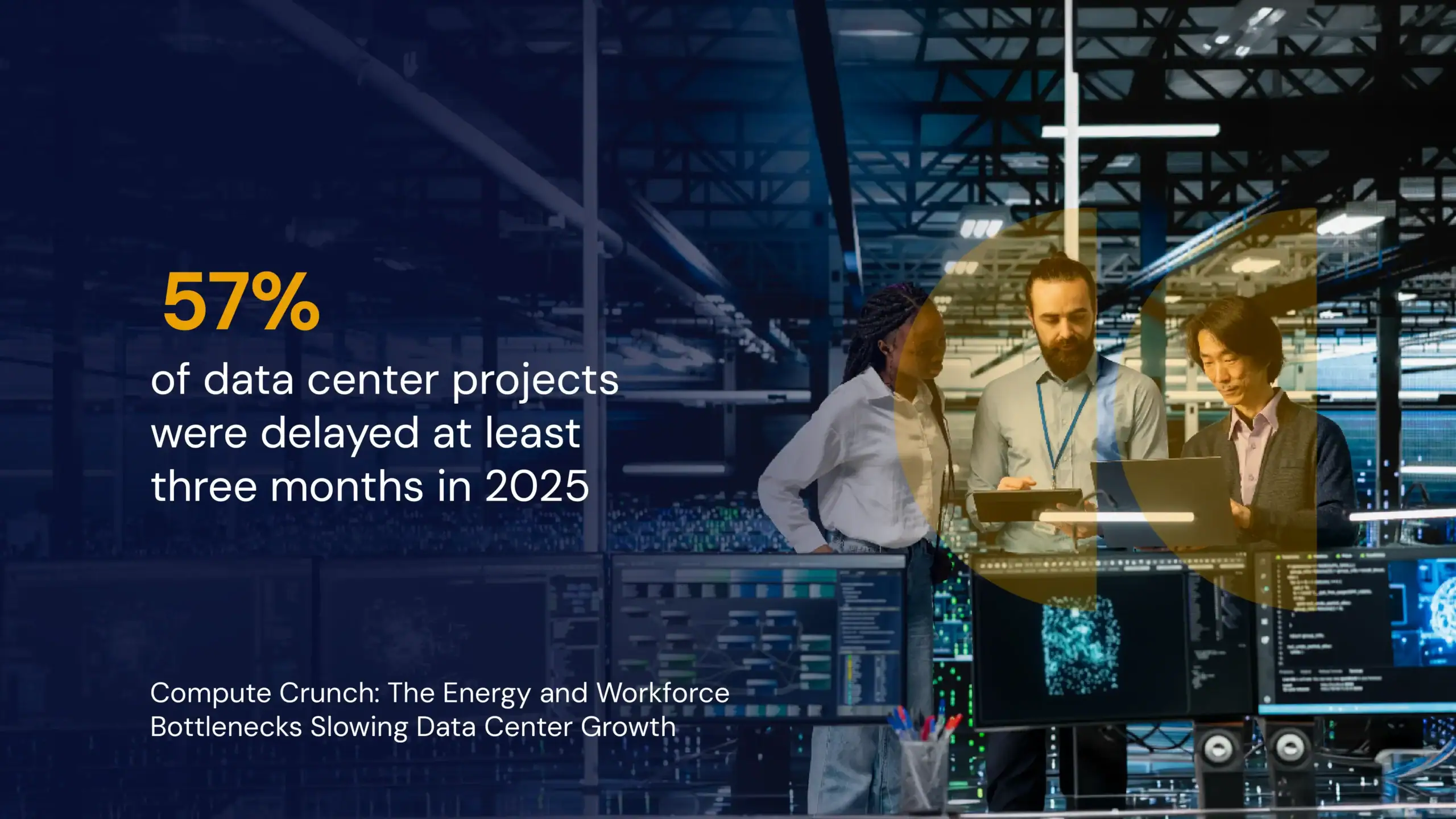
Any construction initiative of such size and pace is certain to run into real world challenges, and more than half of current data center projects met with delays of three or more months last year alone, per JLL research.
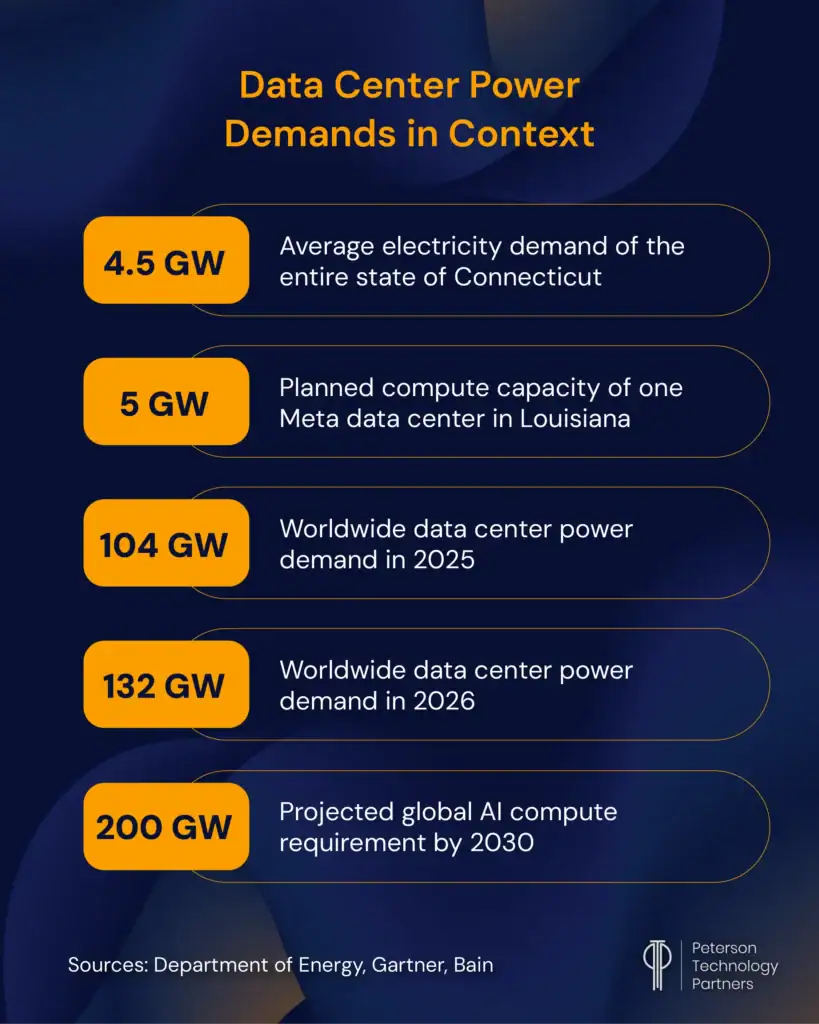
Data center electricity use grew steadily from 58 TWh in 2014 to 176 TWh in 2023, but current estimates cited by the US Department of Energy see this need rising dramatically, to as much as 580 TWh by 2028, or a spike of potentially more than 3x in just five years.
In addition to power, components are also proving hard to get, with projects scrambling to get all manner of materials. This includes powerful AI GPUs as well as CPUs, but also memory, which is in such short supply that it triggered a large Apple price hike on all products earlier this year.
Apple’s outgoing CEO Tim Cook blamed memory shortages and called the situation “unsustainable.”
Long-lead electrical equipment—like switchgear, transformers, and generators—is another common source of delay, with supply chains already severely strained. Average lead times in some cases are at 50% above pre-COVID levels, with waits measured in months instead of weeks.
An AlixPartners survey of more than 400 senior executives in the industry found that 68% expect an increase in such delays and difficulties over the next 12–18 months, fueled by financial and community pressures and especially by labor and power shortages.
National Backlash Is Rising Among AI Infrastructure Concerns
Data centers have been a bright spot in an otherwise weak construction market.
But with a need for land, power, and water for cooling, they’re also rapidly becoming a point of contention throughout the nation and across party lines. Many communities wonder how much long-term gain they’ll receive for the projects, which, as we discuss below, require extensive amounts of power and are expected to drive up rates.
We’ve covered this galvanizing shift in popularity in our AI roundups, with AI building projects going from being desired for labor and tax benefits to being strongly opposed over the course of the past year.
Milltown Partners’ data from June found that nearly half of Americans are now in favor of moratorium on new data center construction overall, with Gallup polling finding 70% opposed to local data construction.
This is significantly higher than the numbers that oppose local nuclear power, and the speed is also a concern. Reuters found that just a third of Americans support the current pace of data center construction.
Opposition is also rapidly organizing (188 groups operating across 40 states) and has extended into legislatures.
In July, New York imposed the country’s first statewide moratorium on new hyperscale data centers (at least 50 MW), pausing permits for up to a year while new standards are established to cover infrastructure, workforce, and what direct benefits should be received by local communities.
A similar bill (blocking builds over 20 MW until at least 2027) reached the governor of Maine, though she’s not signed it, and a planned data center campus was shelved in Virginia due to proximity to a national battlefield.
At least a dozen other states are considering similar construction bans, according to Baird analyst Justin Hauke.
With pressure mounting, presenting clear facts and benefits from the outset (as in a credible community benefits plan) is now deemed as essential for new data center construction plans as finding proactive solutions for power and labor.
Data Center Power Availability Is a Critical Bottleneck
How much power does an AI data center consume?
Data centers have been around for decades, but just a few years ago, a 100 MW lease was considered massive.
Today, that norm is moving closer to 1,000 MW, with Oracle, Microsoft, and Amazon all working on data center projects that require power on par with entire cities, or, as in the case of Meta’s Louisiana site, entire US states.
Bank of America analysts put the need at more than 230 GW of new capabilities within the next five years, but utility companies are only on track to provide around 93 GW.
And while finding the right land and zoning, community approval, water for cooling, fiber, the necessary computing and electrical components, and labor is all hard enough, finding grid capacity where and when it is needed may be one of the biggest challenges.
As Miami-based data center developer Hut 8’s Director of Engineering, Procurement, and Construction Brennan Church told Construction Dive:
“What looks viable on paper usually breaks down on power, permitting or labor, and sometimes all three.”
Per Bank of America analysts, utility power constraints are driving companies to chase transmission upgrades, deploy batteries, and expand coal-plants.
So how can data centers overcome utility power constraints?
One popular approach is self-generation, with more than 7.5 GW of sites already in construction using this model.
B of A’s report estimates that more than 60 GWs of pre-construction is expected to combine traditional utility-provided power with on-site power generation for data centers in a bid to shorten timelines and improve consistency.
Natural gas has been tabbed as a key source, though equipment remains a serious drag, even as providers like Caterpillar, INNIO, and Rolls Royce expand production to accommodate demand. Large gas turbines are sold out through 2030, forcing many developers to utilize on-site gas engines.
Data Center Workforce Shortage Is a Growing Problem
It’s no surprise that the talent needed to plan, build, energize, and support data centers is also in increasingly short supply. Examples abound of spiking wages and poaching, as with electricians in Plano, Texas. Many are now making as much as $280,000 a year with all the overtime they want, per the Dirty Jobs show’s Founder and Host Mike Rowe.
He found this same demand extending to HVAC technicians, welders, plumbers, technicians, and on-site construction managers.
In recent years, large tech companies have invested tens of millions of dollars to get the jump on this shortfall with training programs, like Meta’s America’s Workforce Academy, Google’s Skilled Trades and Readiness (STAR) program, Microsoft’s Datacenter Academy, and the AWS Academy Datacenter Technician program.
And while these have improved the entry-level state of the pipeline, they are not able to rapidly fill the void for experienced foremen, engineers, technicians, and operations managers.
And compounding this shortage is the overlap in skill needs between data centers and power companies.
Deloitte identified 39 occupations (including engineers, technicians, line workers, computer specialists, and power-plant operators) which represent more than 40% of the current workforce for both data center developers and power companies.
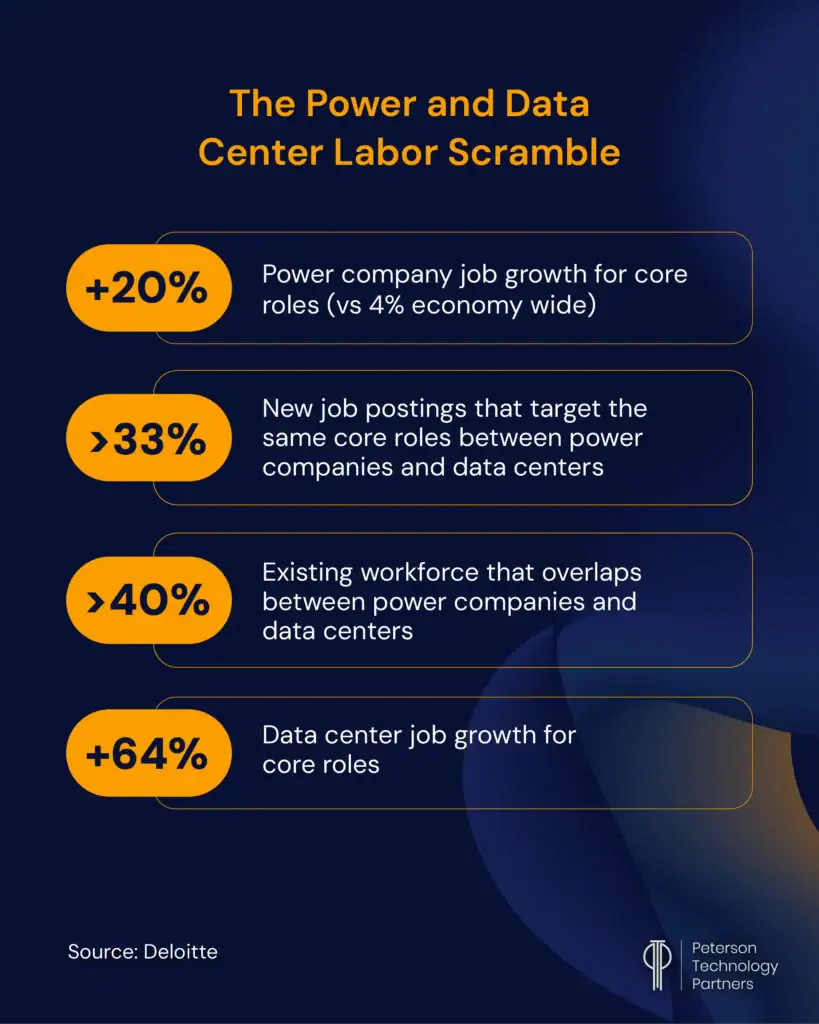
As indicated above, the demand for these roles is only increasing. Between 2023 and 2025, job postings for such core roles at power companies rose by 20%, and for data center developers by 64%, compared to just a 4% increase across the broader economy.
Among the hottest positions, electrical technicians saw a 181% increase in demand at data centers while computer and information research scientists saw a spike of more than 441% in power company listings and a 129% increase by data center developers.
Given this situation, it’s no surprise the power companies they surveyed listed this competition as their top workforce challenge, while 63% of data center developers put this shortage in needed skills as their primary talent challenge.
How Should Companies Plan for Both Energy and Data Center Workforce Shortages?
We are witnessing an AI infrastructure build-out that is almost unparalleled in modern history, at least by official expense. And given the surging demand on compute and amounts being invested in AI, it’s not one likely to subside over the course of the next decade.
But with such scale, even the most well planned and orchestrated approach can find itself pinched with unexpected—and extremely costly—delays.
Whether it’s through better communication around community impact and distributed benefits of compute, pre-secured power, on-site generation, and supply of critical equipment, or by finding—and maintaining—the necessary talent for each phase, companies must be proactive and effective while moving as quickly as possible if they want to succeed.
At PTP, we have nearly three decades of experience providing Fortune 500 companies with top technical talent. If you are looking down the road for the needs of your own power or data center project work, don’t delay.
Talk to us today and we may be able to help.
References
Tracking Trillions: The Assumptions Shaping the Scale of the AI Build-Out, Goldman Sachs
OpenAI president Greg Brockman: ‘We will remain in this compute shortage no matter what’, Yahoo Finance
How Can We Meet AI’s Insatiable Demand for Compute Power?, Bain and Company
Ilya Sutskever — We’re moving from the age of scaling to the age of research, Dwarkesh Podcast
What’s stalling data center projects? Public opposition and power access lead delays., Construction Dive
Microgrids, Large Electric Loads & Grid Support: How to Leverage Microgrids to Support Utilities and Large Load Customers, The US Department of Energy
2026 Global Data Center Outlook, JLL
Google Boosts 2026 Spending Estimate to as Much as $205 Billion and Anxiety is growing among data-center operators that the projects could founder as local backlash builds across the US, according to a survey from AlixPartners., Bloomberg
In the AI age, data centers and power companies compete for the same core workforce, and Why AI’s Next Phase Will Likely Demand More Computing Power—Not Less, Deloitte
AI data center growth could force US utilities to rethink generation plans, BofA says, Utility Dive
‘Dirty Jobs’ host just revealed the lucrative salary Gen Z electricians make from AI data centers—the number is eye-popping, Fast Company
FAQs
Why are data center power shortages becoming the biggest barrier to AI growth?
AI workloads are expanding faster than data center capacity, driving enormous construction initiatives. Against this backdrop, more and more power is needed, driving utility companies to add generation, transmission, substations, and grid connections. But while a site may have land, water, financing, and transmission capabilities, it still requires a firm power-delivery timeline for the project to stay on target, and this is increasingly hard to come by.
Will the electric grid support future AI data centers?
The US power grid can support continued growth, but not at the scale desired in this build-out. Bank of America analysts put the need at more than 230 GW within the next five years, while utility companies are only on track to provide 93 GW.
For this reason, some developers rely on on-site power production to augment what they can get from utilities, both to get ahead of long power infrastructure delays, and to provide more consistency in the near-term.
What is the best energy strategy for building a modern data center?
Data center developers must be proactive in their power needs and coordination to prevent delays. This means early coordination with companies, and considering multiple pathways for power, such as augmenting via on-site generation and storage, and renewable procurement. These considerations have to be taken into account before a site is settled on.
What are the biggest workforce challenges in data center construction?
The scale of construction has long been anticipated to exceed available labor in many areas, including for electricians, engineers, control specialists, project managers, and computer and information research scientists. This has been exacerbated by overlaps in need with power generation companies, who are in many cases searching for the same roles as they look to expand to meet demand. Shortages are also greatest for experienced professionals, with numerous programs and institutions working to train entry-level workers in the needed skills.
How can better staffing and project management reduce data center construction delays?
As with power, anticipating shortages in critical workforce roles is essential to keep projects on task. With the high level of overlap, surging demand, and ongoing need, these problems can snowball downstream. Experience in critical roles can also improve scheduling, procurement, coordination, and knowledge transfer, while reducing risk and likelihood that delays cascade across the entire project.