


Hiring technology talent in the U.S. isn’t getting any easier.
With the demand for some tech roles (like software engineers, cloud specialists, cybersecurity professionals, data experts, and AI talent) continuing to grow, many companies are feeling the pinch.
Nearshore IT staffing offers a solution.
By utilizing talent from other nearby nations (particularly in Latin America), businesses can get access to the skilled technology professionals they’re lacking at home.
For U.S. companies, the model means a broader talent pool paired with better time-zone alignment and easier collaboration than traditional offshoring.
Nearshore hiring is not just about finding lower-cost developers in another country. Companies still need to evaluate technical skills, communication, employment structures, compliance requirements, security, retention, and the actual cost of maintaining the workforce.
This guide explains how nearshore IT staffing works, where companies can find talent in Latin America, what it costs, how to evaluate providers, and how to build a nearshore team that works effectively with an existing U.S. technology organization.
The Short Answer: How Should a U.S. Company Hire Nearshore IT Talent?
The best approach is to start with the business requirement rather than the country.
Define the role, technical skills, seniority, project duration, working-hour overlap, communication expectations, security requirements, and budget. Then compare nearshore markets and staffing models based on the type of work you need to accomplish.
For many U.S. companies, Latin America can provide a practical middle ground between hiring entirely within the United States and working with teams located in distant offshore markets.
The right nearshore staffing partner should be able to provide technically qualified candidates, explain the employment and compliance structure clearly, support onboarding, and scale the team as requirements change.
What Is Nearshore IT Staffing?
Nearshore IT staffing is the process of hiring or engaging technology professionals in countries that are geographically closer to the company’s primary operating market.
For U.S. businesses, nearshore staffing commonly involves technology professionals in Latin America.
The biggest advantage is not simply geographic proximity. It is the combination of talent access, working-hour overlap, communication, and operational compatibility.
A nearshore developer working within a similar time zone can often collaborate with a U.S. engineering team during the same business day. That can make standups, code reviews, troubleshooting, planning meetings, and stakeholder communication easier than working with teams several time zones away.
Nearshore IT talent can support a wide range of technology functions, including:
- Software development
- Full-stack development
- Mobile development
- Cloud engineering
- DevOps
- Data engineering
- Data science
- Artificial intelligence and machine learning
- Cybersecurity
- QA and software testing
- Salesforce development and administration
- ERP and enterprise applications
- UI and UX development
- Technical project management
Why Are U.S. Companies Using Nearshore IT Staffing?
Access to a Larger Technology Talent Pool
A company that limits its search to local candidates is competing for talent within a relatively small geographic market.
Nearshore hiring expands that search across multiple technology ecosystems while allowing the company to maintain closer collaboration with the team.
This can be especially useful for difficult-to-fill positions in areas such as cloud, cybersecurity, AI, data engineering, and specialized software development.
Better Working-Hour Overlap
Time-zone alignment can have a major impact on distributed technology teams.
When nearshore professionals work within similar hours as a U.S. team, organizations can conduct real-time meetings, resolve technical issues faster, and maintain normal development workflows.
This is particularly valuable for agile teams where engineers, product managers, architects, and business stakeholders need frequent interaction.
Flexible Technology Capacity
Nearshore staffing can allow companies to add technical resources without committing immediately to a large permanent workforce.
A business may need additional developers for a six-month product initiative, additional QA engineers before a major release, or cloud specialists during a modernization project.
Nearshore staff augmentation can provide additional capacity while allowing the internal team to maintain ownership of the project.
Potential Cost Advantages
Nearshore hiring can offer cost advantages compared with equivalent U.S.-based hiring, but cost should not be the only consideration.
A lower hourly rate does not automatically mean lower total cost.
Companies should consider recruiting fees, employment structure, benefits, statutory costs, management overhead, equipment, security requirements, replacement policies, and the cost of turnover.
The goal should be to find the best total value for the required technical capability.
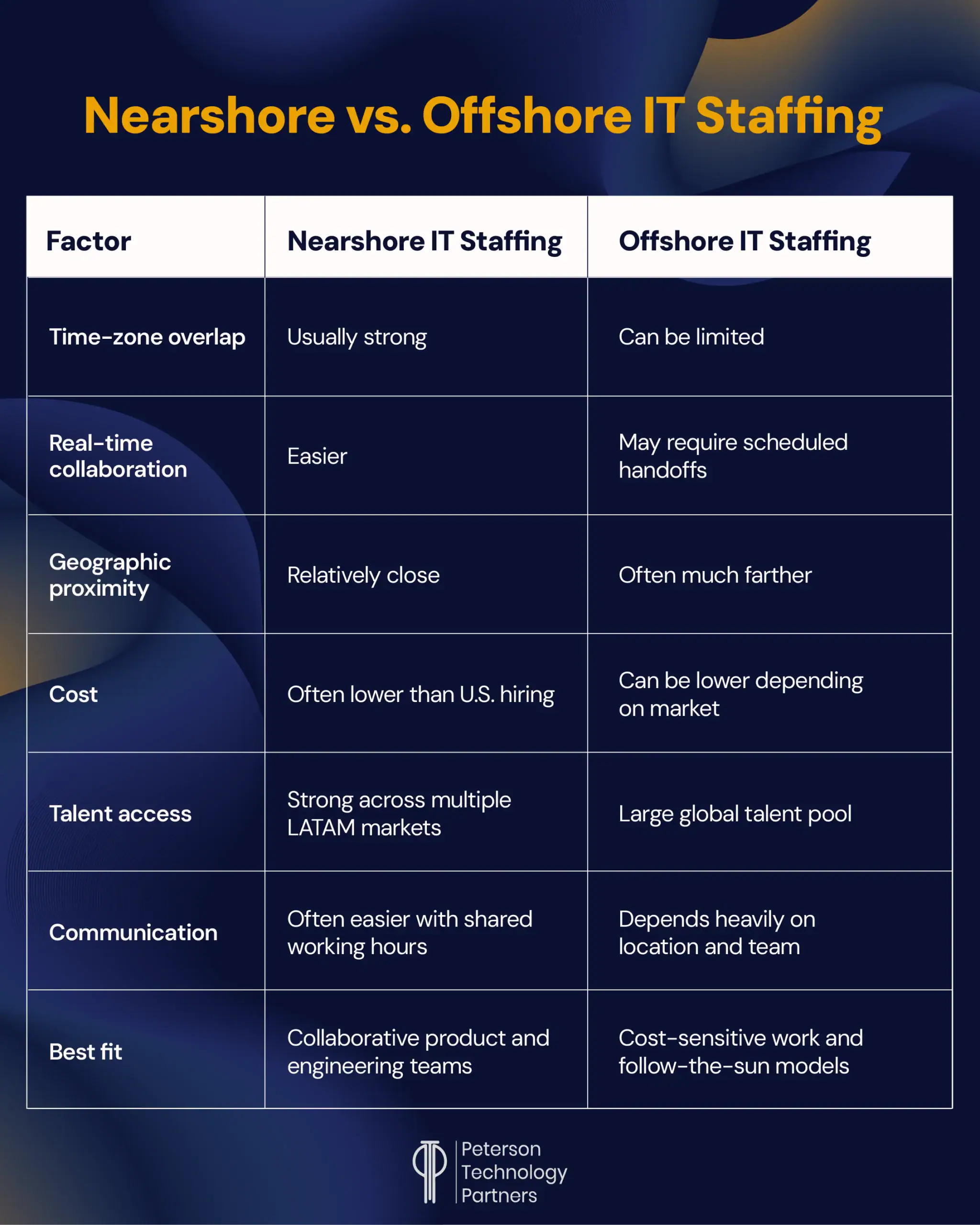
Neither model is automatically better.
A company that needs frequent collaboration with its U.S. engineering organization may benefit from nearshore staffing. A company that prioritizes around-the-clock development coverage may prefer a broader offshore model.
The right choice depends on the work, team structure, communication requirements, and business priorities.
Where Can You Find Nearshore IT Talent in Latin America?
Latin America is not a single technology labor market.
Each country has different talent pools, technology ecosystems, compensation levels, employment regulations, language capabilities, and business environments.
Four markets frequently considered by companies hiring nearshore technology professionals are Mexico, Colombia, Brazil, and Argentina.
Mexico
Mexico is attractive to U.S. companies because of its geographic proximity and strong economic relationship with the United States.
Major technology hubs include Mexico City, Guadalajara, Monterrey, and other growing technology markets.
Mexico can be particularly useful for organizations that prioritize close working-hour alignment and frequent collaboration with U.S. teams.
Companies should still evaluate technical specialization, compensation expectations, employment structures, and local compliance requirements before selecting Mexico for a specific role.
Colombia
Colombia has developed a strong technology ecosystem, particularly around Bogotá and Medellín.
The country offers technology professionals across software development, data, cloud, cybersecurity, and other technical disciplines.
For U.S. companies, Colombia can provide a useful combination of time-zone compatibility, growing technical talent, and access to established technology communities.
Brazil
Brazil has one of the largest technology talent markets in Latin America.
Its size creates access to a broad range of technical skills, including software engineering, data, cloud, cybersecurity, and enterprise technology.
The market also has its own employment, tax, and regulatory considerations, so companies should understand the local operating environment before building a team.
Argentina
Argentina has a mature technology ecosystem and a strong reputation for technical talent.
The country has produced a significant number of software engineers and technology professionals working with international organizations.
Argentina can be attractive for specialized engineering roles, although companies should carefully evaluate currency, compensation, employment regulations, and market conditions when planning a long-term staffing strategy.
Other Latin American Markets
Companies should not limit their search to the largest markets.
Chile, Peru, Uruguay, and other Latin American countries can also provide access to technology professionals depending on the role and hiring requirements.
The best country is the one that provides the right combination of talent availability, technical skills, communication, working-hour overlap, cost, and legal structure.
How Should You Choose the Best Country for Nearshore IT Talent?
Instead of asking, “Which Latin American country is best for IT staffing?” companies should ask, “Which market is best for the roles we need?”
Evaluate each market using the following criteria:
Talent Availability
Does the market have enough professionals with the required technical skills?
A country may have a large technology workforce but still have limited availability for a highly specialized technology stack.
Time-Zone Compatibility
How many working hours overlap with your U.S. team?
This becomes especially important for agile development, product management, support, and collaborative engineering work.
Communication
Evaluate both language proficiency and the ability to communicate technical concepts clearly.
English fluency can vary significantly between candidates, even within the same country.
Technical Ecosystem
Look at the maturity of local technology communities, universities, startups, technology companies, and professional networks.
Employment and Compliance Requirements
Understand how workers can legally be engaged in the selected country.
This may involve direct employment, an employer of record, independent contracting, or another structure.
Retention
Look beyond the initial hiring rate.
A market with strong talent retention may provide better long-term value than a market where employees frequently move between employers.
How Much Does Nearshore IT Staffing Cost?
There is no single price for nearshore IT staffing.
Rates vary based on:
- Country
- Role
- Technical specialization
- Seniority
- English proficiency
- Technology stack
- Contract duration
- Employment structure
- Benefits and statutory costs
- Staffing provider services
- Recruitment and screening requirements
- Security and compliance requirements
- Replacement guarantees
- Team size
Published market data can provide useful benchmarks, but third-party salary and hourly-rate estimates should be treated as directional rather than guaranteed pricing.
For example, developer compensation can vary substantially across Mexico, Colombia, Brazil, Argentina, and other Latin American markets. U.S. wage data from the Bureau of Labor Statistics can provide a domestic comparison point, but salary comparisons alone do not show the full cost of a technology staffing arrangement.
The more useful calculation is:
Total cost = staffing rate + employment costs + provider fees + benefits/statutory costs + management overhead + technology/security costs + potential replacement or turnover costs
That is why companies should compare the total cost of the engagement rather than choosing a provider based solely on the lowest hourly rate.
How to Hire Nearshore Developers in Latin America
A successful nearshore hiring process should look similar to a strong domestic hiring process, with additional attention to location, employment structure, and remote collaboration.
Step 1: Define the Technical Requirement
Start with the work that needs to be completed.
Define:
- Programming languages
- Frameworks
- Cloud platforms
- Databases
- Development methodologies
- Required certifications
- Years of experience
- Industry experience
- Seniority
- Communication requirements
Avoid vague requirements such as “senior developer.”
A stronger requirement might specify the technology stack, expected responsibilities, project environment, and level of ownership.
Step 2: Decide Whether You Need an Individual or a Team
Nearshore staffing can support different needs.
You may need:
- One specialized developer
- Several developers
- A complete engineering team
- QA resources
- A technical architect
- A dedicated product team
- Temporary project capacity
The answer affects which staffing model makes the most sense.
Step 3: Select the Engagement Model
Common models include staff augmentation, dedicated teams, project-based delivery, and direct hiring.
The best model depends on how much control you want over the team and who will manage the work.
Step 4: Screen Technical Skills
Resume screening is not enough for technical positions.
Companies should consider technical interviews, coding assessments, architecture discussions, portfolio reviews, project walkthroughs, and role-specific evaluations.
For senior positions, ask candidates to explain decisions they made on previous projects rather than relying only on theoretical questions.
Step 5: Evaluate Communication
Technical skills are only part of the equation.
Nearshore employees need to communicate effectively with product managers, engineering leaders, customers, and other team members.
Evaluate how candidates explain technical problems, document decisions, ask questions, and handle ambiguity.
Step 6: Start With a Defined Scope
If the company has never used nearshore IT staffing before, starting with a defined project or smaller team can reduce risk.
This gives management an opportunity to evaluate communication, productivity, technical quality, and collaboration before expanding the relationship.
Step 7: Onboard Nearshore Employees Like Internal Employees
A common mistake is treating an external nearshore team as completely separate from the organization.
Provide the same context, documentation, access to appropriate systems, development standards, communication channels, and project expectations used by internal teams.
What Is Nearshore Staff Augmentation?
Nearshore staff augmentation allows a company to add external technology professionals to an existing internal team.
The company generally retains control over the project, priorities, architecture, and day-to-day work while the staffing provider helps supply qualified technical professionals.
This model can work well when a business needs to:
- Increase engineering capacity
- Fill specialized technology roles
- Accelerate a product release
- Support a digital transformation initiative
- Add cloud or cybersecurity expertise
- Reduce hiring delays
- Cover temporary resource gaps
- Scale a technology team quickly
For example, a U.S. software company may have a strong internal product team but need six additional software engineers for a major product release.
Instead of creating six permanent positions, the company could use nearshore staff augmentation to add the required engineering capacity for the project.
Nearshore Staff Augmentation vs. Dedicated Teams
Staff augmentation generally means adding individual professionals to an existing team.
Dedicated teams typically involve a larger group of professionals working together as a coordinated unit.
Staff augmentation can be a better fit when you already have strong internal leadership and simply need additional capacity.
A dedicated team can make more sense when you need a larger group to handle a product, application, or defined technology function.
What Legal and Compliance Issues Should Companies Consider?
International hiring creates legal and compliance considerations that should be addressed before candidates begin work.
Companies may need to determine whether workers should be engaged as:
- Employees
- Independent contractors
- Employees through an employer of record
- Employees through a local legal entity
- Workers under another locally compliant structure
The appropriate structure depends on the country, nature of the relationship, level of control, duration, and local employment requirements.
U.S. companies should also understand the distinction between employees and independent contractors. Worker classification rules can create tax, wage, benefits, and compliance consequences.
Country-specific requirements can also matter.
For example, Mexico has regulations related to subcontracting and specialized services, including REPSE registration requirements in certain circumstances.
Brazil has extensive labor protections and employment requirements.
Colombia has social security requirements that can apply to independent workers.
Argentina has undergone employment-related legal changes that companies should review when establishing new workforce arrangements.
These issues can change over time, so companies should work with qualified legal counsel, an employer of record, or another appropriate compliance specialist before establishing an international workforce structure.
This article is intended for general informational purposes and should not be treated as legal or tax advice.
How Should Companies Protect Intellectual Property and Data?
Technology staffing also creates security considerations.
Before providing external professionals with access to systems or sensitive information, establish clear policies for:
- Intellectual property ownership
- Confidentiality
- Source-code access
- Cloud permissions
- Data handling
- Device security
- Authentication
- Access management
- Background checks
- Security training
- Offboarding
Access should follow the principle of least privilege.
Employees and contractors should receive only the access required to perform their responsibilities.
When someone leaves the project, access should be removed promptly and company devices, credentials, documentation, and other assets should be recovered or disabled.
How to Evaluate Nearshore IT Staffing Companies
Choosing a provider requires more than comparing hourly rates.
Ask each nearshore IT staffing company:
How Do You Screen Technical Candidates?
Find out whether candidates go through technical interviews, coding assessments, role-specific screening, reference checks, and communication evaluations.
Which Countries Do You Recruit From?
A provider should be transparent about where its talent comes from.
Ask whether candidates are employees, contractors, or are employed through another structure.
How Quickly Can You Provide Qualified Candidates?
Speed matters, but qualified candidates matter more.
Ask how long it typically takes to present candidates for common roles and specialized positions.
What Happens if a Candidate Leaves?
Understand the provider’s replacement policy before signing an agreement.
What Is Included in the Rate?
Ask whether the quoted rate includes recruiting, employment costs, benefits, management, equipment, compliance support, or other services.
How Is Security Managed?
Ask about background checks, access controls, data security, device policies, and offboarding procedures.
Who Manages the Relationship?
Understand whether you will have a dedicated account manager or delivery contact.
Can the Team Scale?
Technology projects can change fast.
A good provider should be able to help you add or reduce resources as project requirements change.
How Peterson Technology Partners Fits into Nearshore IT Staffing
Peterson Technology Partners provides technology staffing and recruiting services for organizations that need access to specialized technology talent.
Its nearshore staffing capabilities can support companies looking for individual technology professionals as well as larger team structures.
Depending on the requirement, organizations can use nearshore talent across areas such as software engineering, AI and machine learning, cloud, cybersecurity, data, Salesforce, and other enterprise technologies.
A potential client evaluating a nearshore staffing provider should still ask detailed questions about the countries available, candidate screening process, expected hiring timeline, pricing structure, employment model, replacement terms, security requirements, and scalability.
The goal should be to select the provider that best fits the company’s technical and operational requirements rather than simply choosing the lowest-cost option.
How AI Is Changing Nearshore IT Recruiting
AI is increasingly being used to improve the recruiting process.
Recruitment automation can help organizations with:
- Candidate sourcing
- Resume matching
- Candidate screening
- Outreach
- Follow-up
- Interview scheduling
- Candidate communication
- Recruiting workflows
AI can reduce repetitive recruiting work and help recruiters identify relevant candidates faster.
However, technology should support human decision-making rather than replace technical evaluation.
This is especially important for technology hiring because candidates can increasingly use AI tools during assessments and interviews.
Companies should consider combining automated screening with live technical discussions, architecture walkthroughs, troubleshooting scenarios, project-based questions, communication assessments, and reference checks.
For employers using nearshore IT staffing, this combination can help improve both hiring speed and candidate quality.
Common Nearshore Hiring Mistakes to Avoid
Choosing the Cheapest Market
The lowest rate does not always produce the lowest total cost.
Technical quality, retention, communication, and management requirements can have a much larger impact on project economics.
Treating Latin America as One Market
Mexico, Colombia, Brazil, Argentina, and other countries have different labor markets, regulations, technology ecosystems, and compensation expectations.
Evaluate each market based on the role you need to fill.
Relying Only on English Tests
English proficiency matters, but a language test alone does not demonstrate whether someone can communicate effectively in a technical environment.
Skipping Technical Assessments
A strong resume does not guarantee strong technical performance.
Use role-specific technical evaluations.
Separating the Nearshore Team from the Internal Team
A nearshore team should understand the product, architecture, business goals, coding standards, and communication practices.
Treating the team as disconnected external labor can create unnecessary friction.
Assuming Nearshore Means No Management
Distributed teams still require leadership.
Project managers, engineering leaders, product owners, and technical architects need clear processes for communication and accountability.
Ignoring Employment Structure
Do not assume that a worker can be classified as an independent contractor just because they are in another country.
Review the structure before work begins.
Waiting until Later to Address Security
Security should be part of the staffing and onboarding process from the beginning.
Nearshore IT Staffing Checklist
Before hiring nearshore IT talent, confirm that you have:
- Defined the roles and technical requirements
- Identified the required seniority
- Determined the required working-hour overlap
- Selected potential countries
- Evaluated communication requirements
- Chosen the appropriate engagement model
- Compared total costs rather than hourly rates
- Reviewed employment and compliance requirements
- Defined intellectual property protections
- Established security and access controls
- Created a technical screening process
- Defined onboarding requirements
- Established performance expectations
- Reviewed replacement terms
- Determined how the team can scale
Conclusion
Nearshore IT staffing is not simply a way to find lower-cost developers.
For U.S. companies, it can provide access to a broader technology talent pool while maintaining closer working-hour alignment and collaboration than many traditional offshore arrangements.
The strongest nearshore hiring strategies start with the work that needs to be done.
Define the technical requirements. Identify the right markets. Compare engagement models. Evaluate candidates based on technical ability and communication. Review employment and compliance requirements. Protect intellectual property and data. Then compare staffing providers based on candidate quality, screening, responsiveness, security, replacement policies, and scalability.
Latin America can provide a practical middle ground between domestic hiring and distant offshore delivery, but the right outcome depends on choosing the right talent, operating model, and staffing partner.
The goal is not simply to hire nearshore.
The goal is to build a technology workforce that delivers the right technical capability, collaboration, flexibility, and long-term value.