Let’s face it: Hiring tech talent isn’t easy. And despite AI, it’s not getting any easier.
This is why so many businesses continue to rely on IT staffing agencies. They help their clients fill key skills gaps, manage project demands, and access specialized professionals that can be extremely challenging to find independently.
But not all firms charge the same rates. In fact, staffing agencies charge wildly different rates and use different mechanisms and pricing structures to get there.
Even within a firm, contract staffing, contract-to-hire, and direct-hire recruiting approaches all use different pricing structures, with the final cost likely to depend on various factors beyond an advertised fee or markup.
For employers preparing their 2027 hiring budgets, it’s important to note that IT staffing agency fees can depend on a worker’s pay rate, the agency’s markup, employment-related expenses, and the hiring arrangement.
This guide explains how IT staffing agency costs get calculated, what employers should expect when hiring software developers and cybersecurity professionals, how contract-to-hire fees work, and how to compare proposals before committing to a staffing partner.
Key Takeaways
- Contract staffing: The employer usually pays an hourly bill rate that includes a worker’s pay and the staffing provider’s markup.
- Markup rates: Published guidance cites 25%–40% as a contract staffing planning range, although actual rates vary.
- Direct hire: Recruitment fees commonly fall around 18%–25% of first-year compensation, depending on the agreement.
- Contract-to-hire: Hourly charges may be followed by a conversion fee if the employer hires the contractor permanently.
- Total cost matters: The lowest markup does not necessarily produce the lowest overall hiring cost.
- 2027 budgeting: Use published benchmarks as starting points and obtain quotes based on the role, location, experience level, and contract terms.
How Much Does an IT Staffing Agency Charge Employers Per Hour in 2027?
There is no universal hourly charge for IT staffing. Agencies set their rates according to the position, the contractor’s compensation, employment costs, assignment length, and the services included in the agreement.
For initial budgeting, published staffing guides commonly cite a contract staffing markup of approximately 25%–40%. Some assignments fall outside this range, particularly if specialized skills, unusual employment requirements, or additional services are involved.
(Upwork’s staffing agency fee guide provides an overview of these common pricing structures.)
The most important thing to pay attention to is the difference between the contractor’s pay rate and the client’s bill rate.
The pay rate is what the contractor earns per hour before applicable deductions.
The bill rate is what the client pays the staffing provider for each billable hour.
The difference helps cover the provider’s employment-related costs, recruiting, administration, and operating expenses, with any remaining amount contributing to gross profit.
For example, if a software developer earns $60 per hour and the agency applies a 35% markup, the client’s bill rate is $81 per hour.
At 40 billable hours per week, that equals $3,240. If the contractor works 2,080 billable hours over a full year, the annualized staffing expense is $168,480.
(Note that these calculations illustrate the pricing mechanics rather than establish a market average. Actual annual spending depends on billable hours, holidays, overtime, assignment duration, and the contract’s terms.)
For employers, the practical question is not simply how much an agency charges per hour. It is what that rate includes and whether it represents a competitive price for the required skills.
How Do IT Staffing Agencies Calculate Bill Rates for Contract Software Developers?
IT staffing agencies generally calculate a contractor’s bill rate by applying a markup to the worker’s pay rate.
Some providers use a different pricing structure that incorporates specific employment costs, so employers should confirm the calculation method in the proposal.
A standard markup formula is:
Markup percentage = (Bill rate − Pay rate) ÷ Pay rate × 100
To calculate the bill rate:
Bill rate = Pay rate × (1 + Markup percentage)
Suppose an organization needs a contract software developer who will earn $60 per hour. With a 35% markup, the agency adds $21 to the pay rate, resulting in an $81 hourly bill rate.
The $21 difference is not automatically the agency’s profit. Depending on the agreement and the provider’s cost structure, it may cover payroll taxes, workers’ compensation, insurance, recruiting, administrative support, and other expenses.
What Influences a Software Developer’s Bill Rate?
Several factors can change the final IT staffing bill rate.
Technical specialization: Developers with experience in highly complex enterprise integrations, cloud architecture, legacy platforms, or specialized technology stacks will likely have different compensation requirements from developers working with more common technologies.
Experience level: A senior engineer responsible for architecture decisions or technical leadership will have a different compensation profile from a junior developer.
Geographic market: Local compensation levels, remote-work arrangements, and onshore, nearshore, or offshore delivery models all affect the underlying cost.
Assignment requirements: Urgent start dates, short contract durations, overtime expectations, and scarce skill sets also affect the proposed rate.
Employment and support costs: Expect payroll taxes, insurance, workers’ compensation, compliance requirements, technical assessments, and account management to influence a provider’s pricing.
Employers should compare any proposed rate with wage data for the same occupation and location.
The U.S. Bureau of Labor Statistics (BLS) reported a median annual wage of $135,980 for software developers in May 2025. This is an employee wage benchmark, not a staffing bill rate or a direct measure of contractor compensation. (See the BLS Occupational Outlook Handbook for more.)
A useful staffing proposal should explain the rate, the services included, and any additional charges rather than simply state a markup percentage.
What Is a Typical IT Staffing Agency Markup Percentage?
The IT staffing markup percentage measures how much the bill rate exceeds the contractor’s pay rate, expressed as a percentage of that pay rate.
Published staffing guidance commonly cites 25%–40% as a planning reference for contract staffing.
But expect the actual markup to be lower or higher depending on the assignment, the provider’s costs, the required skills, and the negotiated commercial terms.
It is also important to distinguish markup from gross margin.
Consider a contractor who earns $60 per hour and is billed to the client at $81 per hour. The $21 difference represents a 35% markup on the pay rate.
That difference is approximately 25.9% of the bill rate. The latter is the gross spread as a percentage of revenue before deducting any additional direct costs not already included in the calculation.
This is critical to consider when comparing staffing agency proposals. Two providers may describe their pricing differently, even when their underlying rates are economically similar.
Before accepting a proposed markup, ask the agency:
- Which costs are included in the markup?
- Is the percentage calculated against the contractor’s pay rate?
- Are insurance, payroll, screening, and onboarding included?
- How are overtime and holiday hours billed?
- Are there minimum hours or additional administrative fees?
- Can the bill rate change during the assignment?
The answers to these questions will give you a more reliable picture of total staffing costs.
How Much Do IT Staffing Agencies Charge to Hire Contract Cybersecurity Professionals?
Cybersecurity staffing costs depend heavily on the specific role, experience level, any required certifications, and an organization’s security requirements.
Hence, security analysts, penetration testers, incident-response specialists, cloud security engineers, and security architects do not automatically get budgeted at the same rate.
The BLS reported a median annual wage of $129,180 for information security analysts in May 2025. That equates to approximately $62.11 per hour when annualized over 2,080 hours.
(Again, note that this figure is an employee wage benchmark, not a contractor pay rate or agency bill rate, and employers should review the full data via the BLS information security analyst profile.)
To understand how a staffing markup affects costs, consider a hypothetical cybersecurity contractor earning $65 per hour.
Applying a 35% markup produces a bill rate of $87.75 per hour, calculated as $65 × 1.35. At 2,080 billable hours, that represents $182,520 in annualized staffing charges.
How to Compare Cybersecurity Staffing Quotes
When requesting proposals, always specify an exact security role and responsibilities, required certifications, experience level, work location, expected contract length, and any clearance or compliance requirements.
Also clarify if the assignment requires after-hours coverage, on-call availability, or specialized expertise in areas such as penetration testing, incident response, cloud security, or regulatory compliance.
For security-sensitive projects, the lowest hourly rate is not necessarily the best choice.
Employers also have to evaluate whether the candidate meets the technical and compliance requirements and whether the provider can deliver the necessary expertise within the required timeframe.
What Fees Do IT Staffing Agencies Charge for Contract-to-Hire IT Placements?
Contract-to-hire allows an employer to engage a professional on a contract basis before deciding whether to employ that person permanently.
The arrangement generally begins with hourly staffing charges. If the employer later hires the contractor directly, a conversion fee can apply, depending on the agreement.
Some contracts use a conversion fee that decreases as the contractor completes more billable hours.
Others specify a particular conversion period or allow the employer to hire the worker without an additional fee only after a defined threshold.
Bottom line: Employers should never assume a fee automatically expires unless the contract explicitly states that it does.
How to Estimate Contract-to-Hire Costs
Suppose a company engages a contractor at a bill rate of $80 per hour for six months. Assuming 40 billable hours per week over 26 weeks, the estimated staffing expense is $83,200.
That figure represents the cost of 1,040 billable hours. But it excludes any separate conversion fee, overtime, or other charges not included in the bill rate.
Before signing a contract-to-hire agreement, confirm how the conversion fee gets calculated, whether it decreases over time, how many hours must be completed before a fee reduction applies, and whether any restrictions apply if the worker opts to leave and later returns.
These terms should all be agreed upon in writing before the assignment begins.
How Are IT Staffing Agency Fees Calculated for Direct-Hire Software Engineering Positions?
Direct-hire recruiting uses a different pricing structure from contract staffing.
Rather than paying an hourly bill rate, the employer pays a one-time recruitment fee when the candidate is hired.
The fee is commonly calculated as a percentage of the candidate’s agreed first-year compensation. (Published staffing guides often cite a range of approximately 18%–25%, although actual fees depend on the provider, the position, and the agreement.)
For example, if a software engineer receives an annual base salary of $130,000 and the agency charges a 20% placement fee, the employer pays a one-time recruiting fee of $26,000.
The compensation base must be confirmed in the contract. Some agreements calculate the fee using base salary, but others can include additional components.
What Affects Direct-Hire IT Recruiter Fees for Employers?
Direct-hire fees also can depend on the position’s seniority, the difficulty of finding qualified candidates, the recruiting services included, whether the search is exclusive, and whether the engagement is contingency-based or retained.
A contingency search generally ties a fee to successful placement.
A retained search requires an upfront payment or payments at agreed milestones. As with all terms, the payment schedule, replacement guarantee, and refund terms should be clearly established before a search begins.
Employers should also compare the complete agreement rather than focusing only on the fee percentage. A proposal that includes technical screening, reference checks, and a clearly defined replacement guarantee may have more value to an organization than one with a lower fee but fewer services.
Comparing IT Staffing Pricing Models: What Should Employers Budget For?
The three most common arrangements all serve different hiring needs.
Contract staffing uses recurring hourly charges; contract-to-hire combines hourly billing with possible conversion costs; and direct hire generally involves a one-time recruitment fee.
The following table brings all of this together for easier comparison:
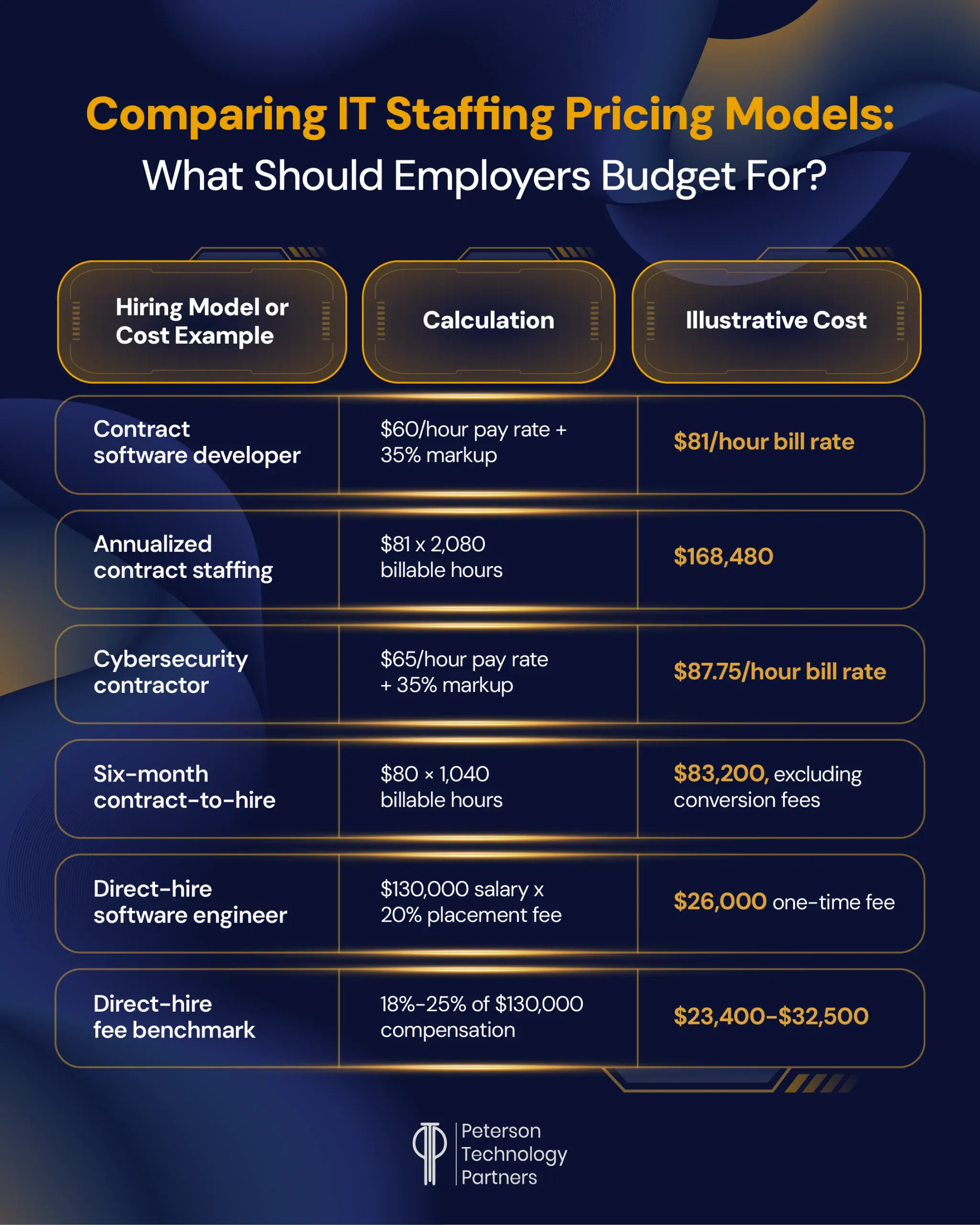
(Note that all figures provided here are just examples for budgeting and not guaranteed market prices or PTP quotes.)
These examples show why hiring models are best compared over the time period the labor is desired.
Which Pricing Model Is Best for Your Business?
Contract staffing is usually best for project work, temporary capacity, or defined technical skill gaps. It gives employers flexibility but gets expensive when a position remains active for a long time.
Contract-to-hire can be the best choice when a company wants to evaluate a professional’s performance before making any permanent employment decisions. The employer should understand both the hourly rate and the conversion terms.
Direct hiring generally is best for long-term roles that will become part of the organization’s permanent workforce. The employer pays a recruitment fee and assumes responsibility for the ongoing compensation and employment costs.
Staff augmentation and global delivery can also be the best choice when an organization needs multiple specialists or broader engineering capacity. These arrangements may use hourly, monthly, team-based, or project-based pricing. Employers should compare scope, team composition, delivery expectations, and included services rather than focusing on a single markup.
Peterson Technology Partners (PTP) supports organizations through contract staffing, contract-to-hire, direct-hire recruiting, staff augmentation, nearshore and offshore recruiting, and global delivery.
With nearly three decades of experience addressing enterprise technology needs, PTP helps businesses evaluate talent and delivery models based on their requirements.
Explore PTP’s services to learn more about the available engagement options.
How to Reduce IT Staffing Costs without Sacrificing Talent Quality
Everyone wants to remove unnecessary expenses while also maintaining quality and the availability of the talent the organization needs.
Here are a few ways businesses can achieve that objective.
Define the Role Precisely
Identify essential technical skills, experience requirements, responsibilities, and expected outcomes. Avoid making optional qualifications mandatory unless they are genuinely needed. A clear job description helps agencies target suitable candidates more efficiently.
Compare Fully Loaded Costs
Ask each agency to explain its bill rate, included services, overtime rules, and additional charges. For direct-hire positions, compare the placement fee, compensation base, replacement guarantee, and payment terms.
As discussed, lower advertised fees don’t automatically mean a lower total cost if additional charges apply.
Plan for Contract Duration
Always estimate how long the organization will need the professional. For an extended assignment, it’s useful to compare the total cost of contract staffing with direct hire or other delivery arrangements.
Consolidate Similar Hiring Requirements
When several professionals are wanted with similar skills, ask whether the provider can provide coordinated delivery, consistent pricing, or volume-based commercial terms.
Evaluate any discount alongside the provider’s ability to deliver qualified candidates.
Review Conversion Terms before Starting
For contract-to-hire placements, negotiate conversion conditions before the assignment begins. This helps prevent unexpected fees if the organization decides to retain the contractor permanently.
Measure Outcomes, Not Just Rates
Track time to fill, candidate quality, interview-to-offer ratios, retention, hiring-manager satisfaction, and total cost per successful placement. These measures help determine whether the staffing relationship delivers value beyond a low hourly rate.
Questions to Ask an IT Staffing Agency before Agreeing to Its Fees
Before signing any agreement, employers should ask the following questions to avoid unpleasant surprises.
- What is the proposed hourly bill rate, and what services are included?
- What pay-rate and markup assumptions support the quoted rate?
- Are payroll taxes, workers’ compensation, insurance, and screening costs included?
- How are overtime, holidays, and after-hours work billed?
- Can the bill rate change during the assignment?
- Are there minimum hours, cancellation fees, or administrative charges?
- What conversion fee applies if we hire a contractor permanently?
- For direct-hire recruiting, what compensation is used to calculate the fee?
- What replacement guarantee or refund terms apply if a placement does not work out?
- How does the proposed rate align with the required skills, location, and engagement model?
Getting written answers also makes it easier to compare proposals, establish a predictable staffing budget, and avoid misunderstandings later.
Frequently Asked Questions About IT Staffing Agency Fees
How much does an IT staffing agency charge employers per hour in 2027?
There is no standardized hourly charge. Published staffing guidance commonly cites contract markups around 25%–40%, although specialized roles and other assignments can fall outside this range. The final bill rate depends on the contractor’s pay rate, the provider’s markup, employment costs, and included services. Employers should obtain current quotes for their specific roles and locations.
What is a typical IT staffing agency markup rate?
A 25%–40% markup is a useful initial planning reference from published staffing guidance, not a universal rate. Markup is calculated against the worker’s pay rate and should not be confused with gross margin or net profit.
How do IT staffing agencies calculate bill rates for contract software developers?
Agencies commonly multiply the contractor’s pay rate by one plus the markup percentage. For example, a $60 hourly pay rate with a 35% markup produces an $81 bill rate. The markup helps cover applicable employment expenses, recruiting, administration, and the provider’s margin.
How much do IT staffing agencies charge for contract cybersecurity professionals?
The rate depends on the specific security role, experience, certifications, location, and contract requirements. Employers should use current wage data as a reference point and request quotes that explain the pay-rate assumptions, bill rate, and included services.
What fees apply to contract-to-hire IT placements?
Contract-to-hire generally starts with hourly staffing charges. A separate conversion fee may apply if the employer hires the contractor permanently, depending on the written agreement. Confirm how the fee is calculated and whether it decreases or expires after a specified number of billable hours.
How are direct-hire IT staffing agency fees calculated?
Direct-hire fees are commonly calculated as a percentage of the candidate’s agreed first-year compensation. For example, a 20% fee on a $130,000 salary equals $26,000. The compensation base, payment schedule, and replacement terms should be confirmed in the agreement.
Is a lower IT staffing markup always better?
No. A lower markup may be attractive, but employers should also evaluate candidate quality, compliance, employment coverage, recruiting support, replacement terms, and total engagement cost. Comparing complete proposals is more useful than comparing markup percentages alone.
Conclusion: Make IT Staffing Costs Easier to Predict
Understanding IT staffing agency fees starts with finding the right hiring model and building a transparent cost calculation.
Contract staffing uses an hourly bill rate, contract-to-hire often adds a later conversion fee, and direct-hire recruiting typically has a one-time placement fee.
For 2027 budget planning, treat any published markup and placement-fee ranges as just starting points. Always validate them against current labor-market data, required technical skills, the location, and any specific services included in each proposal.
Peterson Technology Partners helps organizations evaluate IT staffing and recruiting options, from individual technical placements to broader staff augmentation and global delivery requirements.
By matching the engagement model to the work and agreeing on transparent commercial terms, employers will make better-informed decisions about talent costs and delivery needs.
Planning an IT hire? Explore Peterson Technology Partners’ IT staffing and recruiting services to discuss the talent and engagement model that fits your requirements.