

The German Zeiss Group makes some of the world’s top precision optics and optoelectronics.
Its Semiconductor Manufacturing Technology (SMT) is the basis for smaller, more powerful microchips, tying the company to the foundation of next-generation AI.
Its global business does, more broadly, around €12 billion in revenue across business units.
But despite mastering world-class technological sophistication, Zeiss, like many other companies worldwide, has gotten mired in its ERP modernization.
Originally the company had planned a fresh start with its SAP S/4HANA migration (aka taking a ‘greenfield’ approach).
This meant stripping away decades of workarounds and custom solutions from a system they first started using in 1992. As CIO Carsten Trapp told CIO in 2024, “It’s a lifetime opportunity to clean up, because we, too, have messed up our R/3 system over the last 30 years.”
Their IT team first started the work in 2017, and it became clear to the board in 2020 that the work would be enormous and extremely significant, as they shifted to an all-new, far more standardized approach.
But just last month, the company announced it’s had to hit the reboot on its ERP modernization.
After investing some €200 million (around $223 million, per Bloomberg) and running well behind schedule, the precision optics maker has decided on “realigning” its SAP modernization strategy.
Zeiss is switching now to a ‘brownfield’ SAP migration approach or migrating its existing ERP system to S/4HANA first, to serve as the core for the entire group.
From there, segments will then build out their own unique applications on top.
This is just the latest example of the enormous challenges global enterprises can face when making a real-world conversion match to their ERP migration strategy.
Rarest of all is staying both on budget and on schedule.
Today in the PTP Report we’re looking at greenfield vs brownfield vs selective SAP migrations. As AI capabilities improve and AI budgets rise, what happens to these expensive, complex conversions with deadlines looming?
95% of legacy SAP users have said building a positive case for SAP migration takes a big effort or is genuinely challenging, and 83% admitted they don’t fully understand SAP’s migration policies and deadlines (per Freeform Dynamics).
Is it any wonder why so many companies are still stuck in this arduous transition process?
ERP Modernization Countdown: Several SAP Deadlines Are Coming Fast
The SAP conversion clock has been ticking since 2020.
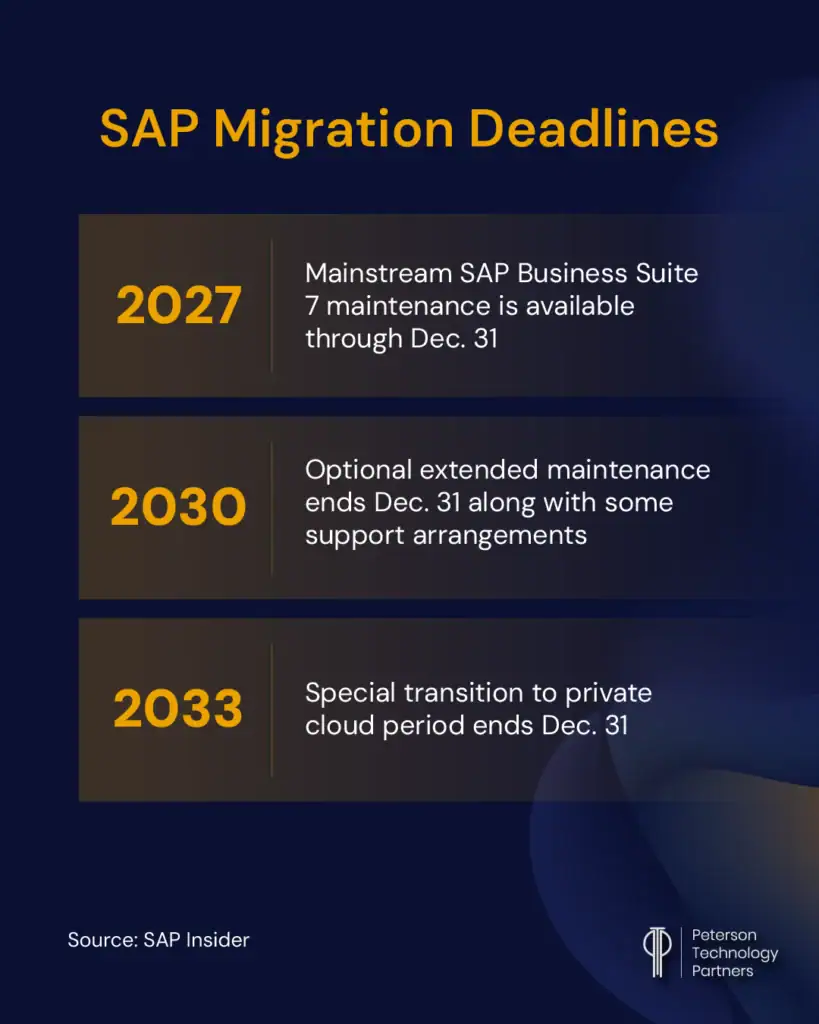
That’s when the world’s largest enterprise software vendor announced that its mainstream Business Suite 7 support would end in 2027 (with optional extended maintenance until 2030).
A third option, for the most complex customers (with transition already underway and several other qualifications required), can extend this support period to 2033, but it requires a move to SAP ERP private edition on SAP HANA by 2030.
SAP CTO Philipp Herzig clarified several aspects of these deadlines in an October blog post.
He noted that at the close of the 2030 extended maintenance period, many additional support agreements will also expire, including coverage of third-party databases and Java.
This means that end-to-end SAP support in these areas will also end at the conclusion of 2030.
For companies under pressure to move off ECC, this means there are a few options:
- Migrate to S/4HANA by the end of 2027.
- Buy the Business Suite 7 (including ECC) extended maintenance for three additional years of support. (As mentioned above, some very large/complex customers already underway with transitions can also extend until 2033 for the transition with ERP, private edition, though this has other specific eligibility rules.)
- Move to third-party support. Some vendors are offering to provide legacy SAP ERP support beyond 2030, which can buy companies more time for the transition. These providers can also offer significant cost savings, though they have no connection to the original manufacturers and can’t provide access to intellectual property, security advisories, or software updates.
A 2026 SAPinsider survey found that migrations to S/4HANA are accelerating in 2026, driven by these deadlines and a desire to maintain support, along with more interest in tapping into AI options through the conversion.
36% of survey respondents had either just started implementation, were in the evaluation phase, or were still building their business case.
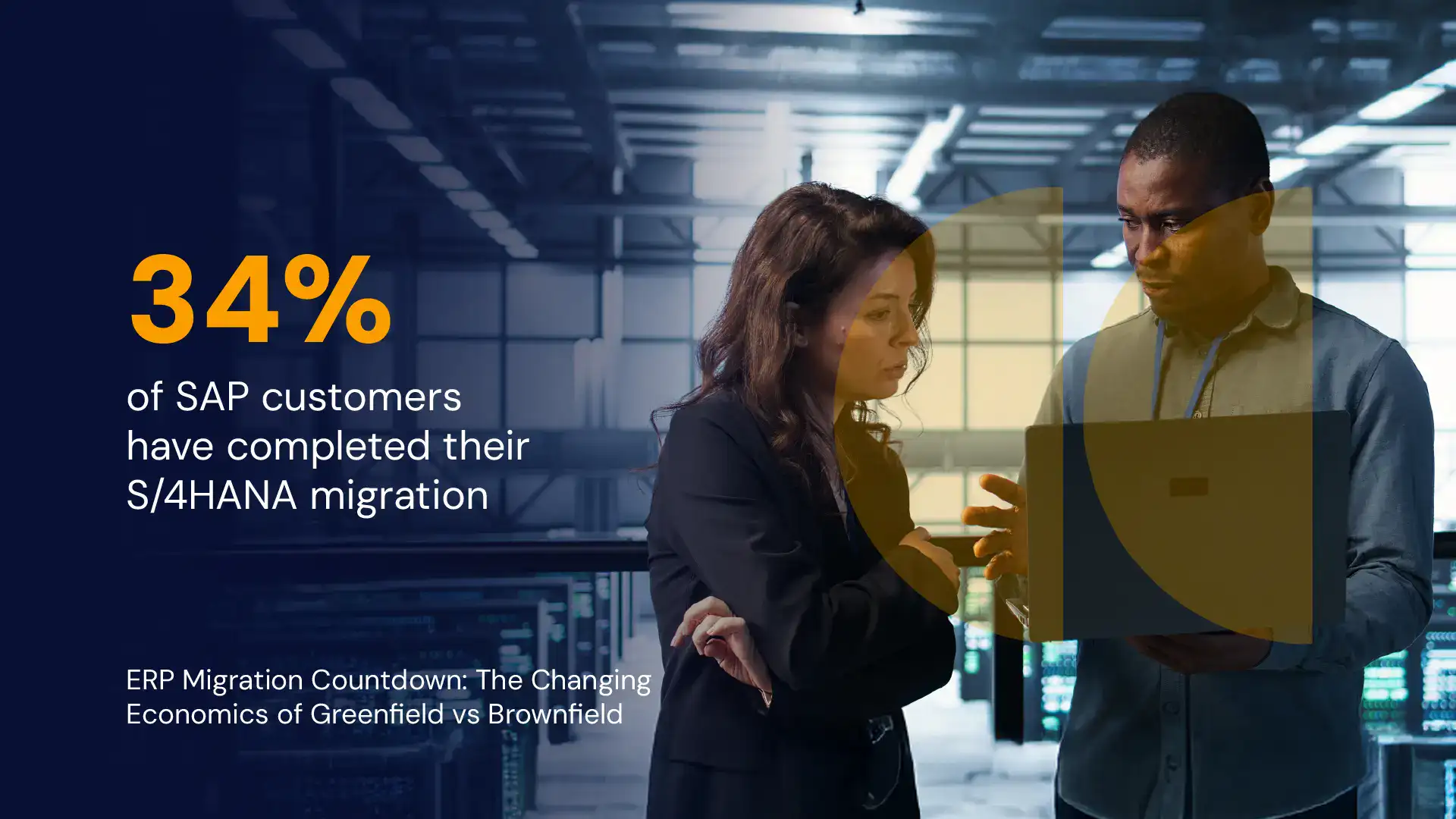
As our banner above indicates, just over a third (34%) indicated they’d completed their transition, though many more have deployed S/4HANA, running multiple systems currently as they begin the cutover. (5% planned not to migrate, and 4% were on hold.)
SAP Greenfield Implementation in Action
And as the Zeiss case shows, migrating ERP systems can be a significant challenge even for a technological powerhouse.
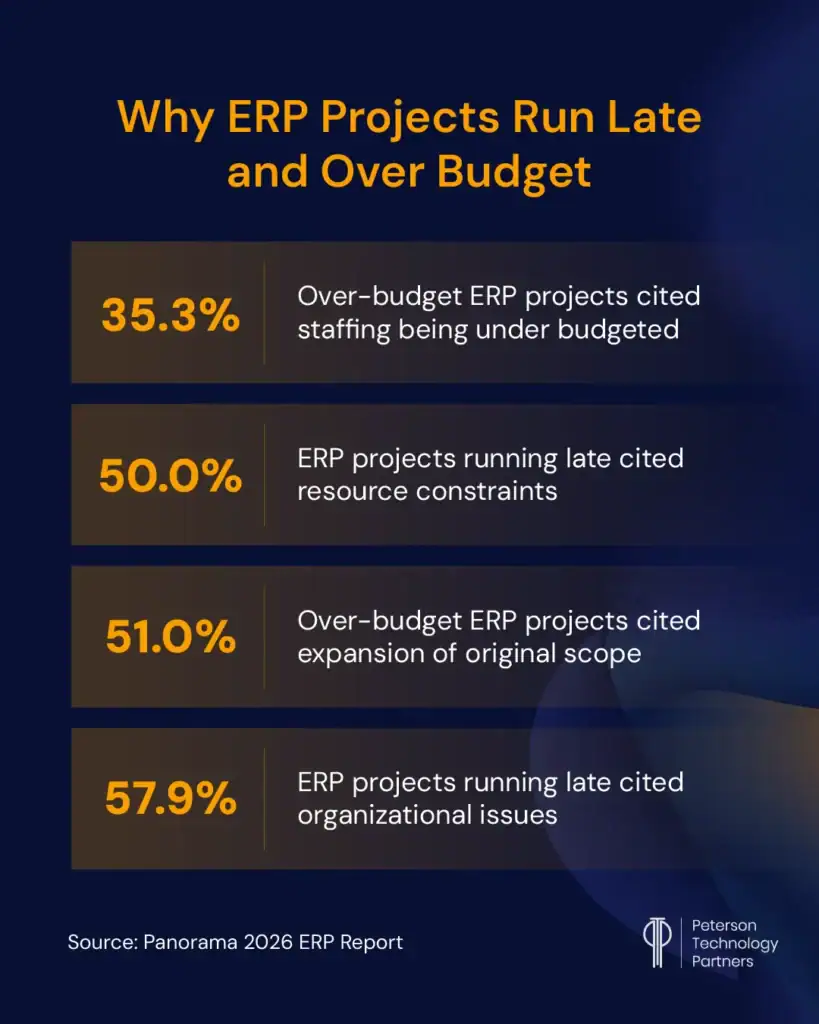
Invariably it means high complexity, a wide array of options to be considered, and a common tendency to run off the rails through scope creep or labor shortfalls.
Typically, three options are considered as overall migration plans: greenfield vs brownfield implementation (or a from-scratch implementation vs converting a current system over), and what some call bluefield/blue field (or a selective transition of data).
Twinings Ovaltine provides a textbook example of the first option: the all-new greenfield approach.
Starting with an accumulated mix of 10 different ERP systems they were running at once, the British beverages firm knew it needed to improve its security while also standardizing data.
It was also high among their goals to streamline operations and their supply-chain processes and improve end-to-end innovation.
The company opted for a highly standardized implementation of SAP RISE, with Global Chief Transformation and Technology Officer Sandeep Seeripat noting, “The fact I’m most proud of is that there are two customizations across my entire environment.”
The company credits their greenfield migration with a 20% increase in productivity, a 10% reduction in costs through efficiency, and a 10% reduction in costs through streamlined procurement.
Their unified approach also includes governance. Seeripat added that SAP program leaders needed to have a clear understanding of who has veto rights over changes, and who has the final say.
The goal for Twinings Ovaltine was to significantly change the way it was operating, and with this conversion they believe they’ve done it.
SAP Brownfield Migration Aims to Preserve What Works
The goal for Nestlé was very different.
As the world’s largest publicly held food company (since 2014), Nestlé’s goal was to make the necessary transition with improvements but also with minimal disruption.
The first of its brownfield migrations covered more than 50,000 users across 112 countries, included a 24TB database, around 3,500 interfaces, and customizations the company had built over the course of two decades.
Nestlé reported that it made the conversion to S/4HANA with just 19.5 hours of downtime, after spending months working to reduce the expected outage window. Initial estimates had put the necessary downtime at 48 hours, but the company deemed this unacceptable.
According to SAP, their new, more simplified infrastructure boasts 99.7% availability, with more than 1,200 TB of data now moved to the cloud.
Global Head of IT Platforms for Nestlé SA Ralf Huebenthal specified how the transition has also helped the company’s resilience: “In the past, failing systems took approximately six hours to recover… Today, our platforms are up and running again in less than ten minutes—and many end users don’t even know that there was an outage.”
Nestlé had previously standardized its business processes globally. A greenfield approach which rebuilt their ERP from scratch would have meant teaching employees to relearn things that were already working well.
The brownfield variation enabled them to continue with their current operating model while making valuable improvements to the underlying technology. This included S/4HANA’s increased speed but also upgrades in finance and supply-chain management, and better analytics.
Huebenthal noted their approach has meant far less disruption than greenfield and a more seamless transition for most users.
“With the brownfield upgrade the biggest amount of training was ‘The screen is not blue anymore, it’s now brown’.”
The company is also working through several AI proofs-of-concept, to expand current use, which boasts 100,000 users working through Copilot or a solution called NestGPT.
Joule, SAP’s AI copilot, will work from the same interface people are already using.
The Bluefield or Selective SAP Migration Strategy
For many businesses, reality dictates that neither a straightforward greenfield nor brownfield approach may make the most sense.
Canadian energy company TransAlta fell into this camp.
It chose a selective modernization approach. Working off 30 years of heavy ECC use with extensive customization, systems had simply become too fragile and too slow.
With the end of life coming for the ERP, it weighed all options but concluded that greenfield was just too ambitious.
Instead, TransAlta opted for a blended approach. They reduced their customization by more than 55% while retaining what they deemed were critical investments made to their solution over the years.
TransAlta credits the new solution with asset management modernization that equips more than 400 technicians with modern mobile solutions (saving an average of two hours a day), an 80% reduction in the time spent on treasury transactions, 100% accuracy that enables automated SOX controls, and a 19% reduction in the number of needed integrations.
Greenfield vs Brownfield vs Blue: What Is the Best SAP Modernization Strategy for Enterprises?
We’ve profiled a few examples here: from a more aggressive transition that changes how a firm operates and modernizes the tech in one swoop to an emphasis on resilience with minimized disruption.
Many opt for phased or mixed approaches of the two.
But Zeiss is just one example of the common cautionary tale, where a planned transition simply wasn’t working after a significant investment of time and money.
For businesses feeling the heat from approaching deadlines, the key is to be clear-eyed about what each transition is going to mean. This means understanding the extent of their own data migration and integration needs, but also the level of testing, disruption, and training that’s going to be needed.
Peterson Technology Partners helps enterprises with SAP transitions of all three kinds.
We can provide transformation assistance like strategy and system mapping as well as the vetted technical expertise and flexible delivery options to help companies that face running over budget or falling behind schedule.
If your business is overwhelmed by a transformation project, consider what PTP can do to help.
Conclusion: The SAP S/4HANA Migration Pressure Is On
There’s a common truism that organizations can be as good at handling short-term crises as they are bad at making long-term corrections.
But in the case of massive and infamously complex system transitions, this likely breaks down.
SAP’s various deadlines begin at the end of next year; so the pressure is mounting. And for such complex and deeply integrated tech solutions, there is no one right path.
The greatest risk comes by letting pressure influence decisions that should be driven by business goals and practical necessities. But flexibility, as the Zeiss example demonstrates, is also critical.
Knowing what must change now, what can wait, and how your business will handle the transition is a great way to start.
References
Zeiss Overhauls SAP Cloud Migration After Costs Hit €200 Million, Bloomberg
The phased approach to S/4HANA migration at Zeiss, CIO
SAP users still wrestling with business case for S/4HANA, The Register
Navigate With Confidence The Migration Options For SAP ECC Customers, Forrester
SAPinsider Benchmark Research – ERP Migration and Transformation 2026, SAPinsider
S/4Hana in 2026: Three ways to move off SAP ECC, Computer Weekly
Standardise to accelerate: Inside Nestlé’s near‑zero‑downtime SAP cutover, Computing
TransAlta Corporation – SAP Innovation Awards 2026, SAP
Planning Beyond 2030: What SAP Business Suite 7 and SAP NetWeaver Customers Using Third-Party Databases or Java Need to Know, SAP Corporate Blog
FAQs
What is the difference between greenfield and brownfield implementation?
A greenfield migration refers to building a new ERP environment from scratch or starting over largely with a clean slate. The goal is to minimize customizations as companies redesign processes and resolve long-standing issues. It also makes automation easier to adopt and reduces latency.
A brownfield approach refers to converting an existing system over to a new platform. This favors preserving some data structures, customizations, and established business processes, though some changes will still be required across all transitions.
When should a company choose greenfield vs. brownfield SAP migration?
Greenfield migration is usually preferable when a business wants to change some of its operational behavior or standardize processes as part of the transition. This can include overhauling technical systems which may now be too fragmented.
Brownfield is often preferred in cases where existing processes are working well; continuity is critical, or migration deadlines make a more significant overhaul unreasonable.
Bluefield/blue field is sometimes used to refer to the selective mix of both, as a middle ground.
What are the benefits and risks of a brownfield SAP migration?
Brownfield migrations aim to reduce business disruptions in comparison with greenfield migrations. This can mean lower complexity by keeping existing processes and configurations, and less need for training. The risks are that it can carry forward outdated processes and potentially limit the benefits gained by modernizing in the first place.