


AI agents are everywhere right now.
Examples include Claude driving hardware, Salesforce’s Agentforce platform, and Microsoft’s Copilot Studio and Dynamics 365.
McKinsey & Company also shared an example of an AI agent used in an onboarding system.
The system reportedly:
- Reduced lead times by 90%
- Eliminated 30% of related administrative work
Gartner predicted that one-third of all interactions with GenAI will be agentic by 2028.
McKinsey also describes agentic AI as the next frontier and a major development for businesses.
OpenAI, which secured a $6.6 billion venture capital deal, also expects rapid progress.
CEO Sam Altman said: “2025 is when agents will work.”
Our CEO has written about this on his Substack, and we covered the idea more broadly last year.
We defined agents as systems built for specific purposes.
These systems can:
- Access the data they need
- Work together
- Take action on their own
- Complete tasks with less human involvement
We are not entirely there yet.
However, today’s edition of The PTP Report looks at one form of emerging AI that is already creating a direct financial impact for businesses.
It combines conversational AI with newer automation capabilities to improve a long-standing challenge: customer service call handling.
Today we look at automated AI calling services.
We will explore:
- How they work
- What benefits they bring
- How businesses can use them
- What future developments may mean for continued growth
The Current Role
Interactive Voice Response (IVR) systems have frustrated callers for years.
These systems usually ask callers to move through pre-recorded options using voice commands or keypad entries.
Common problems include:
- Repeating the same options
- Misunderstanding spoken responses
- Failing to offer the option a caller needs
- Making it difficult to reach a person
For many users, IVR can feel like a poor form of automation that makes the calling experience harder.
Anyone who has become frustrated with an IVR can understand why conversational AI offers such a major improvement.
Conversational AI combines NLP, or Natural Language Processing, with machine learning to support more natural dialogue.
AI-driven IVR systems have already changed customer calling experiences.
Instead of forcing callers through fixed menus, these systems can let people speak naturally.
They can then provide different responses based on what the caller says.
This works in a way that is similar to other types of chatbots.
AI systems can understand human language more effectively and adjust during a conversation.
Even while the technology continues to improve, the experience is already much more flexible than traditional IVR.
AI calling systems can also dial automatically.
They can increasingly use customer information to personalize calls, including:
- Customer history
- Recent interactions
- Previous requests
- Account details
To understand how conversational AI works, start with NLU (Natural Language Understanding).
NLU is a part of NLP.
It allows AI systems to understand spoken responses in more detail than traditional IVR systems.
Instead of looking only for individual keywords, NLU can consider:
- Nearby words
- Context
- Possible intent
- Conversation history
- Meaning within a sentence
This allows the system to process spoken input more like a person would.
Once the caller’s intent is identified, the AI matches it to the most relevant response pathway.
For creating responses, these systems use NLG (Natural Language Generation).
NLG is also a part of NLP.
Traditional IVR systems often play one of several pre-recorded messages.
NLG allows the system to create a response based on the caller’s input and the current context.
These responses can draw from pre-built scripts while still being tailored to the conversation.
Finally, dialog management connects these processes.
It manages the overall flow of the conversation.
Dialog management helps the AI decide when to:
- Ask a clarifying question
- Confirm information
- Provide a response
- Move to the next step
- Change direction based on new information
The more advanced the dialog management system becomes, the more natural the conversation can feel.
This can give callers a stronger sense that the system understands what they are asking and can respond appropriately.
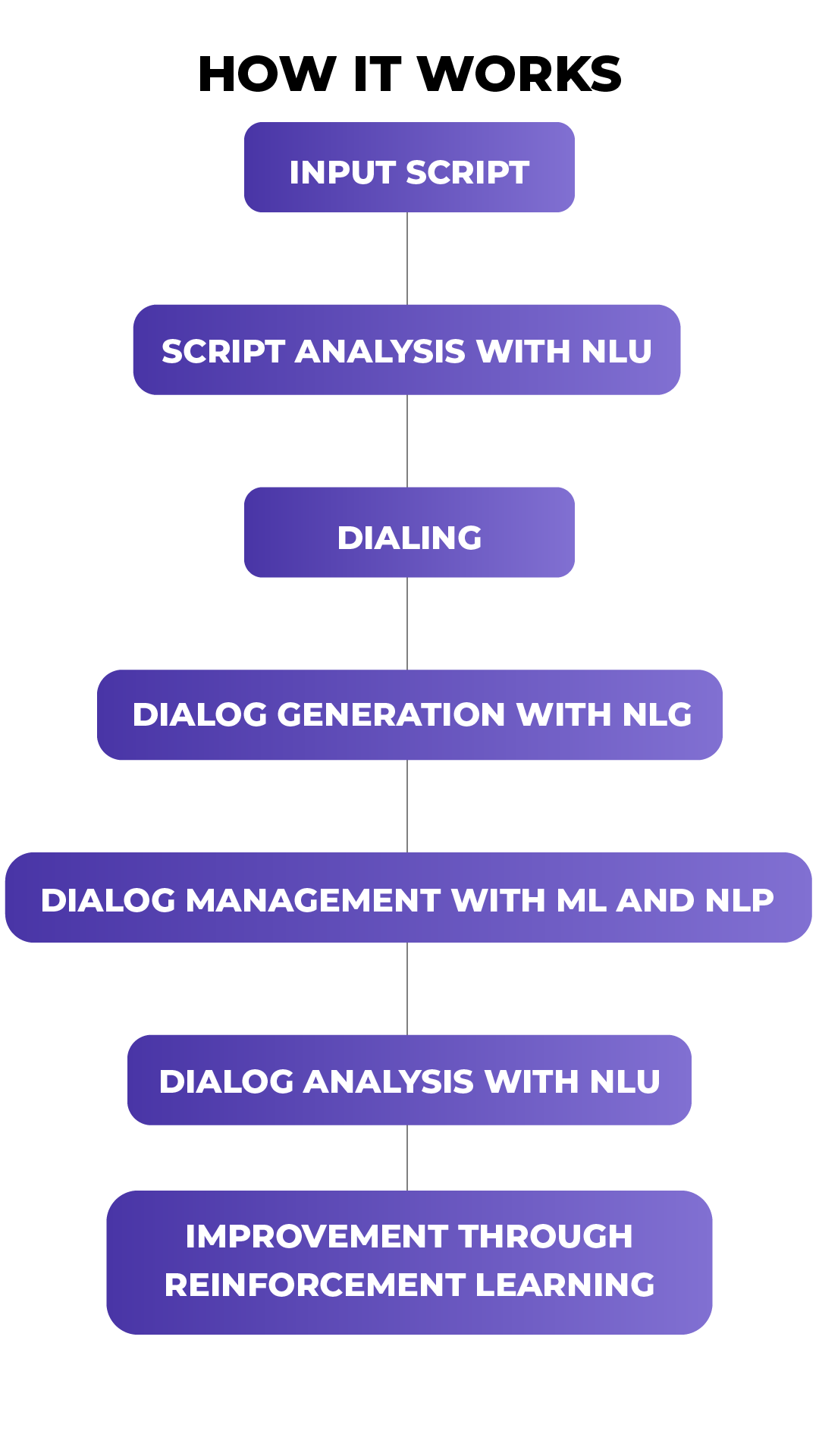
These systems can also apply reinforcement learning to analyze their own performance and continuously improve, ranking successful paths and positive outcomes to strengthen their accuracy. This feedback loop enables systems to handle an increasing range of scenarios, decreasing the need for escalation or hand-off to human beings, a process only now becoming available in the most advanced systems.
In piecemeal, these processes are also at work helping existing customer service and sales personnel in a number of ways, providing real-time analytics, automated dialing, GenAI call scripting (for responses, next steps, adjusted talking points), and features like post-call automated wrap-up (for summaries, updated records, scheduling follow-up communications, and more).
Benefits
We already hit several individual benefits via automation (taking repeated, routine operations off the plates of existing personnel), but there are additional benefits at scale from these systems, including:
- Time savings: It’s long been the goal of customer service systems to offload as much of the routine as possible, through IVRs, online forms, knowledge bases/FAQs, etc. These AI systems finally deliver much of this by providing it in a human-like call experience, freeing up agents to focus on the more complex interactions that require reasoning, empathy, or adjusted practices.
- 24/7 coverage: Overseas call centers have long offered “follow-the-sun” coverage to have people always on hand, but AI systems don’t have on/off times. Aside from being always on (like IVR), they are also ready to dial at the times that best fit a desired recipient’s schedule.
- Concurrent calling and response: AI also enables placing or fielding multiple calls at once, each with the same attention level. While human teams are naturally limited in how many calls they can manage simultaneously, AI systems can manage in parallel, significantly boosting efficiency.
- Better conversion: Generic scripts turn off recipients unless they already want the service (and even then, they get bored of them), but AI-driven personalization can use prior interactions to tailor the approach. Combined with the other elements on this list, this boosts the success rate compared to rote, robotic calls (even by burned-out agents).
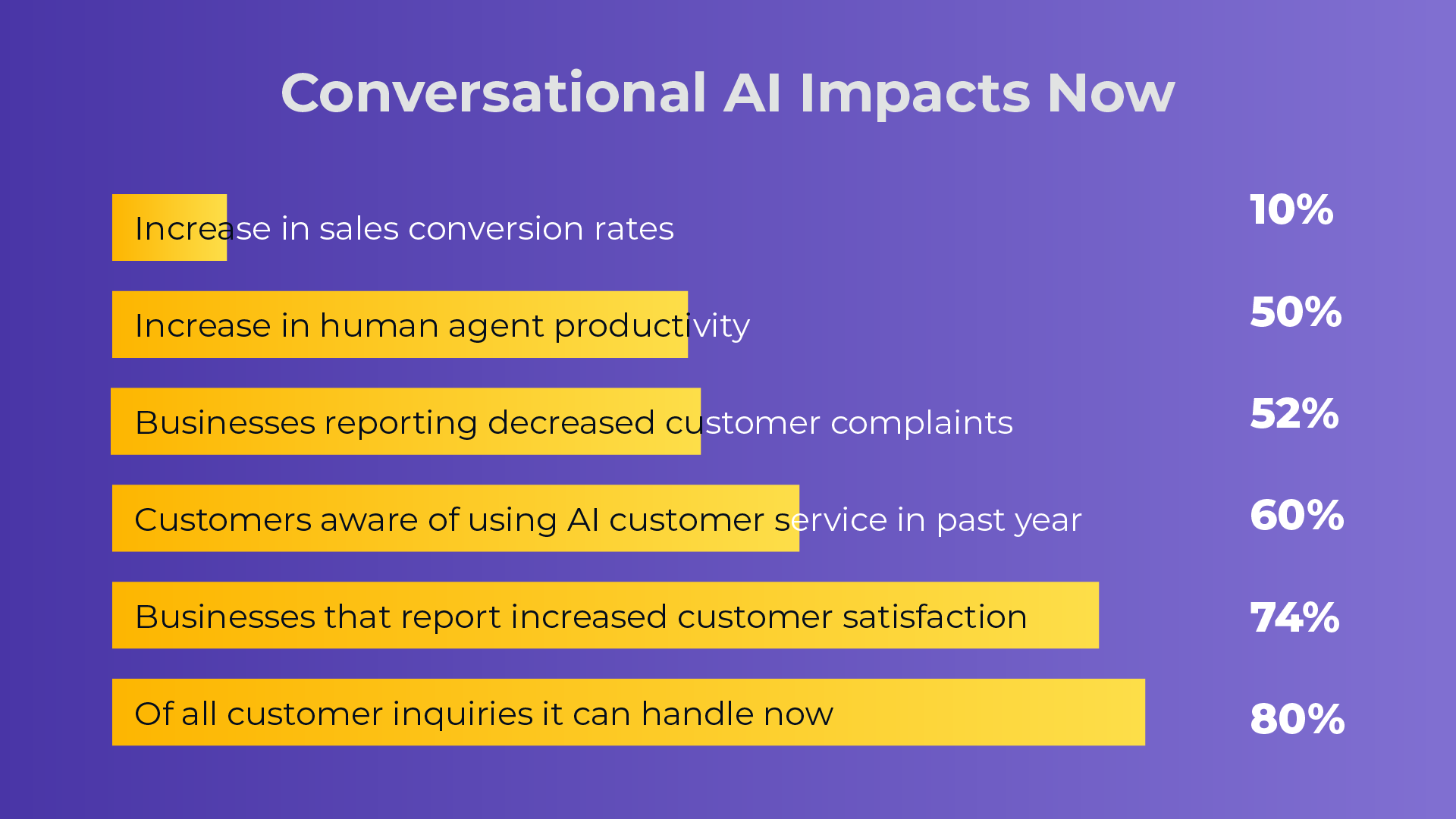
This is one area of AI implementation in business that’s mature enough to already be showing tangible financial gains.
Some of these include:
Near Term Innovations
We started with AI virtual agents.
Now, more focused AI systems can take independent actions to reach specific goals.
This is pushing automated conversational AI to a new level.
That includes AI agents for customer support.
It also includes:
- Automated travel agents
- Medical scheduling systems
- Diagnostic support tools
- Technical support systems that can take action
The future of AI in sales may go even further.
AI systems could:
- Dial provided leads
- Find new leads
- Improve lead quality
- Convert prospects
- Maintain customer relationships
In this role, AI could act like a salesperson’s friendly assistant or apprentice.
At some point, automated systems may even sell to other automated systems.
Humans may only need to approve deals or make counterproposals.
Imagine a marketing campaign built from several AI-generated proposals.
The team selects one.
The AI then drafts possible call scripts.
Those scripts can be reviewed and revised by the team.
Next, the AI studies customer data to find the best times to call.
It can also adjust scripts based on customer behavior.
Once approved, the system can place calls and begin conversations.
[Much of this is possible right now—check out PTP’s proprietary Pete & Gabi for a look at what it can do.]
Real-time AI translation adds another layer.
It can turn these systems into nearly universal outreach and response tools.
They can remain available at any time and support many languages.
With digital twin technology, it is already possible to create virtual versions of a person.
These digital versions can combine:
- Speech samples
- Personal knowledge
- Factual information
- Questions and answers
Combined with the technologies above, AI-driven conversation could become a personalized knowledge base.
Users may one day interact directly with virtual versions of:
- Doctors
- Professors
- Technicians
- Scientists
- Business leaders
These systems could answer questions in a style that matches the original person.
They might even continue to exist after that person is gone.
That possibility is both exciting and unsettling.
As these systems become more human-like, authenticity will become more important.
This is especially true as AI calling systems begin to use:
- Facial recognition
- Voice recognition
- Identity verification
These methods may eventually replace some traditional passwords, phrases, or memorized security steps.
Companies like Anthropic are also developing AI models that can interact with computer screens.
These systems can:
- Move a cursor
- Click buttons
- Type
- Complete digital tasks
Combining these abilities can make automation behave more like a human user.
That creates major new opportunities.
It also creates new risks.
AI systems can already provide personalized, real-time service.
However, human involvement is still necessary.
People are still needed for:
- Oversight
- Decision-making
- Handling unusual situations
- Reviewing sensitive actions
- Managing the gaps between tasks
Conclusion
AI agents are only now coming online.
What is already here in force is the power of conversational AI through practical call automation.
These systems work from scripts and improve through training.
They offer a better experience than older IVR systems.
They can also help solve problems linked to:
- Frustrating automated menus
- Offshore call center limitations
- Missed callbacks
- Repeated questions
- Incorrect inputs
- Limited access to business knowledge
This is one area where businesses are already seeing ROI from AI.
As agentic AI improves, these systems will become even more capable in the near term.
Few people enjoy talking to a machine.
But anyone who has yelled at an automated system, repeated the same answer several times, had the wrong information recorded, or waited for a callback that never came can see the value of better technology.
Conversational AI has the potential to make automated calling faster, more useful, and far less frustrating.