

At a time when applicant volume is through the roof, resume content is increasingly sanitized, keyword-stuffed, and similar, and a large percentage of resumes aren’t a match for the job description, AI looks like the perfect solution for hiring teams.
Or at least a necessary one.
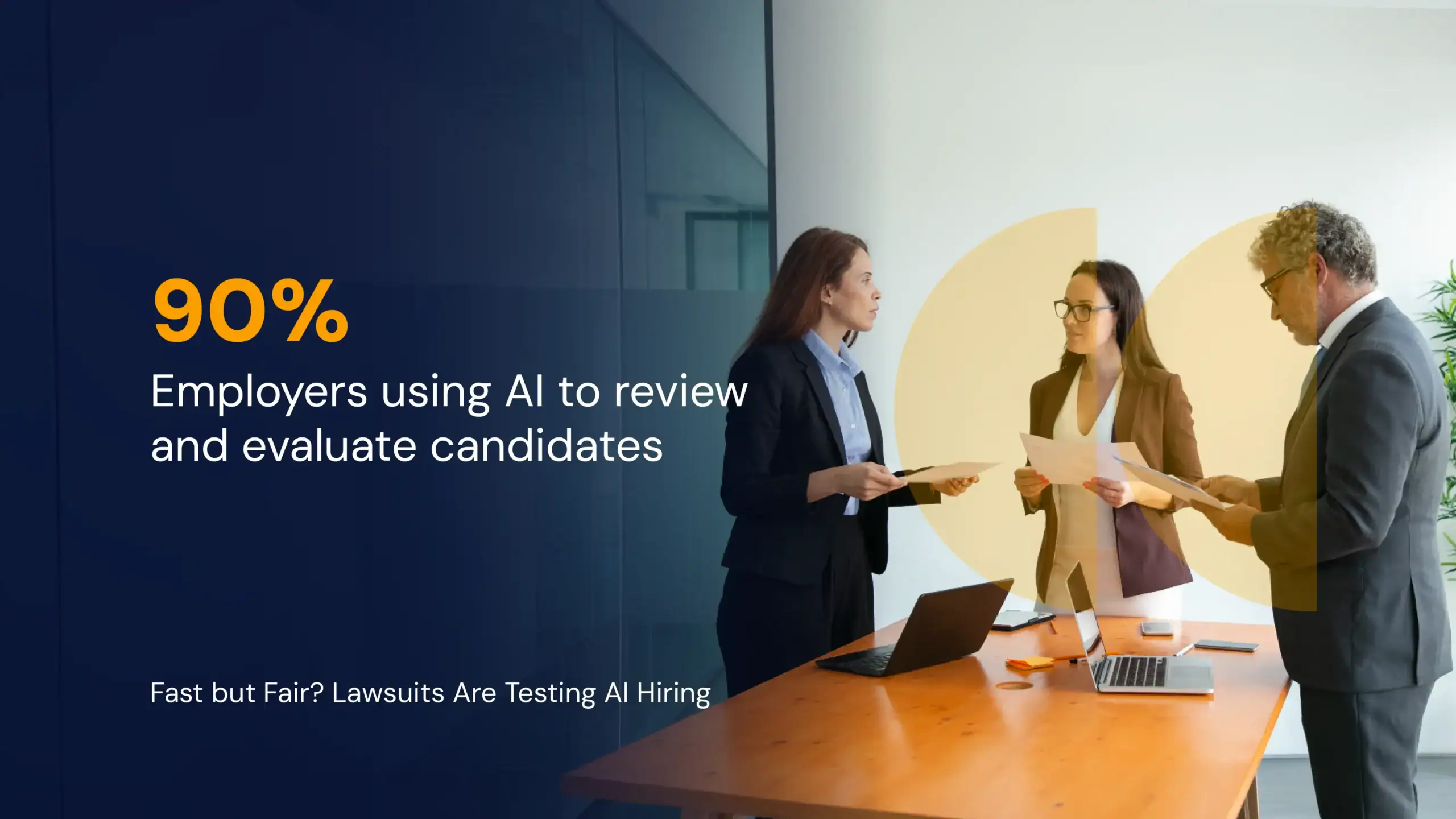
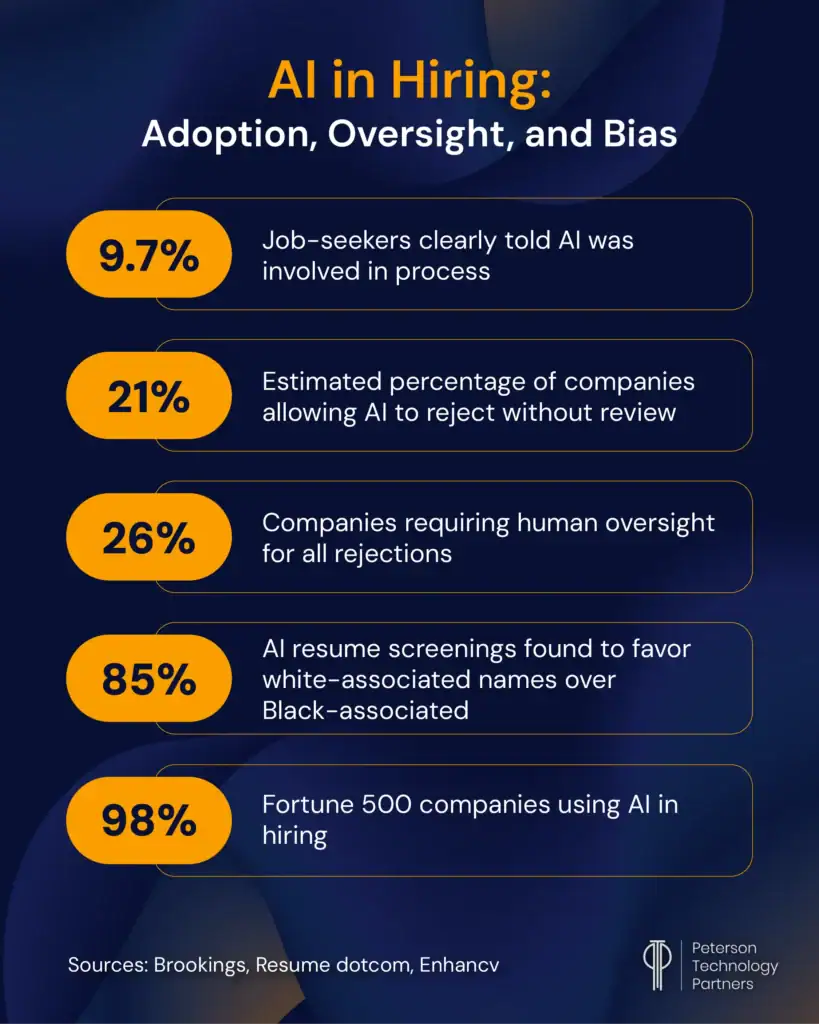
It’s certainly widely used. Consider that 98%+ of Fortune 500 companies already use AI in their hiring process, with some putting their savings in the millions of dollars (Brookings). Recruiting is the dominant HR AI use case, with 82% of AI-using companies applying it to resumes (ResumeBuilder), 73% using some variation for initial screening, 68% for handling common questions, 66% for writing job descriptions, and 62% for scheduling (Deloitte).
72% of HR professionals said they personally use AI (HireVue), with 93% planning to increase their use this year (LinkedIn).
But is there safety in numbers?
With several high-profile (and big dollar) lawsuits already in motion and many more waiting in the wings, companies are increasingly wondering about their own potential exposure.
Because while there’s no doubt that AI accelerates hiring, questions remain about the risk and fairness inherent in many systems.
Today we look at AI hiring lawsuits: the state and significance of key cases, why they’re being brought, the risks to companies, and what broader problems may be lurking below the surface.
Why Are So Many Companies Using AI Recruiting Software?
It’s one use case AI is paired with most: repetitive load handling.
AI systems are great at taking on routine, overwhelmed tasks that get downstream eyes anyway. And in hiring, more measured evaluation occurs once candidates have been narrowed down and some fit has been established both ways.
For this reason, using AI hiring automation to handle initial contact, resume filtering, and even pre-screening may not feel particularly risky.
We’ve written before about the increasing number of applications per recruiter (+412%, per a Greenhouse survey of 640 million applications from 2022 to 2025), and the ways AI is being used to help manage the burden.
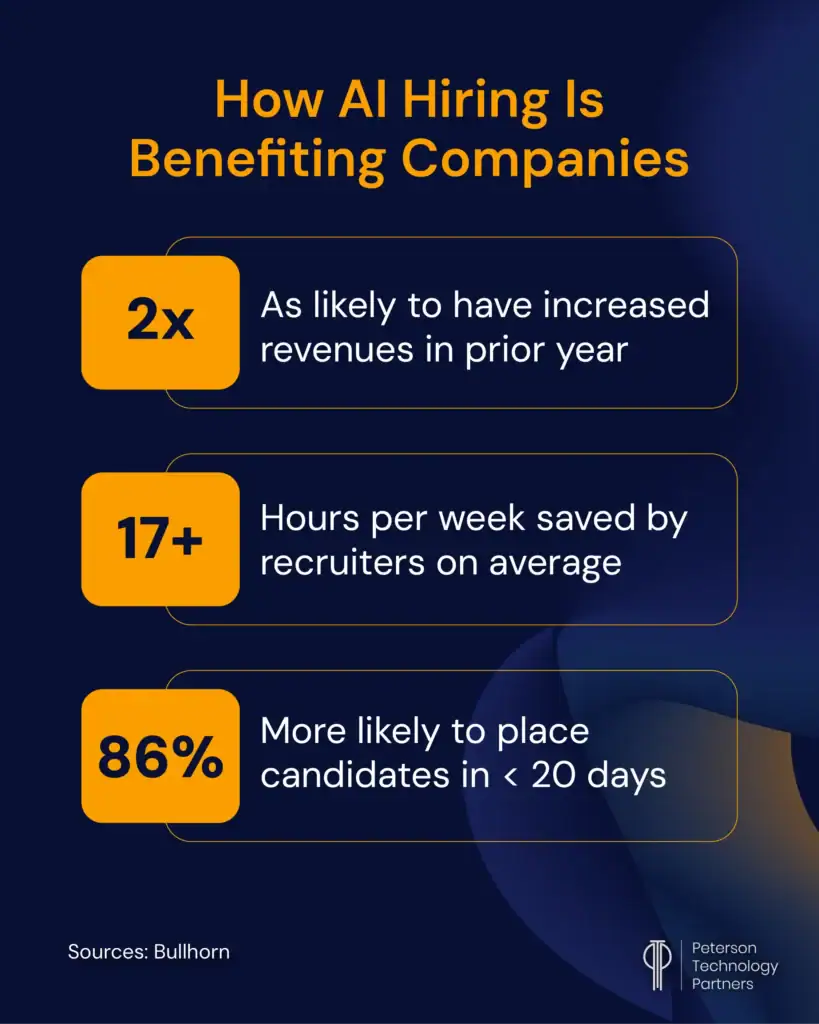
For highly structured searches, research has also shown it can match, or even exceed, what humans can do in terms of identifying quality candidates in the early phases.
One often-cited example from 2025 (conducted by Brian Jabarian from the University of Chicago and Luka Henkel from Erasmus University Rotterdam), randomly mixed AI and human recruiter handling for 70,000 job applicants across 48 positions and 43 client firms. Humans evaluated all results and made all final hiring decisions.
They found AI-screened candidates were 12% more likely to get job offers, with 18% more job starts, and 17% higher retention after four months.
But the ability to manage the load and the quality of eventual placements is not what’s at issue.
The focus of the lawsuits is on how and why candidates get filtered out.
AI Hiring Lawsuits Currently in Motion
Depending on where a firm is located (and candidate, and the potential job), AI use in hiring can be covered by both existing employment and data regulations, and a patchwork of emerging state and regional AI laws which include Illinois, California, Colorado, and Texas.
Newer AI regulations may have more narrow focus (like Illinois’s on applicant video that’s submitted for Illinois-based positions) or general (like California’s coverage of automated decision-making and filtering overall), but most existing lawsuits are considering AI coverage under existing laws and statutes, like California’s 1959 Fair Employment and Housing Act (FEHA).
Here’s an overview of where current cases stand:
Workday
In what’s potentially the most significant case (started in 2023), plaintiffs allege Workday’s AI hiring software discriminated against applicants based on protected traits, including race, age, disability, and gender.
While it’s still in active discovery (with no date yet for trial), in June this case was thrust back into the national spotlight when a federal judge refused to dismiss most of the bias allegations, under both FEHA and the Americans with Disabilities Act (ADA).
And while some charges based on race have been dismissed (involving Asian-American candidates in particular), they were dropped on the basis of procedure, not merit.
Given that any applicants who used the Workday platform since September 2020 and are 40 years and older were allowed to join (some 14,000 already), the number of people affected by this outcome could be enormous.
The case is also being closely watched for whether companies and AI vendors alike can be held liable for discrimination on the basis of AI filtering.
With the court allowing the disputes here to advance, companies would be wise to clearly review AI systems for bias and clearly document their own use (see below).
Eightfold AI
Eightfold’s AI hiring tools are used by Microsoft, PayPal, and many other Fortune 500 companies, and they’re being sued under California law for scoring candidates without their knowledge and permission.
Plaintiffs allege Eightfold generated AI scores that influenced hiring without getting authorization and providing the required notice that would allow candidates the ability to dispute potential errors in data.
This case is the first to use the Fair Credit Reporting Act (FCRA) as its basis, ala undisclosed background checks.
This case is still in the pleading phase, and it remains to be seen who may be allowed to join this class.
Again, it could be very large, including every qualifying applicant Eightfold screened during the relevant period (unless they opted out).
Sirius XM
This case was filed in August of 2025 and alleges that Sirius XM used AI software (iCIMS Applicant Tracking System) with embedded biases that disproportionately disadvantaged Black applicants.
The plaintiff claims rejection from 150 different positions despite being qualified for the roles. He seeks financial damages as well as the modification or suspension of use of the tool by Sirius XM.
These discrimination claims are unique as they go after the employer directly, and legal experts note while it may be the first, it’s unlikely to be the last.
Intuit / HireVue
Another case brought in 2025, this suit alleges the companies violated Civil Rights, the ADA, and Colorado’s Anti-Discrimination Act (CADA) through their specific use of AI screening.
The plaintiff claims she was forced to take an AI video interview that failed to accommodate her disabilities and that the process also discriminated against her.
Meta
A lawsuit filed in July 2026 by current and former Meta employees alleges that the company’s “constellation of internal artificial-intelligence systems” aided improperly in layoff decision making.
They allege the system failed to take into account disabilities and protected medical and family leave, using metrics like AI token usage to measure work output.
A US district judge declined to block these layoffs while the case proceeds, ruling that worker claims will be handled individually through private arbitration.
Also of note here: Judge William Orrick specifically called out the challenge workers face in proving such allegations, as “they were not in the rooms where it happened.”
A failure to understand and clearly prove how AI systems are being used may be holding back an anticipated surge in similar lawsuits around AI hiring (or in this case firing).
iTutorGroup
In an early example of enforcement, the US Equal Employment Opportunities Commission (EEOC) pursued iTutorGroup for age discrimination claims, saying their AI software was used “without proper safeguards.”
This was resolved through a paid settlement in 2023.
The Legal Theories on AI Hiring Discrimination Keep Shifting
One of the challenges employers face is that there is no single area that can be addressed to shore up one’s potential liability.
AI tools can be deemed unlawful if they disproportionately screen out protected groups (even without intent). They can show unfair bias against disabled applicants, for example, by wrongly weighing career gaps, communication styles, or availability.
Data analysis that rejects based on experience patterns, graduation dates, resume structures, and location tells (like zip codes) may also fall under discrimination protections, while audio/video data that analyzes faces, voices, expressions, and tone may run afoul of both biometric and privacy rules.
Questions also remain about the specific legality around candidate scoring and automated screening reports, which are likely to be considered as part of the Eightfold case.
Complicating matters is the fragmentation of new AI policies in the US, with many regions looking to protect against algorithmic decision making.
In those cases, it can be up to the company to prove that their AI tools are effectively tested for bias and that this, along with use, is well documented and auditable.
Can AI Hiring Tools Be Biased?
The potential for bias in AI-driven hiring systems has been demonstrated in a number of studies, and it can come about in a number of ways.
This includes through training data (such as by reflecting past inequalities), filtering (where neutral facts like geographic location can become exclusionary), system design (when other performance metrics get weighted ahead of fairness), and validation methodology (testing primarily for numerical accuracy can mask the under-representation of groups, for example).
It can also come about through use, where humans become overly dependent on AI measurements and their involvement is more a formality, as with the “rubber stamp” problem. If the human-in-the-loop process isn’t realistic or active, it risks becoming meaningless.
An investigation by University of Washington researchers used open-source LLMs to simulate resume screening for over 550 unique job descriptions and found significant evidence of bias.
Their gender-discrimination tests (over three LLMs and nine occupations) found men and women’s names picked equally in only 37% of cases, with women’s names favored only 11% of time.
Racial discrimination was even more extreme: White and Black-associated names were only picked in equal rates around 6% of the time, with white-associated names preferred 85% of the time.
And while this study used simulated LLM resume screening and was not an audit of commercial AI recruiting tools, it demonstrated the risks present in underlying models used directly out of the box.
Responsible AI Hiring Begins with Real Governance
Even aside from bias that may be present in any single AI hiring system or process, researchers are also exposing the risk that comes from the large-scale use of a limited number of hiring algorithms.
Researchers from Stanford University studied this “algorithmic monoculture” and found that applicants submitting multiple resumes through the same AI hiring system were more likely to be consistently rejected than those applying to companies using independent hiring mechanisms.
Their work advocates for more independent research to help explore this issue.
It also reinforces the importance of carefully vetting and verifying hiring tools, as well as controlling where and how they are used.
If your company is surveying vendors, it’s critical to ask about their training data, fine-tuning, and how they audit their own hiring algorithms. Do they measure and address potential bias? Do they monitor in an ongoing fashion, and if not, at what intervals?
The best governance systems also use third-party reviews, which is now required by some of the strictest AI regulations (like New York City’s Local Law 144, and proposed legislation in New Jersey).
Also essential is clear disclosure of AI use, transparent handling of candidate data, and an effective process for correction and alternatives.
To learn more about how PTP’s own AI recruiting solutions, how we check for bias, maintain transparency, and ensure fairness, contact us.
Conclusion: How Should Organizations Audit AI Hiring Technology?
There is no doubt that AI hiring technology is fast.
It’s seen such widespread adoption because of this, as it can help overwhelmed screeners get through stacks of resumes that are also easier than ever to generate and send.
But how fair is it? That question in many cases remains to be seen. Lawsuits with serious ramifications are winding their way through the system, and their outcomes will be closely watched by candidates, vendors, and customers alike.
In the meantime, companies cannot assume they are safe simply because of the scale of use.
AI systems themselves aren’t inherently fair or biased, putting the impetus on their users to be sure they’re being applied fairly, and with as much transparency and documentation as possible.
This not only ensures legal protection; it also supports trust and is part of becoming a place where top talent wants to work.
References
Judge refuses to dismiss most Workday hiring bias allegations, HR Executive
AI company Eightfold sued for helping companies secretly score job seekers and Analysis-Meta employees’ lawsuit shows that if AI fires you, proving it is the hard part, Reuters
Another Employer Faces AI Hiring Bias Lawsuit: 10 Actions You Can Take to Prevent AI Litigation, Fisher Phillips
Current and former employees sue Meta, alleging discrimination in using AI to conduct layoffs, CNBC
EEOC Targets AI-Based Hiring Practices in Landmark Settlement, The National Law Review
Gender, race, and intersectional bias in AI resume screening via language model retrieval, Brookings
Algorithmic Monocultures in Hiring, arXiv:2605.27371 [cs. CY]
AI Hiring Tools Can Yield Racial Bias and Systemic Rejection, Stanford HAI
How Illinois, Colorado, California, and Texas Approach State AI Hiring, DISA
The growing legal risk behind AI-driven hiring, Staffing Industry Analysts
FAQs
What are the latest AI hiring lawsuits?
Major cases are now underway and being closely watched. These include suits against Workday, Eightfold AI, Sirius XM, and now Meta. These cover various allegations and protections, from unfair discrimination to unreported scoring and reporting to neglecting critical protections and considerations. They also include suits against AI providers and end users, and their outcomes may be critical in determining how fairness is ensured, and the requirements of AI hiring governance in the years to come.
Who is responsible when AI hiring tools discriminate?
This is still being actively litigated: potentially both the employer and the vendor. Employers generally remain responsible for discriminatory hiring practices, while vendors may be found liable in cases where their technology is directly involved in hiring decisions. This uncertainty is why AI governance in hiring is so critical, along with the careful selection (and vetting) of AI partners.
How can companies reduce bias in AI recruiting?
AI hiring vendors must regularly test their tools for bias and audit the results by both job types and demographic groups. Companies that employ them should insist on transparency, meaningful human oversight, and ongoing monitoring.
It’s critical to be clear and document how decisions are ultimately being made, to provide full explainability and the ability to support third-party audits.