

Meta’s personal, persistent AI agent Muse has impressed critics and quickly shot to the top of app stores.
In just weeks, it’s got an estimated 600,000 active daily US users and more than four million downloads between the US and Canada, according to Sensor Tower.
And now OpenAI has thrown its hat in the ring, announcing their own, similarly persistent, cloud-based agents (called dots) at the company’s 2026 Dev Day.
But regardless of whether consumers continue to embrace personal AI assistants or not, their broad capabilities point to changes that are coming soon in the workplace.
Agentic AI is just one of the things we’re considering today for our look at the tech talent trends we see taking off in 2027.
In preparation, Peterson Technology Partners analyzed over 3,000 of our enterprise requisitions from 2021 to 2026 for insights on how the market is changing.
What follows is our breakdown of the tech hiring trends already taking hold and expected to grow over the next calendar year.
This includes AI’s fundamental pairing with other skillsets across tech, tech hiring dividing in two tracks (expertise intensified vs ‘new collar’ work), boundaries blurring as job descriptions (and org charts) go in the blender, and increasing demand for capabilities or outcomes over traditional hiring models.
Take a glimpse at the future of IT jobs as AI agents arrive in force: This is our PTP Report 2027 hiring preview.
AI skills shift across tech disciplines
We’ve posted before about Gartner’s prediction that by 2027, three-quarters of hiring processes will include certifications and testing for AI proficiency.
But putting predictions aside, Ashby found that 8% of all tech job titles in Q2 already had “AI” in them, up from 2.8% in Q1 2025.
LinkedIn’s Hiring Lab found so-called “AI touched” jobs (with at least five postings with AI in the job title in a given calendar quarter) shot up to around one in every 12 job titles overall (or 8.3%).
LinkedIn research also noted that jobs requiring AI literacy skills grew 70% year-over-year, while Dice has charted its own massive rise in tech job postings requiring at least one AI skill.
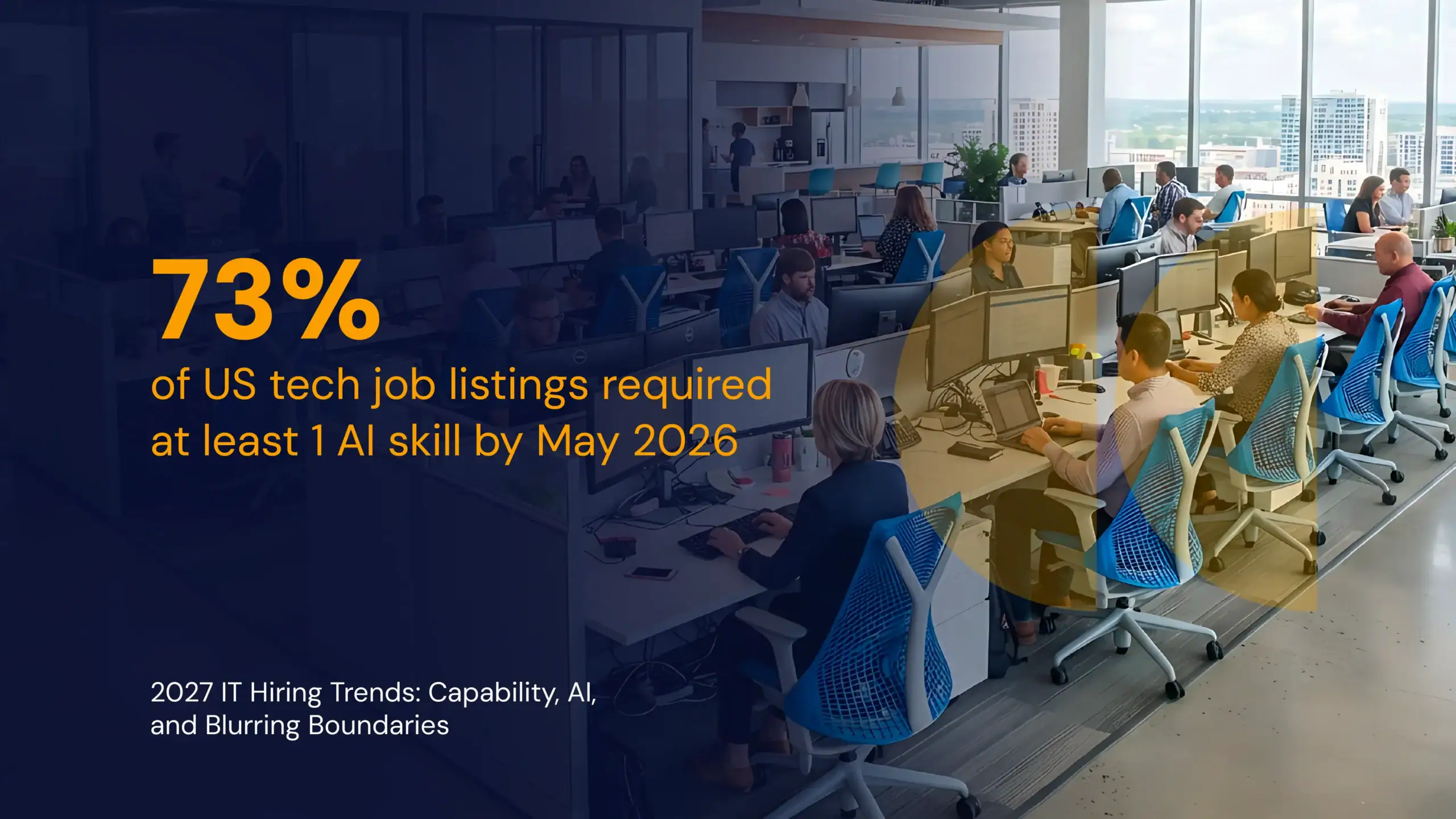
They provided our banner stat above, by finding that 73% of tech job postings in May 2026 required at least one AI skill.
Our own data also supports this transition. In our own requisitions, we’re seeing a move from AI experts to more demand for AI-capable tech specialists.
In the arena of skills-based hiring, this means AI is fast becoming a base tech competency companies expect.
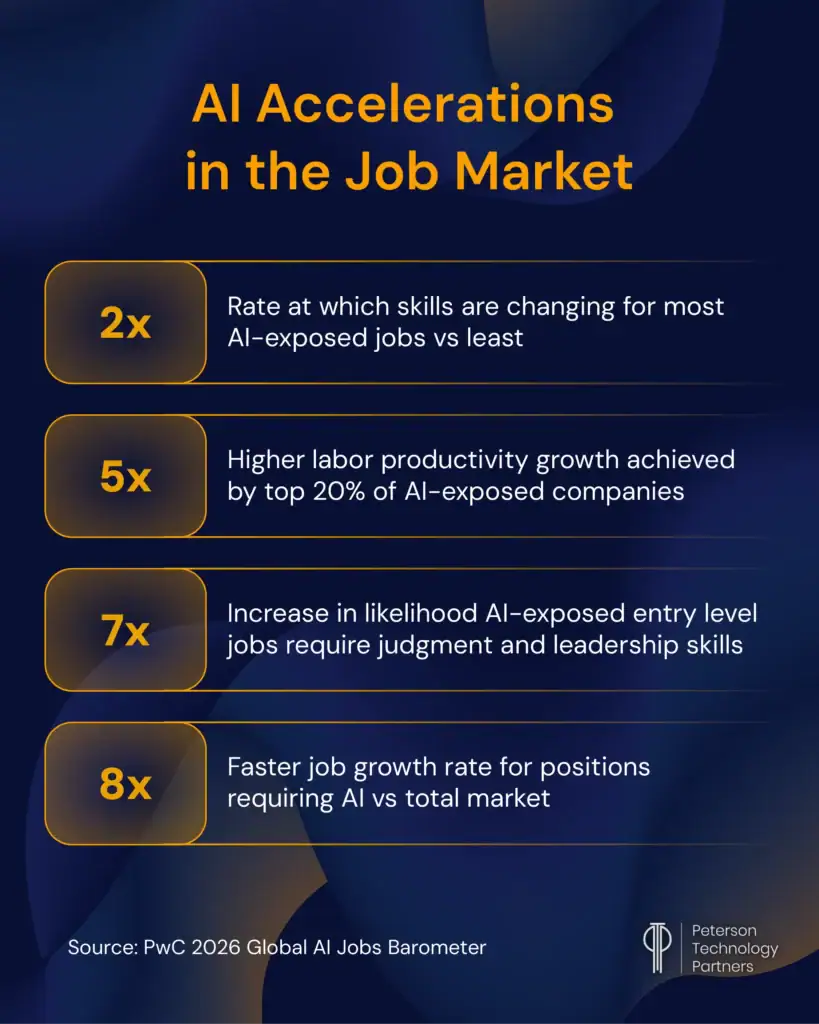
It’s also part of an AI-driven acceleration that’s changing work as a whole.
How are AI skills changing traditional technology roles?
At the top we noted the divide between the rising demand for experienced professionals and a concentration in roles where less experience is required.
Bain’s Technology Report 2026 puts numbers to this. Their research found that far fewer engineering teams are now using traditional pyramid structures (down from 66% to 29%), with AI fluency as the most commonly sought-after skill (62%).
Among developers, time spent coding has dropped more than 10% and is expected to be cut in half within two years, with developers expected to spend a third of their time directing agents. This sees management skills and the ability to work successfully with AI-generated code ever more valuable.
Teams, too, are shrinking in many cases, with smaller PODs of three to five becoming more common, while experienced developers occupy a larger percentage of the overall workforce.
Bain noted that while junior developers used to make up 1/3 of teams on average; now it’s more of a 1/5 mix.
Dice saw demand for professionals with 10 or more years of experience grow 15% in Q1 2026, taking it to 23% above pre-pandemic levels.
What are the biggest IT skills gaps companies will face in 2027?
Hiring for entry-level roles, by contrast, is ever more concentrated on specific skills.
And among postings requiring a year or less experience, data engineering leads the way with 89% growth.
But an IT skills gap is less the issue here than skills like stakeholder management (+315%) and observability (+230%). And, as noted in PwC research (and in our graphic above), AI-exposed entry-level jobs are growing in many cases, but also seven times more likely to require skills more traditionally associated with more senior roles (like judgment and leadership).
Data jobs remain strong overall, with the Bureau of Labor Statistics (BLS) data from June projecting a rise of more than 33% in the decade between 2024 and 2034 (compared to just 3% for jobs overall).
PTP is also seeing this surge, with companies investing heavily in their data architecture as a strong AI foundation.
We’re seeing a push for companies coveting workers with skills in data engineering and architecture, as well as governance, integration, and experience with cloud data platforms.
Cybersecurity talent has long been in demand, and this continues, though the roles are shifting. BLS data charted information security analyst job growth (also 2024 to 2034) at 28.5%.
And in this area, the demand is also shifting heavily to those with experience.
A 2026 working survey by the non-profit International Information System Security Certification Consortium (ISC2) found that 56% of participants saw a moderate to significant reduction in the need for entry-level talent in the field.
AI in the workplace is blurring boundaries and making some mayhem
We regularly report on the up-and-down impact of AI on hiring trends in our monthly AI roundups.
Add to this new research by Stanford economist Lukas Althoff and Hugo Reichardt of the Barcelona School of Economics. Their work projects that AI’s “simplification” ability will enable many lower-skilled workers to benefit the most, with wage increases of 15% to 45% over a lifetime.
Althoff points to the example of an 18-year-old high school student from California who identified 1.5 million new objects in space using his laptop. He’s since received an informal job offer from NASA.
This research sees a reduction in the tech skills gap through AI, supporting the rise of ‘new-collar’ jobs, or what IBM CEO Ginni Rometty called ‘middle-skill’ tech jobs.
LinkedIn research identified that 1.3 million new AI-enabled jobs have been created globally in this ‘new-collar’ category.
But as more people can do more jobs more easily, what happens to the traditional org chart?
OpenAI research from July charted an observed pattern of task crossover, where work that’s traditionally associated with one role was being done with the help of AI by people in other occupations.
This “borrowing” of tasks was more prevalent among smaller companies but was widespread. Overall, they found it happening in some 43% of their analyzed work-specific messaging.
Researchers have also charted this emerging chaos in ways that are both exciting and challenging.
A field experiment conducted by researchers from Harvard, Penn’s Wharton School, and the ESSEC Business School (in collaboration with Procter & Gamble), focused on the work of 776 professionals at the company who were engaged in actual product innovation challenges.
Randomly assigned to work with or without AI, individually or in teams, these employees were studied for their effectiveness and working process.
The results showed that individuals with AI were found to match whole teams working without it. AI use also broke down traditional domain divisions between workers in the groups of R&D or Commercial, seeing them leave their lanes more often, using AI to also do work in the other domain.
This role convergence can be rewarding, but also problematic, and we anticipate some organizations in 2027 may struggle with questions of ownership, process, and boundaries as capabilities break down walls and begin to flow all over organizations.
Some of the challenges that are still being resolved:
- Evaluating quality: As expertise gives way to broader reach, the person executing a given task may not have the training to evaluate its effectiveness at traditional levels.
- Accountability: Who defends or explains AI-produced results?
- Duplication/Overlap: How do you avoid people recreating the same work in different ways from different functions?
- Control gaps: Handoffs can cause bottlenecks, but they can also be points of sign-off or review. Without this independent professional scrutiny, how do you ensure completeness and maintain rigor?
- Job drift: Job descriptions may be what someone is hired to do, but how should HR handle things like compensation, performance evaluation, and workload balancing when actual work tasks may end up varying far and wide?
- Expertise development: One of the biggest concerns overall is maintaining a pipeline for expertise as entry-level roles are shifted. PTP’s founder and CEO provided his thoughts and ideas on maintaining this pipeline in a recent article.
We predict that 2027 sees the continued scrambling of org charts in ways that are both thrilling and messy.
Capabilities focus is among IT hiring trends for 2027
One of the biggest changes we’ve seen over the last two years has been the shift from traditional tech labor staffing to more demand for capabilities of varying kinds.
Sometimes this plays out in the form of outcome-based pricing, where companies look to purchase a completed product phase, for example, and sometimes in the form of hybrid teams that can rapidly scale up an organization’s ability to get work done.
Among our requisitions, PTP has seen a marked trend shifting towards more flexible work engagements.
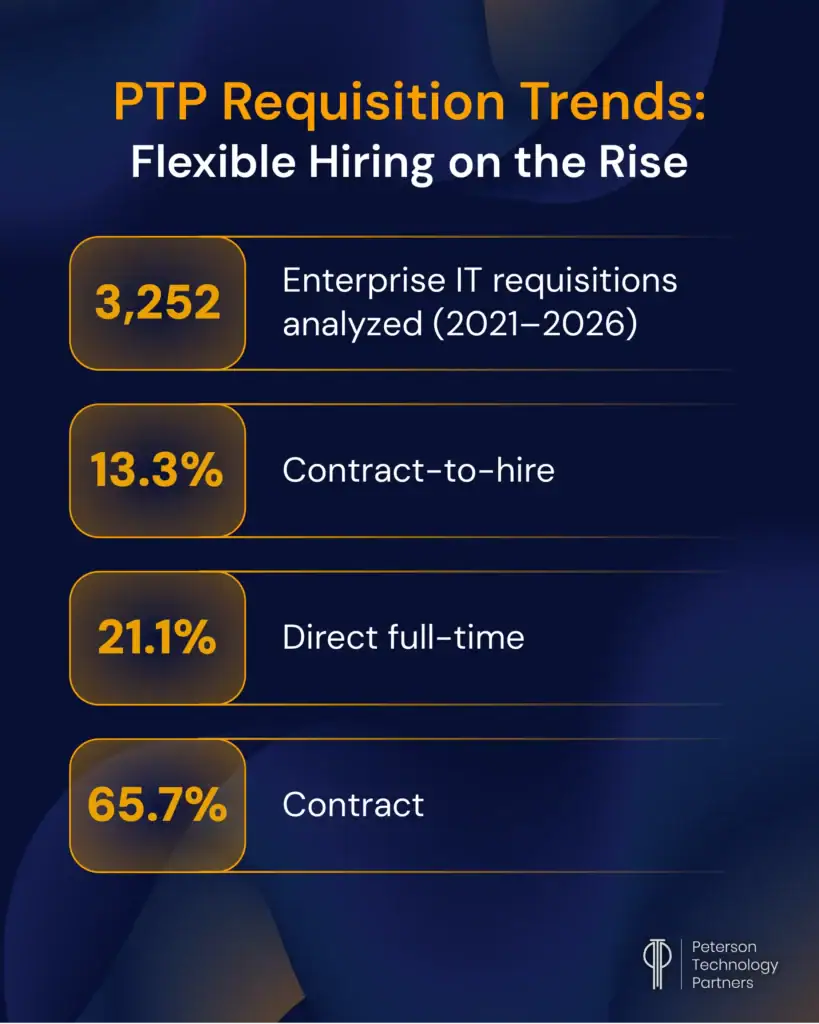
And while BLS data overall still shows a stable (and long-term) balance between full-time employment and contract hiring, among the IT hiring trends we’ve witnessed in-house is more companies mixing permanent and contract talent, specialized partners, AI, and global delivery teams together in novel ways.
It’s become common in PTP’s model for a single tech project to pair:
- US teams for leadership
- Internal for business knowledge and core experience
- Nearshore engineering groups for collaborative work
- Offshore workers for specialized capabilities
- Onshore contractors for scarce skills or temporary expertise
AI underpins this process and also facilitates much of the work.
We anticipate this trend will continue in 2027, as many companies are looking to remain flexible and adaptive as requirements, budgets, or deadlines shift.
Conclusion: IT talent strategy vs job descriptions
What are the biggest IT hiring trends for 2027?
Hiring continues to surge for experienced professionals and those with expertise in needed areas, like data engineering and cybersecurity.
AI skill diffuses among the domains, becoming a baseline that’s expected across the board.
Far more AI agents come online in the workplace, enabling even greater boundary blurring, ‘new collar’ job work, and org chart chaos.
And broader capability delivery + AI becomes increasingly appealing over hiring discrete divisions of contractors or consultants for businesses undergoing transformation projects.
By the end of 2027, how many workers will have their own workplace versions of Muse or dot that maintain persistence and work in their own cloud space?
Regardless, we predict more complicated org charts are coming soon.
References
Muse sure looks a lot like OpenClaw, The Verge
The Rise of AI in Job Postings, Ashby
Tech Hiring Myth vs. Reality, Dice
The Half-Finished Redesign: How AI Reshapes Software Organizations, Bain & Company
Artificial intelligence, information technology, and employment, 2024–34, US Bureau of Labor Statistics
ISC2 Research: Rethinking AI’s Impact on Cybersecurity Roles, ISC2
Lower-skilled workers could earn more in an AI world, Stanford Report
How AI is expanding what people do at work, OpenAI
The Cybernetic Teammate: A Field Experiment on Generative AI Reshaping Teamwork and Expertise, National Bureau of Economic Research
FAQs
How is AI changing IT hiring and tech jobs?
How is it not? Aside from being heavily used in hiring and job searching, AI is also rapidly becoming a baseline competency that’s expected across fields. While AI-centric jobs continue to grow, across domains businesses are looking for workers who can combine traditional tech skills and expertise with AI capability. AI is also blurring boundaries between roles.
What is skills-based hiring and why is it becoming more important for tech jobs?
Skills-based hiring has been a popular approach for several years and is the practice of evaluating candidates for demonstrated capabilities instead of using external or achievement markers, like prior job titles, degrees, or even years of experience.
With AI’s “simplification” ability, many workers are able to bridge or borrow some expertise in certain skills, provided can verify results, apply sound judgment, communicate effectively, and remain grounded in solid foundations.
What technology skills will be most in demand in 2027?
Data engineering is one of the fastest-growing areas, per BLS data. But AI and ML skills, cybersecurity, software development, and cloud/infrastructure capabilities are all valuable skills for 2027.
In each case, employers consistently want talent that can pair these skills with AI literacy and will pay a premium for those who can add business understanding, leadership, effective critical thinking, and the ability to succeed working across traditional boundaries.