AI use in coding is in many ways a unique animal.
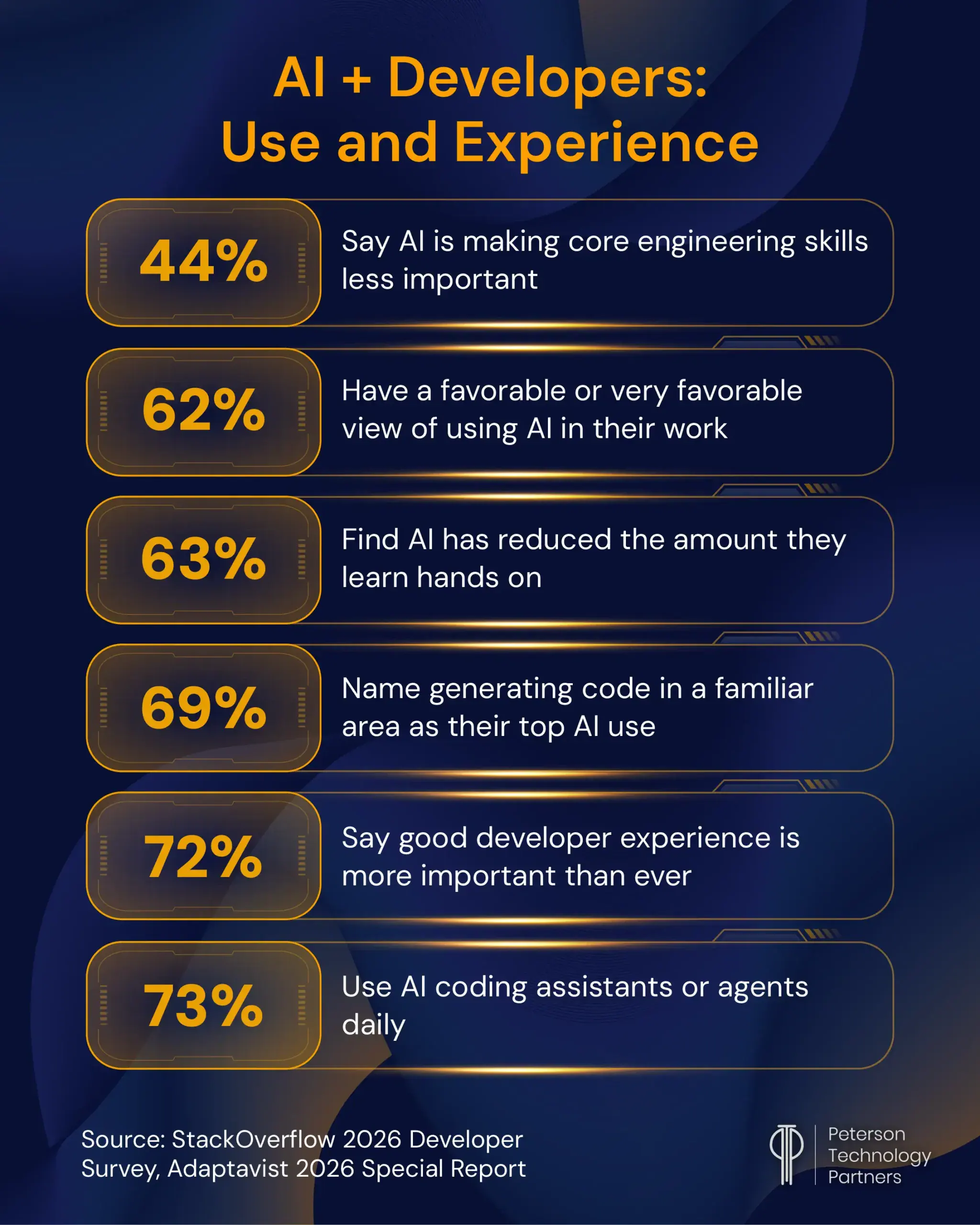
Most developers use it (73% daily), and many do so heavily (55% more than two hours a day and 31% more than four).
Software developers are also more positive about AI than workers in many other fields (with 62% viewing it somewhat or very favorably) according to Stack Overflow’s Developer Survey for 2026.
An Adaptavist survey from March (with Attest) found that 65% of developers surveyed also believe AI’s benefits outweigh the drawbacks (with just 11% disagreeing).
83% acknowledged that with AI, software development productivity is higher.
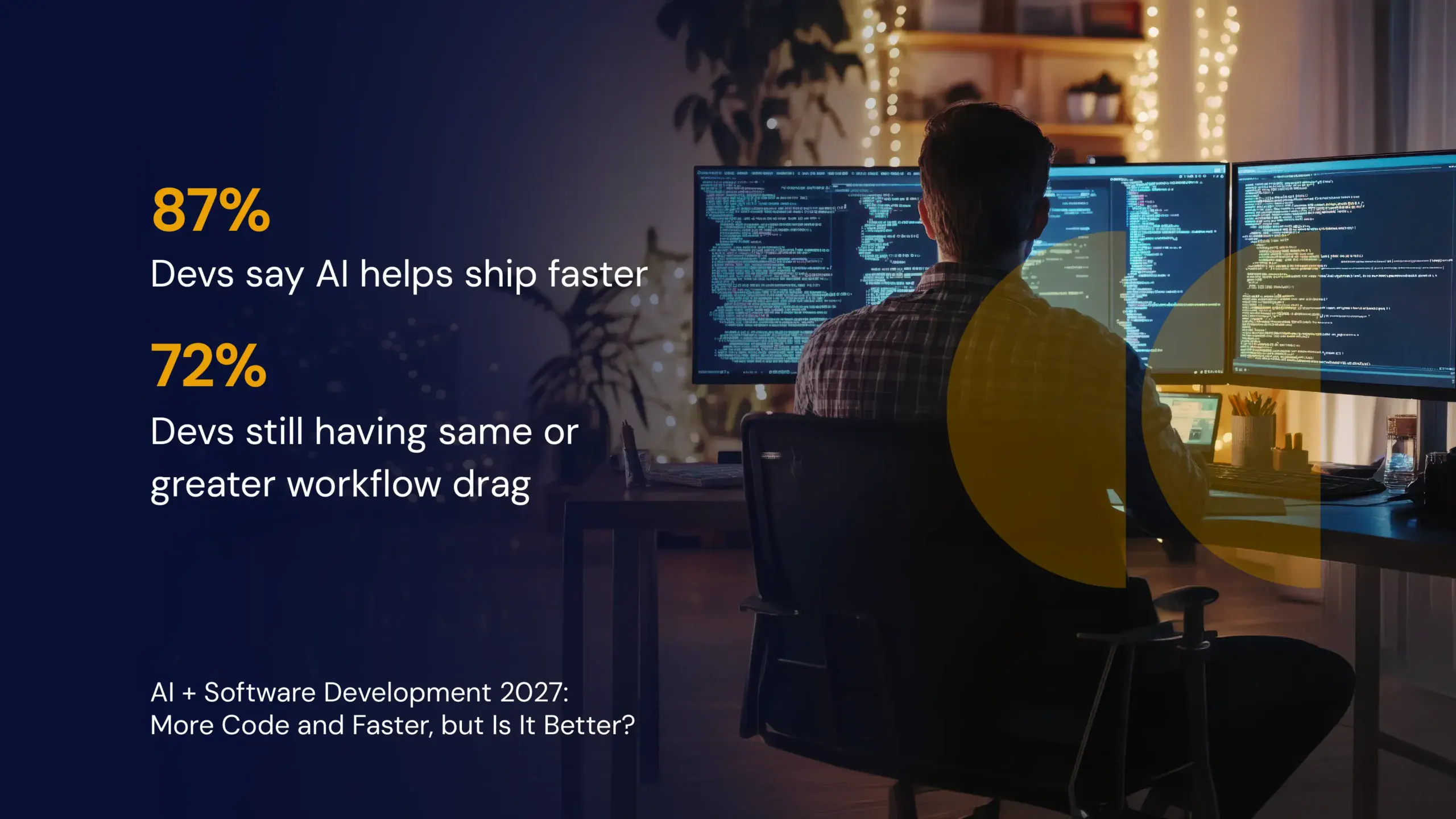
Our banner above is from Atlassian’s State of Developer Experience for 2026, which also found 64% of leaders (less surprisingly) believe that more AI use equates to better outcomes.
There’s also general approval that AI generates code quickly, can accelerate learning and exploring examples, and helps with finding bugs.
But AI-generated code quality is another matter.
While AI is helping deliver more code more quickly, most developers report having the same or even greater challenges to resolve in their workflows.
So where is the disconnect?
Today’s PTP Report looks at the state of AI-powered software development on the eve of 2027.
With Anthropic claiming that more than 90% of its new code for September was written by AI, how are developers at other companies faring in their own work with AI?
And if code is coming so much faster, why isn’t production output following suit?
Why AI in Software Development Is Here to Stay
Workplace surveys always depend on who’s being asked what questions and when.
But consistencies emerge, and the 2025 DORA State of AI-Assisted Software Development report’s findings also landed in the same ballpark as those above, with 90% of tech professionals noting they use AI at work, and 80% claiming increased productivity.
We wrote last year about a large disconnect between leadership and software developers and the reservations some developers still had about AI coding (heavily used but not trusted, and with skepticism over mandates).
And still many developers are feeling the pressure to use AI.
58% in the Adaptavist survey said AI use had become a formal performance metric/KPI, with 52% saying they used AI more often than necessary to meet leadership expectations. (In Atlassian’s study this was 41%.)
Use cases are also proliferating.
Stack Overflow’s 2026 survey found at least half of the surveyed developers were currently using AI for the following:
- Code for familiar areas (69%)
- Debugging and refactoring (64%)
- Writing tests (58%)
- To answer questions (straightforward 58% and complex 50%)
- Code for unfamiliar areas (56%)
- Documentation (51%)
- Searching and summarizing internal knowledge (50%)
- Onboarding to a codebase (50%)
Coding agents can also now execute multiple steps more reliably and iterate to check their own work, decreasing the level of human developer interaction needed in the code-writing steps.
DORA’s analysis of open-ended surveys of more than 1,110 Google engineers found certain universal themes emerged in their analyzed use cases. These included that AI increased coding velocity, helped bridge knowledge gaps, and was useful for cognitive collaboration.
Another popular use case is kicking off new projects. AI can help engineers get past a blank screen with an initial draft, enabling them to focus on editing and improving instead of getting started.
The Bottleneck Shifts to AI Code Review and Testing
But no rapid change at this scale is ever simple in the real world.
Even with all the benefits listed above, for a March 2026 DORA report, authors Jessica Baolin and Nathen Harvey note that:
“AI’s impact on the SDLC is not a simple linear improvement. Instead, it presents a series of profound tradeoffs.”
While it helps write tests, crank out repetitive code, research, learn, and start new projects, the time that’s being saved in these tasks is rarely all freed to be reapplied elsewhere.
Instead, like most workflow applications of GenAI solutions, bottlenecks (at least initially) get shifted along to a new location.
For coding, this is most often verifying the AI work. Which isn’t as simple as it sounds.
In addition to creating lots of code fast, GenAI is also a great imitator (via prediction) by design, making most of the code look better at a glance than it necessarily is.
AI also typically amplifies both the strengths and weaknesses that are already present within an organization and its processes.
Does AI-Generated Code Actually Improve Software Development Productivity and Code Quality?
Harvard University researchers Fiona Chen and James Stratton have been investigating the impact of AI coding assistants and agents on actual software output. Their work has analyzed nearly 450 million work events from more than 720,000 workers at 655 companies.
It’s found that AI heavily increased code creation but has had notably smaller impacts on actual software output and almost no discernible impact (thus far) on developer employment.
AI assistant adoption (after one year) showed around a 30% increase in the volume of code created, with around 17% more commits and 21% more pull requests.
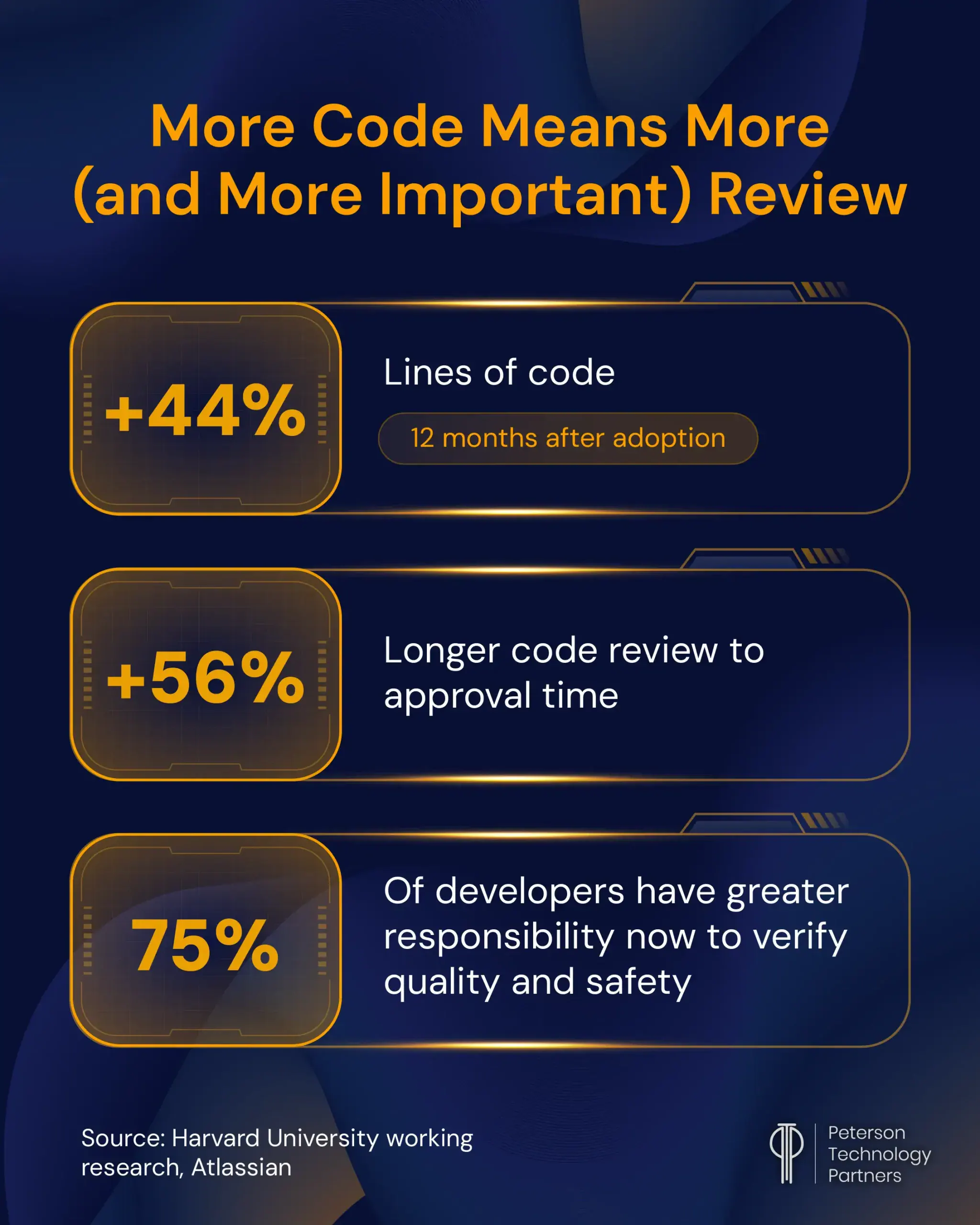
For AI coding agent adoption, results updated through November 2026 estimated a larger, 44% increase in code volume (with 36% more commits and around 36% more pull requests opened).
But in both cases, the ultimate software output levels were far lower. For assistants, they tracked little discernible increase (via Jira, 1.5% boosts for smaller issues and a 3.4% increase on project or feature level epics).
Agents fared better (13.7% for Jira issues and an 18% increase for epics), but with the added caveat that for the issues they resolved, the size and complexity may also have increased.
Meanwhile, the time needed for code review (with AI agents) rose by more than 56%, including both the time spent in backlog and the increase in time after active review had begun.
Hence, these companies were getting much more code more quickly, but with developers having to shift far more of their time to checking it and addressing issues.
And while this is just one working study, the results track with other findings.
DORA analysis (see above) tracked the most consistent negatives listed across use cases by developers. These were the spike in verification overhead and hallucinations.
They also found that the time developers saved by offloading code writing was often taken up in review.
And Stack Overflow’s survey found that trust in AI remains low, with 48% of developers surveyed only trusting if they can verify easily and only 7% trusting AI with important decisions.
76% first run all AI code locally, then compare it against the codebase (64%). More than half always inspect tests or perform security verifications (53%).
Unsurprisingly, Atlassian’s survey found 75% of developers report they now face greater responsibility for validating the quality and safety of AI-generated code.
How Is AI Changing the Software Development Lifecycle (SDLC) in 2027?
As the DORA report highlights, a push for more rapid code production with AI agents risks the addition of more bugs, technical debt, and poor documentation in the short term.
As one developer put it, AI tools “write code faster than I could, but the code is (currently) lower quality than I could write myself.”
But the quality is improving, and organizations can tap the biggest benefits with the lowest risk by first acknowledging these realities and adjusting some of the ways they approach the work.
Handle AI software development challenges with better review and measurement
As discussed, coding automation comes with a trade-off: the time saved from writing gets shifted to verifying and ensuring security and fit.
But these are also potentially different (if overlapping) skills.
Experienced developers have seen a spike in demand in part for this reason, as more of the work shifts to architecture, oversight, and review.
But the review process, too, can be improved to save more of the time AI is freeing up in the first place.
AI agents are already able to review their own work in coding loops, and context-aware agents can be used to check for organizational standards and baselines before humans even enter the mix.
Reviewing at traditional intervals can make the scale, too, overwhelming. The DORA researchers recommend software teams keep the work moving in small, manageable increments which can also be more effectively tested.
And testing automation overall is critical to help keep up with this faster pace.
In terms of measurement, pushing higher AI use at this stage may be largely unnecessary, and measuring the volume of code produced is also of diminishing importance in a world where large amounts of poor code can be created very easily.
This is another area where AI is magnifying existing problems. Organizations should shift the focus to the ultimate impact of development work, rather than keying on details of the work itself.
Google uses SEQ (speed, ease, and quality) for this end, and the DORA team recommends frameworks like SPACE and HEART for assistance in finding better methods for measuring development impact.
PTP’s VOICE Framework was built with measurement as a core pillar. Businesses can reach out for assistance in this area or for help with aligning use cases, governance, or workflows.
Prepare for the software development productivity gap
As demonstrated by the research above, there’s a crucial difference between the speed code is being generated versus actually implemented.
AI solutions will certainly continue to improve in this area, but production-grade software will never come together as fast as limited prototypes can.
AI coding tools really thrive at making impressive pilots, only to then struggle with edge cases, production-scale data, and more nuanced decision making. This is compounded when sensitive data or connections to systems of record are added, where security, reliability, and performance requirements get put under the microscope.
In other words, seeing a great prototype pulled together in record time can seriously skew one’s understanding of the hard work that, as of now, still needs to be done to make that creation a working reality.
Shadow AI also complicates this problem, as workers across teams may be duplicating efforts and working from different starting places.
By unifying the approach within a set architecture, AI tools will be more consistent and better prepared to handle a business’s actual production integration process.
Is an experienced software engineering talent shortage inevitable?
AI is a great skills leveler, as many developers have noted.
In the Adaptavist survey, 70% expressed concern junior developers are becoming too reliant on automation, with 63% noting AI is reducing the amount they’re learning by coding, and 44% finding core engineering skills to now be less important.
But by contrast, 72% of developers believe that experience is more important than ever in the AI era, as the work shifts, but understanding the big picture and the inner workings both remain critical.
Research around the state of entry-level work remains varied, and there’s little consensus even among economists about how, exactly, AI is currently impacting jobs.
(Stanford’s Digital Economy Lab has been keeping an eye on this impact, and updated its statistics in August 2026.)
We wrote in our PTP Report on 2027 hiring trends about the shift in the kinds of entry-level developers being sought after (and the surge in demand for experienced developers).
But regardless, organizations must do some work to ensure they maintain their own developer pipeline. This means leaving time for learning and structuring in the sharing of expertise.
Mentorships are one proven way to achieve this, with highly experienced developers able to share their working expertise and less experienced developers potentially bringing more AI learning to the table.
In short, if building new expertise becomes a casualty of the push for more productivity, companies and developers both only lose out in the long term.
Conclusion: The goal of AI-assisted software engineering is quality
AI has transformed software engineering very rapidly, and it’s only reasonable to expect this trend to continue.
METR researchers recently looked at the accelerating rate of AI R&D at Anthropic and projected the potential ramifications of this, for one take.
But the goal of AI software development is not to just work faster. It’s to generate better software, extend the capabilities for its creation, accelerate it, and make it safer and more accessible.
And in order to achieve these objectives, businesses will remain reliant on human software engineering expertise.
PTP has nearly three decades of experience providing software development staffing services.
As your business looks to tap AI to generate more reliable, secure, and valuable software solutions, reach out to see how we can help.
References
Developer Survey 2026, Stack Overflow
State of Developer Experience Report 2026, Atlassian
Balancing AI tensions: Moving from AI adoption to effective SDLC use, DORA
Artificial Intelligence in the Firm: Bottlenecks in Software Production, Fiona Chen and James Stratton (Harvard University)
New developer realities, Adaptavist
Faster code is not the same as better software delivered sooner’: New report claims AI isn’t solving productivity across the entire software development lifecycle – yet, Tech Republic
FAQs
What are the biggest risks of using AI coding assistants in enterprise software development?
Introducing malware and the extra attack surface is one consideration, but the largest risk comes from insecure, ineffective, or incorrect code. Unchecked, this can lead to the hard coding of secrets, the exposure of sensitive data, and the increased review and debugging overhead that’s required. On the plus side, it can also radically accelerate the process of initial code creation, and prove valuable assistance in learning, researching, and debugging.
Why does AI-assisted software development still require experienced software engineers?
The key word there is “assisted.” While frontier AI firms may be using AI for R&D and large-scale new code creation, as of now the available systems businesses have access to cannot reliably handle complex solutions and consistently provide good decision making. Experienced engineers remain as essential as ever for making architectural decisions, ensuring business requirements are met, and verifying AI coding is correct, safe, efficient, and reliable.
How can companies maintain code quality, security, and reliability when using AI-generated code?
Companies should use clear coding standards, automate testing and security scanning, and integrate AI assistance in reviews. Ensuring good code remains easier with checking at more frequent intervals, providing AI tools with the right project context, and retaining experienced human management. Measurement should focus on improvements and business outcomes instead of AI use and coding volume.
How can companies scale software development teams using onshore, nearshore, and offshore engineering talent?
For companies that need short-term assistance, rapid scaling, or skills they cannot access onshore, these flexible approaches can help businesses tap into the benefits of AI coding without excessive risk. Nearshore teams enable time-zone-aligned development work for Agile processes, while offshore teams, as ever, can enable around-the-clock coverage and rapid scaling.