Does your company have an “AI workflows” role for new grads?
If not, maybe you should.
Stanford lecturer and Laurel Chief Product Officer Jiaona Zhang even recommends to new graduates to try to create the position themselves if it doesn’t exist, since it is still rare.
It can bring value to every department and is just about using AI to optimize work. At Laurel, one new grad found issues in their sales department and implemented automation that’s now a core piece of their workflow. It made the employee very popular to boot.
At financial services firm LendingClub, CEO Scott Sanborn was holding off on rebranding plans due to the cost (six figures, as quoted by outside agencies). Then a junior employee spent one weekend experimenting with AI and found a way to do it that was radically cheaper.
They’re now called Happen Bank, and Sanborn credits the employee with saving them six figures.
These stories are common across industries and happening more rapidly than ever before.
The impact of AI on entry-level and junior jobs is an area of great concern and mounting research, but it’s also a space of opportunity.
Today I look at how several enterprise leaders are rethinking their own entry-level roles to make new hires an essential part of their AI talent strategy.
For Entry-Level, the Future of Work with AI Is Already Here
Economist Erik Brynjolfsson is the head of Stanford’s Digital Economy Lab and we’ve cited his research on AI use in businesses here many times. He’s had an interest in AI for decades, including the impact of AI on jobs.
Earlier this month, he made news for launching a new petition (signed by 16 Nobel Laureates) called “We Must Act Now.”
It’s a straightforward and short document, noting that AI can become much more powerful over the next decade, could have an impact like the Industrial Revolution but much faster, and that leaders need to act now to make sure it’s used in the most beneficial ways possible.
He’s concerned that AI is shrinking entry-level jobs and weakening talent pipelines. (In partnership with ADP Research, his lab keeps updated dashboards on the AI job impact that are worth a look.)
Despite his concerns, Brynjolfsson believes in the beneficial power of AI, and that companies will see it is in their best interest to continue hiring young workers.
[Their research also finds that business problems are now far more significant than technology problems when it comes to AI ROI, but that’s a story for another article!]
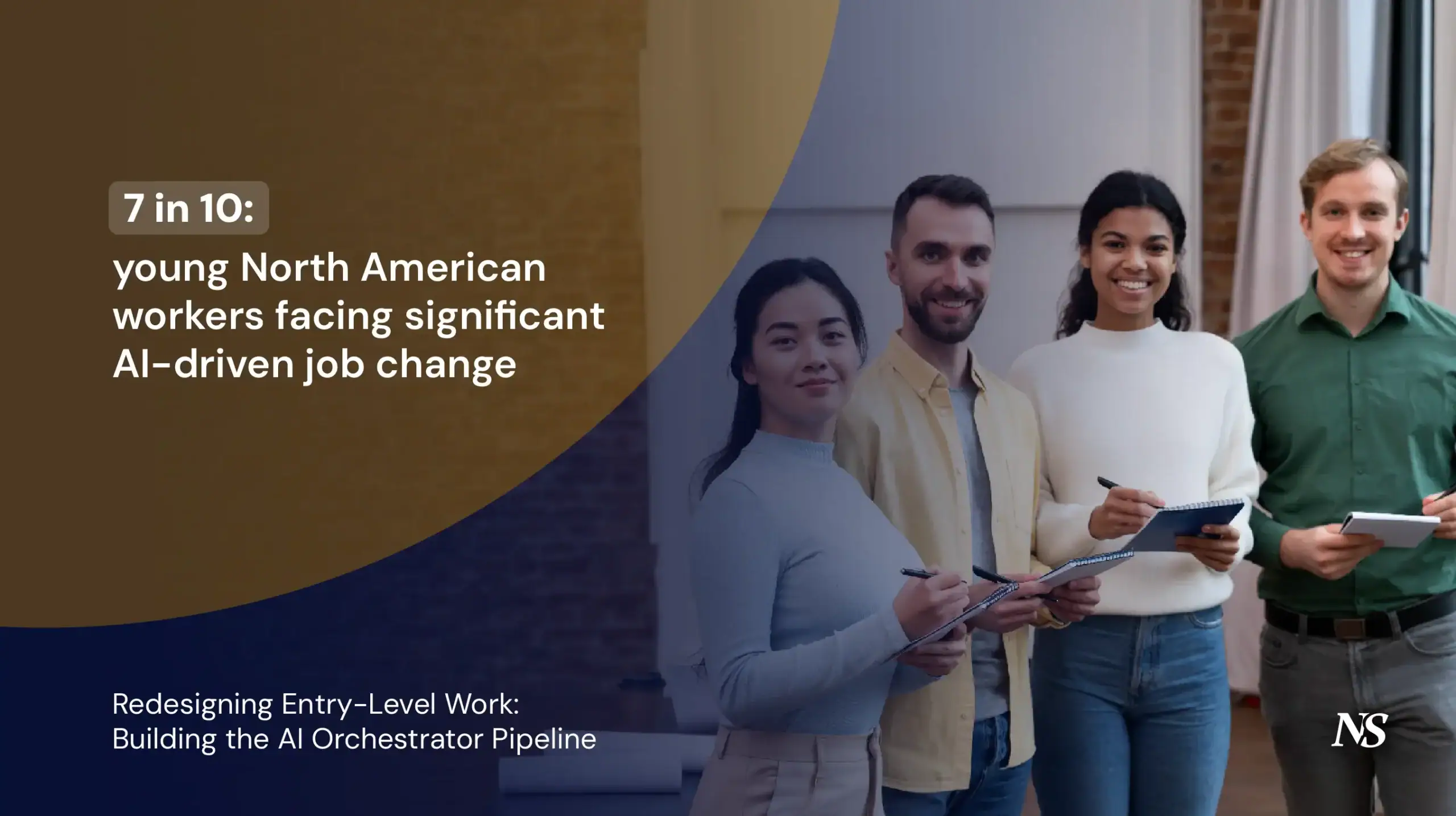
The World Economic Forum added to this discussion in June with their own report on AI’s impact on entry-level work. They found that, globally, 37% of young workers face medium-to-high job change due to AI (and as the banner above points out, this number is even bigger in North America).
Drawing from more than 9,000 workers across 48 countries, it finds that nearly half (45%) say AI is causing them to spend more time working instead of less. For highly impacted jobs, young workers are seeing more than twice the rate of change for needed skills.
How is AI changing career paths for new graduates?
Across fields, new hires report being given more responsibility than expected—empowered by AI—and this is especially true in software development. Recent graduates like Microsoft’s Ume Habiba are often stunned to find they’re getting to serious work much faster.
Habiba told Business Insider that she expected to be fixing bugs and doing grunt work, but instead was shipping a new feature right off the bat.
University of Pennsylvania Wharton School professor Peter Cappelli added:
“AI is changing the entry-level experience for an entire generation of white-collar workers. Companies really need to think through how to support these new hires.”
Much has been made of AI’s ability to take on tasks like documenting, basic research, data cleaning, writing boilerplate code, and fielding repetitive customer requests.
This is making entry-level work a whole new animal—where judgment, creativity, awareness, and communication are more critical than ever.
But with this surprising shift also come great opportunities.
As the President and Co-Founder of National Society of High School Scholars told MarketWatch:
“Young people coming into an organization should have an open mind and great listening skills and document those pain points, and then go back and use AI to come up with some possible solutions.”
As work itself changes over the next decade, new hires who embrace this “AI workflow” approach are doing more than just helping their companies grow with AI.
They’re also setting themselves on the road to the powerful new future of human AI collaboration: the AI orchestrator.
A Look to the Future of Entry-Level Jobs
Entry-level work offers companies more than just immediate production—it also is about development and restocking talent throughout the enterprise.
And while some companies report plans to hire less new graduates this year due to AI (Randstand 2026 research puts this at 38% of employers), and many layoffs are blamed on AI, other companies are taking a different course.
IKEA, for example, used AI to handle 47% of its customer calls. (This also decreased wait times, raised customer satisfaction, and saved a reported $17 million.)
By the numbers, it meant 8,500 people could have been laid off. But instead, they analyzed what customers wanted that they weren’t already providing (more interior design assistance).
IKEA then retrained these people to offer a premium service and this channel accounted for $1.7 billion (3.3% of their revenue).
And it’s expected to grow 10% by 2028.
How are companies adapting entry-level jobs for AI?
IKEA isn’t a one-off.
The World Economic Forum’s report offers several examples of major companies doing similarly clever and effective AI workforce planning for entry-level roles.
Hitachi: How do leading companies train employees to work with AI?
This Japanese conglomerate spans several industries and is a leader in redesigning entry-level roles across the business. They are accelerating their contributions (as above) while also training them to work with AI from the outset.
Hitachi makes deliberate choices on what to hand over to AI, like repetitive coordination work, while keeping developmental tasks they believe build essential skills (like judgement and critical thinking) in the hands of humans. This helps ensure more understanding of their business, too.
New hires work heavily with AI outputs, but also to develop coding fundamentals, for example, and the ability to interpret operational signals, so they can question what a system recommends.
Allianz: Reciprocal AI apprenticeship programs
The world’s largest insurance company has put an emphasis on getting the four generations in their workforce working together from the start.
Their mentorship programs help junior workers get exposed to veteran judgment and business savvy, while also helping experienced workers with AI.
This reduces generational knowledge gaps with learning opportunities for both sides and also has the benefit of getting new graduates contributing from the outset.
Dropbox: Should companies stop hiring entry-level employees because of AI?
Cloud firm Dropbox is expanding its internship and new-graduate programs by 25% thanks to AI, instead of reducing them.
They’ve found that these new hires come with AI-fluency and experience at using AI for tasks like research and coding.
They are reinventing roles with AI embedded and shifting hiring criteria to put a priority on critical judgment.
Dropbox reports that its interns and new graduates beat more experienced hires in retention, engagement, performance, and speed of promotion.
Dentsu Japan: How do I build an AI-ready workforce?
Dentsu is one of the world’s largest advertising firms by revenue, and they’ve put their focus on AI upskilling, both for new hires and their existing workforce. Their goal is to have an “AI native” workforce, and they’ve increased their training for new graduates more than ten-fold to make it a reality.
This is backed by an internal certification framework with tiers (stats from May 2026):
- AI Basic: AI tools and governance (20,000 certified)
- AI Facilitator: Applying tools within projects (1,619)
- AI Master: Advanced problem-solving in GenAI (259)
- Chief AI Master: AI strategy leadership (6)
Merck Group: Working with universities to accelerate the AI-ready workforce
The German multinational science and tech company (not the US big pharma company, though they have common origins) has partnered with universities to complement their own internal programs.
Through internships, apprenticeships, dual-study programs, and graduate development, they include data and AI training to give students exposure to strategy, governance, and real business projects, enabling them to hit the ground running.
IBM: The AI workforce strategy adding more young people, not less
Big Blue may have had a tough month at the stock market, but they’ve been strong in their commitment to entry-level workers.
IBM CEO Arvind Krishna described this approach last October:
“People are talking about either layoffs or freezing hiring, but I actually want to say that we are the opposite. I expect we are probably going to hire more people out of college over the next 12 months than we have in the past few years, so you’re going to see that.”
With an expressed plan to triple entry-level hiring in 2026, the company is like others on this list in also redesigning the jobs themselves.
As AI takes on more of the routine, they will be getting new hires into important work faster, while also ensuring the talent pipeline remains stocked into the future.
To Orchestrator: Starting an AI Workforce Transformation
We wrote a prior PTP Report about emerging this role, which has varying definitions today but looks to be increasingly essential to the work of the near future.
Orchestrators coordinate work across systems and with inside and outside partners, with a focus on end results. This means making smart decisions about where automation should and shouldn’t be, what needs to be validated, and what happens in the event of failures.
These are the very skills that so many companies are already looking at new hires to develop. With a focus on “AI workflows,” a new hire is learning the business while at the same time exploring how AI changes what needs to be done.
And while they still may lack the needed skills for fully validating work and establishing escalation rules, they are beginning the process of coordinating tasks among people and systems, while considering how workflows can be improved.
What is an AI apprenticeship?
Some companies use “AI apprenticeship” to describe upskilling, but the US Department of Labor launched an official AI apprenticeship portal at the end of April.
Its goal is to give employers resources to develop AI apprenticeship programs with several options: join an existing apprenticeship with AI, create a new program, or add AI to an existing program.
Its training modules are tailored by industry, including education, finance, healthcare, and advanced manufacturing.
Why are some companies hiring more entry-level employees despite AI?
While I covered a few specific cases above, there is another trend I want to mention from new research by Ramp and Revelio Labs.
In comparing AI spending data to workforce records for more than 21,000 US companies, they found that companies spending the most on AI are also growing employment.
That is, they’re growing their workforce by some 10% over two years after AI adoption, and expanding entry-level hiring even faster, by 12%.
The findings were a surprise for many, with low-intensity adopters not showing significant gains at all.
And while heavy AI adopters are usually larger, more-likely to be venture-backed and faster-growing, it flies in the face of some thinking about AI inevitably cutting entry-level hires.
It’s also a trend I’ve seen first-hand, where effective AI grows capacity and scale and can grow demand with it.
The Bottom Line
How can businesses create AI orchestrator roles?
Starting with young people. Workers who are AI-native from the start. Entry-level workers have always needed to learn the realities of business on the ground, and that hasn’t changed.
But today they can also provide highly needed skills and a more dramatic ability to make improvements with their AI experience and fresh takes.
This is more than the “enlightened self-interest” some economists describe—keeping our pipelines active and ensuring we’re developing the leaders of tomorrow—it’s also proving to be smarter business today, too.
If you haven’t already done so, consider creating your own “AI workflows” role.
Given initiative, a clean look, and opportunity, exciting things can happen.
References
A junior employee saved this company six figures using AI. Here’s how., MarketWatch
Goodbye, grunt work. AI is raising the bar for entry-level employees. and The hot new AI job every grad should get into, according to an AI chief product officer, Business Insider
MIT AI expert warns automating Gen Z entry-level jobs could backfire—and cost companies their future workforce, Fortune
Artificial Intelligence and the Future of Entry-Level Work: A Framework for Safeguarding and Reinventing Early Career Pathways, World Economic Forum
Instead of Laying Off 8,500 Workers Because of AI, Ikea Used This Radical Leadership Playbook to Grow Revenue, Inc.