

What skills are “untrainable”? It depends on whether we’re talking about people or AI.
Both may be relevant here, but my focus is on what people can uniquely do—and do uniquely—as opposed to AI systems.
Our most recent AI news roundup opens with this question: if companies are all using Claude, for example, what’s the competitive difference between them?
Of course, it’s how they’re using it, and for what. And maybe just as importantly, who is using it.
Microsoft made news recently for dropping most of its own Claude Code licenses, despite the tool having become quite popular in-house. CEO Satya Nadella responded by describing the challenges of a new management discipline: how to match productivity improvement to AI (token) cost.
His company, like many others, blew through much of their year’s AI budget in months. But while this experience across industries may be sounding the death knell for “tokenmaxxing,” it’s not going to slow AI coding overall.
This is just one example of the numerous new challenges companies are facing as they implement, scale, and mature with AI.
Why isn’t AI delivering the ROI companies expected?
It is the people, processes, workflows, skills, incentives, oversight, data, and judgment required that makes AI useful for real business.
While it’s frequently used as a tool in the process of doing work, this approach is often not worth the cost. And it definitely doesn’t bring the 80%+ productivity gains real AI leaders are enjoying.
In voice AI, for example, agents are providing some 70%+ first contact resolution rates (in radically reduced timeframes), large-scale inbound deflection, improved customer experience scores with improved self-service, and 40%+ average first-run engagement rates in B2B outbound calling.
But studies abound on AI ROI challenges for companies overall.
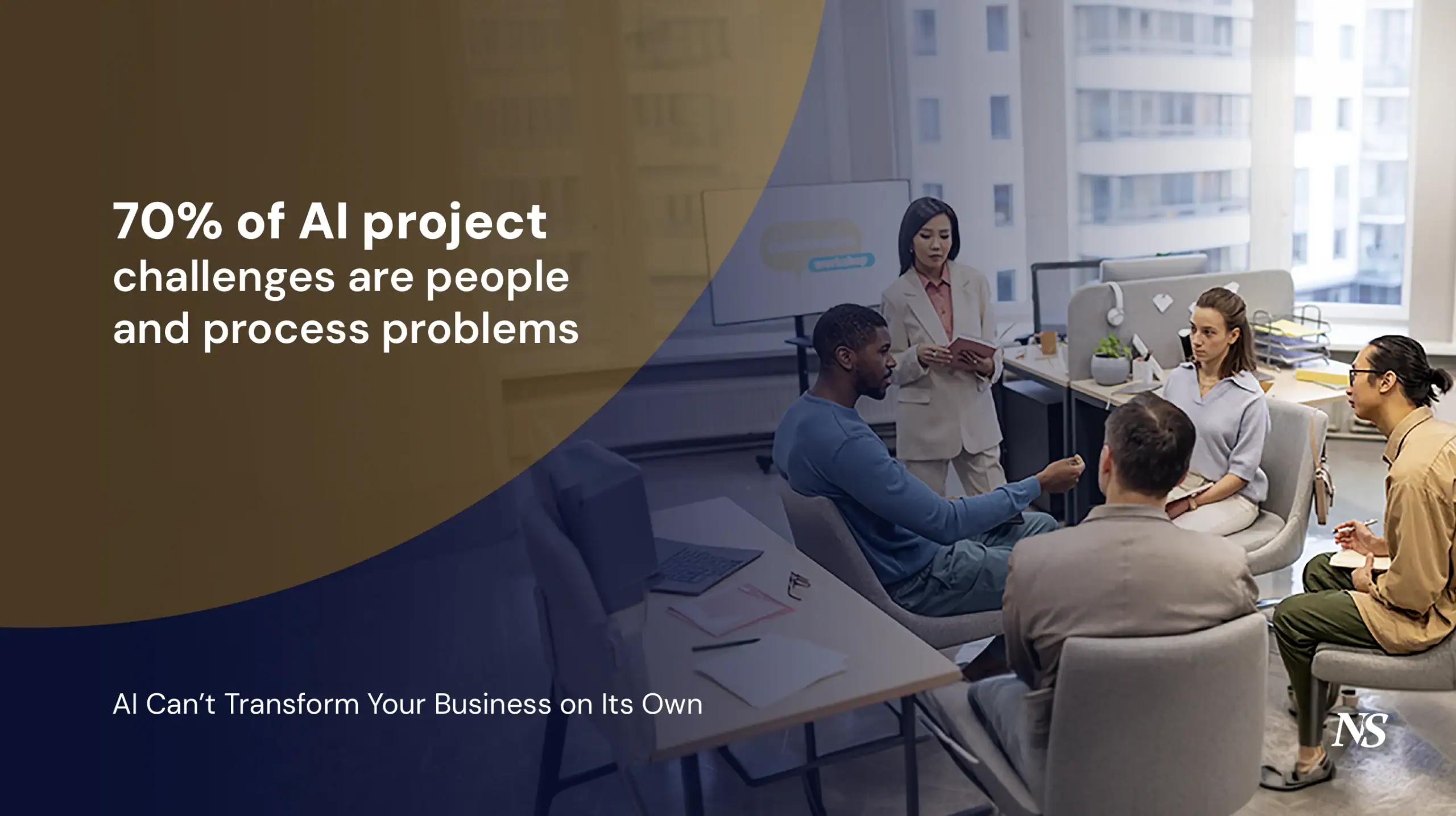
In one, BCG surveyed C-suite executives across 59 countries, finding that 74% of companies aren’t able to scale AI to generate meaningful value. (This is also the source of the headline stat above.)
A more recent survey released by Randstad Digital found that while 63% of enterprises have invested in AI training in the past year, and 60% of workers report productivity gains, 74% of workers believe they must still develop AI skills to remain relevant.
Futureproofing is critical to workers, with 23% globally reporting having quit a position because it lacked such opportunities.
Randstad Digital’s Global Head of Platform and Talent Michael Morris spelled it out as follows:
“If you increase the velocity of your tools without increasing the capacity of your engineers to govern and optimize them, you get technical debt at scale.”
But this goes past worker skills and capabilities. Workday research released in early 2026 showed that while 85% of employees say they’re saving one to seven hours a week using AI, a sizeable chunk of that time is being lost in reworking low-quality AI generated content.
How much? Nearly 40% per their research. Among employees who use AI every day, 77% report having to review AI work as carefully or even more carefully than work done by humans.
[Our most recent PTP Report references ‘workslop’ in its look at getting effective human oversight and handoffs with AI.]
How many report getting “clean, positive net outcomes” from AI?
Just 14%.
What are the biggest barriers to AI adoption in organizations?
So how do you build an AI-ready workforce?
Maybe a better first question is: How do successful companies implement AI to facilitate this in the first place?
Because while skills are critical, the “use of AI” and how AI does work are not the same thing.
I’ve cited this McKinsey study many times in articles like this, and I will (at least) one more time: AI high performers are nearly three times more likely to have fundamentally redesigned workflows with AI.
Your human AI collaboration is the competitive advantage
As our last PTP Report covered, human workers face a serious “rubber stamp” problem with many of today’s AI workflows.
The agent produces work at incredible speed and volume, and all of it looks right. But as the Workday research points to, human review ends up having to be at least as careful as it is with human work, which simply kicks the can down the road.
In voice AI implementations, this is the equivalent of having AI agents transfer most every call to humans for verification and complete.
Such approaches are more like co-work, and they do have their place. (We’ve worked with clients in models like this that have still found such voice AI warm-up brings significantly gains compared to cold calling without.)
But escalation models, where 80%+ of the work is done by AI automation and humans take on the rest (as for exception handling, opt-outs, or distress) are radically more productive.
Rather than ask humans to parse AI work, the AI takes on the simple, repetitive work that scales. It also produces the necessary artifacts needed for audit and oversight.
We’ve covered fintech firm Klarna’s incredible early customer service success stories in their partnership with OpenAI, as well as their claims that the AI transformation enabled a move off SaaS providers like Salesforce and Workday. It reportedly saved the company $40 million a year.
But after laying off some 700 members of their customer service team back in 2022, the company is today rehiring customer service team members. This as they’ve shrunk their headcount overall by 50% and anticipate it getting smaller still.
What’s changed? Their approach. Having achieved near full automation, they realized the results weren’t as good overall as a tiered approach.
Per Klarna spokesperson Clare Nordstrom:
“AI gives us speed. Talent gives us empathy. Together, we can deliver service that’s fast when it should be, and emphatic and personal when it needs to be.”
Five traits of effective and responsible AI implementation
What skills are needed for successful AI transformation?
Technical, business, and human all.
And perhaps as important as anything is experience. Yes, it requires knowing what AI can and cannot do (harder to anticipate with sophisticated software layers like Claude Code), but also data literacy, workflow design, change management, communication, governance, and (for AI) “untrainables,” like critical judgement, adaptability, accountability, emotional intelligence, creativity, and the like.
Now, before I look at my own experience with implementation, I want to draw on another third-party source, MIT NANDA’s The GenAI Divide. This study is most famous for suggesting that 95% of enterprise AI implementations are yielding no return at all.
But it also covers what was working for those companies that are succeeding. They found this included: customizing heavily for specific workflows (including simpler voice AI work), leveraging effective partnerships (including system integrators), learning from feedback, and starting small with safe, controllable pilots before scaling and expanding capabilities.
At PTP, we’ve been helping companies implement AI solutions for years across a variety of use cases. Our work has spanned industries as well, and from the most successful outcomes, we’ve developed our own rules for the road to help guarantee the most gainful, safe, and effective deployments.
I’ve boiled this down to five key things:
- Start at the business problems and refine. As discussed in the MIT report, the flashiest uses are not usually the ones that yield the biggest real gains. I believe all companies have work that AI agents can take on today safely and effectively, in escalation models that make a huge difference. The key is finding them.
- Redesign the workflow. I write this one again and again and I’m not alone. Still, it can be easier said than done. This owes debt to #1, because the right use cases lend themselves to this more easily. But the goal is not “rubber stamp” or “workslop” being handed from one worker to the next who must then fix it. The goal is automating the repetitive effectively while humans retain agency.
- Train people and systems effectively to work together. This means AI workforce transformation within the workflow just discussed. It means clear escalation paths, with context, awareness of what requires human contact. This ensures people are ready to receive work in motion and can even pass work back to the AI when it’s for routine follow-up tasks.
- AI governance and security make projects actually work. Without building this control of risk into the foundations of the project, you’re playing with fire, and likely will experience failures and rollbacks. Know and handle your risk going in.
- Measure the right things effectively. This means making sure it is all clearly identified, specified, tested, and put into action before going live. From there, it drives decision-making.
Companies that nail these five things ensure their AI business transformation sets off on the right foot.
Across studies and real-world successes, the single most common thing regardless of use case or size is this: iterate effectively.
Start small, adapt, and then scale and expand.
The bottom line: Getting enterprise AI adoption that works
One thing AI isn’t even close to doing is implementing itself.
Another is taking responsibility.
At PTP, we love helping companies get off on the right foot with AI. This is one reason we’re releasing our VOICE Framework™ that’s built from our own implementation experiences.
It gets at specifically applies the five things I described above:
- Validate the use case
- Orchestrate the workflow
- Integrate human judgment
- Control risk and customer trust
- Evaluate through measurement
Used effectively, it can be the difference between a fitful and costly AI experiment and a productive and safe AI transformation.
We help companies throughout this process, and a great place to start is with an AI readiness assessment. This helps point out areas of potential strength and weakness, and where assistance might be needed.
References
Microsoft starts canceling Claude Code licenses, The Verge
your AI investment is failing. here’s the part no one is fixing., Randstad Digital
New Workday Research: Companies Are Leaving AI Gains on the Table, Workday
The state of AI in 2025: Agents, innovation, and transformation, McKinsey
Klarna changes its AI tune and again recruits humans for customer service, CX Dive
The GenAI Divide: State of AI in Business 2025, MIT NANDA