

AI agents are here. Are they changing the way your business works?
If not, what’s standing in the way?
What I’m seeing most today is the big, real-world gap between building and operating. Between demo work that’s right down the middle, clean, easy and effective, and the bevvy of edge cases, overlaps, and policy necessities that put the freeze on the best agentic progress.
To put some numbers on it, the MIT Technology Review with Deloitte just ran a piece on real world agent-first governance. They found that 74% of companies in 2026 are planning agent deployments over the next two years, while only 21% have a governance model for the autonomy.
Nearly three-quarters of executives are most concerned about data privacy and security (73%), followed by compliance (legal, IP, regulatory at 50%) and their oversight capabilities (46%).
The agents may be here, but the combination of operational expertise and confidence is still a rare animal.
Here’s my look at why.
Bridging the 94% capability vs 33% automation gap
We reported in our last AI roundup about Anthropic’s labor market study, released in March. What’s relevant here is that they found a strikingly large gap between what AI can do and what it is actually being used for today.
They counted in theoretical capability anything LLMs can do at least twice as fast as people (in many cases it’s far more). Still, in most areas, automation coverage sits at around a third (or even less) of what’s possible.
I’m not proposing that all of this is—or even should be—attainable right now. But what is clear is that the barrier has shifted from building AI solutions to using them effectively.
And with most companies realizing the need and already investing, this means many are already paying for capabilities that they’re not fully benefitting from.
Enter AgentOps, or agent operations.
This domain is built on implementing, integrating, securing, optimizing, and ensuring your agents continue to improve, bringing you the ROI you should be realizing from their current capabilities.
Bridging the gap between AI capability and real-world adoption
I wrote last time out about getting and keeping business momentum with AI initiatives. Without this, many projects die before getting to the scale they need to make a difference.
But one thing that may still be standing in the way is control. Here I mean the controls to observe, secure, and govern AI agents across the entire business.
This includes observation—ensuring the right people are using the right agents with the right permissions, all under your policies—but it also means optimization, or, with conversational AI as an example, ensuring:
- Drop-off analysis occurs
- Prompt and workflow tuning is continuous
- A/B testing ensures success
- Continuous improvement loops maintain effectiveness
These aspects of AgentOps grow from having the strong foundation that separates blind action from effective agentic intent.
You also need the right agents, staying on the right tasks. With non-human identifies (NHI) rapidly surpassing people at many organizations, mismanagement goes beyond just sprawl. It becomes a security and governance problem, too.
One of AI’s greatest superpowers is scaling, but this amplifies the benefits as well as the limitations in your solution.
It kills the power of agents that:
- Can’t handle edge cases
- Drop mid-flow
- Stall in conversions
- Give little visibility on performance
The operational layer is where your ROI will either thrive or go to die.
Mitigating enterprise edge cases with Guardian App frameworks
One of the greatest breakthroughs in AI coding has come from agents reviewing their own work or even other agents. Increasingly, these approaches are expanding across use cases, with one approach regularly called “guardian AI” or supervisor agents.
These agents observe other agents, working from instructions on expected behavior. They watch for anomalies at agentic speed and take action. They can alert when issues are detected and also ensure behavior is adjusted.
Gartner sees this kind of agent expanding to 10–15% of the total market by 2030. Supervisor agents can already function as:
- Reviewers: Ensure AI-generated output is accurate and acceptable
- Monitors: Track action for human or AI follow-up
- Protectors: Ensure permissions remain appropriate, and adjust or stop agent actions during operations
Gartner projects 70% of all agent apps will be using multi-agent protections like these within the next two years.
In conversational AI, we’ve seen edge cases also lead to significant financial impact for companies struggling at the operational layer.
In a healthcare context, this means agent issues with:
- Patients asking unexpected questions
- Multiple intents being present
- Necessary context is missing
Ultimately, this kind of coverage is essential in the real world—and the difference between functional AI and great-looking demos.
Supervisor agents also enable scaling without manual QA, bring faster iteration cycles, and help you guarantee higher reliability overall.
Observability vs. monitoring: Tracking the ‘why’ behind agentic reasoning
What’s consistent across successful implementation is that success requires multiple layers, while many companies today are finding themselves stuck at first.
This agent layer is the commodity, in this context SMS bots, voice assistants, or chat interfaces. Here the entry cost is getting lower, the tech to build them more mature, with most engineering teams able to reliably and quickly get them on their feet.
But that is just the starting place. Real AI orchestration requires the infrastructure to be in place that determines when and how agents act. This means what channels are used, in what sequence, with what retry logic, and what permissions and system connections must be in place.
Scheduling agents, for example, are worthless if they can’t read from and update to the necessary systems, remind the right participants, and handle rescheduling easily and consistently.
This is layer two, and the functionality is critical, but it’s not enough to get most businesses where they need to be for both safety and real value.
The optimization layer is the critical advantage and where ROI is really made or lost.
This is where monitoring occurs, as well as analysis, fine-tuning, and A/B testing against the outcome metrics that matter most. This is where continuous improvement loops are informed by your multi-agent infrastructure, and where you close the capability-to-use gap.
Currently, it’s also arguably the biggest area of need for many organizations that have deployed agents but are still struggling to get enough from them.
AI ROI, healthcare AI automation, AI efficiency, and observability
Okay, so this all sounds fine and well. But let’s look at it in action.
Here is an example of conversational AI agents deployed with effective optimization:
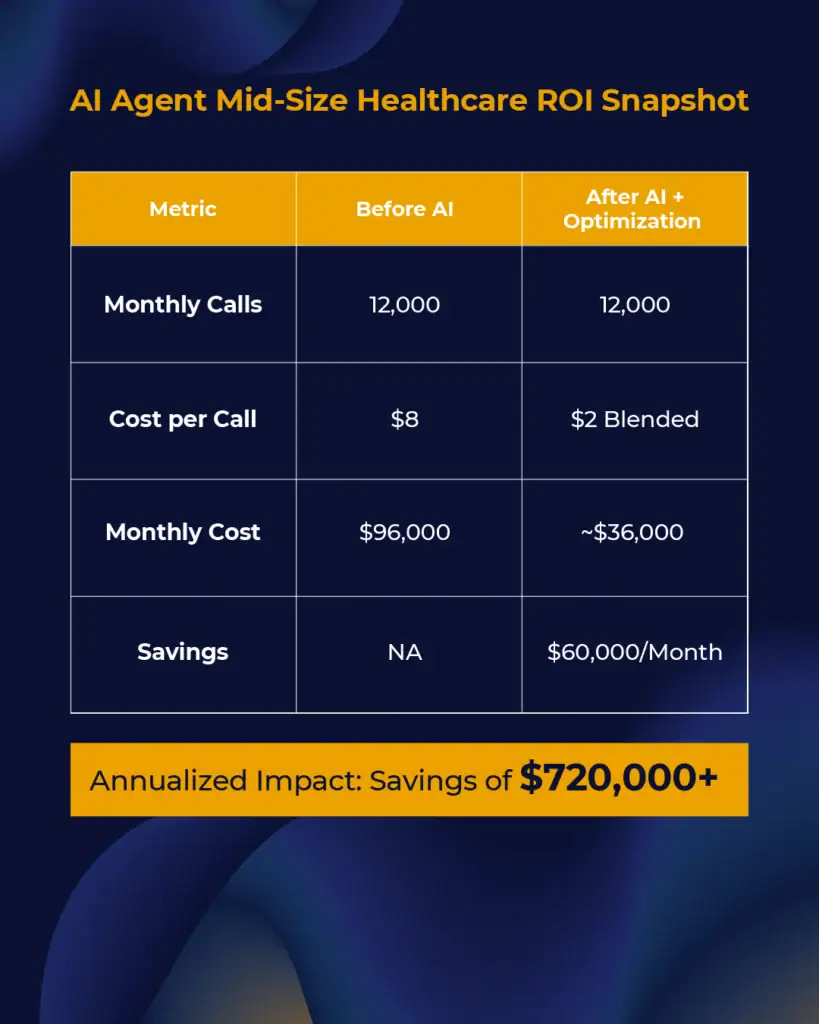
In this case, the company has moved past the “how do we deploy agents” question and instead has focused successfully on governance and getting measurable (and steadily improving) ROI. This has enabled them to shift their investments, work structures, and even improved patient outcomes.
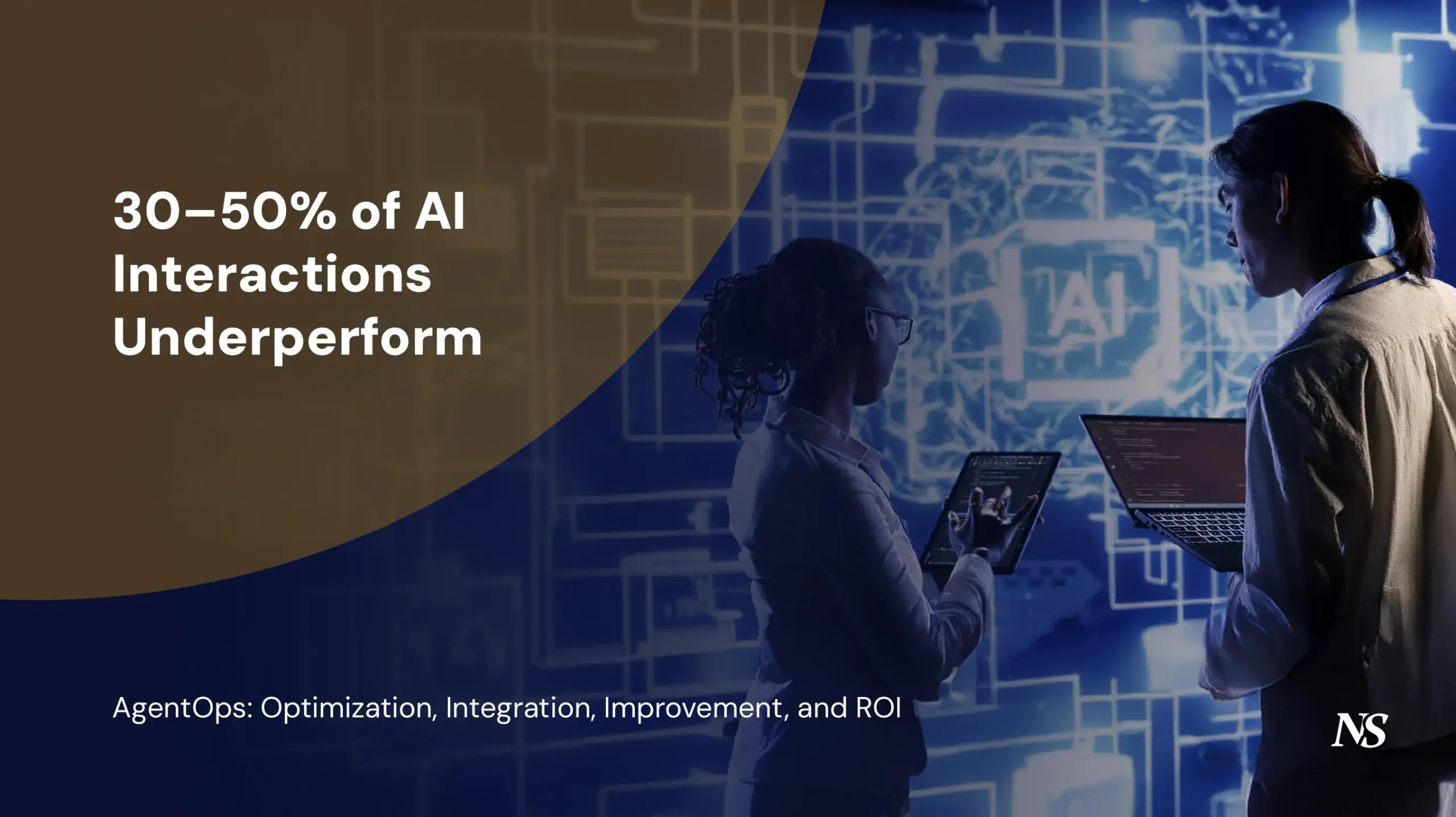
Here we see inbound call automation at scale, with 30–50% being handled successfully by AI.
Appointment conversions have also surged, with missed appointments being cut by a quarter (15–25%), and bookings up (+20–40%) due to smart reminders and follow-ups that work.
Overall, patient satisfaction rates are also up, due to significantly faster response times.
From a staffing point of view, they’ve seen a 40–60% reduction in manual call handling, which relieves hiring pressure and has enabled workforce redeployment, shifting more quality and care to high-value patient interactions.
How is this done? With effective, mature AgentOps and a structure that ensures adaptable and effective agent outcomes cover more of what the business actually needs.
It’s also been achieved on timelines that matter—not in18–36 months after initial investment—and as an ongoing innovation that grows and adapts with the business, as well as with emerging AI.
The bottom line
When agents first appeared in 2024, companies were experimenting with the technology, exploring use cases, sandboxing their execution, and dealing with high failure rates.
Last year we saw AI agents break through, providing consistent performance with far greater reach and depth.
So far in 2026, I’m seeing AgentOps emerge as the newest distinction between capable vs transformative implementations. Guardian agents are a growing solution for monitoring and optimization, but they don’t work as a bolt-on tool.
Effective implementations have orchestration and optimization layers as part of their essential foundation, ensuring they succeed today and continue providing lasting benefits.
If your company is looking for agent solutions that perform at scale and bring measurable ROI, talk to us.
References
Building agent-first governance and security, MIT Technology Review
Labor market impacts of AI: A new measure and early evidence, Anthropic
Gartner Predicts that Guardian Agents will Capture 10-15% of the Agentic AI Market by 2030, Gartner