I want to start by considering two very different companies: the first, well over a hundred years old, has multiple thousands of employees. It operates across a broad category of industrial products and in 2025 neared two billion dollars in sales (landing it well in the top half of the Industrial Distribution Big 50 for 2025).
The second firm was founded late in 2024. It had just one employee until this year (now two and some contractors), but in 2026 is on track to match or even exceed the company above in sales (as validated by the New York Times).
“It’s not an AI company, but I did it with AI,” its founder, Matthew Gallagher, said. He got it on its feet in two months, with $20,000 and a dozen AI tools. That’s all it took to get this telehealth company, Medvi, up and running.
And by the end of 2025, it had more than 250,000 customers.
Is this like comparing apples to oranges?
In some ways. But industrial distributors are among the businesses already seeing the impact from startups like Gallagher’s, working across products, industries, and nations.
In today’s newsletter, I take a deeper look at this dynamic and what we’re learning from it: how startups like this are competing with enterprise industry leaders, and two concrete ways that leading players can harness these advantages for themselves.
Is AI a threat to your business?
The answer is yes. But it’s also a massive opportunity.
The Startup Surge: How AI Is Disrupting Traditional Industries
The AI startup success story is less about replacement and more about the margins.
These approaches work by attacking (and collapsing) inefficient workflows: product discovery and intelligence, quoting, forecasting, routine procurement, and customer self-service. They thrive by pairing speed and relative ease with cost efficiencies that come from not fielding their own massive sales, IT, or customer service teams.
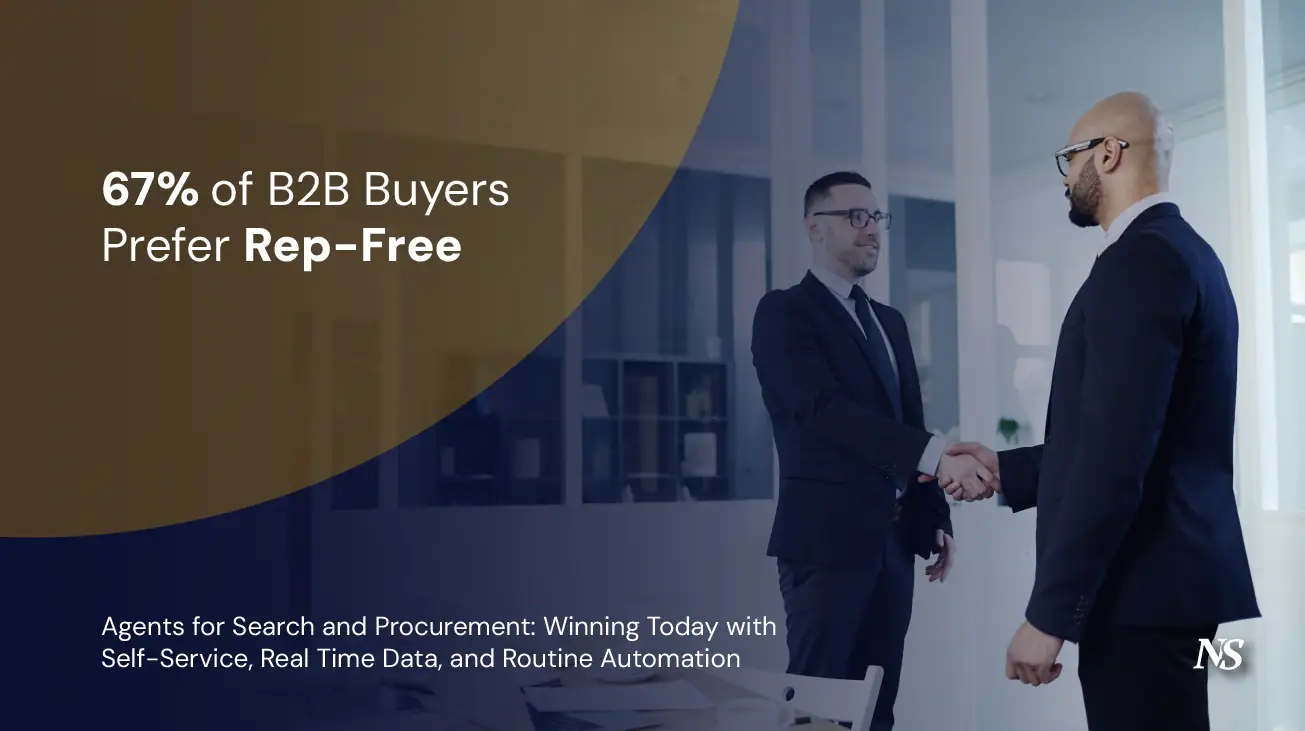
And as our banner stat points out, buyers are hungry for some of these changes across the board. Gartner’s March sales survey found that 67% of B2B buyers preferred going rep-free, with nearly half saying they’d also used AI for a recent purchase.
Companies like Medvi, Didero in supply chain, and Levelpath, Zip AI, and Oro Labs for purchasing, are thriving by inserting themselves between buyers and suppliers.
Zip’s scale—processing more than $355 billion across more than seven million suppliers last year—shows this isn’t a flash in the pan.
And while they can’t compete across the board, they are providing an offering that’s easier, faster, and more direct; eroding value that established companies have spent decades building.
But these advantages can also be tapped in-house and without radical overhaul or requiring enormous investments.
First Fix Product Discovery
The easiest, fastest, and most effective way to leverage these AI benefits in industrial distribution and procurement is with product discovery.
Customers no longer need to deal with ineffective on-site searches, or sitting on hold, waiting for inside sales reps who are themselves digging through PDFs, ERPs, spreadsheets, or running down siloed individual expertise.
Many procurement teams already start with contracted distributors, but when they don’t get what they want, quickly pivot to services like Amazon Business. Here they get simplified searching, substituting, and buying. They want easy answers, as well as delivery and purchase controls.
Product Discovery Agents are a solution to bridge these two systems. They are built on conversational AI and translate natural language buyer queries to structured product catalogs, pricing, or contract parlance. They’re trained with deep knowledge and access to current inventory, and work with substitution intelligence, making them radically faster than human call centers and more effective than online catalogs.
They talk with customers—enabling search the way people actually think—to deliver the speed and efficiency that buyers crave.
They draw from your catalog and product attributes, rapidly check documentation, and are fine-tuned to reliably provide price, lead time, inventory, approved alternatives, and Q&A on things like technical documentation.
Caterpillar is the world’s largest manufacturer of construction equipment, and they’re using agents like these to solve problems their prior innovations only made worse: complexity for their customers.
Their high-quality digital solutions—including things like inspection tools, fleet management dashboards, condition-monitoring systems, multiple mobile apps—solved a number of problems but put added burden on users to learn, understand, and work across numerous systems.
Now they’ve disrupted themselves to stay ahead of competitors—bringing everything together with their Cat AI Assistant, powered by natural language conversation.
This system works across 1.5 million connected assets, accessing operation and maintenance manuals, parts catalogs, customer purchase history, and more. It’s being embedded across Cat applications to allow users to ask what parts are needed for maintenance, but also to answer when their next maintenance is due, the status and usage of their assets, and, when they’re ready, will schedule appointments at their nearest dealer.
These agents simplify and accelerate, getting customers what they need in a fraction of the time.
Ultimately, they remove unnecessary complexity for both sides and stop enterprises from hemorrhaging buyers when what they need can’t be found quickly and easily enough.
From B2B Self-Service Platforms to Automated Routine Procurement
But solving product discovery is only one part of the process.
The next low-hanging fruit is to automate the repetitive parts of your buying process.
AI-Mediated Buying Agents leverage AI for another highly manual and cyclical part of the process: routine procurement.
These AI agents monitor inventory, compare supplier pricing in real time, and conduct transactions, only routing to humans for exceptions.
Today this process is often highly manual at many organizations, with inventory monitored in one system and supplier pricing kept somewhere else. Contracts may be accessed in a third process, or siloed with another expert, while exceptions get managed slowly via email or exchanged calls.
These bottlenecks can now be safely and effectively collapsed by AI: comparing suppliers, digging up policy or contract data, checking pricing, routing approvals, and updating systems in real time.
AI-Mediated Buying Agents work across intake, approvals, sourcing, contract review, payments, and inventory processing. They accelerate the process by multiples of 3+, while also integrating directly with SAP, Oracle, and JDE. They remove manual mistakes and the layering of additional systems on top of the process and reduce complexity by centralizing and simplifying.
They are trained on your data for deep knowledge on contract terms and pricing, and they work by simple rules the business controls: monitoring inventory levels and thresholds in real time. They compare supplier options and choose the best fit within the rules.
By compressing the workflow, these agents reduce repetitive human efforts across sourcing and follow-up by as much as 30% (BCG) and cut overall costs between 15 and 45%.
Toyota has long made use of AI and its associated technologies, from machine learning to improve engine performance to embedded GenAI in its products.
Today, their agent-driven global planning system is replacing an old process that involved some 75 spreadsheets, more than 50 team members, and countless hours of manual planning work.
Their AI agents pull in demand, check supply, watch thresholds, compare options, and do routine analysis. They handle the regular, repetitive work (optimizing in the process), and leave only the challenging solutions and most advanced work for humans.
Here again, the routine and repetitive bottlenecks that open the door to competitors get removed from the process, lowering logistics and procurement costs in the process.
Beyond the Hype: Utilizing AI Agents in Your Business Now
These are two ways that enterprises are rapidly and easily adapting to capitalize on the benefits customers are seeking from smaller players like Medvi, Didero, and Zip.
Both thrive doing what today’s automation does best, safely, efficiently, and securely. They automate the routine and repetitive and collapse areas of unnecessary waste that are increasingly being put under pressure by faster, smaller challengers.
The Product Discovery Agent handles self-service and makes it simply easier to buy.
The AI-Mediated Buying Agent automates the cyclical and repetitive that’s pulling so much unnecessary human time and attention today.
Incumbents in industrial distribution have enormous advantages over newcomers: years of transaction history with invaluable data, deep relationships with suppliers, and customers who want to continue to work with them.
Deploying agents like these moves past playing defense. They improve what you do well today to help you stay more flexible and relevant tomorrow.
Why PTP over Anyone Else?
At Peterson Technology Partners, we’re experienced at building and implementing AI agents like these.
With more than 28 years of enterprise technology experience serving Fortune 500 companies, more than 500 award-winning consultants and engineers worldwide, and an AI-first approach that informs everything we do, we ensure secure, effective solutions that are readily scalable and also productive from the start.
Our merger of best-of-breed AI solutions and patent-pending in-house innovation delivers AI voice agents, testing and knowledge base automation, digital twins, and AI-driven CRM and analytics.
We’ve leveraged AI to help companies generate hundreds of thousands of dollars from dormant accounts in months, transform manual and siloed processes for greater efficiency and stability, automate forms, contact, and customer service, and radically improve QA and testing coverage.
PTP provides the AI products, services, and teams that move the needle now and keep it moving tomorrow.
Book 30 minutes for a live demo to see what our focused, practical, and secure AI execution can do for you.
Conclusion: The Time Is Now for Effective AI in Industrial Distribution
The AI threat is real.
But the same thing that’s exposing institutions to lighter-weight challengers can also transform them into stronger, faster, and better businesses.
AI agents make it easier for customers to use your business and improve the flow and reliability of the services you offer.
It doesn’t take radical overhaul—ripping out systems and losing valuable talent—or dedicating extensive time and resources to see eventual ROI a year or more down the road.
The time is now. Disrupt yourself or be disrupted.
References
Gartner Sales Survey Finds 67% of B2B Buyers Prefer a Rep-Free Experience, Gartner
The 2025 Industrial Distribution Big 50, Industrial Distribution
How A.I. Helped One Man (and His Brother) Build a $1.8 Billion Company, The New York Times
Didero lands $30M to put manufacturing procurement on ‘agentic’ autopilot, TechCrunch
GenAI in Procurement: From Buzz to Bottom-Line Cost Reductions, BCG
From Dirt To Data: How Caterpillar Is Reinventing Construction With AI, Forbes
Reimagining operations with agentic AI at Toyota, Deloitte