

AI-driven QA automation is no longer the next big thing in tech. It’s already the standard for successful businesses.
But this still relatively new tech phenomenon still has some mystique to it—and that’s why we’re answering all your potential questions about using AI agents for QA automation, now and in the future.
What is agentic AI testing in software QA?
Agentic AI testing uses autonomous agents that mimic real QA testers—monitoring in real time, integrating with workflows, and evolving for smarter testing.
How does agentic AI testing work in automation?
AI agents power test automation in a variety of ways, including:
- Generating, updating, and maintaining test cases
- Finding bugs before they deploy
- Reviewing code in real-time
- Never getting burnt out
How do AI agents autonomously perform software testing?
AI software testing agents are trained to do more than just generate test scripts; they can autonomously:
- Refresh test data
- Trigger CI/CD pipelines with code changes
- Learn and improve their testing process over time
That last one is key. It’s what makes the QA process agentic and not just another chatbot.
Agentic AI testing vs traditional test automation: what’s the difference?
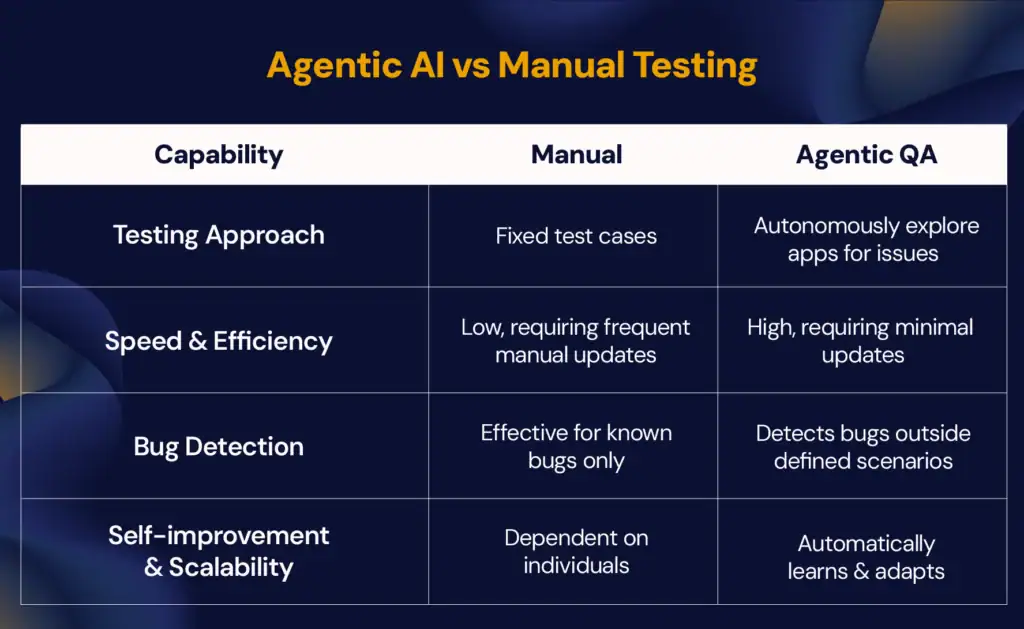
Agentic AI takes QA to another level, beyond just mimicking human software testers. Here are some of the key differences between agentic and human testing:
What are the benefits of agentic AI in software testing?
- Faster Sprint Automation: QA becomes embedded into DevOps—handling test cases, finding bugs before they deploy, and reviewing code in real-time.
- Better Code Quality: AI reviewers cover more, enabling them to catch what humans miss, and without getting burnt out.
- Smooth Integration: Testing agents seamlessly integrate with Git, JIRA, Jenkins, and Report Portal for real-time feedback without workflow disruption.
- Constant Improvement: AI QA agents continuously evolve by analyzing bugs, regression patterns, and release history to improve accuracy and efficiency.
Here at Peterson Technology Partners (PTP), we have seen our QA agents achieve the following for our clients:
- 50% faster sprint automation
- 80% better code quality
- 70% faster root cause analysis
Can agentic AI replace QA engineers?
While AI testing agents mimic the work of human QA professionals, they are not fit to replace them.
In fact, research by Anthropic found that, while developers use AI in roughly 60% of their work, they report being able to “fully delegate” only 0–20% of tasks.
Meanwhile, GenAI is now the top-ranked skill for quality engineers (63%), according to The World Quality Report 2025–26.
That’s why the most competitive companies see AI agents as a constant collaborator, requiring human experts to contribute:
- Thoughtful set-up and prompting
- Active supervision
- Validation
- Human judgment
What are real-world use cases of agentic AI in testing?
- AI Test Script Generator: Build complete test suites automatically, from user flows to edge cases—fully documented and Git-ready.
- Bug Detection Agents: Agents enable bug detection using AI that inspects every build, flags hidden issues, and provides actionable diagnostics instantly.
- Smart Regression Analysis: AI also maps failed tests to impacted modules, shortens triage cycles, and reduces noise in test results.
- BDD Assistants: Autogenerate Gherkin steps that are clean, readable, and ready for business review.
- Test Data Agents: Test data generation with AI autonomously builds and maintains your backend test data—meaning no more stale, missing, or duplicate data issues.
What tools or platforms support agentic AI testing?
Most AI testing agents are easily integrated into any tool that might be part of your current QA setup—making agentic QA an enhancement, not a replacement.
The following tools integrate smoothly with testing agents:
- Git
- JIRA
- Jenkins
- Selenium
- Report Portal
- Custom-built frameworks
How can you implement agentic AI testing in an enterprise?
The most reliable way to implement agentic AI testing in your business is to research potential consulting partners who can offer expertise and even the talent to ensure all the tech is handled effectively and securely.
[Learn how to keep your AI-powered software testing secure in this PTP Report.]
Is agentic AI the future of QA automation?
Yes, and it’s also the present. So, if you aren’t looking into how AI testing agents can help you keep up with the competition, now is the time.
PTP is an AI-first tech consulting firm with nearly three decades of expertise in the most cutting-edge technologies. If your company needs guidance, we would love to talk.