Choosing the right talent acquisition strategy can impact critical business factors, including cost savings, flexibility, and project delivery speed.
Outsourcing tech talent has become increasingly popular in a post-pandemic landscape, but there are different ways to outsource that could be the better fit for your business.
This article outlines the key differences between nearshore vs offshore outsourcing, so you can decide which method will lead to better business outcomes.
What is the difference between nearshore and offshore outsourcing?
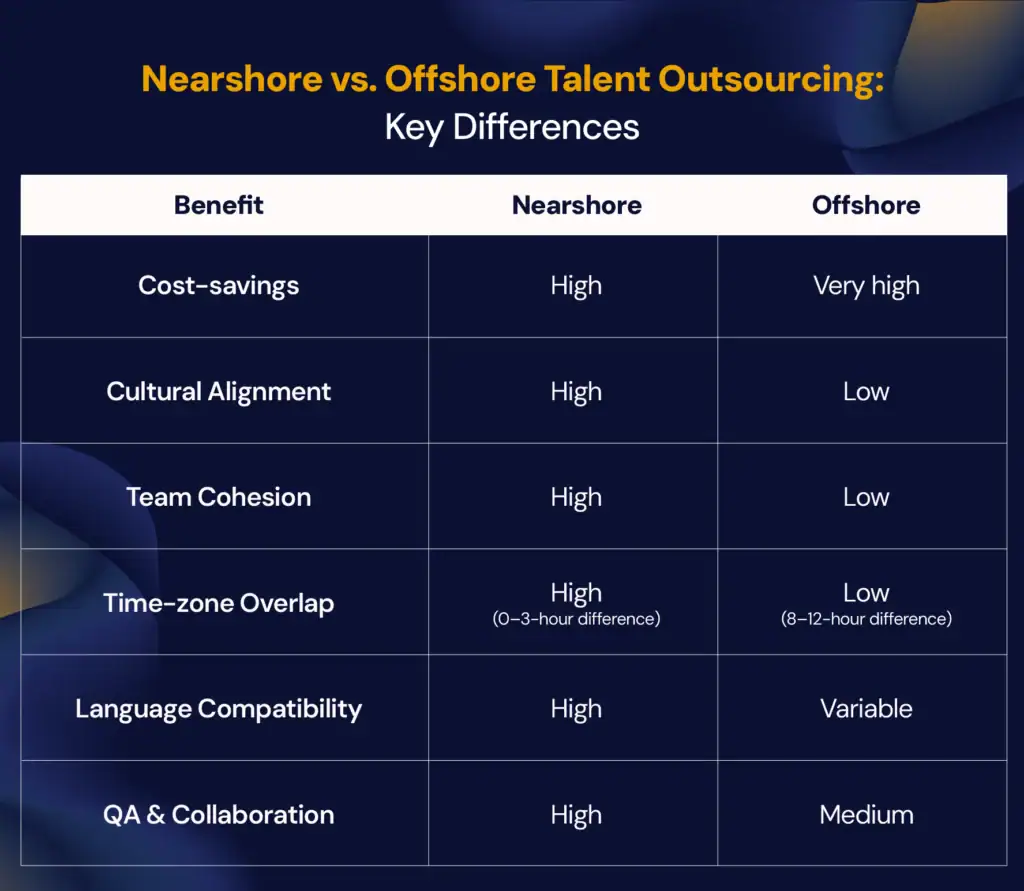
Both nearshore and offshore outsourcing pose similar cost-savings for businesses, but each offers specific benefits for different business needs.
Some key differences between nearshore outsourcing vs offshore outsourcing:
- Offshore: Recruiting talent from across the globe is a great move when cost is the ultimate driver and round-the-clock coverage is needed.
- Nearshore: Recruiting talent from nearby regions with overlapping time-zones is best when team cohesion and oversight are critical for project speed and success.
[Read our CEO and Founder’s most to-the-point definition of nearshore staffing.]
Which is better: nearshore or offshore outsourcing?
Let’s explore some nearshore and offshore outsourcing advantages and disadvantages:
Is nearshore outsourcing more cost-effective than offshore outsourcing?
Typically, nearshore outsourcing is not more cost-effective than offshoring, though there are many variables that can impact this.
Specifically, PTP has tracked percentage savings for software developers in the ballpark of 60–64% for onshore vs offshore, and more like 41–45% for onshore vs nearshore.
What are the advantages of nearshore outsourcing?
Key nearshore outsourcing benefits include:
- Better time-zone, language, and cultural alignment
- 40% reduced project delivery times compared to onshore
- 20–45% reduction in hiring and operational costs compared to onshore
What are the disadvantages of offshore outsourcing?
Although offshore outsourcing offers convenience and cost-savings, it lacks the critical oversight needed for coordinated IT projects.
Additionally, it’s important to consider: What are the risks of offshore outsourcing?
- Bottlenecks from trying to meld Agile approaches, i.e., with offshore schedules and language barriers
- Regulatory and legal risks like misclassification of workers
- Geopolitical tensions causing potential disruptions, greater technical costs, and less stability and security
How does time-zone impact nearshore vs offshore outsourcing?
The more overlap workers have in terms of time-zones, the more they can coordinate collaborative tasks, like Agile development sprints.
So, if your priority is software development and other time-sensitive projects that require oversight, nearshore talent sourcing is the right move for you.
However, if your teams are working on tasks that can be easily handed off and worked on asynchronously, offshoring will work just fine and save you a bit more money.
How do companies choose between nearshore and offshore outsourcing?
Companies choosing between nearshore and offshore talent solutions need to consider:
- The amount of oversight and coordination the project requires
- Whether you need a couple of experts or full sprint-ready teams
- The importance of cost-savings and flexibility to your operations
When should a business choose offshore outsourcing over nearshore?
Offshore outsourcing may be the right choice for businesses prioritizing cost, where oversight and coordination are not as critical.
Offshoring can also be the better choice for an organization in need of round-the-clock coverage, also known as “follow-the-sun” schedules.
Finally, offshore recruiting also tends to offer deeper talent pools. However, this is partially because nearshore is relatively new, and staffing partners like PTP have been in the nearshore game for decades.
[Here are our top picks for the best nearshore staffing firms—take a look!]
Which outsourcing model is best for software development?
Software development is particularly suited for nearshoring talent.
Nearshore software development outsourcing models prioritize both cost savings and team cohesion, as Agile software methodologies require developers to work synchronously a significant amount of the time.
Conclusion
As soon as your hiring team has a firm grasp on when to use onshore, nearshore, and offshore talent, you will immediately see more cost savings, faster delivery times, and better quality when it comes to your IT projects.
For a partner with the best of each world, consider Peterson Technology Partners, an “allshores” tech staffing firm with nearly three decades of experience. Get in touch about your hiring challenges today.