

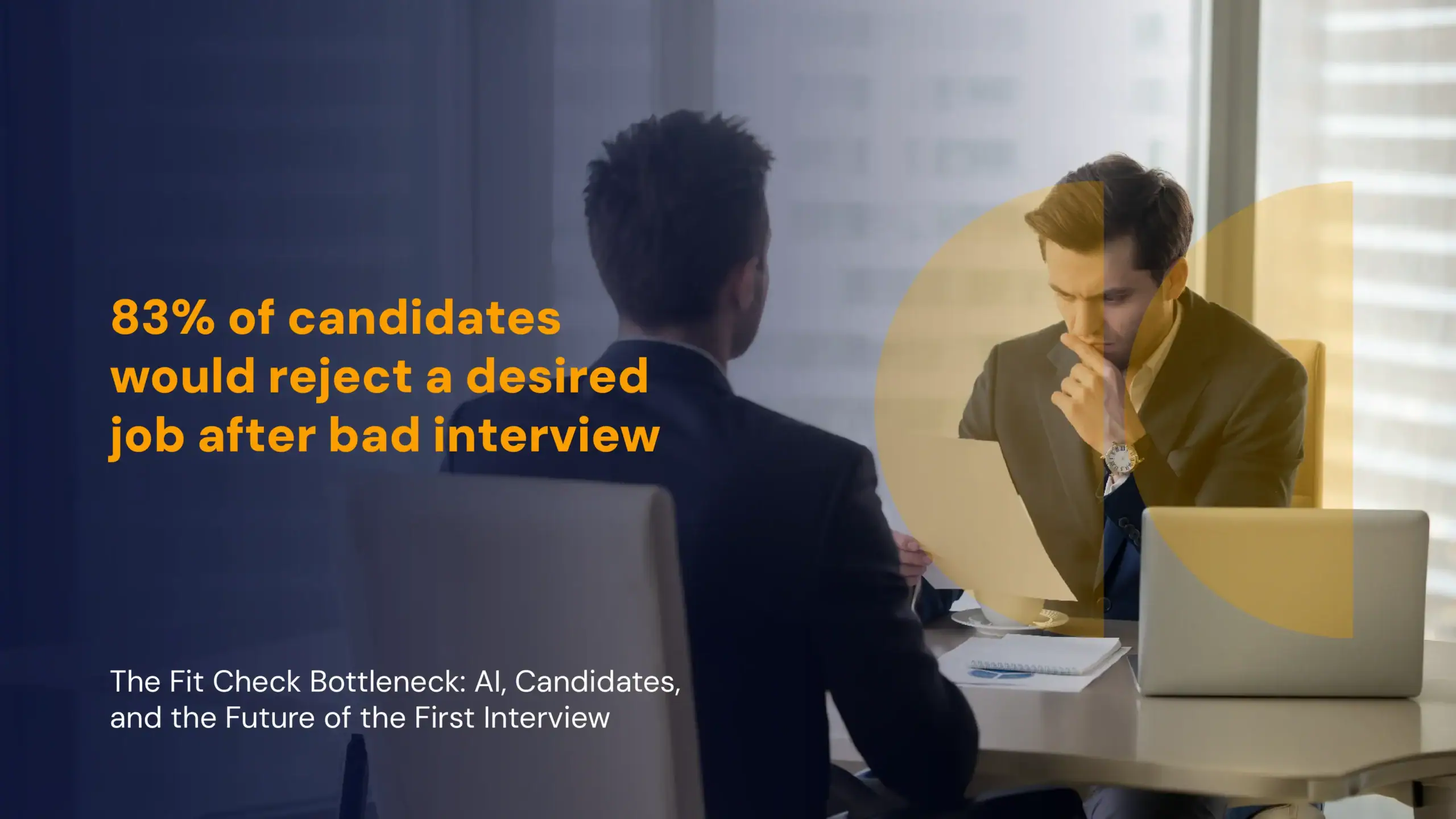
Tell me about yourself.
93% of hiring managers ask this question, making it probably the most commonly asked interview question of them all.
It’s supposed to ease candidates in and let them get comfortable while also giving interviewers a chance to hear if they can relate their background to the position being considered.
This, like first interviews overall, serves as a warm-up, first impression, and initial filter for everyone.
How serious is the candidate, and how professional is the company doing the hiring?
Can everyone handle a brief conversation to check qualifications and fit? It’s where the paper (or pixels) and reality first really meet.
So why are so many companies now handing it over to AI?
As innocuous as it seems, the first interview is a place in hiring today where the process starts breaking down.
The Role of First Interviews in the Hiring Process
It’s always been a big ask from a small thing.
The first interview is supposed to be conversational but also perform important filtering. It should be fair and unbiased but also friendly and adaptive.
It’s supposed to be fast and accurate.
For some companies, the first interview serves as a reality check: do the location and availability work? Can this person communicate, do they match their resume, and do they have work authorization?
For others, it can be more of a culture screen: Does this feel like someone who can work successfully for this company?
Sometimes there’s a technical aspect—the bare basics usually—administered by someone who may not have the technical background.
For staffing firms, these interviews also include a necessary security function. With the rise in fraudulent candidates and AI deepfakes, they’re tasked with ensuring the firm is dealing with a real person, and also the real person indicated in their credentials.
For a short initial chat, that’s a lot to get done.
And as anyone knows who’s been through these interviews for different companies, the experience varies wildly.
They can feel completely general, or zero-in on role-specific questions. Candidates can be asked to explain how they’ve navigated difficulties, failed at a task, or gone the extra mile; or they can cruise through with affable generalities.
As with any interview, a candidate may feel it went great and still get rejected, and the interviewer can get excited about a prospect only to have them suddenly drop out of the search.
And in all cases, delays and ghosting increasingly reign supreme.
Why Todays First Interviews Mean More in Candidate Screening
Time is money and delays can also cost firms great talent.
In high volume hiring, this stage has become a surprising chokepoint for companies, because of the time pressure, reduced volume of recruiters, and necessity for mix-and-matching large numbers of schedules ASAP.
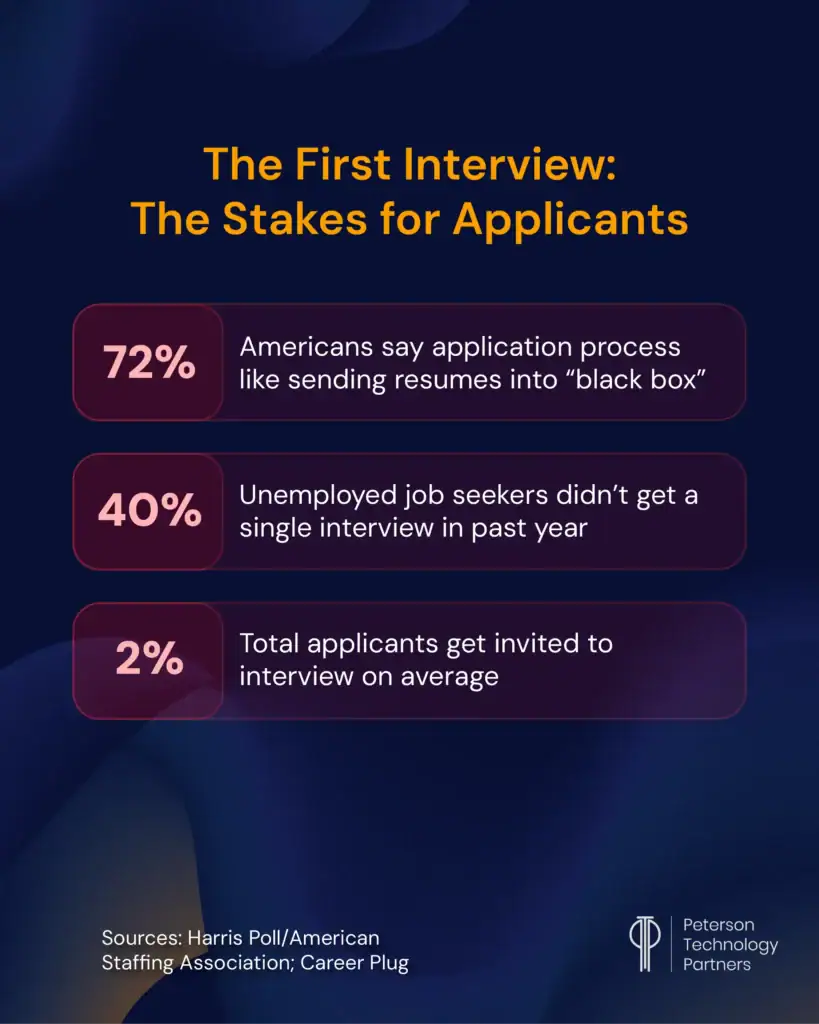
For many job seekers, they’ve also become far more elusive. Every year, more unemployed job seekers report not getting to interviews at all.
For businesses on the other side, AI is helping manage a surge in application volume with submitted materials that have also become increasingly similar.
PTP’s Founder and CEO wrote late last year about these trends: noting cases where 70%+ of cover letters and resumes are either entirely composed or heavily revised by AI, 62% of hiring managers firing new hires because skills didn’t match materials, 95%+ of applications for many positions not meeting the basic requirements, and recruiters having to review 71% more candidates than the prior year.
Research from Greenhouse (spanning 2022–2025 and looking at data from more than 6,000 companies) charted a 412% increase in annual applications.
To sum it up, first interviews are under increased pressure from surging applicant volume, less recruiters are asked to do more of them, they’ve become far more elusive for candidates, and the interviews themselves are expected to achieve more than ever before.
Recruitment Automation Is Taking on More and More
This is why AI use is surging.
While some business use cases look to AI to provide new capabilities or profit, in recruiting it’s largely being deployed as a means of survival.
Anything that’s repetitive, time-sensitive, and overwhelmed by volume has become a hot candidate for automation. This includes communication (which, as our CEO noted in the article referenced above, has been in bad shape in hiring for some time), scheduling, initial materials review, and now first interviews.
An initial interview meets many of the criteria for effective and compliant AI use: the process is repetitive, it’s constrained by bandwidth, it requires verification of documentation and careful documenting, and it’s not a final check.
While first interviews can frequently be unstructured and variable in practice, they’re far fairer when they are structured and consistent. AI interviewers can also check identities, identify missing materials, flag potential problems, and focus-in on relevant issues for more rapid human follow-up.
Is AI Really How Companies Can Speed Up the Hiring Process?
Definitely yes to speeding up. But of course, there are abundant complications (see below).
2025 research by Brian Jabarian (University of Chicago) and Luka Henkel (Erasmus University Rotterdam) examined the impact of AI voice agents vs human recruiters.
Their work took 70,000 job applicants across 48 positions and 43 client firms and randomly assigned applicants between the two, with human recruiters ultimately evaluating all results and making the final hiring decisions.
There were significant benefits for both sides with screening automation: the AI-screened candidates were 12% more likely to get job offers, had 18% more job starts, and enjoyed 17% higher retention after four months.
As their work notes:
“AI voice agents achieve controlled variance: structured and consistent interviews that remain responsive to individual applicants, collecting more hiring-relevant information.”
AI Recruiting Risks for Candidate Experience
We’ve written before about some of the risks of using AI in hiring. AI is not popular overall, and though the majority of candidates (60%+ depending on the source) use it on their own materials or in the submission process, applicants remain concerned about the limited number of backend systems analyzing materials.
This is demonstrated with more than three-quarters of applicants wanting a legal requirement for disclosing AI use in interviews.
63% of candidates have already had an AI interview of some kind, but for most (70% per Greenhouse) it came as a surprise.
AI interviews are meant to fix the bottlenecks present around first interviews as well as the communication falloffs that consistently poll among candidates’ least favorite thing in job searches (the hiring “black hole”).
Yet as many as 38% of candidates still don’t hear back, even with AI interviews.
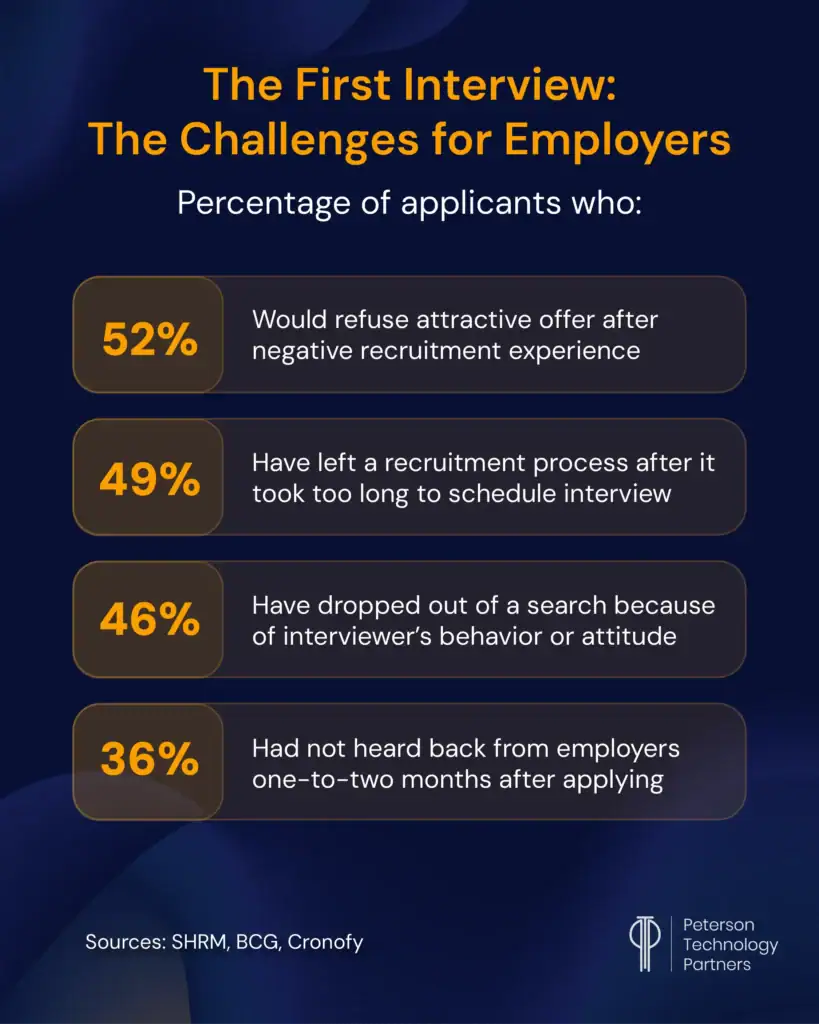
As we’ve noted across businesses, AI solutions can magnify problems that already exist, and that’s also proving true in recruiting.
Structured interviews are routinely shown to be fairer, and yet AI interviews are often being implemented with extreme variation in format, structure, and outcomes.
Much of their success, as ever, depends on their requirements, training, tuning, and effective use in workflows.
AI Hiring Tools Need More Structure
A study by researchers at MIT and the University of Texas at Austin provides one example of this “magnification problem” from some AI use in hiring.
Looking at the tension between what they call exploitation (selection from proven groups) and exploration (selection from under-represented groups to expand learning) in hiring, their research found that AI’s algorithms and supervised learning techniques lead systems to almost exclusively rely on the exploitation approach.
But their work also used professional recruiting work with a Fortune 500 firm to show how AI can better incorporate exploration and improve outcomes—more fairly—in the process.
One way that AI hiring can provide more fairness is with consistent structure. Unstructured interviews are often meant to rely on instinct and “gut,” and while experienced human recruiters still provide the best analysis, a lack of consistent structure in these interviews has consistently been shown to increase bias.
By implementing highly structured AI solutions, companies can give candidates a more comparable experience every time out.
This can also be essential for a more effective workflow, with human recruiters knowing exactly what experience the candidates have received and having the transcripts, summaries, and recordings readily provided that match up.
Conclusion: So What Are the Best Ways to Automate Candidate Screening?
There’s no question that AI can improve time-to-hire and lower the cost-per-hire.
As mentioned, it also is helping companies climb out from under a mountain of resumes and consistently and efficiently takes on repeated hassles like scheduling and initial communications.
But to really solve first interview problems, AI should do much more. It can also:
- Apply a consistent, fair structure without losing the benefits of friendly conversation (albeit with a machine)
- Enable more candidates to complete a first interview, and do so promptly
- Clearly identify the use of AI throughout the process
- Fix rampant communication problems, by establishing immediate contact and maintaining contact that shares timelines and status updates
- Include regular testing for bias with training that encourages greater exploration
None of these things stands in the way of the AI’s benefits: speed, consistency, reach, and affordability.
Hiring has changed with automation and the process is only going to continue to change. With the posting of jobs and applying and fielding applications all easier than ever before, the volume of applications for each listing is only going to continue to climb.
Now the impetus is on hiring firms and companies using AI screening to ensure the process doesn’t dehumanize or worsen an already troubled process.
References
How to Answer: ‘Tell Me About Yourself’, Harvard FAS
Hopeless Hunting: 40% of Unemployed Job Seekers Report Not Having a Single Job Interview in the Past Year, American Staffing Association
Why the best staffing firms are rethinking the first interview, Staffing Industry Analysts
Research Reveals Candidates’ Frustrations with Hiring Process, SHRM
Voice AI in Firms: A Natural Field Experiment on Automated Job Interviews, Brian Jabarian and Luka Henkel
Hiring as Exploration, Oxford Academic Review of Economic Studies
Structured Interviews, US Office of Personnel Management
Hiring as Exploration, Danielle Li (MIT), Lindsey Raymond (MIT), Peter Bergman (UTAustin)
FAQs
Why are candidates dropping out during interviews?
Candidates drop out of job search processes for a wide variety of reasons, with some of the most commonly cited being: communication delays, being forced to “jump through hoops,” bad recruitment experiences, job descriptions that don’t match positions, and negative interview experiences.
What are the benefits of recruitment automation?
Recruiting automation can handle repetitive tasks at a far greater speed and with typically much more consistency than people. Many studies have also shown that using AI agents in recruitment leads to more hires and greater retention. It can also greatly reduce costs. When implemented well, it can ensure less bias, and extend more opportunities to more candidates, as well as improve communications throughout the process. It can be part of a more secure process that identifies fraudulent candidates and screens for unapproved AI assistance in interviews.
How can AI speed up the hiring process?
AI/ML systems can screen applications at scale, handle initial communications to verify materials and interest, schedule and confirm interviews, and consistently conduct first-round screenings. It can also summarize and transcribe results, providing this context to recruiters to make additional verification and human screening far more efficient. At scale, this can mean enormous reductions in time-to-hire as well as establishing contact with all viable applicants immediately.
What is the best AI interview software for hiring?
There are numerous options for hiring software that utilizes AI, but the most successful outcomes across the board require a considered adaptation of entire workflows, not just adding AI tools that work as separate systems. Vendors offer AI solutions to provide structured interviews with transcription and summaries, resume screening, cross-channel communications, ATS system updates and tracking, assistance with writing job descriptions and creating screening materials, and more.
At PTP, we help companies implement safe, effective AI solutions that meet real business needs. If your company is interested in learning more, contact us.