The AI-driven job losses haven’t yet arrived. At least at scale.
Depending on who you ask, there’s potential evidence for a reduction in entry-level positions, and the potential for job losses overall seems obvious and almost inevitable, but as economist Noah Smith wrote on Labor Day:
“And yet, somehow, this job-killer keeps stubbornly refusing to kill jobs. In the aggregate, the labor market is about as healthy as it’s ever been. The prime-age employment rate — the single best indicator of how many Americans have jobs — continues to hover near all-time highs.”
But does it feel healthy to job seekers or HR professionals at the moment?
81% of US software developers surveyed by HackerRank in 2025 answered that they’re finding it hard or very hard to find a job despite openings.
And on the other side, things aren’t much easier. Despite the rapid adoption of AI recruiting tools, AI-generated or edited resumes and agentic systems are keeping pace, making it harder for companies to assess who is actually qualified, or even real, vs who isn’t.
As former HR executive Tessa White told Wired:
“We’re currently in a place where employers are complaining that they can’t find good people, and people are complaining that they can’t find job.”
Today in the PTP Report we return to AI in recruitment, looking ahead to 2027 with the question: What’s gone wrong with AI hiring, and what can businesses and applicants do about it?
How is AI changing the recruiting and hiring process?
The roots of the current problem likely pre-date AI-generated resumes.
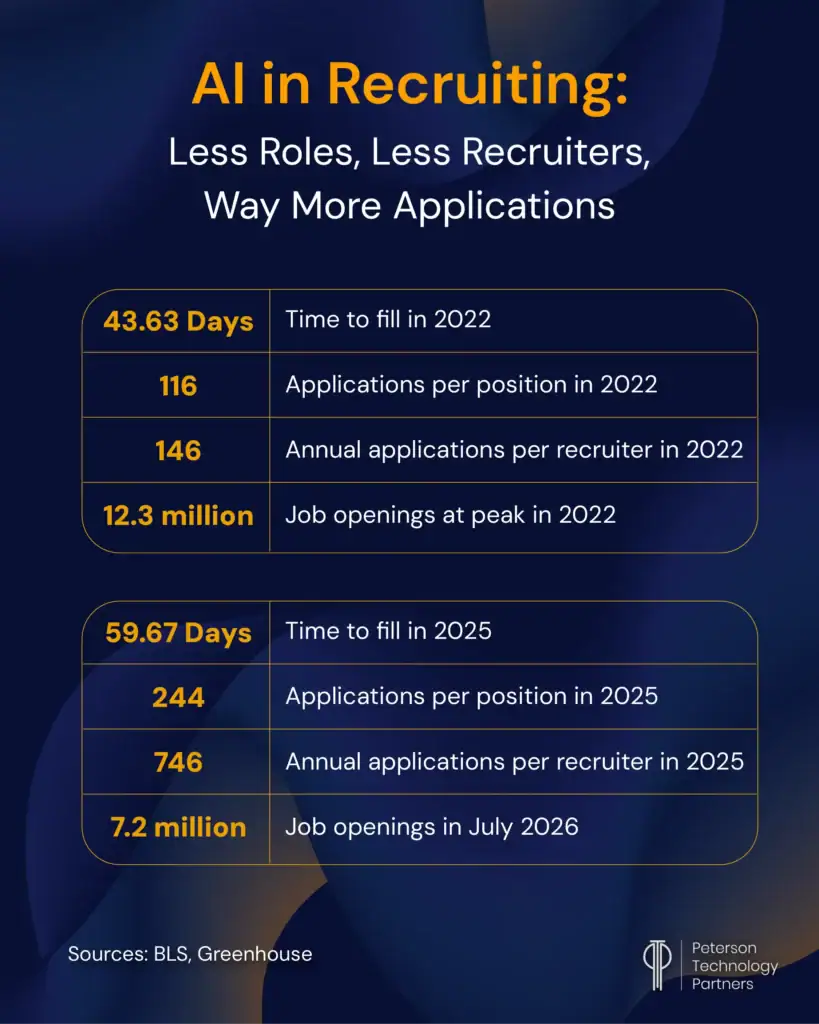
Back in 2022, many firms were dealing with the opposite problem: too many job openings and too few candidates. And the process was too slow and manual. It was blamed for keeping some candidates away (or reducing how many applications they’d send) and stretching the time-to-hire overall.
As former Head of People for software-pricing company Vendr Andrew Stockwell noted to Wired, they’d post a listing and after a few days have just a few dozen applications to review. (For the hottest positions, maybe they’d manage 100 eventually, with recruiters chipping in a few more applications.)
He’d read the resumes, conduct interviews, and pass along the best talent.
But then, in the past year, everything changed. Their volume spiked, with positions drawing hundreds and hundreds of resumes, and most of them being what he described as “totally bogus.”
Ultimately this led to Stockwell and others like him “paying my talent-acquisition professionals—who are high-paid, high-quality individuals—just to look through applications all day long.”
And while AI’s ability to help candidates research positions, generate or polish resumes, and even submit them is a part of the volume crunch, it was also accelerated by the companies themselves, who’d spent years greasing the wheels to try and make applying easier.
As Head of AI Voice for Greenhouse Ophir Samson described to Wired, recruiters were coming to them wanting a more “seamless experience.”
“What they got,” he explained, “was 2,000 applicants in 24 hours for a job. That is a shitty experience for everyone.”
[PTP’s Founder and CEO wrote about how recruitment automation was about to furiously accelerate this process back in November of last year.]
How can companies identify qualified candidates when applicants use AI to create their resumes?
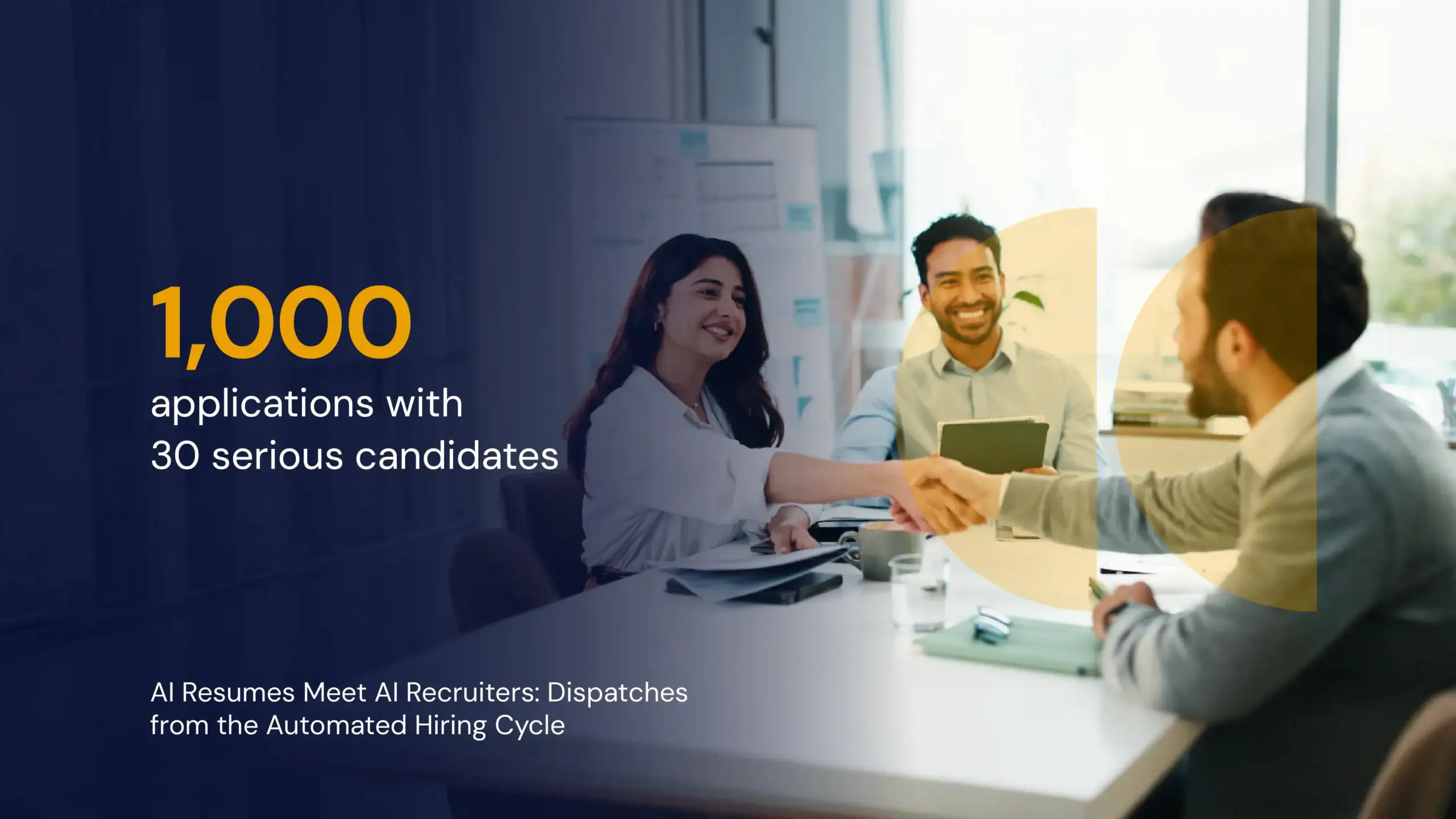
Greenhouse’s Samson: “We frequently hear from recruiters: They have 1,000 applications, but they know that only 30 of them are serious.”
The volume is just part of the problem. The resumes themselves are also giving less information than ever, as AI is being used to create or polish them, ensuring they’ve got the right keywords, are mapped precisely to stated requirements, use the terminology businesses seem to want, and ultimately are as non-offensive and ATS-friendly as possible. Even as it ultimately rounds off, or even overstates, what many candidates are bringing to the role.
And many aren’t even being submitted by people at all.
AI recruitment software is used to parse these AI submitted materials, with AI candidate screening deployed sometimes just to sort the real (and really interested) people from the junk.
While once automated recruiting systems were all about speeding things up, now more organizations want them to be more rigorous, like by applying earlier skills testing or implementing criteria that can isolate truly interested and capable candidates from the rest.
Failing this, many organizations are reverting to old-school methods like referrals to help surface viable candidates.
Meanwhile, for qualified and interested candidates, AI screeners, black hole processes (offering no response on submission or rejection), and ghost job posting (as many as 1 in every 7 listings) are also making the process a slog, even with AI assistance and easy-apply options.
What are the risks and benefits of using AI for recruiting and candidate screening?
Bloomberg reported in August how Google DeepMind was quietly advising candidates to use an internal form to circumvent certain AI systems that weren’t tuned correctly. This would better enable them to find “a real human.”
Google’s AGI Safety and Alignment Team warned there was “a non-trivial probability your CV will be screened out incorrectly.”
This concern, more broadly, is seeing many candidates pay for services like Jobscan, which after free trial charges to help align resumes to AI resume screening systems.
The company proposes that only the top 10 to 20% of resumes even get considered, and therefore candidates must utilize techniques like these to get their materials into that group.
But as Greenhouse’s CEO Daniel Chait explained, this is flawed reasoning, because ATS systems (like theirs) are changing rapidly, use different AI models in different ways, and ultimately can’t be so easily predicted and targeted.
As he told Wired’s Jill Duffy:
“We’ve got this tragic situation where each side has a problem. They’re using AI to solve their own problem, but in ways that make the problem worse. And so more AI use begets more AI use, to no one’s benefit. The more it’s happening, the worse it gets.”
He cautions job seekers to avoid the “spray-and-pray” method with resume submissions, which not only contribute to the problem but also don’t put their best foot forward for positions they’d actually want.
The benefits of AI use for companies are clear, in theory: to manage otherwise impossible volume, add additional touchpoints (like skills evaluations, for example), and, ideally, help to fix an often broken communication process.
Toshiba America’s Vice President of Human Resources Kim Jones told Wired she doesn’t mind candidates using AI to clean up their resumes but warns it won’t help them get through their ATS, and might actually backfire, as they have human eyes on all applications.
But where she has seen unwanted AI use is during interviews, noting the sound of typing and pauses before getting “a verbose answer.”
AI recruiting solutions and evaluating technical talent
For technical talent, the situation is even more complicated.
HackerRank’s 2025 Developer Skills Report found that despite active hiring, 74% of developers (more than 13,000 surveyed in 102 countries across levels) indicate they’re still struggling to find positions.
More than three-quarters (76%) answered that AI is making technical assessments easier to fool, with 78% also saying current hiring assessments don’t effectively measure real work.
We’ve written previously about several big-name tech companies going back to in-person technical screenings with most struggling over whether to allow, or even how to catch, AI use in interviews.
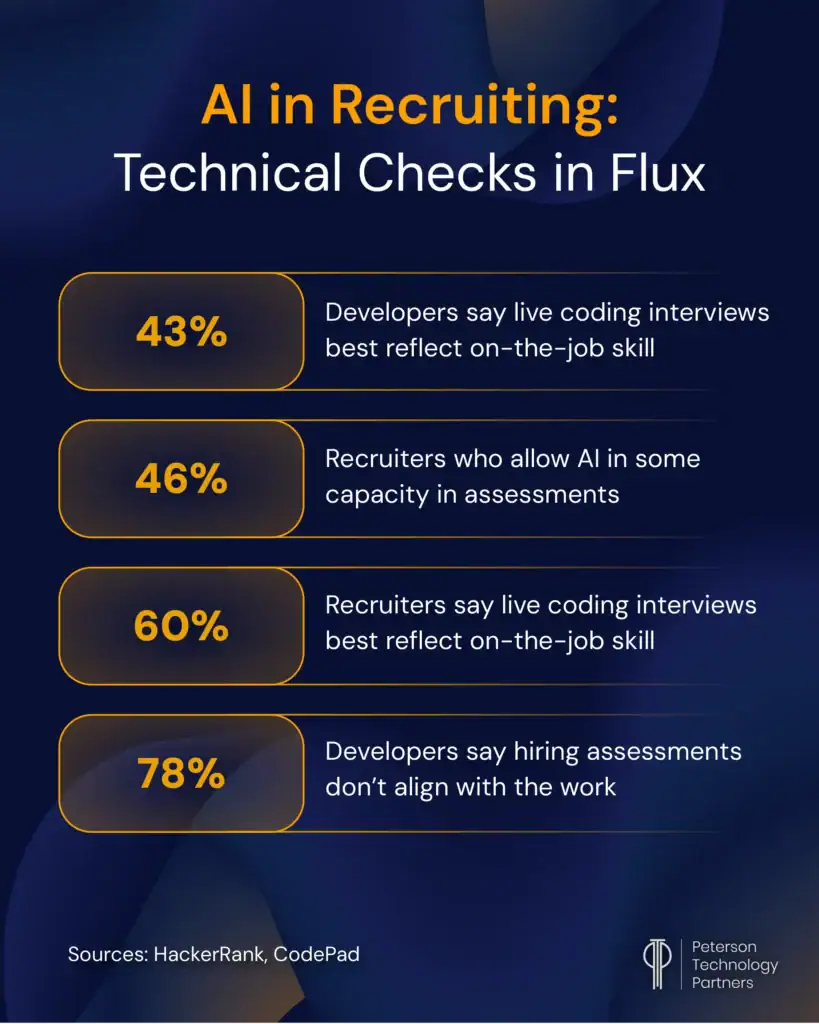
Many are just trying to enable AI use in a controlled fashion.
DoorDash in March explained how they’ve restructured their technical screenings, noting that coding interviews rarely matched the on-job experience, and that AI was rendering it obsolete anyway. Now they use a 60-minute, AI-assisted session, with applicants joining a realistic project, showing their full process, and explaining the work.
Cloud services provider DigitalOcean redesigned their technical interview process from scratch for accelerated hiring needs earlier this year, arguing that the traditional process (“recruiter screen, hiring manager screen, technical phone screen, take-home, onsite”) was no longer useful or even valid.
Their new process focuses on adding collaboration. It’s built around a three-hour session where candidates choose from options and then design, build, and deploy a working prototype in-session.
And while candidates struggled to prepare for the new approach (one used Claude to try to simulate it, another happy to get the chance to talk through his thinking afterwards), it did radically accelerate their process, with decisions made same day and some offers going out the next morning.
Many are trying to balance both, with traditional screening stages as well as AI code-assist or code-review stages.
But there are ample challenges each way.
With AI, how do you evaluate the necessary underlying knowledge is there, and without, how do you accurately represent today’s environment and avoid attempts to game or cheat the system?
Back to manual vs AI hiring done better
This same challenge exists throughout the hiring process, and there are no easy answers or shortcuts.
As Hireview’s Chief Science Officer Mike Hudy explained to Tom’s Guide’s Elton Jones, the advantage ultimately goes to “hiring processes that can separate presentation from capability.”
So how does AI resume screening help recruiters find qualified candidates faster? By managing massive talent pools that they otherwise can’t.
But the risks come in the trade-offs, where valid candidates can get lost and where poor systems can be dehumanizing and ineffective overall.
Final accountability, if it exists, must be human, and experience ultimately in this process is decisive. As Hudy notes, these decisions must be “supported by job-relevant, validated evidence in the form of direct skill measurement.”
From the candidate side, the little things continue to matter. As Toshiba’s Jones noted, she rarely gets cover letters anymore, and when they’re good, they can still help candidates stand out.
Conclusion: Managing the surge of an ironic reversal
As Greenhouse’s CEO Daniel Chait noted: “It’s not you; it’s the system, and it stinks.”
For candidates, companies, and hiring firms.
At PTP, we are dealing with the same challenges as everyone else. But with nearly three decades of technical recruiting experience paired with a long-term commitment to responsible and effective AI, we’ve been working for years to anticipate and manage this volume effectively, or without losing humanity or short-circuiting the valuable experience of our recruiters.
Before presenting candidates, we work to stay on top of fraud—verifying they are who they say they are—while also testing their technical skills and experience, alongside soft skills like communication and cultural fit.
And as ever, the challenge remains to ensure quality (despite sometimes overwhelming quantity) without sacrificing integrity or speed.
AI capability is getting better fast. Will it begin to eliminate jobs at scale in 2027?
One thing we’re fairly sure of: they won’t be recruiters.
References
AI keeps stubbornly refusing to take our jobs, Noahpinion
AI Use in the Job Market Is Creating an Infinite Doom Loop and It Should Be Harder to Apply for a Job. No, Really, Wired
Picture-Perfect AI Resumes Push Firms Back to Tests, Referrals and Google Team Tells Applicants Its HR Filters Are Unreliable, Bloomberg
1 In 7 Job Postings Are Ghost Jobs, New Study Reveals. Here Are 3 Steps To Avoid Fake Job Ads, Forbes
What We Learned Hiring 33 Engineers in Two Weeks, DigitalOcean
‘AI can help you find the words. It cannot give you the experiences behind them’: I asked a hiring expert how AI is changing how we job hunt, Tom’s Guide
FAQs
How are recruiters dealing with the rise of AI-generated resumes and job applications?
Combined with easy-apply portals and increased automation, it’s proving to be a significant challenge just in terms of volume. Many recruiters are adjusting by putting more weight on things like referrals and networking and even going back to in-person interviews. Overall, the process requires more effective skills and experience assessments alongside evolving identify verification.
What is recruitment automation and how can it improve the hiring process?
AI is used on the hiring side to handle rising applicant volume and manage repetitive tasks like sourcing, initial contact, scheduling, and workflow management. Many systems perform varying kinds of resume screening, and AI screenings are being used with varying levels of effectiveness. At their best, when their use is clearly divulged, they can give more candidates a chance to explain themselves in their own words, ask questions interactively, accelerate the process, and get updated information faster and more consistently. But at their worst, AI interviews can come as a surprise, as with countdown timers and canned responses that ultimately turn off candidates.
What are the best AI recruiting tools for screening large volumes of job applications?
There’s no one best system for all companies, and if there were, it could potentially be bad for candidates by potentially amplifying biases or limiting selection algorithms, for example. The best systems pair highly effective AI automation with capable and experienced human review, loop in candidates with transparency and effective notification, and help manage volume without replacing decision-making. AI tools should also be checked for bias and feature ongoing review and improvement.