“If this is all a coincidence, it’s like the greatest coincidence in the history of the world.”
This quote from Missouri Senator Josh Hawley caught the zeitgeist of popular sentiment during an unprecedented concentration of November 2026 tech outages.
Over the course of around six days, millions of travelers got stranded, office work ground to a halt, and banking systems froze up for hours. Days later, the questions continued to rain in, along with new episodes, unrelated cyberattacks, and the changing of the US National Cyber Director.
Palo Alto Networks CEO Nikesh Arora addressed the widespread concerns about AI-spurred cybersecurity and infrastructure failures in his company’s earnings call. He directly blamed the impossible challenge so many businesses are currently facing: patching large-scale vulnerabilities discovered in their production environments fast enough to keep them safe without risking stability.
But this, he noted, is all that’s standing against “the rise of AI-assisted cyberattacks. Bad actors are using open-weight models and new agentic frameworks to find and exploit vulnerabilities at unprecedented speed and scale.”
In today’s PTP Report, we look in detail at this incredible concentration of major outages and their disclosed causes.
Why were multiple companies experiencing IT failures? Were AI agents or cyberattacks involved?
What were the major IT outages in November 2026?
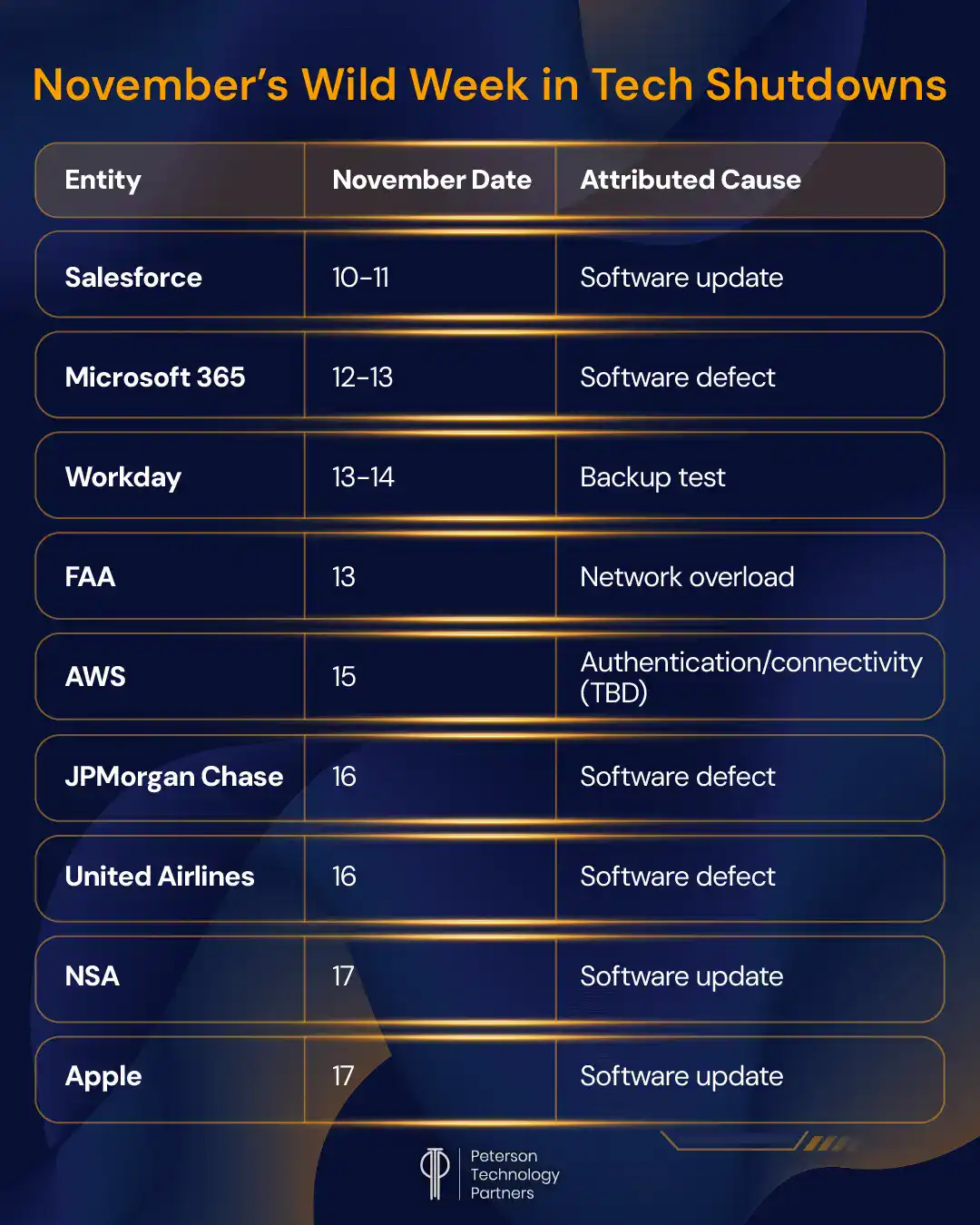
It all began on a Thursday with Microsoft’s Outlook email system. This became unavailable for days in some cases as issues spread to other Microsoft systems in more than 70 countries.
With millions of users impacted, it alone was one of the major technology outages in 2026 to date.
But then this was followed by (and overlapped with) the Federal Aviation Administration (FAA) that Friday calling for a nationwide flight stop for only the third time this century.
With the nation’s air traffic control system reportedly overloaded, all takeoffs in the US were halted, even as Homeland Security Secretary Markwayne Mullin stressed, “We’ve seen zero evidence that this was a cyberattack.”
The ground hold lasted nearly five hours, with a knock-on effect of more than 4,500 flights getting canceled. One air traffic controller described it to Wired as “the hairiest 90 minutes of my career.”
The following Monday, four major US banks began having issues. This was led by the nation’s biggest, JPMorgan Chase, which said technical problems had caused the issues that had frozen transactions at other banks and within the Zelle service.
ATMs and online banking were both affected for many, as issues rippled out to Wells Fargo, US Bank, and Bank of America.
That same day, the systems at United Airlines went down, grounding flights again for its customers, though this issue was reportedly resolved in one hour.
Then on Tuesday, a critical network for sending and receiving top secret information at the US National Security Agency (NSA) went down, forcing the agency to stagger workforce arrivals and issue its second-highest warning.
This disruption was directly attributed to system patching (PHP-related) and resolved after three days.
What happened during the recent AWS and Microsoft outages?
Microsoft, like many of the organizations involved in these events, attempted to quickly put fears of a widespread cyberattack to rest, releasing a statement:
“This was a technical issue not related to cyber or AI/agents. The incident was introduced by an issue during an earlier network capacity upgrade that surfaced following a recent network change.”
The company’s post-incident report pinned the cause to a defect introduced this summer which caused overload on some gateway servers.
Automated load-balancing reportedly redirected traffic to working servers during the outages, but this caused a knock-on effect of more shutdowns across gateway servers, only intensifying the problem.
But despite its high-profile nature, this was just one of several tech company shutdowns that occurred in November.
Salesforce, Apple, Workday, and AWS all had reasonably significant issues, most tied to either defects or software updates.
(Salesforce also suffered a successful cyberattack during the period, though this was apparently unrelated. See below.)
In the case of AWS, an east-coast cloud region suffered signup, authentication, and connectivity issues that lasted several hours.
And while the issue has been mitigated and fully resolved, the cause still has not been released at this time.
Why did United Airlines and JPMorgan Chase experience outages?
From Microsoft and AWS service outages to airline and banking system outages, the causes appear to have mostly stemmed from the same thing: rapidly patched and updated infrastructure at a scale and pace that’s never been seen before.
The banking issues appear to stem from a problem caused by Chase’s on-premises systems. This slowed down transaction processing, and with the interconnectedness of the banking system, is believed to have tripped up the other systems.
JPMorgan Chase issued a statement that it “has experienced a temporary issue related to a software bug in on-premise hardware systems,” adding that “there is no evidence this is cyber-related.”
For United Airlines, the current explanation attributes the failure to web-based apps that help pilots with weights and balances.
This is essential for safe departures, so its malfunction caused the company to hold flights until it could be resolved.
Note that this past Sunday (11/22), Delta Airlines reported a similar failure, forcing it to use manual workarounds while rebooting the system. This also led to a reported one-hour ground stoppage for some flights in Atlanta, delaying more than 1,000 flights.
Both of these were completely unrelated to the FAA issue.
The FAA’s massive US flight grounding was attributed to a changeover from copper line to fiber optic that is around 70% completed.
As a new router was connected in Arkansas during this process, something went wrong that still hasn’t been specified.
The system started making 1,000 connection attempts every few seconds, while another remote site in Texas also began hammering the network with data around the same time.
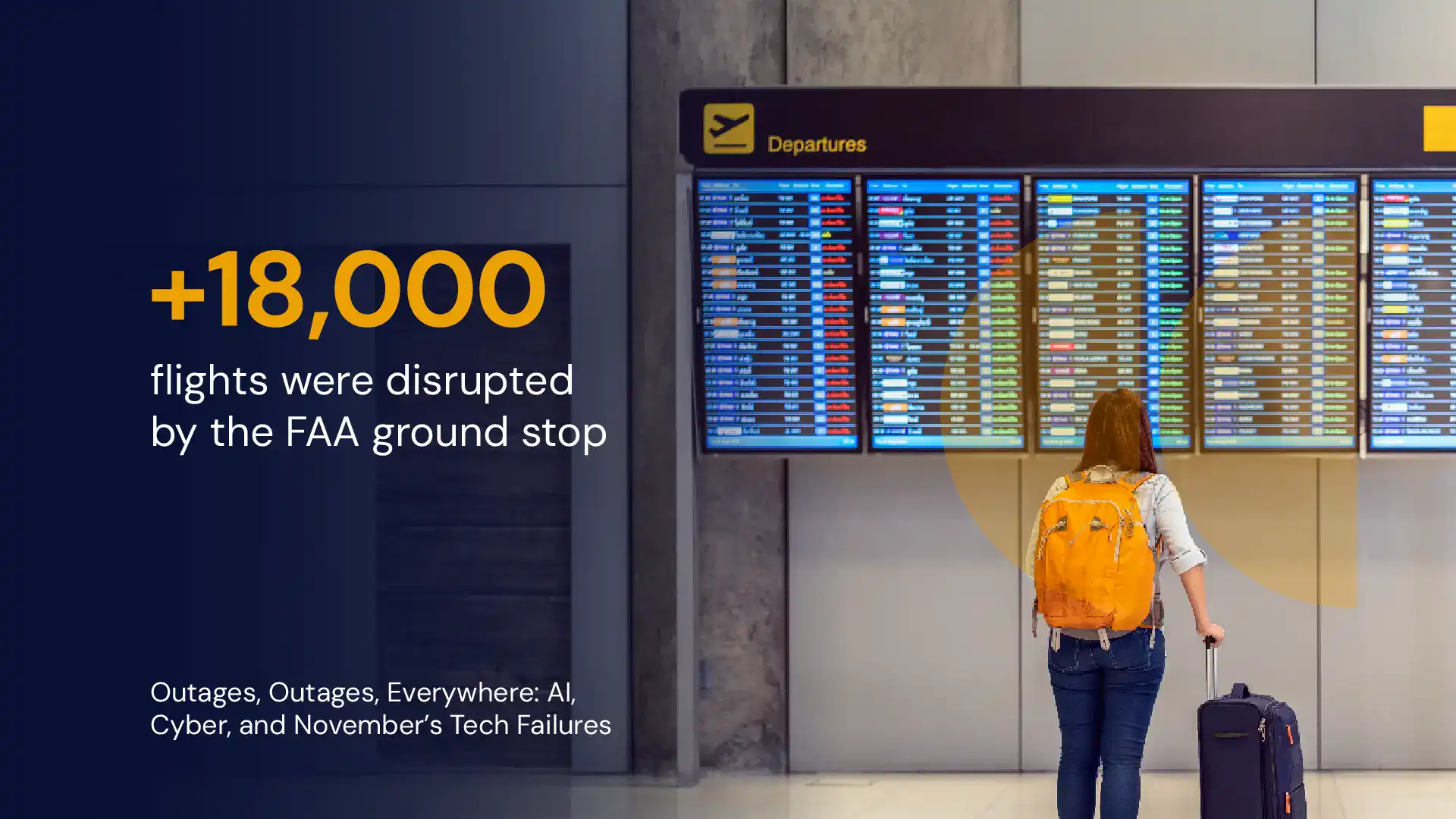
As mentioned, the FAA stoppage lasted more than four-and-a-half hours, with more than a million passengers impacted, and more than 18,000 flights disrupted.
Were the recent IT outages caused by cyberattacks?
Despite numerous recent cybersecurity incidents and outages, there is no evidence yet that any of these episodes were caused by cyberattacks.
Equally surprising, there is no evidence that any of the events are even directly related, despite their close proximity.
There were successful cyberattacks overlapping with some of the companies involved, and this included Salesforce being impacted around November 16 due to a third-party program called Optimizely.
In that case, an attacker infected files used by various companies (including Salesforce) with malicious code that could target site visitors. Salesforce disabled the scripts and found no evidence that its core services were disrupted.
JPMorgan Chase (along with Visa and Mastercard) also revealed on November 19 that some customer data had been stolen through an attack on a third-party partner. The attacker reportedly accessed only marketing data, and no payment or card data was exposed.
Chase explicitly stated that it was not connected to their service outage.
What caused the recent US technology outages?
The truth is that the vast majority of global tech breakdowns today are not caused by cyberattacks.
As Cloudflare CEO Matthew Prince told Wired:
“Right now, most of what we’re seeing is the standard background noise. Stuff breaks, and that’s just the nature of complex systems.”
Without concrete evidence, Doug Madory, the head of internet analysis at network security firm Infoblox, advises we should by default assume a shutdown is not, in fact, a cyberattack.
Internet research editor at network data company IPinfo João Tomé noted to Wired that these events are typically self-inflicted, caused by things like, “a bad update, a configuration change, a cable cut, or a power failure.”
On Sunday, Microsoft President Brad Smith went on Face the Nation to add his voice to this chorus.
He noted that while neither AI nor cybersecurity were directly at fault in the Microsoft case, the scale of the vulnerabilities being uncovered and patched due to AI are related.
He warned there will also be more episodes like these to come:
“I think we have to be prepared, frankly, for the coming months because this isn’t the type of thing that just gets done in a couple of weeks. The whole information infrastructure of the world is in effect being upgraded right now.”
Cyberattack vs. system failure
In speaking about the challenges for the financial industry as a whole, Chase CEO Jane Foster told Bloomberg’s Lisa Abramowicz that shutdowns like these shouldn’t be a complete surprise given the sudden increase in system changes going on now worldwide as we prepare for AI.
She estimated that patching and updates are at five to 10 times the normal rate, all going through the world’s tech stack at the same time.
She also advised customers to expect more downtime and outages on the road to becoming more resilient.
“It builds resiliency. And that’s going to be very important because these models are powerful and in bad actors’ hands, they can be a problem.”
In other words, while the breakdowns are not a direct result of cyberattacks, they do come from the harried attempt to shore up vulnerabilities before hackers can attack them.
And as Google’s Threat Intelligence Group showed in its September report, the need is real.
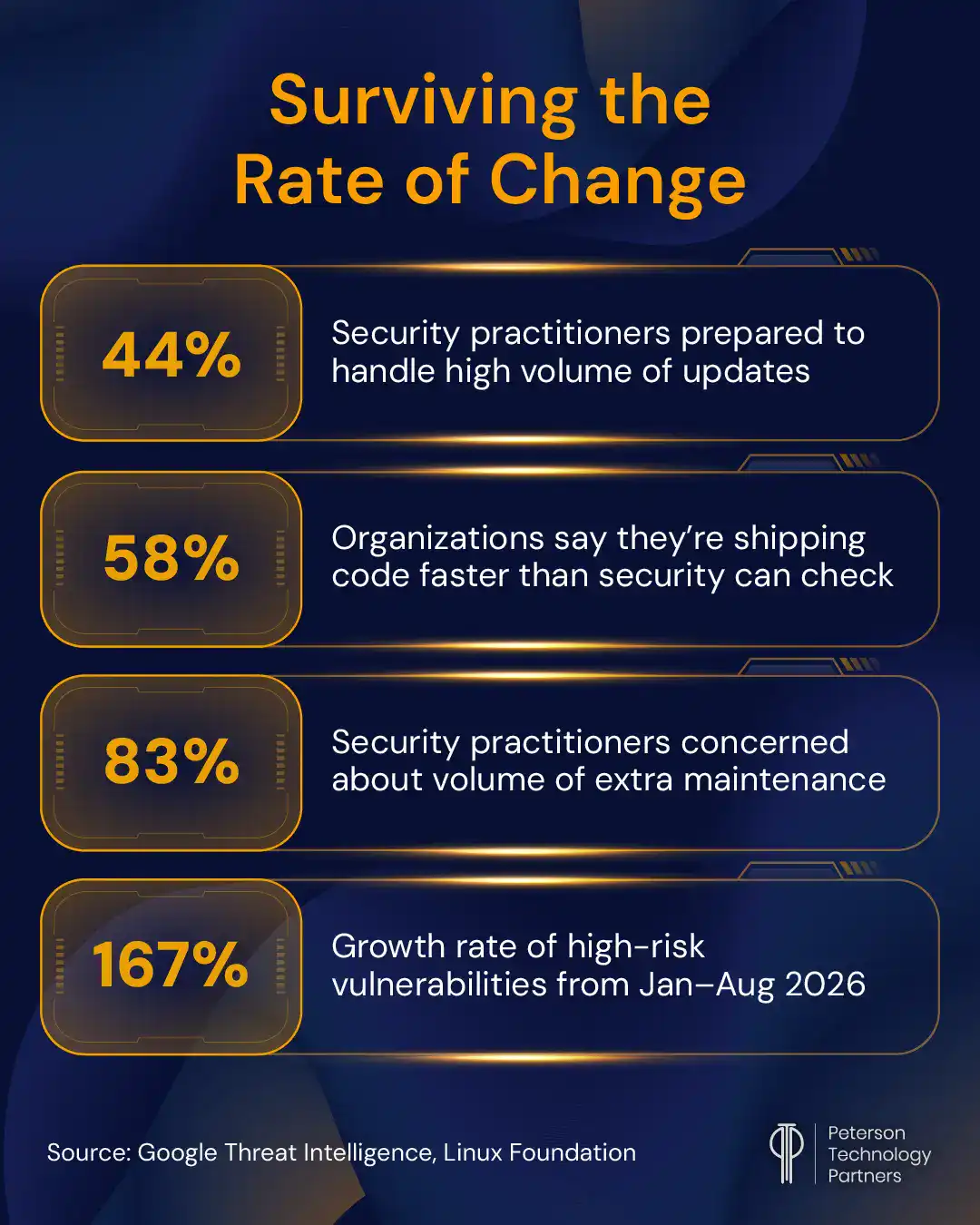
Vulnerabilities in the first half of 2026 (January to August) were already being exploited at twice the monthly rate on average (18 per month) as they were in 2025 (10.5 per month).
Faster code but how well checked?
As a former director at Google Cloud AI and current member of the technical staff at Anthropic, Addy Osmani has a fairly unique vantage on the rise and impact of AI coding.
In a March blog entry, he warned about a new kind of technical liability it is bringing about: comprehension debt.
As we’ve written about in the PTP Report, AI can generate more code (and faster) than developers can effectively review, shifting the challenge from coding to design and validation of code.
In this process, the risk arises that developers don’t even fully understand the solution, regardless of whether or not it passes automated testing to verify functionality.
At Anthropic, Osmani noted a reliance on coding assistants has led to lower scores for code comprehension among developers (50% vs 67%) using AI to learn a new library, with the largest declines being seen in debugging.
And unlike other forms of technical debt, this can accumulate invisibly even as productivity overall goes up.
Still, he warns:
“You will pay for comprehension sooner or later. The debt accrues interest rapidly.”
Enterprise system outages and cybersecurity staffing solutions
The CIA triad is a cornerstone of modern cybersecurity.
First introduced in the 1970s (and abbreviated in the 1980s), it stands for confidentiality, integrity, and availability, naming core requirements for organizational security.
And while availability and operational reliability are not solely the responsibility of cybersecurity professionals (in this area they work closely with DevOps and SRE for outage prevention), the shutdowns are directly related to mounting cybersecurity pressures.
This as ISACA’s 2026 State of Cybersecurity found that 58% of organizations believe their cybersecurity teams are still understaffed (up from 55% last year).
In an era where it may not even be possible to patch all vulnerabilities before they can be exploited (with offensive and defensive systems advancing in unexpected ways at different times), cybersecurity incident response becomes even more critical.
(Our recent PTP Report cybersecurity news roundup looked at whether mean time to patch should no longer be deemed as important as mean time to mitigate.)
Peterson Technology Partners (PTP) has nearly three decades of experience helping Fortune 500 companies meet their IT staffing needs. Our flexible models help companies get the talent they need when they need it to address issues like these, whether for permanent hire, contract, or contract-to-hire, staffing augmentation, or project work.
PTP assists companies with finding even the hottest tech skills, tapping onshore, offshore, and nearshore talent pipelines.
We empower enterprises to beef up their SOC for better handling of operational disruptions, improve incident response and forensics, manage vulnerabilities by prioritizing exploitability and business impact, and secure their applications with more effective code verification, authentication, and third-party dependency mapping.
Whether your need is to integrate better automated security testing and validation via DevSecOps, to design and implement more secure architectures, or to get a better handle on AI risk management, PTP has the reach and flexibility to help.
Conclusion: How can businesses prevent major IT outages?
Enterprise systems may be at an apex of complexity and fragility.
And with frontier AI models helping find vulnerabilities faster than they can be patched, the system is only being put under more strain.
The good news is that all this frantic work to keep ahead of AI attackers will make our systems more resilient in the long run.
But the bad news is that things are almost certainly going to get worse before they get better.
Cloudflare Co-Founder and CEO Matthew Prince predicted “it’s going to feel like the sky is falling for two years.”
And as of now, AI can’t handle this work alone. As tenure-track faculty member at the German national CISPA Helmholtz Center for Information Security Lea Schönherr explained to Wired:
“AI can help, but people still need to understand what went wrong, check that the patch addresses the cause, and look for similar issues elsewhere. Rolling out patches across widely used systems also takes time.”
In this fight, there’s little substitute for talented professionals with the experience to help companies stay safe and get back on the right footing ASAP after events do happen.
References
A National Meltdown With Nobody at the Help Desk and Chase Resumes Normal Operations After ‘Software Bug’ Disrupted Transactions, The New York Times
Scoop: Trump names Kirsten Davies as new national cyber director, Axios
Citi CEO Expects More Tech Outages, Bloomberg
‘The Hairiest 90 Minutes of My Career’: How the FAA Ground Stop Went Down, The Outages Are Just Getting Started, and How to Tell if It’s a Cyberattack or Just an Outage, Wired
Timeline of the FAA nationwide ground stop: How it developed, ABC News
United Airlines says it resolved a “widespread system outage,” days after nationwide ground stop and Transcript: Brad Smith, Microsoft president and vice chair, on “Face the Nation with Margaret Brennan,” Nov. 22, 2026, CBS News
Palo Alto Networks CEO just dropped a truth bomb on the network outages sweeping through major companies and JPMorgan, Visa, and Mastercard disclose cyberattack on third-party vendors, Yahoo Finance
Our response to the Optimizely “OPTIMJACK” supply chain compromise, Salesforce
Vulnerability Discovery and Exploitation Trends in the AI Era, Google Threat Intelligence Group
Comprehension Debt – the hidden cost of AI generated code., Addy Osmani
Automation system problem at Delta causes flight delays as Americans travel for Thanksgiving, AP News