


It’s an argument as old as work: If you’re paid by the hour, what’s your incentive to be efficient?
If things take a little longer, well, there’s some extra income.
This thinking has long informed some contracts, such for home renovations, where homeowners often don’t pay by workers and hours worked so much as delivery of a final improvement.
We’ve seen this same thinking emerge in the smartphone era as ride shares with a set price replace metered taxi rides or even some per-day or per-mile car rentals. These changes were made possible, in part, by real-time map data.
The same trend is now being applied across more and more businesses, with AI leading consulting, contingent staffing, and IT services to bleed further together in the pursuit of rapid and effective outcomes.
Today’s PTP Report is another in our series that looks five-to-ten years out on the impact of AI across staffing and consulting.
Today we consider how AI is driving this new iteration of outcome-based pricing.
AI-driven business outcomes are changing fast
PTP’s Founder and CEO recently wrote about how AI is accelerating change.
And in the two odd months since it ran, AI has hit multiple new plateaus, according to metrics like METR’s time horizon of software tasks, the Google-Proof Q&A benchmark, the GDPval, and Humanity’s Last Exam. (You can check out Ethan Mollick’s blog and PTP’s own AI roundups for a detailed look at each of these.)
Okta Co-Founder and CEO Todd McKinnon recently told Yahoo Finance’s Brian Sozzi that AI has doubled the amount that companies need to change every year just to keep up.
Not changing, he asserts, means facing potential extinction.
“You need to change probably 40% or more of what you’re doing… That could be how you think about markets and opportunities in the past and how you go after new things.”
Change is also king in software and coding, where scenarios abound like the Software Factory method pioneered by StrongDM. (Some, like Simon Willison, call this the Dark Factory method, because no lights are needed for machines that produce on their own.)
Driven by a methodology that explicitly disallows writing or even reviewing code, StrongDM’s approach employs their humans to make roadmaps, while their AI agents do all the coding, testing, and feedback.
The final product is tested by people.
What’s particularly fascinating is that their product is built on security: zero trust access management. The company has shared public documentation of their techniques and invited high-profile, tech-savvy AI bloggers (like Simon Willison and Dan Shapiro) to their work in action and comment.
They found a Dark Factory approach that is surprisingly effective, pointing to a potential future where a handful of skilled people may be able to spin up solutions in days that once took large teams several months.
StrongDM pushes token use (engineers that aren’t spending at least $1,000 in tokens every day have room for improvement) and deploy a “holdout” approach to hide criteria used by testing agents from coding agents.
These agents then give feedback to each other.
Also of note is their Digital Twin Universe (DTU), or clones of third-party services (like Okta, Jira, Slack, Google Docs, Drive, and Sheets) also created by AI agents, built in part from digested public API documentation.
In the DTU, StrongDM’s agents can validate at volumes greatly exceeding production limits without racking up API costs or triggering anomaly detectors.
And this trend is only intensifying. At Davos in January, Anthropic’s Dario Amodei pointed out that, as models improve in both research and coding, they will increasingly be deployed to build AI itself (in recursive self-improvement or RSI), accelerating the improvement loop.
Engineers at Anthropic reportedly already barely write code themselves anymore, as at StrongDM.
How AI is driving staff augmentation alternatives
This same self-disruption phenomenon is happening across businesses, from Google’s AI in search to consulting firms like Accenture racing to lead in consulting automation.
Earlier this month, The New York Times reported on this very dynamic, which has seen the most aggressive automation impacting coders while in other fields, like medicine and law, the changes have come far more slowly than expected.
Debates continue to rage over AI-driven layoffs, but as the chief economist for the City and County of San Francisco Ted Egan told Kalley Huang, “If you think A.I. is this amazing productivity pill, take the pill and don’t lay anyone off and just double your revenue.”
Across approaches, the efficiencies and productivity of AI are rapidly on the rise, and with this comes changes in how things get bought and paid for.
For three decades in software, providers have charged businesses using “seat-based” pricing, or a pay-by-user approach. But with AI the model is breaking down, making what Wolfe Research analyst Alex Zukin called “the wild, wild West,” with customers “in a state of massive, simultaneous experimentation.”
Pricing is being disrupted, as AI in its varying forms:
- Amplifies what individual users can accomplish
- Doesn’t always bring more users/seats with more success (upending conventional scaling)
- Can function other than as a tool for users (performing vs supporting work)
- Isn’t a one-to-one, with a single user able to launch multiple agents
- Can operate autonomously and even launch additional agents itself
- Runs potentially 24/7 365
This dynamic across work changes the long-standing understanding of what user work hours, at varying levels, can and should buy.
It has companies across industries once again returning to the question: why am I paying based on effort if all I really care about is the end result?
What is outcome-based pricing?
The outcome-based pricing model is self-explanatory in the broadest sense: you pay for results.
Buyer and provider agree on what the result should be, and then the provider goes out and gets it done as efficiently and effectively as possible.
But the simplicity ends there. One of the primary challenges remains how to measure outcomes in pricing objectively.
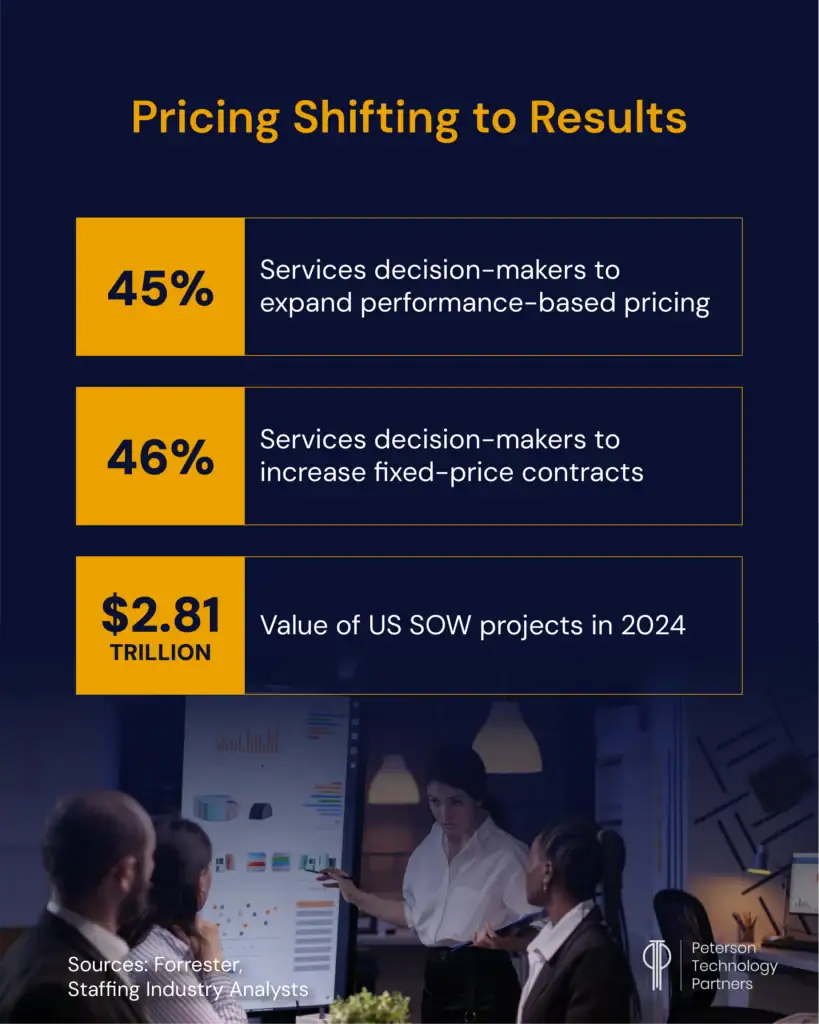
In IT staffing, the traditional method has been for the buyer to control the means and also bear the repercussions of the delivery timeline.
In the outcome-based approach, it’s the provider that controls the means and also takes on the delivery timeline risks. Buyers in this approach may step out of management and instead be responsible for clearly defining and then validating results.
Variations on the pay for results pricing model
Trust is crucial in such arrangements; without overseeing the entire process, a buyer must be able to rely on the provider to deliver. Forrester calls this “co-innovation” and attributes trust as the single most important factor in partner selection.
Even still, the devil’s in the details. How exactly is required quality measured? How long is too long? How does this work with iterative projects and what are the repercussions of failure?
Here are some variations on how the pay-for-results approach is already playing out and alternatives which we see increasingly coming into play.
Fixed outcome-based contracts
The most obvious structure for such arrangements involves a buyer specifying a result in sufficient detail with an allowed window. The provider either delivers or doesn’t, and payment is tied to acceptance by the buyer.
This approach is arguably the most common of these today and one most have experience with. For IT projects, the deliverable must be both thoroughly defined and testable.
Variable outcomes allowed
This approach is used in commission-based models, where a base unit is specified and pricing scales with results.
For IT, this includes making outbound calls at a base rate with premiums for conversions, pay by tickets resolved or even workflows completed. In hiring, it could mean verified candidates that get placed.
McKinsey profiled one AI-native company that gave customers the option of choosing by variable outcome-based pricing (per each qualified lead) or activity-based (per customer outreach) but found 90% of customers chose the latter.
They also noted negotiations were arduous around the point of what a “qualified lead” exactly was.
Ultimately, the closer the value metric is to being verifiable by automation, the more useful such an approach can be for all parties.
Sequential outcomes: pay for performance pricing
One common starting point for companies that are new to the approach is a cumulative, or stair-step approach. In this case, outcomes get clearly defined as thresholds or phases, and the contract either only covers just one phase, or is conditional on review at the completion of each step.
This spreads some of the risk and management to both parties and may be a more realistic approach for using outcome approaches to projects of larger scale.
Of course there are potential drawbacks here as well. Defining a completion stage before project’s true end risks losing momentum and may introduce artificial barriers or gateways.
For providers, it may also incentivize gambling for additional phases by front-loading initial steps.
Speculative and competitive outcomes are becoming more reasonable
If price were no object, companies would more frequently run numerous teams in parallel for the same goal and choose a winner from among them.
But with the capacity of AI to build at scale and fast (see the Digital Twin Universe above), these approaches are increasingly plausible.
Here a buyer could request a series of speculative products and only buy or license what they actually need. AI has already lowered the cost of building multiple versions of the same thing (for one example here, note how the leaked Claude Code was refactored to python in a single day), and the provider in such instance could potentially use alternatives elsewhere.
Competitive models—such as three companies all submitting the same solution—might pay out a base amount to each, while giving the winner a premium on acceptance. These approaches are similar to hackathons or contests, like the UK’s inaugural Agentic AI Pioneers Prize.
This competition awarded £500,000 as a top prize for the construction of an agentic “Digital Twin Builder” in life sciences, and two additional rewards of £250,000 each for winners in advanced manufacturing and the creative industries.
With coding increasingly democratized, such approaches are likely to spread into the private sector, as well.
Signal-based, or verified new results purchase
On the subject of democratizing skills, our prior article in this series was about AI orchestrators in business. As individuals skilled with getting innovative and unique results from AI continue to rise to the forefront, buyers might pose problems to solve or buy based on a signal, such as an improved or new algorithm, process benefits that reduce expenses, or even new discoveries that improve what they do.
These contracts might pay on the basis of actionable intelligence, or else extend to research in new frontiers. Ultimately, the goal could be to reward challenges to the status quo by looking to outside talent to generate fresh solutions.
Once again, in such a model, trust would be paramount.
Outcome-based pricing vs staff augmentation
In the abstract or general, shifting from service-level agreements to outcome-based is a no-brainer. The company that’s buying gets the thing they need (which they know will improve business), at a price they’ve settled on.
But the complications and variations are extensive. AI is not only changing the meaning of work hours and complicating questions of efficiency; it’s also critical in outcome measurement strategies, and effective validation is essential going in.
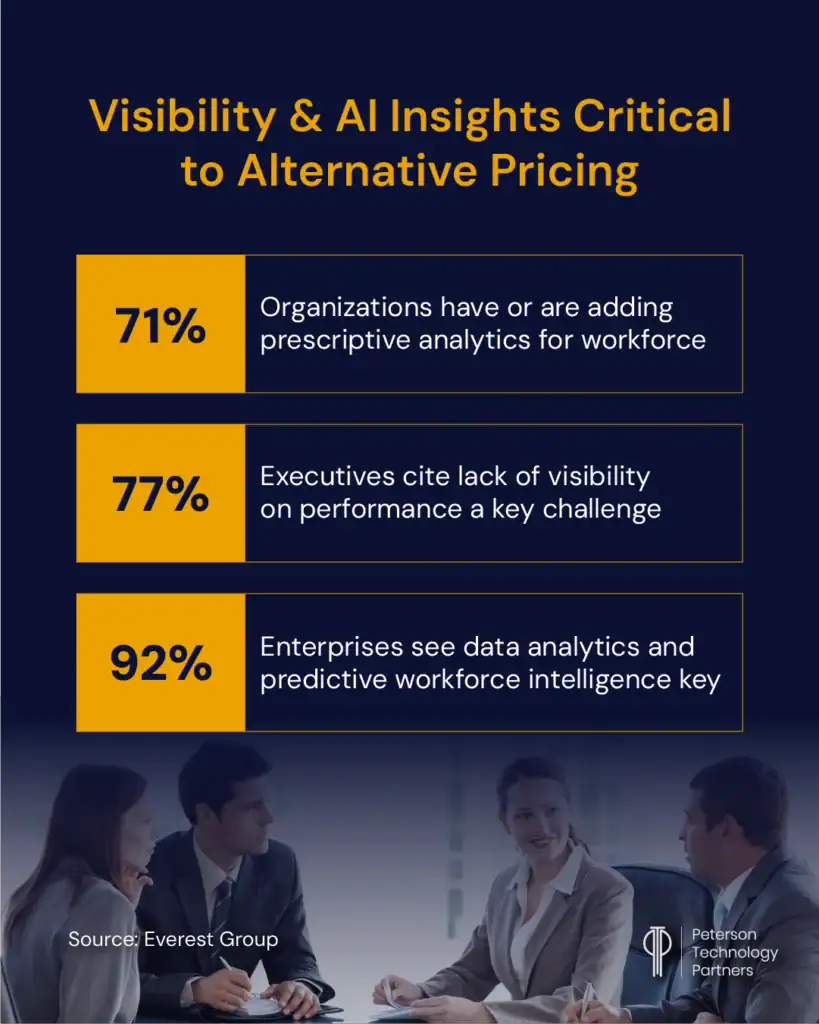
At PTP, we are seeing more outcome-based approaches today (with most being hybrid), and we see that trend as likely to continue overall.
Such mergers agree on fundamental fees but also can factor in additional payments or reductions based on metrics like those discussed above.
This balances risk and reward but also can help resolve some of the complexities that are inherent in these models.
With change coming fast and adaptability being critical, staffing needs can be very difficult to anticipate.
At PTP, we’ve seen this shift also play out in the rise of demand for our nearshore staffing, especially in software development, where customizable solutions are popular to increase time-to-market and flexibility.
Conclusion: Buying results over hours is only growing
Hourly billing, like per-seat pricing, isn’t going away any time soon. In a report in October, Bain took stock of alternative software pricing models and found new approaches, like outcome-based pricing hybrids (used by 65% of the SaaS vendors they analyzed), on the rise.
At the same time, they noted that none of the major SaaS vendors have shifted entirely to usage or outcome-based pricing, contrasting with numerous AI vendors.
In staffing, flexibility and variability are only on the rise. And with AI capabilities increasing faster than ever, we predict that variability in this arena will only increase in the years to come.
References
How StrongDM’s AI team build serious software without even looking at the code, Simon Willison’s Weblog
Software Factories And The Agentic Moment, StrongDM AI
The Shape of the Thing, One Useful Thing
Okta CEO: AI is moving so quickly, companies must change 40% of what they are doing every year, Yahoo Finance
A.I. Could Change the World. But First It Is Changing Silicon Valley., The New York Times
Upgrading software business models to thrive in the AI era, McKinsey
Innovate UK names winners of first Agentic AI pioneers prize, Business Matters
Per-Seat Software Pricing Isn’t Dead, but New Models Are Gaining Steam, Bain & Company
FAQs
What is outcome-based pricing?
Outcome-based pricing is a professional model where clients pay for defined results instead of process-oriented aspects, like hours worked, headcount supplied, or seats used. In this model, the buyer and provider agree beforehand on the necessary outcomes and it is the responsibility of the provider to decide what talent, AI, software, data, and process are best to deliver it.
How is outcome-based pricing different from staff augmentation?
Staff augmentation is about providing talent or selling access to labor, with billing typically assessed by hour or day. Outcome models shift the deliverable to results, though as discussed in the article these can vary significantly and include things like a finished product, phases of a project, providing a best-case solution among competitors, or some hybrid of various conditions. Ultimately the goal for buyers to purchase a result that directly benefits their business and avoid managing the process directly.
What are examples of outcome-based pricing?
Examples include paying a fixed fee to build and deliver a necessary component, payment for resolved support interactions, payment for verified conversions, delivery of one phase of an iterative project, successful resolution of a provided business problem, or even delivery of a best-case solution from among a field of competitors.