When most people think of AI, they think of language-based systems. Chatbots and copilots, search tools, customer service bots, and voice agents all running on LLMs.
World models are different. And while the two types have many varieties and often overlap, their goals are also distinct.
What are world models, what problems do they solve, and when will businesses really be using them?
Today’s PTP Report looks to answer these questions and more.
Billions of dollars have been invested, the demos are impressive, and Gartner has named world models among its top strategic technology trends for 2027.
So how close are they to really delivering value for enterprises?
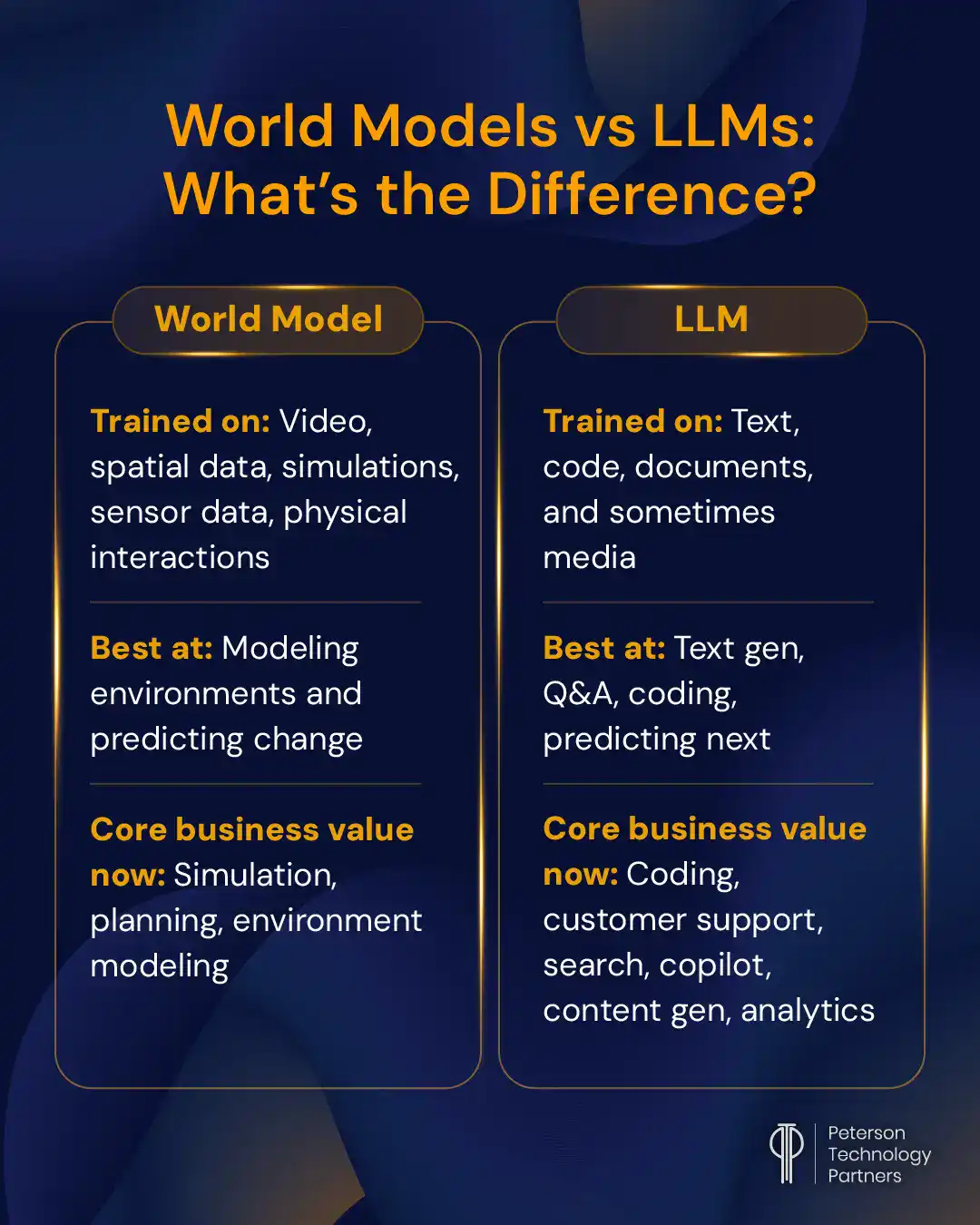
World models vs LLMs
As with many AI terms, ‘world model’ gets used for a wide variety of things.
While large language models emerged first as a technological capability and later sought use cases, world models have come about in the reverse order. They are driven by real-world goals.
One of these is a shortage of training data that is hampering robotics and other applications of physical AI in manufacturing. AI world models are viewed as one of the most practical ways of meeting that demand, as well as being a means of training, testing, and driving robotics within a virtual world. They’re also being positioned for all manner of 3D simulations and modeling across industries.
World models are also being built as a way of giving AI spatial intelligence and a means of interacting with the physical world in the broader quest for AGI or ASI.
As human beings, we can process language, imagine space conceptually, and move about in it with mental maps and an inherent understanding of how the physical world works. World models are viewed by some as being a missing piece of the AI mental puzzle in this regard.
One of their most outspoken pioneers is former Meta Chief AI Scientist (and NYU professor, Turing Award winner, ‘Godfather of AI,’ and Co-Founder and Executive Chairman of Advanced Machine Intelligent Labs) Yann LeCun.
As he told Wired:
“The idea that you’re going to extend the capabilities of LLMs to the point that they’re going to have human-level intelligence is complete nonsense.”
LeCun has pointed out one example on numerous occasions: A human being can learn to drive a car in a matter of months, while AIs, despite years of work and substantial investments, still struggle to do so with our natural capability to react to the unexpected.
The exact definition of what a world model must do and be still varies.
Fei-Fei Li is one of the co-founders of World Labs, a company created with the goal of making AI that’s capable of understanding the 3D world. It was recently acquired by American chip powerhouse AMD for $8.2 billion.
(Fe-Fei Li is also the Co-Director of Stanford HAI and considered the ‘Godmother of AI.’)
She wrote on Substack (see below) that while LLMs are changing how we access and work with certain forms of knowledge, spatial intelligence is critical and a missing piece.
“Spatial intelligence will transform how we create and interact with real and virtual worlds—revolutionizing storytelling, creativity, robotics, scientific discovery, and beyond. This is AI’s next frontier.”
She believes three criteria are required for a world model:
- It can generate worlds with “perceptual, geometrical, and physical consistency”
- It is fundamentally multimodal
- It can predict results from actions
World Labs Co-Founder Ben Mildenhall explained what he views as a key difference between LLMs and world models to Ars Technica this summer: “A very distinguishing aspect of interacting with an LLM is they are turn-based.”
The LLM receives input, and it provides output. But world models don’t have this same linear approach.
Using a world model enables you to be “actually able to interact with it like it is some sort of world and you are taking continuous actions” and “there are parallel things happening at the same time.”
AI video and world models are also closely linked, and the industries have bled together. AI video startup Runway has pivoted to world models, recently releasing its second model (GWM Worlds 2).
For a look at how they work, you can try World Labs’ Marble immediately without a sign-in here, though their newer model Atlas is also available.
Google’s Genie 4 is an impressive-looking world model that integrates with Google DeepMind’s frontier LLM Gemini 4 Argon.
It’s in research preview for trusted testers, incorporates real-time audio (including dialog), allows users to write prompts that change the world mid-stream, and runs twice as long as its predecessor, for simulations up to two minutes.
Decart is a world model startup that’s been in the news this year for being eyed for acquisition by multiple big tech companies, from Anthropic (a reported $6 billion deal that fell apart) to Amazon (in talks now for a reported $7 billion).
Industrial AI applications of world models vs digital twins
Companies are taking varying approaches to world models, but the goal is to create a reactive, predictive 3D environment.
This has all manner of uses across industries, including as an emerging form of AI adoption in manufacturing (see below).
One use is for training automation in simulated environments, and in this way world models can interact with digital twins, though the two sometimes get confused for each other.
Digital twins are also virtual creations of 3D things—from people to complex machinery to prototypes or components—rather than predictive spaces. They typically are created from extensive amounts of data collected from the real world (sometimes using real-time updates as via sensors) and often incorporate live operational data.
World models differ from traditional simulations in that they learn patterns and can predict outcomes that aren’t directly programmed. In this way, they enable AI to better understand the 3D world.
How are Siemens and Nvidia testing world models for industrial applications?
Europe’s largest engineering company, Siemens, reported in October on the benefits it’s already seen from its pioneering use of world models alongside other AI automation.
In partnership with Nvidia, Siemens committed to spearheading AI implementation in manufacturing and has been testing new innovations in live work at its Erlangen plant in Germany.
Siemens has claimed an annual productivity increase of seven percent at the site and is using world models (and digital twins) alongside AI agents in this process.
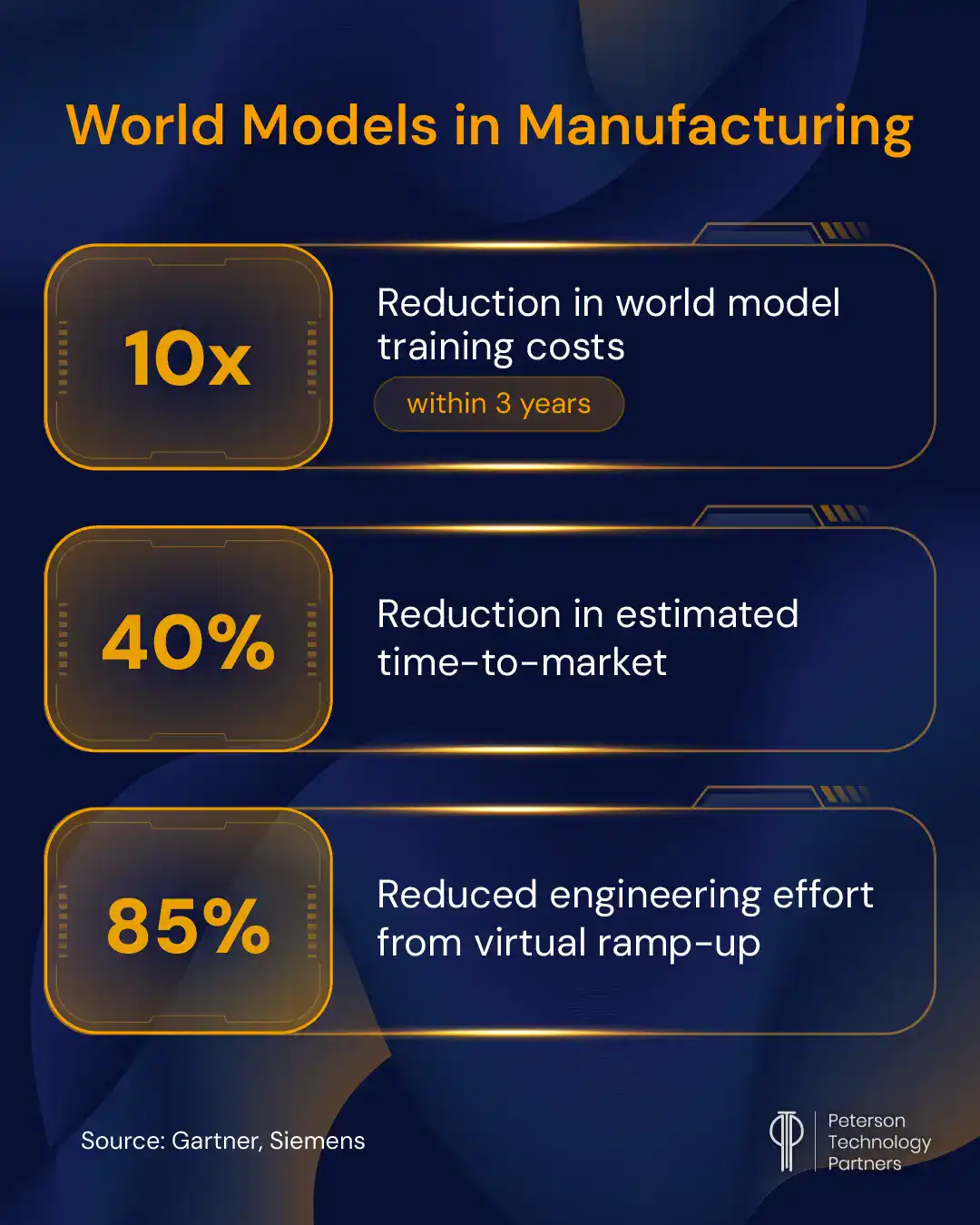
Among its uses: generating training data for inspections, use in planning and development, and preparing equipment to test products that haven’t been built yet.
As Nvidia Vice President of Physical AI Simulation Rev Lebaredian explained:
“Factories need to handle change as well as they handle repetition. AI and simulation make that possible.”
As designs change, systems must be configured to recognize correctly assembled products so they can identify defects.
Traditionally, that process started with physical prototypes, which were passed to engineers for manual work configuring complex inspection equipment.
Now Siemens is using predictive AI systems to train the inspection systems and to design and test production systems before making any real-world changes, and even before physical prototypes are ready.
The company is also testing AI-assisted scheduling in its manufacturing, with alternate plans checked using a factory’s digital twin.
How close are world models to real-world applications in American manufacturing?
The Siemens effort is an experimental prototype aimed at pioneering all-new AI infrastructure for manufacturing.
But Gartner estimates widespread deployment for enterprises is still three years off at a minimum, due to the fragmented (but consolidating) nature of the field, competing architectures, high computational costs, and overall lack of stability.
And as with other AI developments, the real world is much messier (and more complex) than narrow test cases.
There are other issues specific to world models, too, like questions of how best to control them and stop drift over time, and how to handle interaction.
While a chatbot makes sense for a language-oriented system, what is the best way to interact with a system built to model whole realities?
But Gartner recommends businesses get moving on world models in 2027 due to their incredible potential and emerging capabilities. The research firm advises leaders begin preparing their businesses ASAP, starting with a five-year enterprise AI strategy.
At the same time, companies should begin building their multimodal data pipeline now, including tapping synthetic data generation.
Conclusion: 2027 and world model AI readiness for enterprises
Amid market volatility, data center backlash, international spying stories paired with leadership changes, and an ongoing struggle for enterprises to prove AI business outcomes, it’s a strange time for LLMs overall.
Some leaders in the field, like Co-Founder and CEO of Hugging Face Clem Delangue, believe an over-reliance on LLMs deserves blame for some of these issues.
“I think we’re in an LLM bubble, and I think the LLM bubble might be bursting next year,” he said at a conference. “But ‘LLM’ is just a subset of AI when it comes to applying AI to biology, chemistry, image, audio, [and] video. I think we’re at the beginning of it, and we’ll see much more in the next few years.”
World models are a leading alternative, and they’re developing fast, as evidenced by massive, multi-billion-dollar deals like AMD’s recent acquisition of World Labs.
Siemens and Nvidia are showing how the technology can work in live production, but wider adoption will require more stability.
As your business continues building its AI capabilities, the AI staffing services from Peterson Technology Partners (PTP) can help.
As a provider of technical staffing solutions since 1997, PTP pairs consulting with AI talent acquisition and patent-pending solutions, providing enterprises an array of flexible delivery options.
Whether it’s laying the groundwork for innovations like world models, preparing your defenses with (and against) AI cyber, or preparing your data to bring more flexible and effective automation, PTP is available to help.
References
Simulating everything, sort of: The promise and limits of world models, Ars Technica
From Words to Worlds: Spatial Intelligence is AI’s Next Frontier, Dr. Fei-Fei Li Substack
Google’s Genie 4 world model adds audio, more realistic worlds, and real-time steering, TechCrunch
I Saw the Future of Robotics in a Virtual Duck That Chases My Cat, Wired
Siemens partners with NVIDIA to advance AI-driven, autonomous factories, Siemens
FAQs
What is the potential of physical AI in manufacturing?
Physical AI refers to AI systems that can act in the real world, like self-driving vehicles and robotics. These are seeing enormous investments and steady developmental progress, and could transform manufacturing with their adaptive capabilities in real time. Among the benefits: more flexible production, improved quality control, better resilience with less downtime, and safer, more efficient operations overall.
What are world models in AI and how are they being used in manufacturing?
World models are seen in many ways as an enabler of physical AI. They are systems that learn how environments behave (often without ingesting our understanding of physics, interestingly enough) in order to predict how they will change in response to actions. In manufacturing, Siemens and Nvidia are currently using world models in Germany to generate realistic inspection scenarios and help prepare quality-control systems even before physical prototypes are ready. These innovations are reducing engineering effort and production delays.
How can manufacturers prepare their data and infrastructure for AI adoption?
Begin with an assessment of current systems. Critical to making use of world models is an effective multimodal data pipeline, and companies should work at improving their own data quality and accessibility. This includes connecting equipment, sensors, engineering data, and enterprise platforms. In terms of a broader roadmap, Gartner recommends prioritizing measurable use cases and modernizing processes and infrastructures where necessary as companies are already investing heavily in the field.