

Artificial Intelligence has emerged as a promising solution to alleviate workplace stress and minimize technological errors. With its ability to enhance efficiency and streamline processes, AI has become indispensable across various industries. Paradoxically, for certain employees, AI’s introduction into the workplace has yielded unintended consequences: Burnout.
Concerns among employees regarding the pervasive use of artificial intelligence and monitoring technologies are taking a toll on their well-being. In 2023, the American Psychological Association conducted a survey titled “Work in America: Artificial Intelligence, Monitoring Technology, and Psychological Well-Being”, delving into the sentiments of 2,515 employed adults nationwide. The findings reveal that 51% of the workforce is aware of their employers utilizing technology, such as computer software and cameras, to monitor their activities during the workday.
Alarmingly, the survey hints at a connection between this monitoring and a decline in psychological well-being. Monitored employees expressed discomfort with the tracking methods (46%), a sense of being micromanaged (51%), and increased emotional exhaustion (39%).
So, how can leaders address the looming specter of AI burnout among their teams? Let’s explore actionable tactics to foster a workplace where technology aligns with employee well-being.
Table of Contents:
- Introduction
- Show Employees Their Value in Real Life
- Set clear goalposts that are well-communicated
- Reduce Pressure for permanent availability
- Use Automation For Your Team’s Benefit
- Conclusion
Show Employees Their Value in Real Life
Chatbots are changing the way we work. According to a survey by resume builder, 1 in 4 ChatGPT users say the tool saves them more than 10 hours per week on work-related tasks.
In the fast-paced modern workplace, chatbots may seem like reliable teammates, always ready to field questions. Yet, a heavy reliance on AI interactions, at the expense of face-to-face communication, can breed isolation and detachment from the team. Recent research from Simon Fraser University underscores the connection between loneliness, a lack of social support, and the looming specter of burnout. 28% of remote workers report more burnout compared to office-based employees.
Managers must play a pivotal role in fostering a connected and resilient team. Regular one-on-one check-ins are not just a formality but a lifeline, providing employees with a dedicated space to share ideas, concerns, and insights. Emphasizing the unique value each team member brings to the organization during these sessions not only bolsters morale but also acts as a powerful buffer against burnout. As a manager, cultivating an open and supportive environment through consistent communication can be the antidote to the challenges posed by the digital age.
Set Clear Goalposts That are Well-communicated
In a team environment, clarity is a powerful weapon against burnout. Some employees find themselves overburdened, not with tasks, but with the quest to decode vague expectations. Gallup reports only 60% of workers know precisely what’s expected of them, a challenge further compounded by the reliance on generative AI.
Effective leaders dispel ambiguity through direct conversations, aligning daily tasks with overarching performance objectives that navigate employees to the correct turn. The payoff is significant – employees who feel supported are 70% less likely to burn out. On the flip side, neglectful or confrontational managers leave employees feeling isolated and uninformed.
Successful leaders must foster an environment where goals are not just set but comprehensively communicated and jointly pursued.
Reduce Pressure for Permanent Availability
With AI reshaping how we work, employees often grapple with burnout, worsened by leaders who expect weeks’ worth of tasks to be completed within a standard workday.
The domino effect of unrealistic deadlines can exacerbate the situation, causing employees to fall behind and perpetuating a cycle of stress. As a leader, setting a positive example becomes paramount. Take steps to encourage your employees to disconnect. Demonstrating a commitment to work-life balance by taking regular breaks and adhering to reasonable working hours can foster a healthier and more sustainable work environment. Moreover, avoiding after-hours emails and treating extended work hours as exceptions rather than the norm contributes to a culture that values the well-being of its employees. When employees consistently find ample time to accomplish their tasks, the likelihood of experiencing burnout drops by a significant 70%.
Use Automation For Your Team’s Benefit
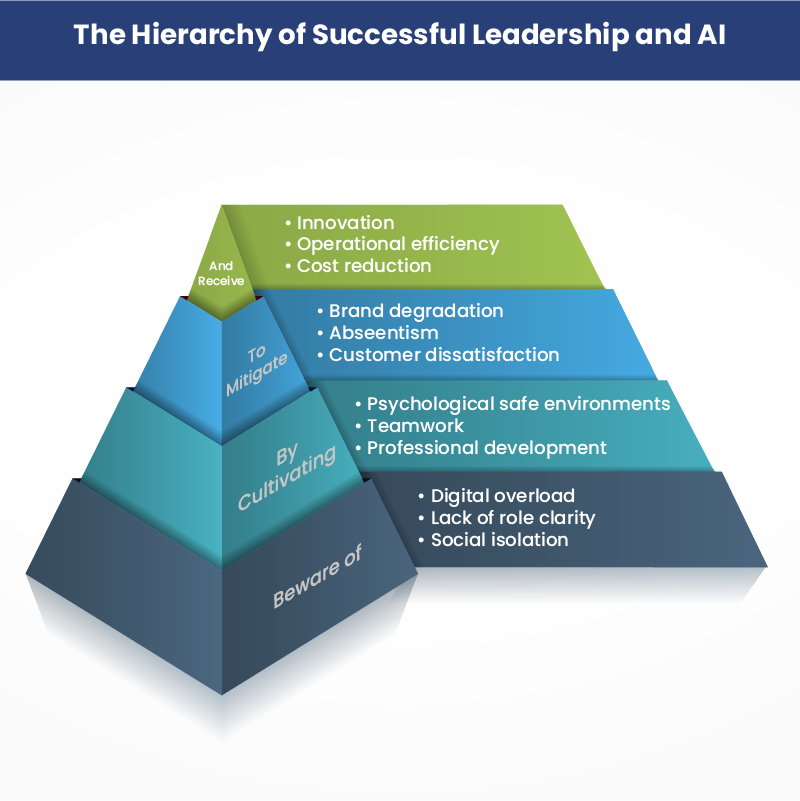
AI enables the automation of many repetitive and time-consuming tasks, freeing up time for employees. However, if this automation is not accompanied by proper planning and management, it can lead to a redistribution of tasks that could increase the workload of remaining collaborators. The feeling of cognitive overload can then set in, increasing the risk of burnout. AI should streamline operations by automating repetitive and time-consuming tasks and significantly enhance the mental well-being and productivity of a team.
The solution? Companies must anticipate changes related to automation and invest in employee training to acquire new skills. Proactive human resource management will also balance workload and prevent burnout.
Reducing burnout starts with leaders
Embrace leadership that prioritizes psychological safety. According to research, teams with high psychological safety were 47% more likely to be innovative, compared to their peers.
While AI is on its way to becoming a standard tool across every industry, it should not be implemented without thinking of the employees’ well-being. Mitigating burnout demands a proactive stance from companies. Balancing workloads, preserving social interactions, setting boundaries on perpetual availability, and championing workplace equity are essential strategies to cultivate a thriving and sustainable environment. Though AI is the key to unlocking uncharted benefits for an organization’s bottom line, humans are the driving force behind the success. Burnout is not an inevitable outcome, and it’s crucial to take tangible steps, including responsible AI use, to eliminate it from our workplaces.