

The AI-powered Salesforce is growing fast. Even in the face of a SaaSpocalypse that wiped out nearly a trillion dollars from software providers in one week in February (per Reuters).
Salesforce, meanwhile, keeps on trucking. Their annual recurring revenue for Agentforce and Data 360 neared $3.4 billion in May and grew 200% year-over-year.
Even so, the company’s own research points out that 84% of data and analytics leads believe their data approach needs an overhaul.
51% of sales leaders using AI now say their silos are a big problem, and that they’re delaying or limiting what they can do.
Few leaders will argue that Salesforce lacks capabilities. The bigger problem is leveraging it to the fullest. Using Salesforce to directly address your real business pain points.
Today we’re looking at Salesforce partnerships. Specifically, we’re addressing different kinds and what each brings to the table.
Below we break down the difference between Salesforce consulting services and Salesforce implementation services.
Let’s go!
What Does a Salesforce Consultant Do?
First things first, aren’t they all consultants?
My definition for consultant is someone who provides professional assistance. (Or in the case of PTP, someone who provides top quality, reliable assistance focused on business results…)
But yes, many times “Salesforce consultant” does get used for the lot. Anyone and anything that’s going into helping you with a CRM.
Strictly speaking, Salesforce consultants are about matching Salesforce solutions to your business problems.
They evaluate your business, how you serve customers, manage data, share information, measure results, and what tech you’re using now.
Salesforce is extremely complex and has many options and products. Good Salesforce consultants shouldn’t be trying to push you to the biggest deployment with the most customization.
They should instead work backwards off your business needs to help you get the biggest and best CRM returns possible.
They also create the maps and plans needed to make this not only a reality, but the best, safest, well governed, effective, and efficient rollout possible.
They may also provide enterprise architecture, inventory, and workflows, and help you strategize needed data migrations and cleanup.
In short, it’s about directing and maximizing your Salesforce investment to best fit and serve your business.
What Is Salesforce Implementation?
Salesforce implementation makes all this a reality.
It’s the process of implementing (duh), but also configuring, enhancing, customizing, integrating, and testing the solution.
This is also the stage where data migration and cleanup actually gets done.
But without consulting, this is where wrong assumptions can get very expensive.
Key Differences between Salesforce Consulting vs Implementation
In short, one’s the plan and the other’s the action.
But let’s dig in a little deeper.
Here are some important distinctions between the two:
- Consulting specifies the outcome; implementation then delivers it.
Consulting finds, details, and plans for the destination.
Implementation gets you to where it begins.
- Consulting starts with business problems; implementation starts with requirements.
You may know you have a problem and still not know exactly how to solve it. This is where Salesforce consulting shines. It identifies the causes and provides options to solve it.
Implementation isn’t exploratory. This team needs workflows, user stories, data requirements, security rules, acceptance criteria, and a clearly defined scope.
- Consulting can cover the lifecycle.
Salesforce consulting often begins before licenses are purchased and often goes on after the product launches.
This is because it can entail evaluation, business cases, strategy, roadmaps, and then adoption, realization and measurement that powers optimization.
Implementation runs through deployment.
While it’s a critical stage, it’s not a broader partnership journey with Salesforce.
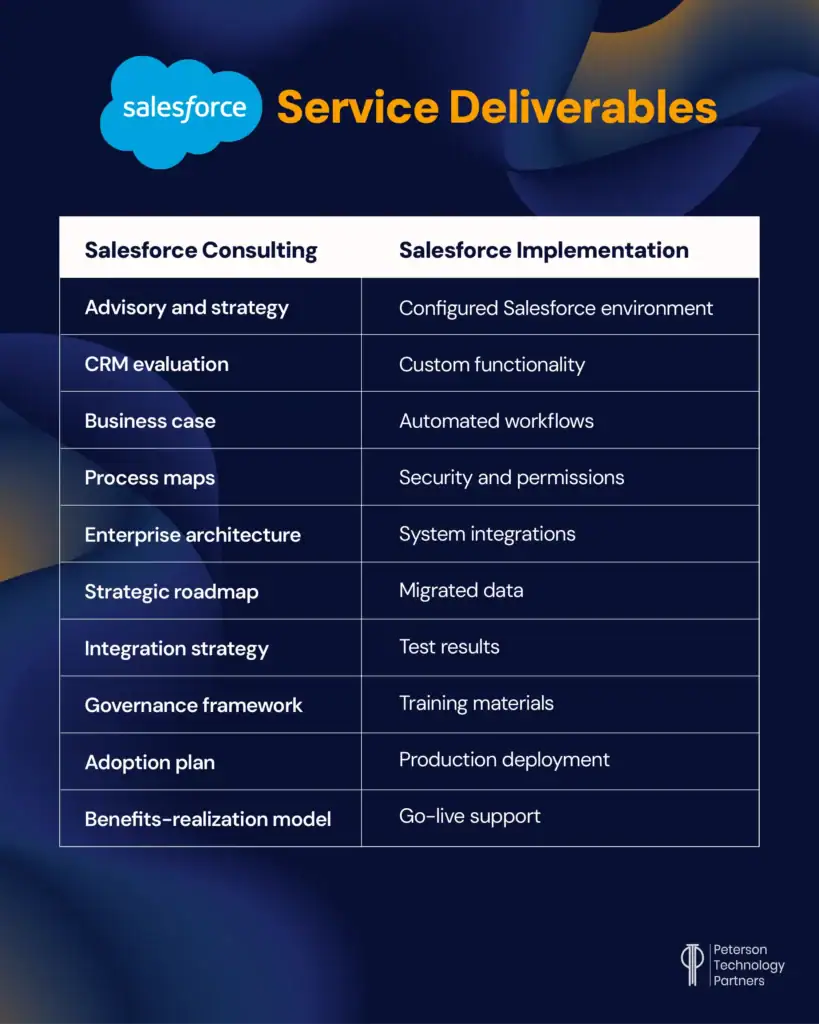
- Their deliverables are different.
Obviously by now this is clear, but let’s look at the specific outcomes of each type:
- A Salesforce consultant and implementation partner have different skills.
There is overlap of course, and the two services don’t always come from different companies. (PTP, for example, provides both.)
But consultants bring business analysis, industry knowledge, experience with stakeholder alignment and process design, as well as transformation strategy, enterprise architecture mapping skills, change management, and governance.
Salesforce implementation specialists are geared on admin and configuration, custom Salesforce development, data security and migration, engineering integration, QA, security, DevOps, and technical documentation.
- Implementation thrives with a precise scope.
Exploration and discovery is more how Salesforce consultants helps businesses.
Implementation contracts usually have well-defined boundaries, including Salesforce products, orgs and sandboxes, business units and user groups, standard config vs custom development, objects and data volumes, clear delineations on data cleaning and migration, and requirements for security, testing, training, and any post-launch support.
- They measure success differently.
With differing deliverables, this is a must.
So let’s look at what defines success for a Salesforce consultant:
- Strategic alignment
- Stakeholder agreement
- Strong business case
- Clear, prioritized roadmap
- Reduced/managed risk
- Improved processes
- Stronger governance
- Higher adoption
- Measurable business value
For Salesforce implementation:
- Delivery matches scope
- On schedule and on budget
- Data migration accuracy
- Integrations are reliable
- Security requirements met
- System performance requirements met
- User acceptance
- Implementation ends at launch, but consulting often goes on.
For your business, go-live is just a stage or step in the process. For your partnerships, that can vary depending on what you need.
Some consultants continue to monitor adoption (and train users), resolve defects, adjust and improve workflows, and help manage Salesforce releases. They ensure and strengthen governance and prioritize enhancements.
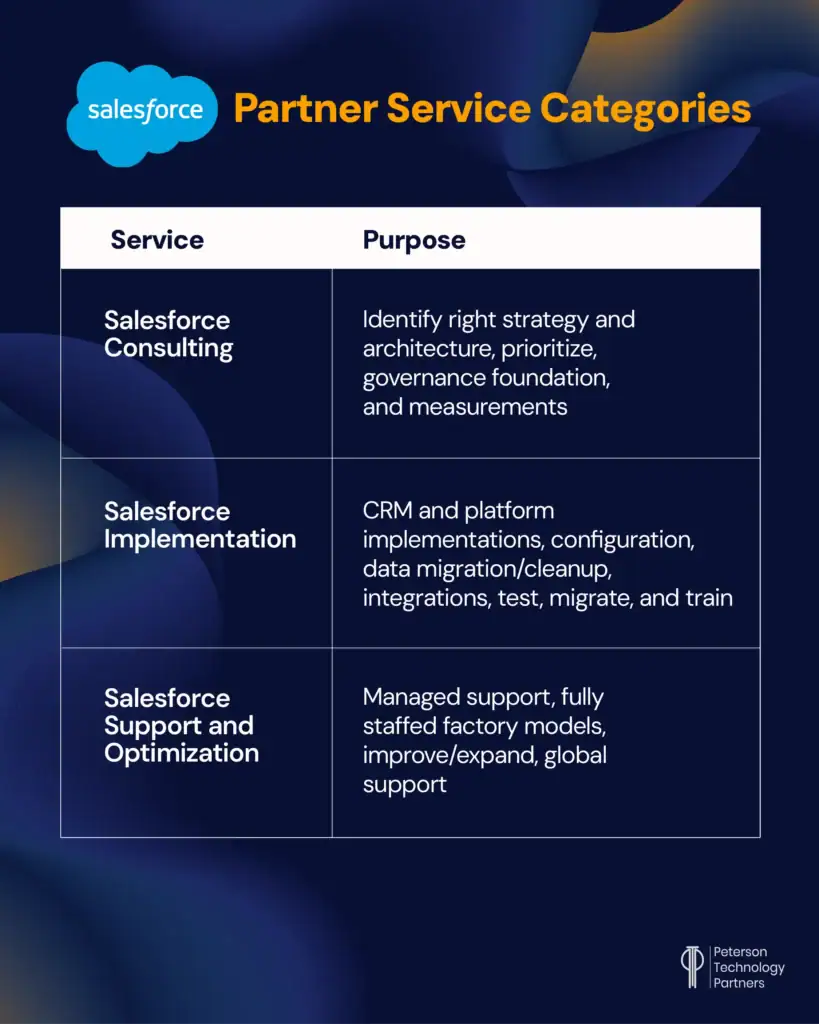
You can consider this as three different categories of service:
Should You Hire a Salesforce Consultant or an Implementation Partner?
If your leaders aren’t in total agreement about priorities, you’re unsure what Salesforce products you need (or even which CRM you want), you have Salesforce now but its not delivering like it should, or you need help with architecture and integration mapping, scope, adoption, or governance, you should hire a Salesforce consultant.
Hire a Salesforce implementation partner when you have objectives with clear requirements and really need configuration or development expertise.
Maybe you’re migrating from another CRM, have a good handle on the plan but need complex data migration or integrations, are adding another Salesforce product, need to boost your internal team, or must hit a hard deadline.
Hire a partner that offers both when you’re dealing with enterprise transformation, multiple Salesforce products, major process redesigns, AI adoption, unreliable data, or launch with continued support desired after.
How to Choose a Salesforce Partner
Certifications are important and show that a partner is current with Salesforce (which changes fast), but they shouldn’t be the sole measure, and more (especially if they aren’t in a needed area) don’t necessarily mean better.
The same is true with hourly rates, which may be meaningless if you’re not getting a lasting solution with a strong, scalable foundation.
A good partner will have the experience you need, with customer testimonials and metrics.
They’ll also identify and challenge weak assumptions before agreeing to build.
Frequently Asked Questions (FAQ)
What is the difference between Salesforce consulting and Salesforce implementation?
Salesforce consulting is about clarifying the business strategy, requirements, architecture, and roadmap, while ensuring governance, and directing the Salesforce initiative for maximum value.
Salesforce implementation builds, integrates, tests, migrates, and deploys the resulting solution.
What are Salesforce implementation best practices?
Salesforce implementation best practices may include: defining measurable goals, mapping processes clearly, cleaning and migrating data, limiting unnecessary customization, designing integrations effectively, testing with real users, providing role-based training, and establishing clear post-launch ownership. Phased rollouts ensure success before scaling, reduce risk, and make optimization easier.
What are the steps involved in Salesforce implementation?
The Salesforce implementation process begins after the consulting work is done. It typically includes: preparing and cleaning data, configuring, potentially customizing Salesforce, integrating connected systems, testing the solution, and training users before launch.
After deployment, the team should resolve initial issues, monitor adoption, measure performance and may suggest ongoing improvements.
What is included in Salesforce implementation?
Salesforce implementation may include discovery and solution design, though these are typically the purview of consulting.
Salesforce implementation is focused on configuration, customization, data migration, integrations, security, testing, training, deployment, and go-live support.
What does a Salesforce consultant do?
A Salesforce consultant is focused on ensuring the solution meets your business needs. They typically begin by assessing business problems, gathering requirements, recommending solutions, building roadmaps and architecture, preparing users, and helping measure results.
Do Salesforce consultants implement Salesforce?
Yes, some Salesforce consultants participate directly in implementation. Salesforce itself lists implementation, training, adoption, and post-launch evaluation among common consultant activities. Sometimes “Salesforce consulting” is used to refer to the entire process.
What is the Salesforce implementation process?
This process typically includes strategy, discovery, blueprinting, architecture, data preparation, configuration, development, integration, testing, training, deployment, and post-launch stabilization.
Should I hire a Salesforce consultant or Salesforce implementation partner?
This decision depends entirely on what you need. Use consultants for: defining the strategy, business case, requirements, architecture, and roadmap, or for assessing and improving a current Salesforce org.
Use an implementation partner to build and deploy a defined solution. Complex programs may need both capabilities.
What is the role of a Salesforce implementation consultant?
A Salesforce implementation consultant helps align the solution to your needs. They translate business requirements into practical solutions, via discovery, process mapping, functional design, configuration guidance, testing, training, deployment preparation, and coordination between business and technical teams.
Salesforce consulting vs. implementation: What is the difference?
If you don’t know by now you may never know! But here’s one more recap:
Consulting is what Salesforce should accomplish.
Implementation turns that plan into a working platform.
In Conclusion
Is Salesforce implementation different from consulting? Yes, and we’ve covered the many ways.
But it’s also true that “Salesforce consultant” sometimes gets used as a blanket for all forms of Salesforce partner assistance.
As described here in detail, there’s a big difference between what Salesforce consultants and Salesforce implementation partners deliver and how.
Clarifying now helps be sure you’re addressing the right problem for your business.
The best Salesforce partners can do both seamlessly. They connect your business strategy with a Salesforce solution that encompasses data, AI, and effective processes in one highly disciplined effort.