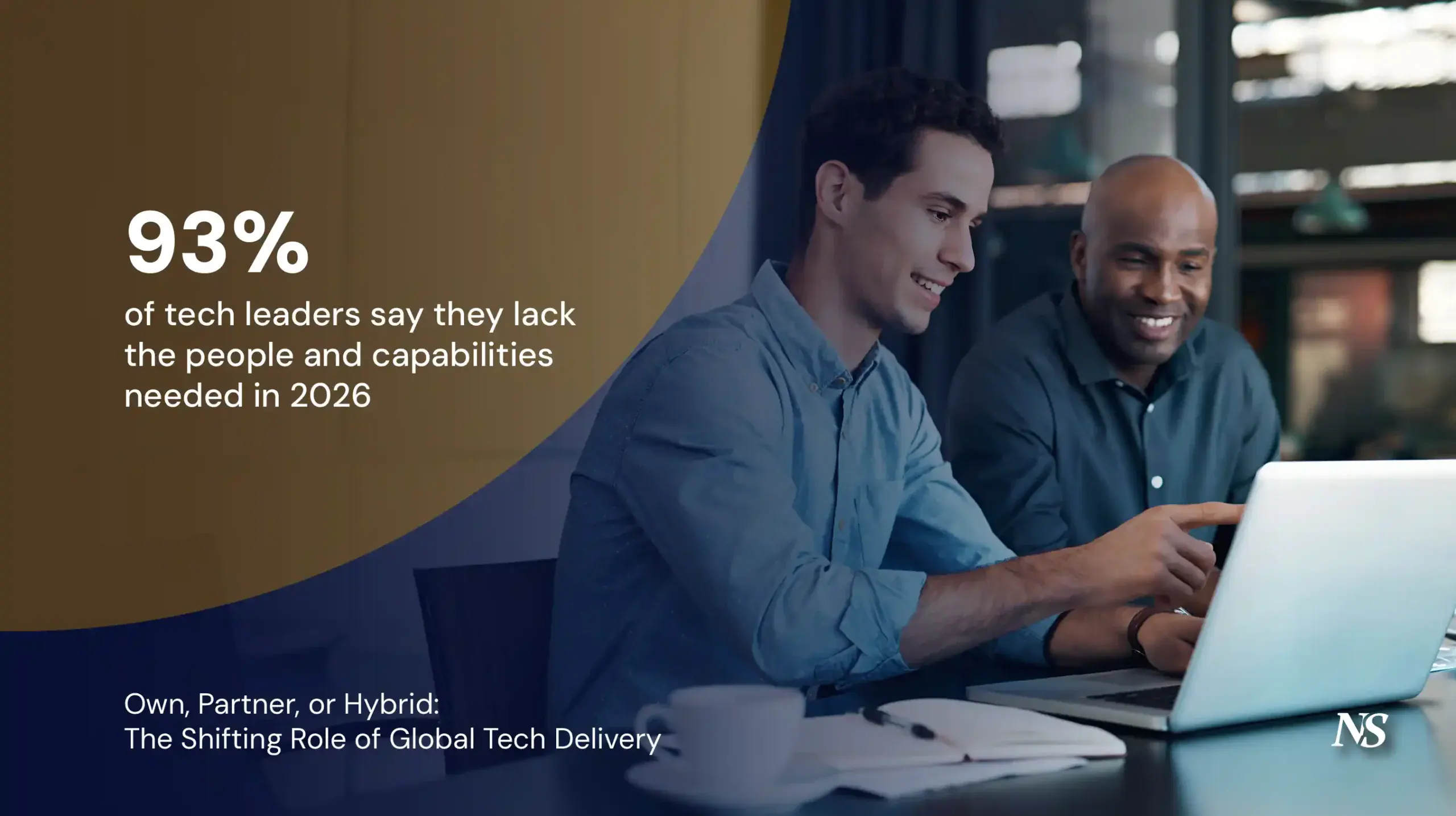
Enterprises are continuing to shift their global tech delivery models. Who owns it, where is the work done, and how is it being run are the questions, and they’re seeing varied answers based on the organizations and the initiatives alike.
Deloitte research found that more than three-quarters of organizations have been adjusting their global footprint. Why?
To get the talent they need, better stability, and lower costs.
Geopolitical turmoil and the shifts we’re seeing from AI-driven global delivery are definitely factors.
The US Bureau of Economic Analysis found that American companies spent $81.7 billion just on research and development outside the US in 2023 (and across all industries, not just tech).
This demonstrates as well the shifting nature of the work being moved outside home offices and countries. It’s also a clear indicator that these shifts in global delivery strategy aren’t being driven only by cost.
Of course, there is no one right approach, and with supply-chain risks high and security concerns rampant overall, and AI acting as a powerful leveler, a lot remains in flux.
Today I look at some of the ways I’m seeing businesses structure their enterprise technology delivery to ensure they continue to get the best blend of quality, speed, safety, and cost.
The changing dynamics of Global Capability Centers (GCCs), global IT outsourcing, and nearshore IT services
Nearly two-thirds of CFOs (65%) polled by Grant Thornton in 2026 were using outsourcing in some form or another.
In the arena of digital services (computing, finance, and business services), the World Trade Organization tracked the market at a staggering $5.27 trillion in 2025, up 10% from the prior year.
And in Latin America, where 30% of the finance leaders polled above also use nearshore solutions in their model (up 11% from the prior quarter), the UN’s Economic Commission found foreign investment in the arena of services grew nearly 20% in 2025 (compared to overall regional investment increases of just 1.7%).
Countries like Costa Rica have seen technology and business service exports overtake tourism as their leading export. And most of those services are being used by companies in the USA.
Global Capability Centers (GCCs), which used to be cost-centric offshore sites for companies to execute more routine work, have been changing rapidly with AI into hubs for greater technical specialization.
GCCs are now also popular for things like governance, strategy, and product development. They’re also helping companies tap workers with the hardest-to-find technical skills.
The Economic Times reported this month on the push from the Big Four professional services firms alone, whose GCC work has become their fastest-growing business (generating more than $2 billion in combined revenue for the 2026 fiscal year).
KPMG generated a reported 30% to 35% of its entire advisory revenue in the fiscal year from GCCs, and they represented 35% of PwC’s tech consulting business.
The growth is surging (+32% since 2021 per Nasscom-Zinnov) at a time when many believed AI might erase it. India is now expected to host as many as 5,000 GCCs by 2030.
As Partner and GCC Market Segment Leader at PwC India Rajesh Ojha told the Economic Times:
“Companies are increasingly looking to India to build a ‘strategic twin’ that can own transformation and experimentation, rather than merely execute work handed down by headquarters.”
And why are these areas all growing?
Cost has long been a driving factor in outsourcing of course, but the latest surge is being driven by talent access and innovation increasingly empowered by AI.
As the Lead of Financial Services GCCs at Deloitte South Asia Prashant Choudhary explained:
“The client increasingly needs more and more domain expertise. The combination of agentic AI, domain expertise and top talent” is making the GCC option only more compelling for businesses worldwide.
When should companies choose onshore, offshore, or nearshore technology teams?
Given these choices and the changing nature of where work gets done, how do companies decide what they should own and what they should partner for?
This must begin with a company’s business strategy, and they should of course own what capabilities give them a competitive advantage.
This includes product strategy and IP, but also the bedrock of what connects their critical business systems.
Cybersecurity, too, remains important to own (at its core at least) as risks are rising fast in the near term (as I recently wrote about in an article on accelerating AI cybersecurity threats).
I believe governance ownership, too, is essential, even as vendors provide the necessary controls.
But owning these things, as demonstrated above, doesn’t necessarily mean keeping them within your physical headquarters.
Target is one example.
The popular retail company has maintained a significant presence in India for more than 21 years. It recently expanded its Bengaluru office park with merged campuses for more than 5,600 employees (and 40% of their global tech workforce) that work on site.
This center is deeply integrated with their Minneapolis US HQ, supporting core aspects of business that include merchandising, digital, stores, and cybersecurity.
It’s also at the forefront of their AI initiatives, where the company is planning to spend an additional $2 billion this year. They’re working to get more effective business intelligence from a massive volume of retail data.
Here again, this is not the traditional model of passing lower value work offshore to save money.
American-Swiss insurance firm Chubb Limited is another company that’s sending high-value tech work to an owned offsite center, but in this case at a nearshore location.
With engineering centers already in place in India, Mexico, and Greece, in 2025 Chubb added a new site in Colombia, too, specifically to support software development, AI, data analytics, security, and cloud computing.
This gives the team greater agile capability by taking advantage of overlapping time zones without having to sacrifice ownership.
When to choose a technology partner vs in-house team
But not every need requires building a permanent presence in a distant country. These kinds of investments require a lot of area knowledge and aren’t easy to jump into from scratch.
Most companies today are merging approaches together, to take advantage of the expertise, speed, and scalability partnerships provide without having to take on the overhead and risk of offshore ownership out of the gate.
As expertise keeps becoming more specialized and challenging to recruit (or to upskill), more organizations are also adding the services of partners with ready, established global IT staffing solutions.
This keeps ownership at home (or in owned GCC locations) but enables capabilities that can come together quickly either offshore (where talent pools are deepest and coverage can run around the clock), nearshore (with growing talent pools and overlapping time zones), or onshore.
This approach is popular because it’s often the fastest way to add specialists and keep projects on task as requirements shift.
What are the advantages of hybrid global technology delivery models?
So, what is the best global technology delivery strategy for enterprises scaling their IT teams?
Most articles I read that consider GCCs vs outsourcing or offshore vs nearshore will tell you point blank: what they’re selling is best, of course.
At least for a certain kind of business at a certain size, in a key industry, or chasing a specific need.
But the truth is that the hybrid global delivery model is the one that’s actually taking root at scale.
This sees organizations tapping the benefits of all of these approaches at once: core strategic work remains owned, while non-core needs—including handling surges and getting specialized skills fast—come through partnerships.
It’s popular because it best balances control, quality, speed, and cost.
Within this approach, all of the other considerations still apply.
Large-scale engineering support may best be tapped from an offshore location for the fastest scaling, most available talent, and usually the best price (though it’s rising).
Meanwhile, ready, specialized teams that can mesh in real time with onshore teams are popular for adding capabilities at a smaller scale from nearshore locations.
At PTP, I am increasingly seeing enterprises adopt structures like these:
- Product strategy, data governance, and security driven from home.
- Offshore teams handle testing, automation, and 24/7 operational assistance.
- Nearshore software development teams work with the US team in rapid iterations, can build components, and bring short-term or specialty needs.
- Onshore consulting teams provide short-term guidance, analytics, and directional or oversight assistance.
Flexibility is arguably the single greatest benefit from an adaptable partnership like this.
It enables companies to easily and quickly scale based on shifting requirements or demand, or else deliver capabilities for whatever duration is needed ASAP.
Pulling all of this together of course also requires effective leadership and strong communications.
The risks to a hybrid approach come from gaps that can spring up in accountability, overlaps in work, or a failure to get fragmented groups to work together effectively.
The bottom line: Choosing the right mix of onshore, offshore, and nearshore delivery is a delicate balance
You don’t need me to tell you that there’s no one right global delivery arrangement for all enterprises.
Its potential for variability, after all, is one of the main benefits.
But AI is becoming highly significant in this consideration.
We wrote a PTP Report in February of last year about AI’s ability to level up expertise (especially from the least experienced to the middle). We have long believed this would bring large changes to how global delivery works.
At PTP I am seeing this in action.
AI is already breaking down regional barriers, and we have ample evidence this trend is going to continue and escalate in the years to come.
To maximize this and its ability to provide a competitive advantage, the impetus is on leaders to clearly identify what needs to be owned, what should be outsourced, and what works best in a hybrid approach for their own businesses.
This thinking may do more to help businesses achieve AI productivity advantages and tap into cost savings than any other as we enter 2027.
References
Activities of U.S. Multinational Enterprises, 2023, US Bureau of Economic Analysis
Digitally delivered services trade dataset, World Trade Organization
Accelerating M&A value creation through outsourcing and AI, Grant Thornton
Big Four battle for India’s $2-billion and growing GCC work, The Economic Times
Why GCC operating models offer a new competitive advantage, EY
Target Expands Bengaluru Campus With New Office, CIOL
Target pushes deeper AI adoption, reviews usage‑based pricing, India head says, Reuters
FAQs
What are the different global technology delivery models for enterprises?
Enterprises often build their own Global Capability Centers (GCCs) which are typically offshore, outsource specific tech needs to specialized providers, and use hybrid models that merge internal teams with these approaches and additional external expertise. I see companies today utilizing varying mixes of onshore, nearshore, or offshore workers, depending on availability, business requirements, and cost.
How do GCCs compare with outsourcing and nearshore delivery models?
GCCs are company-owned. This means they handle the direct oversight, infrastructure, and protection of their intellectual property. Outsourcing taps external providers for similar uses in many cases. Nearshoring is a specific kind of sourcing involving nearby countries to tap into extended talent pools with overlapping work time and greater proximity. GCCs can be offshore or nearshore, the same as outsourcing.
How can enterprises balance cost, security, control, and speed when choosing a global delivery model?
It has to start with what’s most important to the business itself. Offshore costs have been rising alongside nearshore capabilities, so cost isn’t always a clear decider between the two. And overall, more companies are looking around the world for skills they may not be able to get quickly at home. I recommend companies maintain ownership of what’s most strategically important to their business, while working with partners to take advantage of access, speed, and scalability. Hybrid models that mix all of this (and consulting as needed, too) are popular because they often allow the greatest flexibility and control.