

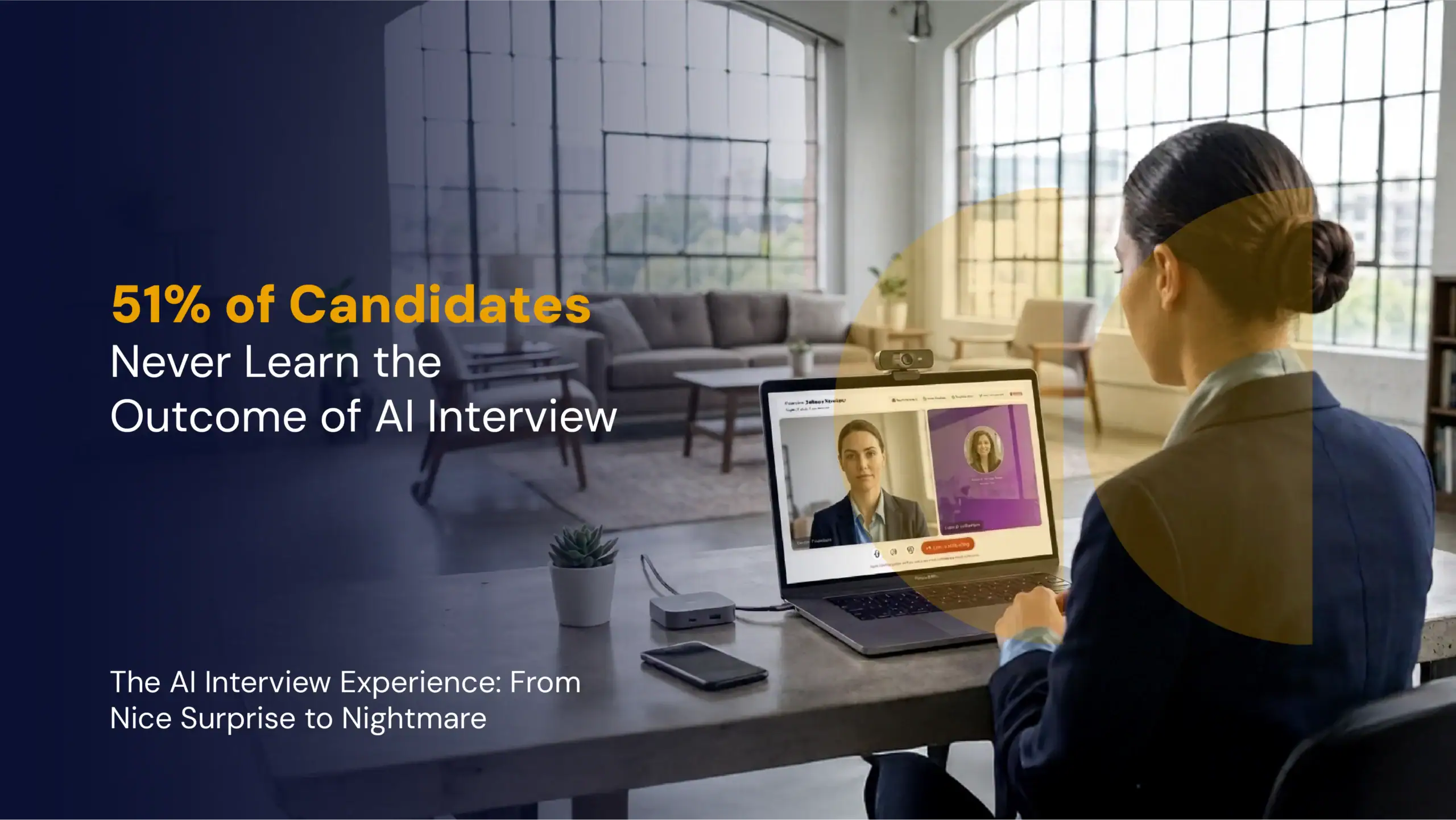
Are AI interviews good or bad for candidates?
It depends on who you ask. A recent write-up in the Chicago Booth Review of research from the University of Chicago and Erasmus University Rotterdam (in partnership with PSG Global Solutions) surveyed some 70,000 applicants who interviewed with either a human, an AI, or were given a choice between the two.
Their results favored AI—and more than expected. And while humans ultimately made the final hiring decisions, 80% of candidates favored AI interviews to the human.
The AI interviews also led to more offers, more starts, and more tenures lasting 30 days or more.
But there are findings that run contrary to this, including a Greenhouse survey finding that 38% of 1,200 candidates considered dropping out of a search after being interviewed by AI.
(With another 12% saying they would drop if they had to be interviewed by AI.)
Across studies, there are contradictions, but there are also consistencies: candidates crave transparency and communication, and overwhelming oppose AI making the final hiring decisions (Pew put this at 71% opposed to just 7% accepting).
In today’s PTP Report we look at trends and individual candidate reactions to AI interviews: what they liked, what they loathed, and why the experience has brought pleasant surprises or frustration and dismay.
Automated Job Interviews: The Why and How
We’ve written before about the escalation of AI use on all sides of the hiring process. AI has seen application volume surge (LinkedIn getting 11,000 applications per minute last summer) with increasing similarity among submitted materials (62%+ now with AI-generated content); as the number of recruiters per candidate has declined.
Overall, a Greenhouse survey of 640 million applications from 2022 to 2025 saw a 412% increase in annual applications handled by recruiters.
But in addition to just getting by, AI has also helped lower time-to-hire (73% of recruiters say it is improving theirs) and cost per hire (up to 60% lower), at a time when speed had been lagging.
No doubt this is why 63% of candidates have already experienced an AI interview of some kind.
But what exactly is an “AI interview”?
The category is broad and includes more variations than you might think. It can mean voice agents that ask screening questions via phone or chatbots walking candidates through qualifications Q&A.
It can be a one-way interview where candidates directly (or largely) reply to pre-set prompts, in the form of an AI voice, text interface, or even questions with recording buttons and countdown timers.
Broader AI interviewing tools can summarize interviews (human or AI), score, rank, sort, perform keyword analysis, schedule, transcribe, and handle all manner of back-and-forth communications.
They can be integrated in a single flow or serve as spot-use tools.
This is another reason why comparing candidate AI interview experiences is tricky.
Effective conversational AI phone screens (at the high end) can deliver effective pronunciation (as Fast Company’s Shalene Gupta noted, even better than humans in some cases), adapt on the fly, ask questions on par with industry experts (see below), and operate from a candidate’s provided information effectively.
They can measure many soft skills, with the Booth study referenced above finding AI proved at least as effective as humans at identifying effective communicators.
But on the other end, they can be slow, obtuse, robotic, sycophantic, or mistake prone.
So let’s look in more depth at our leading question: Do candidates like AI interviews?
Skeptical or Negative AI Interview Experiences (the Nightmares)
There are numerous social media channels that exist entirely to bemoan bad AI interview experiences. One example calls it: “everything you probably expected it to be.”
Too positive, not responsive, asking odd questions, too slow, and appearing to not even listen.
Articles have run across outlets charting the POV of candidates frustrated from experiences like these, with several citing Greenhouse’s stat for candidates abandoning hiring processes that include AI interviews.
In that study, far and away the greatest frustration seemed to come from a lack of transparency overall, with 70% of those surveyed noting AI use wasn’t clearly disclosed beforehand, and one in five noting they only found out it would be an AI interview at the time it actually happened.
A May article in The Guardian profiled the frustration of several specific UK job seekers, who described the process using words like “faceless,” and “frustrating.”
These interviews included AI interviews with pre-recorded video of someone asking questions, and the candidate given two minutes to think, and three minutes to respond.
Another type posed five general, pre-set questions displayed on-screen, with a record button and countdown timer for responses. One candidate they interviewed found this “awkward and humiliating.”
Some expressed frustration in not knowing what systems were actually evaluating. Was it their words, tone, pauses?
Were facial expressions being considered?
Or was it all just about the transcript? In one example, a CEO told a candidate in a later round that he just fed the text from the AI interview into ChatGPT to get its take.
Ultimately, this unknown nature of the experience and the general ambiguity around it may be most consistently off-putting to candidates.
One-way interviews don’t allow for a candidate’s own questions, and there is no flexibility when things go wrong. Submitting a recording of yourself for evaluation is a very different experience than having a dialog.
Bad AI interviews can also lead candidates to change their own behavior. As one candidate explained, “I spoke in bullet points and keywords; the real me would never speak like that.”
Positive Candidate Experiences in AI Hiring (the Pleasant Surprises)
On the flip side, there are real potential advantages to effective, responsive AI interviews for candidates when part of an effective hiring system overall.
Chief among these is better communication, speed, and overall transparency.
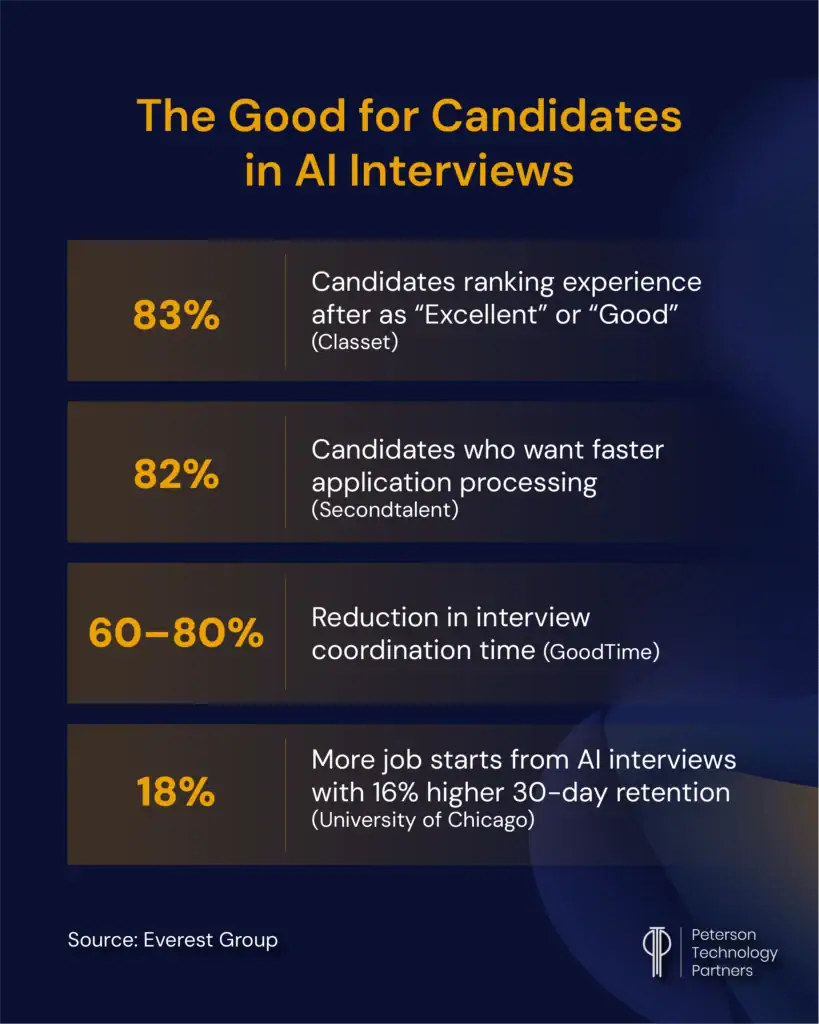
Across surveys and studies, applicants often repeat the same message: they want to know what’s going on with their application, be notified in a timely fashion about the state of the search and their own evaluation, and in general not waste any more time than is necessary in cases where they don’t have a realistic opportunity to advance.
AI systems that succeed can deliver on all of these fronts. We led with the University of Chicago study, and ultimately this was one of their greatest takeaways. As researcher Brian Jabarian explained: “The attractiveness of AI is that it’s always available.”
It can provide a standard and structure that includes greater convenience for candidates as well.
He noted their results found the AI “better at picking up on linguistic features—like interactivity during a conversation—that actually matter for a job decision made by humans.”
They also reported less gender discrimination, though Jabarian also noted the AI interview approach they surveyed worked best for highly structured roles.
In our own studies, PTP has received similarly positive feedback from candidates, even when expressing reluctance or expressing a negative perception of AI interviewers beforehand.
One software manager who agreed to share his take called that the process “fairly natural,” and was impressed, noting the AI “analysis of my response was quite good.”
He also praised the AI interviewer’s vocal quality and parsing, even in some of his “rambling” responses when he was thinking out his answer out loud.
Another java engineer called it a “good experience,” noting some small pauses, but stressing how impressed he was with how accurately it processed what he was saying, even when it was of a highly technical nature.
“The follow-up questions were spot-on,” he noted. “Because it knew what to ask next based on my previous response.”
A current PTP employee noted she’d been through nine months of “black hole experiences” in her job search, estimating that 75% of her correspondence with job openings resulted in no response at all on next steps.
She came away from the AI interviews pleased, calling it “refreshing,” and saying she’d been won over quickly the adaptation and speed. Most of all, she relished that it gave her insight into her status and accelerated the entire hiring process.
Fast Company’s Gupta said she “did not like” her AI interviewer, but at the same time called it “maybe the best thing to happen to hiring for employers and candidates.”
Where AI Recruiting Gets Off Track
Most candidates may prefer to talk to a warm and responsive human interviewer (while also getting immediate feedback on performance), but this has never been a very realistic real-world experience, especially for first interviews.
And as in most applications of AI, the success or failure of AI interviews goes beyond a binary success/failure evaluation. As important as the AI solution itself is how it’s implemented, and how it fits into the broader hiring process.
Some things are consistent: bad AI interviews come as a surprise, are not responsive, and diminish the humanity of the experience.
They also don’t do enough to solve communication processes that are already broken in so many hiring processes.
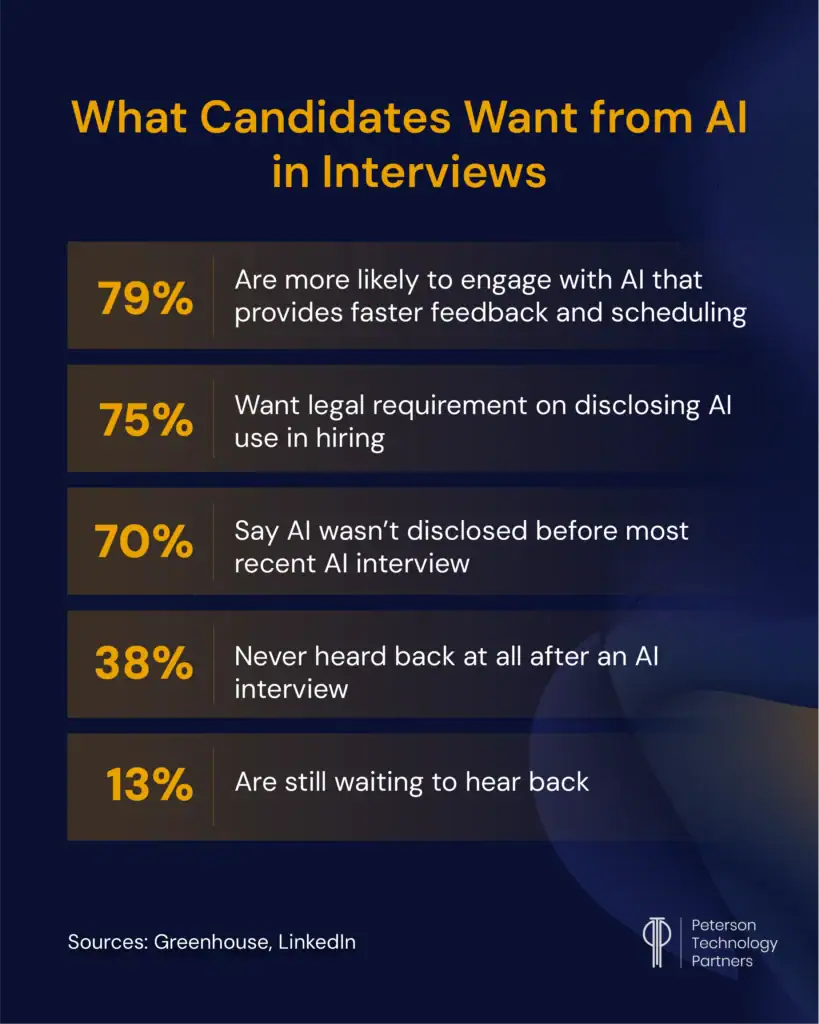
AI should—and can, when done well—decrease uncertainty and accelerate the flow of information for both businesses and candidates alike.
It should help candidates more easily schedule, get information, and know where they stand. It should also include human review and ultimately rely on human decision making.
Otherwise, the entire process risks being less “interview” and more “extraction” or “data capture.”
How Can Companies Make AI Interviews Feel More Human?
The bottom line is respecting everyone’s time and humanity, and this is something AI can, ironically enough, do better than us at the start of the process today.
Companies need AI hiring solutions that provide consistency, transparency, and improved speed.
Candidates ultimately want many of the same things: better and faster communication with a clear idea of what to expect.
Ultimately, AI interviews don’t take away the importance of human relationships or decision making in the process, something increasingly required by regulatory necessity as well as desire on both sides.
For companies, this means clear disclosure and consent, while also giving insight into the form an AI interview will take. As we’ve noted above, there are wide variations.
Candidates should be made aware of what the AI is evaluating, and AI should be used effectively in the right parts of the hiring process.
The easy wins include: scheduling, initial screening and communication, candidate FAQs, interview summaries and transcripts, and system updates (such as ATS and CRM).
Some AI interviewers are capable of conducting technical screenings, for example, but ultimately there should be both human review and support, in cases of candidate request or technical necessity.
And follow-ups should be completely unlocked by AI. It can and should effectively end ghosting in the hiring process.
One thing that is consistently noted in the wide array of surveys, both promotional and academic: Candidates judge companies highly when AI in hiring goes right and harshly when it fails.
Conclusion: Is AI Recruiting Actually Helping Hiring?
The reality today is typically less about companies replacing recruiters with AI and more about using AI to keep up.
And while AI does improve metrics like time-to-hire and cost-per-hire, the bottom line is that it must also fix broken aspects of the process to work.
AI interviews aren’t going away, but candidates are telling companies loudly and clearly what they need from it: to be clear, convenient, responsive, and part of a hiring process that’s fairer and more transparent instead of less.
For more information on PTP’s own AI hiring automation, check out our website. We strive to bring clarity, consistency, and quality even to high volume technical hiring.
References
Does AI Beat Humans at Recruiting, Chicago Booth Review
Employers are blindsiding candidates with AI interviews—and scaring them off, Fast Company
Americans’ views on use of AI in hiring, Pew Research Center
AI interviews in hiring: What candidates actually want – and how to get it right, Greenhouse
Nearly 4 in 10 job candidates have bailed on a hiring round because it required an AI interview, Fortune
‘Awkward and humiliating’: UK job hunters share frustration with AI interviews, The Guardian
FAQs
What is an AI interview?
An AI interview is a job interview that is either supported by or run through AI. There are a wide variety of formats, from chatbots to one-way video recordings to responsive conversational AI systems. They can be one-off tools or part of more extensive virtual AI interview platforms.
Do candidates dislike AI interviews?
There are as many responses to this question as there are types of AI interviews. Some candidates dislike the rigidity, isolation, and impersonal nature of some kinds of systems, while others admire the speed, responsiveness, and improved communication they’ve received as part of AI-powered hiring processes.
One consistency: candidates prefer transparency about AI and the nature of its use in hiring overall.
Why are companies using AI interviews?
AI interviews enable companies to screen more candidates more quickly, to better handle increased application volume. They can also help with scheduling flexibility, organization, bias, consistency, and speed overall.
When well used, AI interviews can be part of a solution to problematic parts of the hiring process, like delayed or broken communication that creates a “black hole” or ghosting experience for many candidates.