

It’s nearly summertime and we kick off our May 2026 AI news roundup with this: If everyone’s using the same AI, how do you get a competitive advantage?
This question keeps popping up in various ways as companies push to effectively reimagine workflows with AI. One of the most common answers: It’s the humans, and how we’re kept involved.
For its part, AI capability continues to improve faster than expected. The Forecasting Research Institute points out that the popular METR benchmark’s May update already hits the median task horizon predicted by experts and superforecasters for the end of 2026 (Anthropic’s Mythos model).
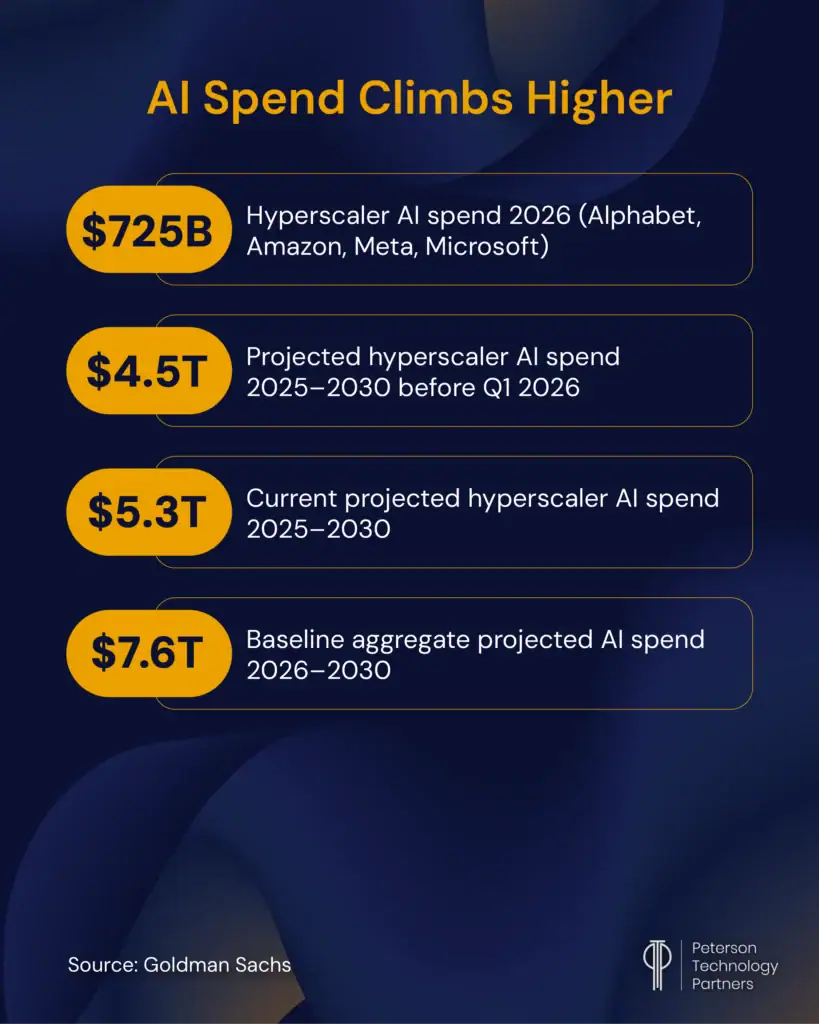
Meanwhile, several bottlenecks are becoming increasingly pronounced. The Wall Street Journal reported at the start of June how far behind data center production has fallen, with more than 60% of the data center capacity that’s supposed to be ready next year not even started, per JPMorgan.
Permits, supply chain, and power are among the leading drags, while AI companies also add data and engineering talent to the list.
This is one of the topics we cover in this edition.
Among the others: enterprise AI adoption triggering brutal usage costs, the surprising shifts in the AI jobs impact story, three of the most massive IPOs in history coming soon, Google I/O 2026, Opus 4.8, and a roundup of the newest releases and AI business news.
For our updates from the last three months, you can check out the most recent roundups below:
On Regulation and Other Generative AI Developments
Before we get to our leading stories, here are some of the other AI headlines from May:
- There was ongoing speculation throughout the month about the executive order from the White House requiring all new models to first be screened by the US government. Tech leaders from companies like OpenAI, Google, Anthropic, and Meta were reportedly on their way to Washington for the signing of one version that was ultimately scrapped, with the final version getting signed with less fanfare at the start of June. This version asks companies to voluntarily provide their models to the government for a pre-screening period of 30 days and tasks the Treasury with forming a “cybersecurity clearinghouse” to check vulnerabilities uncovered by new frontier models.
- AI executives praised the order, though overall most of the major companies have consistently worked against regulation in various forms. A report released in May from researchers at Trinity College, Carnegie Mellon, Delft University of Technology, and the University of Edinburgh looks in depth at the ways, building a taxonomy of 27 mechanisms across five categories.
- Meanwhile, US states have continued with their own regulations, with California signing an executive order focused on AI’s jobs impact (including worker training programs, an examination of universal basic capital, and considerations on compensating companies that keep employees, per the New York Times).
- Illinois passed SB 315 in May, with Governor JB Pritzker noting that he plans to sign it. If it becomes law, it will go further than AI laws in New York and California for requiring safety and guardrail information. SB 315 requires AI companies to verify safety practices with third party auditors like the Big Four accounting firms. Anthropic claims it was the first AI lab to support it, telling Wired in a statement that it could help “establish a baseline that every leading AI developer is expected to meet.”
- Also in May, Pope Leo XIV released an encyclical titled “Magnifica Humanitas.” It warns about many dangers of AI as it continues in development and intersects with society. Crafted after extensive dialog with Silicon Valley (including Anthropic’s Christopher Olah, who also joined the pope for its presentation), the document warns about the “idolatry of profit” and “new forms of dehumanization.” Comparisons were made between being AI and nuclear technology, urging that it must be “disarmed” and put “at the service of all and of the common good.”
Hardware, Chips, and AI Data Center Infrastructure Updates
We opened with the split between AI’s growing capacity and an accompanying shortage of AI compute. This demand is playing out across hardware, employment, real estate, and even in global politics.
The demand for memory and AI-optimized servers continues boosting companies like Dell (raised annual revenue and profit expectations, per Reuters), HPE (record second quarter earnings with raised annual and longer-term forecasts), Micron (topped a trillion dollars in market value in May, per Yahoo Finance), Samsung (also topped a trillion dollars in value, per the Wall Street Journal), Corning (on fiber optics for data centers), and AMD (nearly doubled net income from last year with revenue up 38%, per CNBC).
Revenues for chip-maker and cloud-services firm Cerebras jumped 76% last year, setting the table for more upcoming AI-related IPOs (see below) with the biggest public offering of 2026 so far. Its IPO price was $185, went public for $350, and closed up 68% (before dropping 10% a day later). The company’s made broad deals across AI with firms like OpenAI and Amazon (CNBC).
But while many businesses are thriving in the space, power remains a concern. Wired reported in May that even automakers like Ford and GM are shifting from EV to power storage that can be used for AI to tap into the incredible demand.
Amazon, meanwhile, published research last month on a breakthrough in network design called RNG (Resilient Network Graphs), and have begun deploying the architecture in AWS data centers. The company claims this advance (which “flattens” the network) cuts power consumption by 40% and lowers costs by 27%.
UIUC professor Brighten Godfrey—who’s a leading scholar on the topic but wasn’t involved in Amazon’s research—called it a “mind-bending problem to solve” and their real-world use “remarkable.”
China has continued its own push for AI self-sufficiency with products from companies like DeepSeek optimized to run on Huawei chips.
Huawei’s president Tingbo He claimed the company has found a way around the limits of Moore’s Law by speeding up computations instead of adding more components. She promises a big “surprise” in this arena before winter 2026.
.
AI Business Cost Impacts Continued in May 2026
Along with a compute crunch comes mounting cost concerns for customers.
Snowflake, ServiceNow, and Uber are among the firms now admitting they’re concerned about the rising cost of their AI spend. Routing through cheaper models, often on a per-task basis and using custom routing tools, is one of the methods firms are using to get control (The Information).
As we reported last time out, another is just defaulting to cheaper models, which for coding use cases has shown a surprisingly large benefit (30% savings for some).
Microsoft reportedly canceled many of its own Claude Code licenses due to cost concerns (per the Verge), with one AI consultant telling Axios they had a client spend half a billion dollars in a single month after failing to limit Claude usage.
Coding capability is continuing to improve: Anthropic reported that 80% of their new code is authored by Claude, with Mythos providing a 52x acceleration, while Cognition’s Devin reportedly authors 89% of their own (with the rest by local agents in Windsurf).
Preprint research from the University of Michigan, Stanford University, AllHands AI, Google DeepMind, and MIT looks at where exactly coding agents are spending company money. (You can try your own with their “guessing game,” too.)
They found that agent token use is highly variable, with runs on the same task having as much a 30x variation and with accuracy not always corresponding to the number of tokens used. Frontier models were also found to often struggle to predict—and often underestimate—real usage. (The researchers also found code accuracy peaked at intermediate cost and even degraded at the highest costs.)
Senior vice president of Palo Alto Network’s threat intelligence arm Sam Rubin may have summed it up perfectly in a discussion with The Information.
Using Anthropic’s Mythos model, the leading cybersecurity firm found more than two dozen critical vulnerabilities in just weeks (around five times what their existing tools were finding), but also “very quickly” burned through more a million dollars in tokens.
AI Job Market Trends: Is AI Actually Replacing Jobs in 2026, or not?
The US gained 172,000 jobs in May, per the Bureau of Labor Statistics. That’s more than twice what analysts were expecting.
Meanwhile, long-term unemployment (of at least 27 weeks) has also surged, reaching 1.8 million (CNBC). Tech layoffs climbed over April, hitting their highest May total since 2020, with AI listed as the main reason for the third month in a row.
But these layoffs are also down overall compared with the first five months of 2025, with the tech sector also leading in May hiring.
Bottom line, while there are what BlackRock’s Rick Rieder calls “concerning trends that could point to some trouble down the road,” we’re not yet seeing the “jobspocalypse” many predicted, per Yahoo Finance.
Nevertheless, May memes and news reports made the rounds of college graduates booing commencement speakers who talked positively of AI (Business Insider).
Artificial Intelligence hiring trends
Many economists like Nobel-winner Daron Acemoglu don’t yet believe in the AI-driven jobs apocalypse, at least in the near-term. He told the MIT Technology Review’s James O’Donnell that there’s definitely a great deal of uncertainty, and that he is concerned about AI companies recruiting economists for hype purposes.
But he still sees AI agents better used as tools, pointing out that a human x-ray technician, for example, can routinely juggle 30 tasks, switching between formats, databases, and styles with ease. Even with their improving capabilities, this is beyond what today’s agents can do.
Apollo Global Management Chief Economist Torsten Sløk cited ADP payroll data to argue that firms are hiring implementation experts and that he sees: “zero evidence of job losses because of AI.” Instead, he sees the technology creating more demand and more jobs (Yahoo Finance).
70% of HR professionals say they’re still facing challenges in hiring for full-time positions, with about half saying it’s harder than it was last year, per data recently released by SHRM.
Eight in 10 say skills like communication, judgment, decision making, complex problem solving, and time management are still hard to find, even over tech skills, with two-thirds saying they struggle to find creativity and critical thinking.
In light of all of this, it’s not surprising that AI leaders from Demis Hassabis (“it’s a lack of imagination,” per Wired) to Jensen Huang (“it is just too lazy,” per Business Insider) to Sam Altman (“I’m delighted to be wrong about this,” per Reuters) to Dario Amodei have either talked against the value of replacing workforce for AI or said that AI will create jobs rather than take them in the near term.
Big AI Goes Public: OpenAI, Anthropic, and Google AI Announcements from May 2026
“We are definitely in a moment where there’s more greed than there is fear.”
This was Goldman Sachs CEO David Solomon talking with CNBC’s Leslie Picker about the surge in AI investment on the eve of three massive industry-related IPOs.
Citibank raised its forecast for the global AI market to $4.2 trillion (by 2030, per Reuters), as the hyperscalers continue to all increase their own investments (see above).
But it’s not all been runaway success for Big Tech in the market, with only two of the Magnificent Seven outperforming the S&P 500 since the start of 2025: Alphabet (gains of 49%) and Nvidia (88%). The broader S&P 500 is up 27%, with Apple, Amazon, Microsoft, and Tesla all trailing that mark.
While Microsoft is believed to have made some $30 billion in revenue from the OpenAI deal (doubling its investment), the company is undergoing a more difficult AI stretch so far in 2026 (The Information).
Meta has fared the worst in the market, with just a 3% increase over this period, as the company’s AI investments are a drag but continue being viewed as a critical necessity (Yahoo Finance).
And speaking of investment, companies expected to be worth more than three trillion dollars are planning to go public in the weeks and months to come.
First up on the IPO watch is xAI parent SpaceX, aiming for a $1.75 trillion valuation to raise $75 billion in its public offering, according to The Information.
While the company includes AI and is deeply invested in the data center business, it is grounded in SpaceX and the highly successful Starlink.
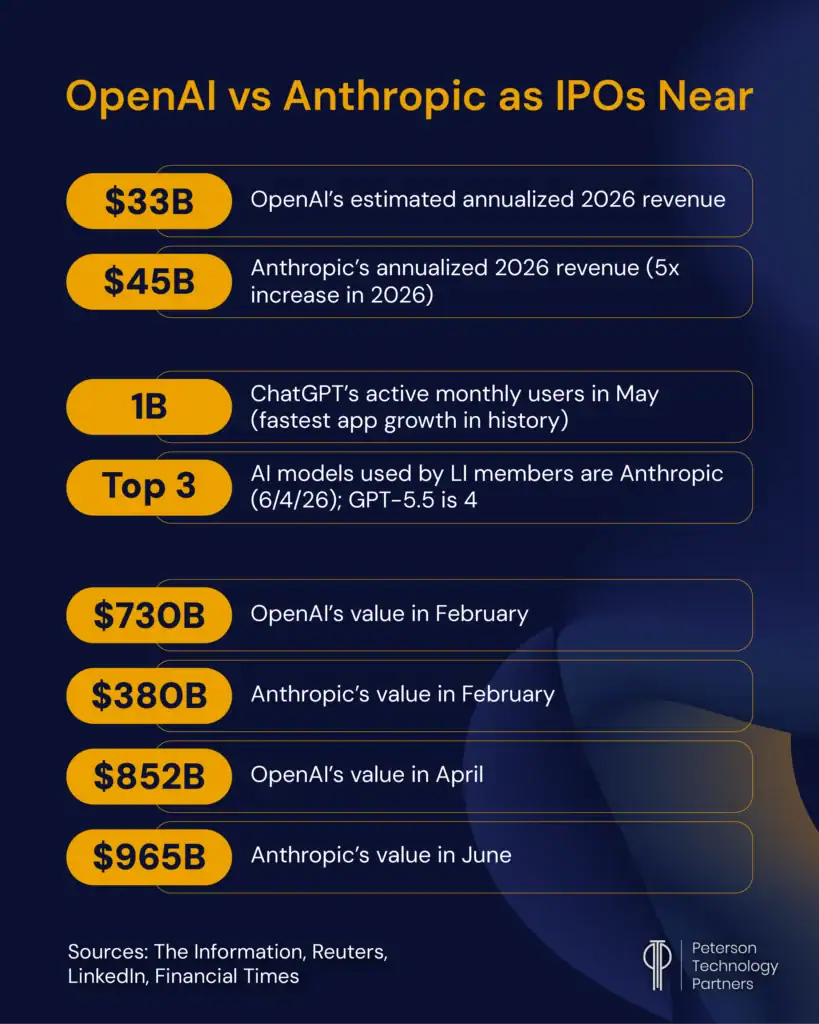
The two biggest pure AI companies, Anthropic and OpenAI, are also planning to go public this summer.
OpenAI is believed to have generated $6 billion in revenue in the first quarter of 2026 alone but finds its numerical lead over Anthropic dwindling in many areas.
What happened at Google I/O 2026?
While Anthropic’s success is undoubtedly one of the top stories in AI so far in 2026, Google has done very well on its own right, noting it has 2.5 billion monthly users of AI Overviews, and reporting a seven times year-over-year growth in token usage, reaching some 3.2 quadrillion tokens per month.
(Their model APIs process around 19 billion tokens per minute.)
These were just some of the insights shared at I/O 2026, the company’s annual developer conference held in May.
Other announcements included:
- AI Mode has now become central to Google Search, powered by the new Gemini 3.5 Flash (its faster, cheaper, “workhorse” model). Touted as the biggest update to search in 25 years, this change lets users enter longer queries and even use agents straight from the box.
- Google is pairing the success of their Nano Banana with Omni, a new video generator with video editing capabilities. (It also upgraded the Flow tool.)
- Like most of the AI companies, Google is providing its own answer to OpenClaw-style agents with Gemini Spark.
- Antigravity 2.0 is the company’s newest agentic coding app, consolidating some existing tools in a desktop app for orchestrating agents and designing custom workflows.
- We’ve reported previously on tech leaders like Mark Zuckerberg creating their own digital twins with the goal of enabling more access and interaction with more people. Googe’s Gemini’s app has added an avatar tool that may be the beginning of offering such functionality for more adult users. It allows users to clone themselves for other media use within five minutes.
- DeepMind Co-Founder and CEO Demis Hassabis produced the most memorable quote from the event, saying in his keynote: “When we look back at this time I think we will realize that we were standing in the foothills of the singularity.”
We’ve written before about how the even fairly rare errors in AI Overviews snowball at Google’s incredible scale.
As a counterpoint, The New York Times profiled several ways Google’s AI Search is actually an improvement on the pre-AI version (despite the periodic errs): shopping for groceries with images (and a TV show reference in this case), ordering repair parts with an image (in this case for a car), finding flights (they found it superior to Google Flights), researching products (while accounting for personal preferences), and spotting scams (both by asking it to research sites and by providing things like serial numbers for parts ordered online).
What are the other biggest AI announcements from May 2026?
Here are some of the updates from major AI companies as we round out the month:
- Anthropic released their newest frontier model not named Mythos: Claude Opus 4.8. The company claims it beats rival frontier models GPT-5.5 and Gemini 3.1 Pro on benchmarks for coding, agentic financial analysis, and tool use (Yahoo Finance).
- Mythos, meanwhile, has still not been fully released, but their Project Glasswing is quietly being expanded to 150 new organizations (The Information).
- OpenAI is reportedly creating a “superapp” ahead of their IPO which will combine both Codex and ChatGPT (The Information).
- Anthropic’s value could exceed one trillion dollars when it goes public (Financial Times), and this is buoyed by a number of deals it has made for compute, including a $1.8 billion cloud deal with Akami (Bloomberg) and the purchase of all of the computing capacity from SpaceX’s Colossus 1 data center. Anthropic has also made recent agreements with Amazon, Microsoft, and Nvidia (Yahoo Finance).
- OpenAI and Apple have come to tensions over their two-year partnership, with OpenAI failing to see expected benefits like increased subscriptions. Apple’s use of OpenAI within its operating systems has remained limited, with OpenAI not ruling out legal action (Bloomberg). Apple has rebuilt Siri through its partnership with Google (Axios).
- Apple’s WWDC 26 is going on right now, so we’ll have coverage of it and their new AI directions in our June roundup.
- Former OpenAI co-founder, Tesla executive, and AI educator Andrej Karpathy (also frequently quoted in these roundups) joined Anthropic in May, noting that he was very excited to “get back to R&D.”
Conclusion
We’ve been writing regularly about agentic AI breakthroughs, like the surge in coding, customer service, and rapid adoption in areas like healthcare (as with OpenEvidence). In May, AI progress in math also entered the spotlight.
Frontier models were once focused on the Math Olympiad and managed to win gold but still could make mistakes with elementary problems, as pointed out by Google’s Demis Hassabis a year ago.
But in May, OpenAI revealed that one of its models had disproved a significant 80-year-old conjecture, by solving a non-trivial Erdős problem. Even more noteworthy, the AI’s work was lauded by many mathematicians as being novel, with the University of Toronto’s Jacob Tsimerman calling it: “really impressive piece of work, and I would accept it for any journal without hesitation.”
But on the heels of this has come the Leiden Declaration on Artificial Intelligence and Mathematics. Authored by 16 mathematicians in partnership with global mathematics organizations, it warns about AI’s role in the field. Among the concerns: a flood of papers and proofs (like the code overload we covered last time for software) that seem plausible but lack sufficient rigor, jobs in the field, a loss of value in mathematics for thought and discovery, and the general impact on human development.
What’s undeniable: AI capacity at math, once a joke, has been radically improved.
That ends our coverage of the major AI events from the month of May.
If your business is in need of AI consultation, labor, or solutions, contact PTP.
Our VOICE Framework™ incorporates what we’ve learned about creating effective, secure AI solutions that keep humans involved in the right ways.
References
Experts and Superforecasters Update Their AI Timelines, Forecasting Research Institute
Trump Signs Executive Order Seeking Oversight of A.I. Models, California’s Governor Signs A.I. Order Aimed at Protecting Workers, Five Ways A.I. Search Beats an Old-School Google Search, The New York Times
Illinois Lawmakers Just Passed America’s Strongest AI Safety Bill, Amazon Thinks the Future of Data Centers Depends on a Technical Problem It Just Solved, Huawei’s ‘Chip Queen’ Throws Down the Gauntlet, Wired
Pope Leo says AI ‘needs to be disarmed’, Financial Times
Three things in AI to watch, according to a Nobel-winning economist, MIT Technology Review
Job market vibe check: Recruiters say creative thinkers are hard to come by, Yahoo Finance
The Briefing: Anthropic Has Opened Up a Big Lead in AI Revenue, The Information
I/O 2026: Welcome to the agentic Gemini era, Google’s The Keyword
Google launches Antigravity 2.0 with an updated desktop app and CLI tool at IO 2026, TechCrunch
A New Declaration Warns AI Could Threaten the Foundations of Mathematics, Gizmodo