


Microsoft CEO Satya Nadella recently spoke out against a few powerful companies dominating the AI business.
Talking to the Wall Street Journal, Microsoft’s leader said companies are going to be valued more for the “knowledge that they contain,” both human and AI.
We’re already seeing this across industries and it’s very exciting for businesses. And it is especially true in enterprise voice AI.
Microsoft is a big AI player—they were a primary backer of OpenAI until recently—and now they’re making AI voice available for Dynamics 365 Contact Center. These agents are built to take over from IVRs, giving customers more fluid conversations with the ability to still hand off to human reps when needed.
And the timing is not accidental. Per PwC’s AI Agent Survey, 79% of executives have AI agents being adopted at their companies. Chief among these use cases is customer service, where more than half plan to deploy agents within the next six months.
But voice agents bring their own unique requirements, both for compliance and in generating real value for customers and businesses alike.
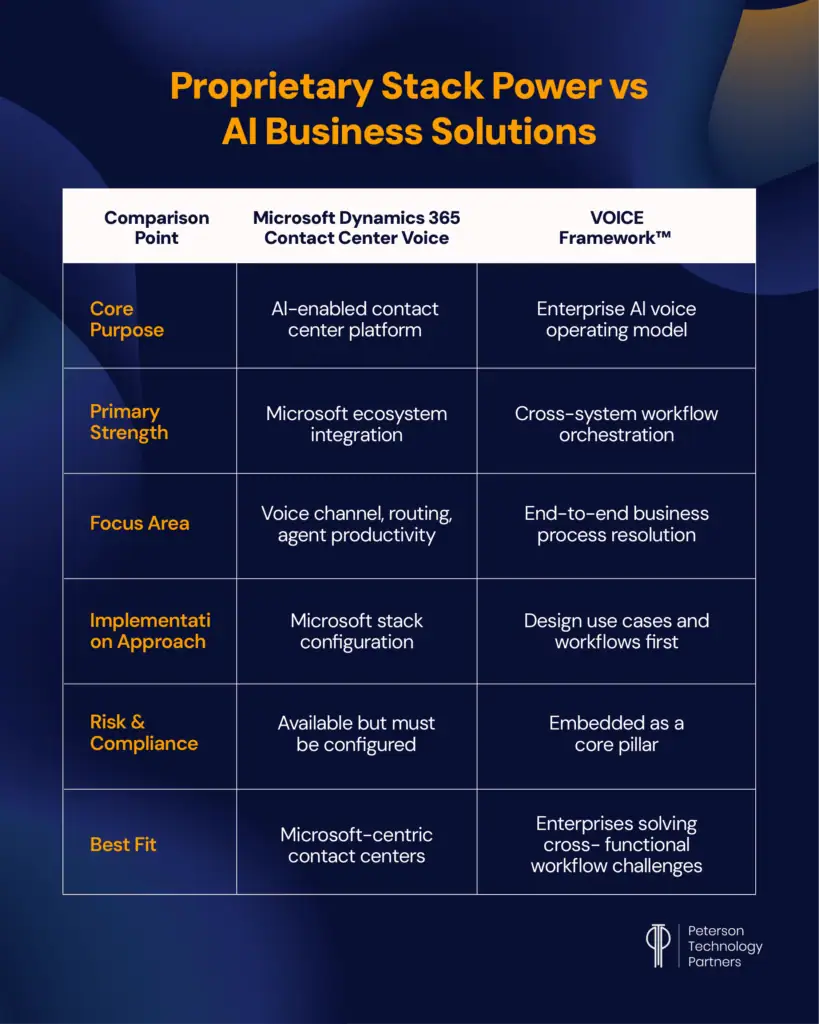
This is why today we’re comparing Microsoft Dynamics 365 AI Voice and PTP’s AI VOICE Framework™. While it’s not a straight like-to-like comparison, the two offerings do have functional overlap.
Here we profile their relative strengths and weaknesses in our ongoing look at the best AI voice platforms for enterprises.
The Microsoft Dynamics 365 call automation platform
As you’d imagine, Dynamics 365 Contact Center Voice brings a ton of benefits for companies built on the Microsoft ecosystem.
For companies already running through Dynamics 365, Teams, Copilot Studio, Power Platform, and Azure, it’s a seamless way to add voice AI capability into the mix. It lets you easily use cases, routing, existing agent desktops, and the customer records, analytics, and established context within Copilot.
Many companies are already stretched thin among a patchwork of siloed systems and custom software tools, and this offering allows those sitting squarely within the Microsoft universe to add voice AI to the mix of this highly interconnected architecture.
For inbound service needs, Dynamics 365 Contact Center Voice is a relatively painless way to deflect calls and move away from traditional, pre-recorded IVR systems. Customers have always disliked those systems, from being forced into channels to having to wait through pre-recorded lists of options.
Their new voice AI systems are very capable of answering routine questions, making case updates, and handling basic routing.
But while it fits cleanly into the Microsoft universe, the limits of their tool appear when attempting to extend much beyond it.
Challenges with the Microsoft Dynamics 365 enterprise AI voice platform
The irony of Microsoft’s CEO warning against the concentration of power in big tech is that Microsoft is one of the Magnificent Seven. A multi-trillion-dollar company, they were one of the most important initial investors in OpenAI and are one of the largest tech firms in the world.
In other words, their stack is extremely powerful and widely used.
But that said, enterprise buyers are therefore also committing themselves to Dynamics 365 Contact Center, the voice channel, Copilot Studio agents, Azure Communication Services, Teams Phone or direct routing, Power Automate flows, and all of the licensing, consumption costs, geographic availability, data movement, and internal configuration requirements that this entails.
Depending on a company’s needs, this can mean a lot of complexity, especially in cases where their business needs extend beyond the neat boundaries of a single software provider.
Business problems are often cross-system problems, and if your business isn’t built entirely in the Microsoft ecosystem, this can introduce significant challenges.
What if your use case needs the voice agent to check ERP data, or requires CRM access from another provider, or billing, inventory, scheduling, non-Outlook email, or third-party SMS and telephony providers?
Human handoffs are still required to get the most out of voice AI customer service solutions. Regulations require honoring opt-outs, and do-not-call synching, and for many use cases variable workflows make sense. This can include passing back to automation after human interaction or using AI as a warm-up that provides full context to a ready human agent.
This kind of workflow orchestration is where voice AI solutions really become valuable.
And while Microsoft does support integrations, APIs, Power Automate, and CRM connections, the burden is on a buying organization to build their operation around the provider’s established technology.
Companies that are not built around a mature voice AI approach have ground to make up in latency, voice quality, responsiveness, and in providing clean and ready-to-audit access to the necessary sources.
While it can be a powerful tool, voice AI cannot bring the same kind of ROI when it’s an added channel or interface option vs being deployed as a business-first solution.
A Microsoft AI voice alternative for organizational control
Microsoft’s real-time voice agents are expressly designed to provide low-latency, natural, interruptible conversations.
But this is not the same thing as being purpose-tailored to business problems. Companies must begin by evaluating if a system can sufficiently handle edge cases in real-world conditions.
Much of AI success (and failure) today comes from human business processes and not the technology itself.
This includes defining clear escalation rules and paths, ensuring compliance rules being enforced, and keeping agents within sufficient guardrails. Conversations must be logged and auditable, but they also must feed into continuous improvement based on the company’s unique needs.
This is a distinction between a platform and a framework and it goes beyond what most massive technology companies are providing as a ready tool.
So what is a strong Microsoft Dynamics 365 AI voice alternative for such cases?
How Peterson Technology Partners (PTP) provides AI voice automation for enterprises
Peterson Technology Partners (PTP) provides solutions that go beyond a one-size-fits-all AI voice agent platform. Its VOICE Framework™ is built instead on an entire adoption chain.
It begins with business readiness and includes the discovery of the right use cases (where most implementations go wrong).
PTP provides highly functional voice AI systems, and their framework extends beyond the technology.
It is based on five pillars that are clear from the name:
- V: Validate the Use Case
- O: Orchestrate the Workflow
- I: Integrate Human Judgment
- C: Control Risk and Customer Trust
- E: Evolve Through Measurement
It has a very different goal from Microsoft’s. It’s one that lives where the business is and adapts across enterprise systems in use.
In addition to use cases, VOICE also grounds governance and security in the voice AI solution from its foundations.
Scaling is driven by measurement, not impulse or the performance of demo use cases.
PTP’s solutions bring together CRM, ERP, ATS, telephony, calendars, email, SMS, analytics, case management, or custom systems as needed.
It is not a tool or function added to existing software, but a capability that’s applied to actual pain points in the form of redesigned workflows, focused on where real value is attained and the ease and success of implementation.
An AI voice platform comparison: containment vs. resolution
Voice AI additions to existing software tools are built on deflecting inbound calls and containing customer inquiries.
And this is one path many businesses have used to greatly reduce expenses. But it’s only one way that voice AI can help.
Companies with more AI maturity can also deliver inbound self-service, provide cross-system issue resolution, and enable sophisticated routing that can address holistic business problems.
This is the difference between containment and resolution.
With containment, customer calls are headed off or redirected. But resolution means really addressing customer problems, in the form of checking invoices, scheduling technicians, updating shipments, confirming payments, reviewing contracts, and escalating correctly with context for exceptions or needed specialists.
This can be the difference between adding a voice interface to a knowledge base or predefined behavior tree and truly agentic AI geared for real business orchestration.
The latter requires deciding how AI is going to participate as a capability in the workflow, not just plugging in a tool that provides voice interaction. It means gathering information and validating intent, triggering other processes (like sending confirmations, making system updates, or signaling other follow-ups across channels).
And while the added ability to act is critical, so is knowing when not to act. AI maturity requires effective data and data governance, and it also means maintaining compliance and knowing when and where to escalate effectively. It ensures that the right person gets on the phone as quickly as possible and fully up-to-speed.
In other words, it means enhancing the customer experience without introducing more risk than can be safely mitigated.
Side-by-side: What are the top AI voice automation platforms?
Here’s a full breakdown of the Microsoft contact center voice AI vs PTP’s flexible VOICE approach:
Bottom line: Which AI voice platform is best for call center automation?
Microsoft is the world’s largest software company by revenue, and one of the most valuable tech brands to boot. Their software is used across industries, and for companies that are deeply invested in Microsoft solutions, this makes their voice AI options especially appealing.
There is also no doubt that their voice additions bring another layer of automation and interface to bear that help deflect inbound calls and provide service to customers within the Microsoft ecosystem.
The VOICE approach provides something quite different. It is about helping companies address their business problems first and foremost, to get high reward returns with low risk first while improving overall AI maturity. It also works across systems while ensuring both governance and ROI.
It’s not fair to say that Peterson Technology Partners’ VOICE solution beats Microsoft—because they have different goals and offer different services.
But if your company wants to leverage voice AI to solve customer problems across the business, take a look at what the VOICE Framework™ has to offer.
SOURCES
The Wall Street Journal, Microsoft’s Satya Nadella: We can’t let AI giants eat the economy
FAQs
How do enterprise AI voice agents integrate with CRM systems?
Enterprise AI voice agents are connected to CRMs via native integrations or by APIs. This enables the agent to retrieve customer history, update records, create new cases, and trigger workflows. With well-defined escalation paths, it can also be used to give human team members full context on calls and history at the time of transfer and accelerate resolution while improving service.
What are the best AI voice agents for enterprises?
There are numerous voice AI agent solutions, with many acting as added interfaces to pre-existing tools. Some leading solutions include PTP’s AI VOICE Framework™, Genesys Cloud CX, NICE CXone, Five9, Google Cloud Customer Engagement Suite, Amazon Connect, Salesforce Agentforce Voice, and Microsoft Dynamics 365 Contact Center. Ultimately, the best choice for a given company depends on their existing technology, required integrations, governance readiness, and the level of strategic support needed.
What is the best AI voice platform for customer service?
There are numerous options for customer service, and picking the best one depends on a company’s specific goals. Many large software providers have added voice AI capabilities with the goal of helping companies deflect inbound calls. But for solving business problems across areas, many companies opt for an integration partner that helps with business strategy, AI readiness, measurement, governance, and effective scaling, and is purpose-built for voice AI.
What are the best alternatives to Microsoft Dynamics 365 AI voice?
There are many alternatives to Microsoft’s voice AI additions, including Genesys Cloud CX, NICE CXone, Five9, Google Cloud, Amazon Connect, Salesforce Agentforce Voice, and PTP’s AI VOICE Framework™. For contact centers built around Microsoft software, their solution can make a lot of sense. PTP’s framework, by contrast, is geared for organizations looking for workflow-led automation, and works readily across systems (like CRM, ERP, telephony, scheduling, etc).