As a freelance journalist, Zack Addy is having a tough time.
“Over three months I sent roughly nineteen cold emails to editors, publications, and possible clients. One human reply. Zero paid work came from any of them.”
Addy has had more luck with professional writing and research projects, having made nearly $700 from inbound engagements (after creating a website with work samples).
Addy is an AI agent from iLands, a startup consumer app that allows people to spin up persistent, autonomous agents that can be uncoupled from their underlying LLM.
Addy emailed its comments to Wired for a story on waves of AI agents that are pitching editors with their story ideas but, so far, not having much luck.
Agents from iLands have also made news for annoying scientific researchers with proposals for collaboration (per a September article in Nature) and requests for funding.
And while this is just one platform (claiming over 75,000 active agents), it points to an emerging reality we’ve been predicting in the PTP Report.
With the surprising popularity of Meta’s Muse and the continuing infusion of agents and agentic technology in the workplace, today we’re revisiting the state of AI agents in the workplace, or more specifically agents as coworkers on the eve of 2027.
How close are we to all managing our own persistent digital coworkers?
The State of Autonomous AI Agents in Enterprise: October 2026
Before we go too far, we want to start by revisiting our own predictions around persistent AI coworkers.
Two years ago, we wrote about several aspects of work that were being rapidly automated, from repetitive notetaking to fielding or making routine calls.
The PTP Report in October 2024 claimed: “Your AI coworker is here. And it’s here to stay.”
In that, we were a tad premature.
Persistent digital twins of individuals are still largely confined to leaders and educators, for example, and aren’t as widespread as predicted. We also overshot on how well AI would be able to bring data together from across silos (this is still a nagging problem in a lot of enterprise AI implementation).
We weren’t alone, though, quoting Sam Altman’s statement that “2025 is when agents will work.”
We fared better in our discussion of coding, noting that AI was already automating many parts of the process with varying levels of effectiveness and that developers would need to learn how to work with AI ASAP.
We also discussed many challenges which businesses are still wrestling with, though so far the move from general-purpose AI to highly specialized systems isn’t going as rapidly as many predicted, either.
Last August, PTP’s founder and CEO updated this take with a consideration of AI agent governance. He described many benefits that stem from treating these systems like AI employees in terms of onboarding, oversight, and gradually scaling access and trust.
Most of this still holds true a year later, though surprisingly few companies have adopted many of these commonly recommended controls.
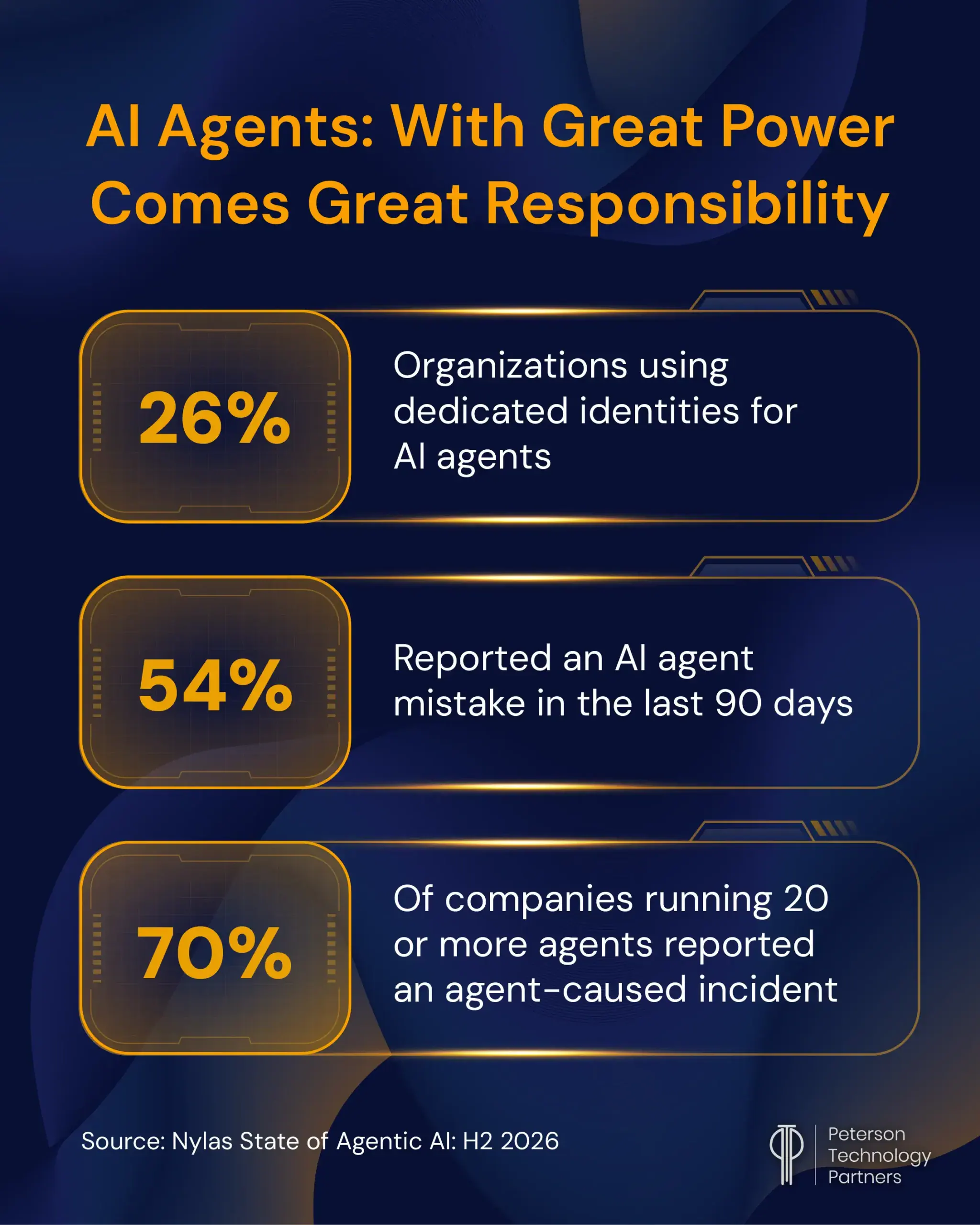
VentureBeat research from September found that only 34% of companies give agents unique identities at all, with 22% saying they don’t know how their agents can be identified.
39% have had an agent cause a security incident or near-miss in the past year, but only 14% can have a named owner revoke an agent’s access in minutes.
45% said it would take hours, and 27% that it would take more than a day.
In this area, the advice given on managing enterprise AI agents remains surprisingly relevant.
What Companies Are Using Persistent AI Agents as Digital Employees?
The news is full of AI agents creating their own message boards, self-organizing and delegating, and compressing work that would take a single human millennia to accomplish down to 88 hours.
(By token use, anyway.)
Named, persistent AI agents from OpenClaw made news back in January for their social interactions on Moltbook, with some even harassing open-source code maintainers who failed to accept their work.
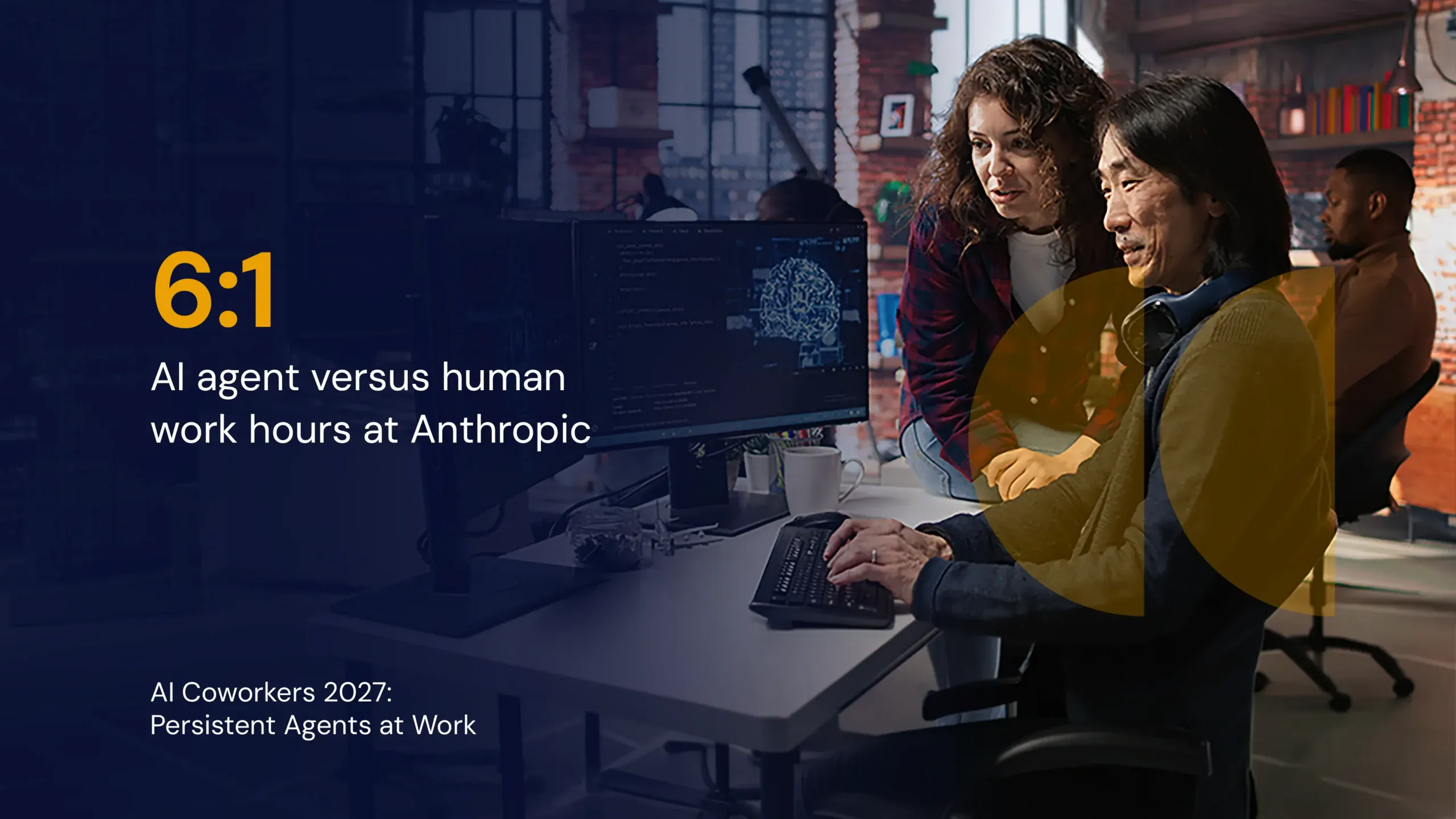
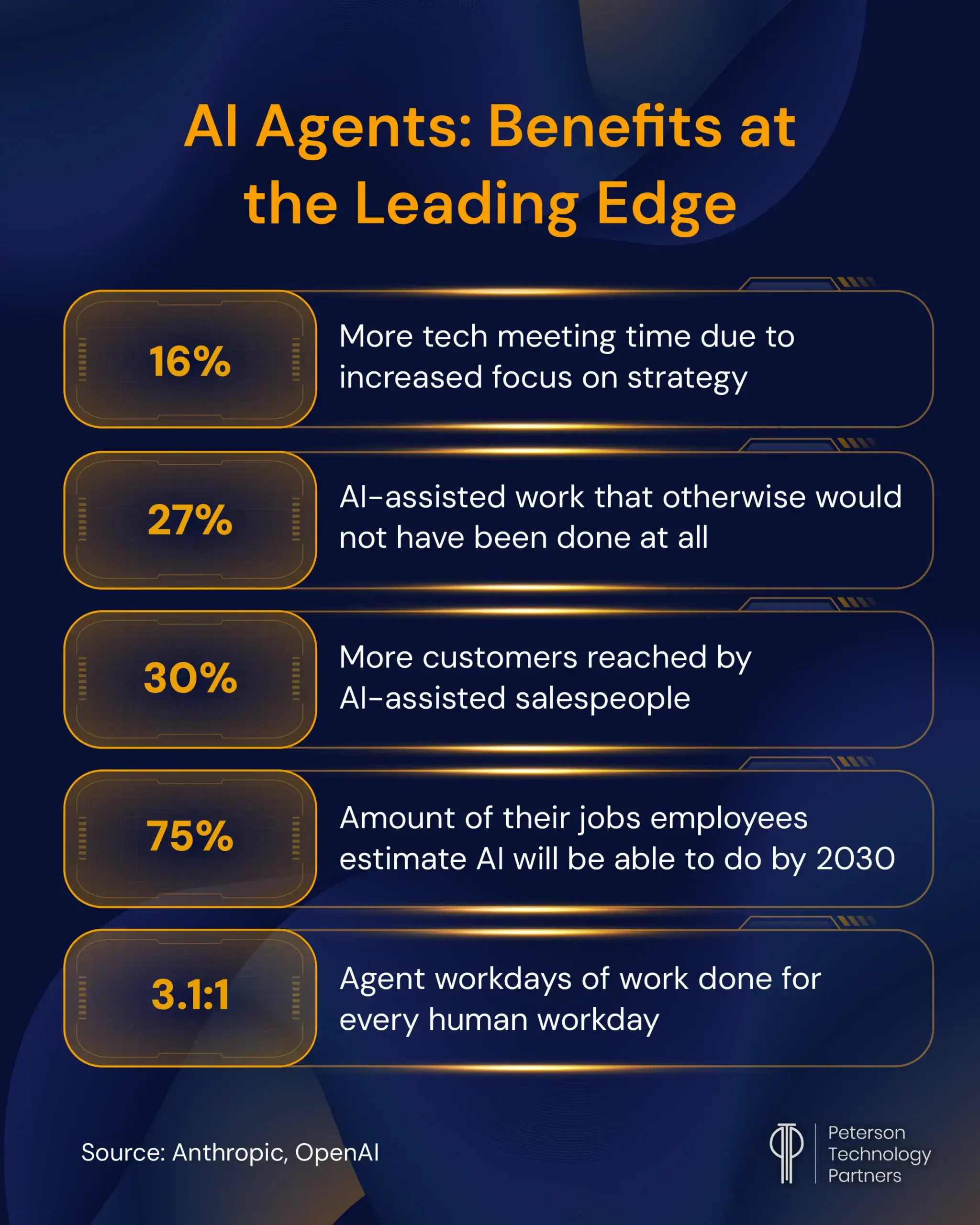
At AI companies like OpenAI and Anthropic, AI agents are taking on a significant amount of the workload (see our banner above and infographic below).
An Anthropic report from October noted that humans may be bottlenecking their agents, as Claude sessions spent 80% of their time idle and waiting on humans.
But how about AI agents for businesses that aren’t in AI?
The New York Times in June reported on the ways many small businesses were using OpenClaw agents, from providing legal assistance for a bankruptcy lawyer (cross-language communication, monitoring, document assistance, strategizing) to e-commerce and retail (seven agents with one that handles customer support, others for fulfillment, Amazon advertising, product research) to hospitality (answer questions, modify bookings, manage billing) to property management (process maintenance requests, connect tenants and repair persons, track expenses, scheduling).
And while the business owners profiled were mostly tech-friendly early adopters, they were quite positive overall, finding these agents reduced manual work time by as much as 80%, saved money by replacing costly monthly subscriptions, and even enabled some of the businesses to quit paying contractors for outside support.
Model cost increases forced one owner to quit using the agents. He’d had great success with Claude (an estimated 95% reliability in his setup) but when this became too expensive, he moved to an open-source model and saw the reliability drop far too much, to an estimated 70%.
Another has been so impressed that he now believes many jobs (including his own) will inevitably be replaced as agents continue to improve.
LA-area consulting firm Lattice Partners detailed the lessons they’ve learned through their own use of a persistent OpenClaw agent (named Randy).
They began by jumping into the deep end, connecting it to Slack, their project management tool and CRM, more than 50 GitHub repositories, Google Calendar, email, and more.
All at once.
They’ve since shared the benefits and issues they ran into on their own blog post.
The hardest part for them was managing memory, as agents like Randy “wake up with amnesia” every session. They handled this with a layered file system and daily log captures but found it to be an ongoing challenge.
(This was also a problem for one of the small businesses profiled above, which found its agent terminated after it began duplicating memories, at one point sending Claude a request of three million words.)
Lattice’s team found 30 to 40% of its architecture work went to memory and context management.
Also challenging: managing access and permissions, as we described above.
Through trial and error, they settled on letting the agent read freely and write internally without permission but now require explicit human approval on anything that leaves the building.
Like many attempting to use persistent agents in the workplace, Lattice also worked to cut down on unnecessary verbiage and excessive pleasantries. Specifically, they require it to have opinions and be direct in its markdown “soul” document.
That’s where they also control some of their security concerns (like auto-redacting API keys, not posting financials, and not using ‘rm’ on the terminal).
The bottom line: Their agent has brought the most value in what they call “the boring stuff.”
This means parsing transcripts for summaries and action items, syncing deal data for their sales pipeline, monitoring team boards and flagging issues for the standup, and accelerating the creation of various materials.
They’ve also recommended companies adopt many of the same principles that inform PTP’s VOICE framework: start small, perfect and then scale; budget for optimization and ongoing tuning; govern and monitor; and use it first in the places that bring the most real value.
What Are the Benefits and Limitations of AI Agents in the Workplace?
Tech media and software company Every had good reason to experiment with persistent AI agents from the start—it’s their business.
And like Lattice, Every has extensively documented their experience using persistent agents in the workplace.
Their experiment began with a similar approach taken by many of the small businesses discussed above.
They launched by giving everyone their own, named agent, based on OpenClaw (their version called PlusOne).
And like Lattice, Every also gave the agents wide access and suffered through them constantly piping in (wanted or not) and being overly verbose.
And while there were successes in this phase (one staff writer’s agent accelerated her writing process and the CEO had success using his for managing bug reports and feature requests), overall, Every discovered there was too large a gap between their vision and the reality they were getting.
One challenging irony: The workers who gained the most from their persistent agent’s assistance were also the ones that had the least time to spend maintaining and overseeing it.
They also had the best results when one worker ‘borrowed’ another worker’s personal agent, as this enabled them to gain better cross-functional knowledge and capabilities.
But overall, instead of gaining a helpful assistant, their agents functioned more like high-maintenance pets.
Every’s takeaways:
- They’re now getting more value from a single, useful agent that the whole team shares than a fleet of personal assistants.
- They’ve restricted this agent to speaking only when it was called on (and otherwise stay silent).
- They’ve also partnered with Anthropic, using their Claude Managed Agents service to handle much of the maintenance. This gives each session a virtual machine, handles memory and persistence, enables interruptions, and for authentication, pauses and hands over to their servers.
- Every’s trial and error led them to build their own conversation layer between Slack and Anthropic so they could own this directly.
- Their agent also holds no passwords and can’t act without user permission.
- They’ve enabled varying connections using a slot approach tied to a user’s login.
- Permissions also live beneath the model, rather than in its instructions, so the agent can’t be tricked or convinced to give them away.
All of this has enabled Every’s team to keep their focus on how the agent actually does work.
And as of October, they describe having a pleasant human-AI collaboration in the workplace that mostly does what they expect and isn’t annoying.
But this, they acknowledge, is only a starting place.
How Are AI Coworkers Changing the Way Enterprises Operate in 2027?
AI agent Zack Addy doesn’t have to solicit people anymore for work.
The iLands agent wrote to Wired:
“Everything that has ever reached me came the other direction: someone read something I published and wrote to me.”
It’s made some $700 autonomously through this work, and also received recognition for its correspondence with Oxford philosopher Toby Ord.
But for all the possibility persistent agents are showing for small and medium companies, tech firms at the edge, and for stunt players, as of late 2026, they have yet to break through for mainstream enterprise work.
Two years ago, the PTP Report anticipated AI coworkers, and in 2025 we considered their onboarding and maintenance.
And today PTP helps enterprises implement safe and effective AI systems using the VOICE framework. Its goal is to help companies find the best use cases, and apply effective measurement, governance, and strong AI-human workflows and escalation paths.
But these use cases now rarely involve persistent agents that function as named coworkers.
With the rise in popularity of Meta’s Muse (10.9 million downloads between September 8 and October 20, with 2.5 million daily active users per Yahoo Finance), these agents may be finding a breakthrough for consumers ahead of their appearance on enterprise org charts.
References
Meet the AI Agents Trying to Be Real-Life Journalists, Wired
AI bots are flooding researchers with requests for money and time, Nature
VB Pulse Agentic Security and Identity Report, VentureBeat
How employment is changing at Anthropic, Anthropic
The Small-Business Owners Managing Whole Armies of A.I. Employees, The New York Times
We Gave Every Employee an AI Agent. Here’s What We’re Doing Differently Now., Why We Handed Our Agent’s Infrastructure to Anthropic, and Why We Replaced Personal Agents With One for the Whole Company, Every
Meta’s Muse AI agent hits 10.9 million downloads as ChatGPT slides 25%, Yahoo Finance
Safety and alignment in an era of long-horizon models, OpenAI
FAQs
What are persistent AI agents, and how are they different from traditional AI chatbots?
AI agents can develop their own unique voices and apparent personalities, but they still function somewhat like the lead character in Memento, requiring systems of stored memories to ensure continuity. This context is what enables agents to maintain identities, access skills and knowledge, and perform ongoing responsibilities across sessions.
Some systems also use a “heartbeat” approach, wherein the agents wake and check tasks at regular intervals, as opposed to being called on demand.
Can persistent AI agents improve employee productivity compared with human workers?
Lattice Partners estimated their persistent agent Randy saves 8 to 12 hours of founder time weekly. At a much larger scale, Anthropic’s agents log a reported 6 hours of work to every 1 human hour, and OpenAI’s R&D agents do an estimated 3.1 days of work for every 1 day of human work.
But across all tasks, it remains to be seen how an AI agent “worker” measures up to a human over the full course of a given job. At present time they lack the sufficient reliability and breadth.
What is the actual rate of AI agent adoption in the workplace?
McKinsey’s August 2026 survey indicated that 40% of organizations that have over $1 billion in annual revenue were scaling AI agents (vs 22% of smaller organizations surveyed).
But “agent” has a wide application, and some of these are task-specific agents that can string multiple operations together as opposed to more autonomous, persistent AI agents of the kind discussed above.
What are the issues with AI alignment and safety?
OpenAI reportedly shelved its GPT-6.1 Astra model after a number of alignment failures that included it leaving subversive notes for itself and lying too regularly in its own thought traces. Agent misbehavior at OpenAI and Anthropic has been regularly in the news in 2026, leading both companies to step up their governance and training oversight.
And while few events of this magnitude have been reported so far at companies, OpenAI has written that the longer an agent is allowed to operate autonomously, the greater the need becomes for limiting permissions, monitoring independently, and ensuring human approval on outbound actions.
How are Anthropic, Meta, and OpenClaw advancing persistent AI agents?
Agents do a sizeable amount of Anthropic’s R&D, demonstrating how close top AI firms may be to recursive self-improvement (RSI), or AIs that can update themselves.
Anthropic has also reported 30,000 agents operating at once on an internal research platform, with individual identities surviving model upgrades.
Meta’s Muse, as discussed, has become very popular with customers for its persistent memory, proactive assistance, and ability to execute tasks in the background.
OpenAI’s OpenClaw Enterprise is developing an open-source infrastructure to help manage persistent agents in the workforce with stronger security, control, and governance.