

Ask any sales leader what their biggest challenge is, and you will hear some version of the same answer: pipeline, conversion, quota attainment. Fair enough. But ask them to pull up last month’s call activity, and a different picture tends to emerge.
The average B2B sales rep makes a fraction of the outbound calls they theoretically could make in a day even though phone calls remain one of the highest-converting outreach channels in B2B sales. A qualified prospect who picks up the phone is significantly closer to a decision than one who opened an email.
The lag occurs because each call requires preparation, dialing, logging, and follow-through that eats into the hours available for the next one. In addition, the rest of the day gets absorbed in either making CRM entries or researching a prospect who may never reply, writing a follow-up email that could have been templated months ago, or scheduling, rescheduling, logging the reschedule. However, none of it closes deals. And yet we are asking reps to do it anyway, quarter after quarter, at scale, and then wondering why the numbers are soft.
Sales reps are finding it difficult to close deals because calls are hard to scale and easy to deprioritize when there are emails to write, fields to update, and follow-ups from weeks ago that never got sent. This structural issue has been building for years. Sales cycles are longer than they were a decade ago while buying committees have expanded. The number of touchpoints required to move a deal from initial contact to signature has grown considerably, while headcount budgets have not kept pace.
Why and How to Deploy an AI Sales Phone Agent
Businesses deploy AI sales phone agents to eliminate the two biggest drags on revenue pipeline: the cost of SDR headcount at scale and the inconsistency of human outreach quality across time zones, shift changes, and call volume. A fully deployed AI sales phone agent handles outbound prospecting, inbound lead qualification, post-demo follow-up, and meeting booking over live voice calls at any hour, without ramp time, attrition, or performance variance.
Deployment follows four steps: first, define the specific funnel stage the agent will own (top-of-funnel cold outreach, inbound response, or pipeline reactivation); second, select a platform matched to that use case voice-native agents such as Olivia AI by Pete & Gabi for structured screening calls, or developer-configurable platforms like Retell AI for custom sales workflows; third, configure the agent with a structured script, objection-handling logic, and a knowledge base built from your actual sales playbook; fourth, integrate with your CRM so call outcomes, qualification data, and booked meetings flow automatically into pipeline without manual entry.
The organizations seeing the strongest results in 2026 are using AI agents to handle the first two to three minutes of every conversation so human reps only engage when there is qualified intent on the other end of the line.
What Does the Data Actually Show?
There is ample independent research to back up the deployment of AI sales call agents.
According to Gartner, sellers who partner with AI calling tools are 3.7 times more likely to hit quota than those who do not. That number represents a structural competitive gap between organizations that have made this transition, and those still working it out.
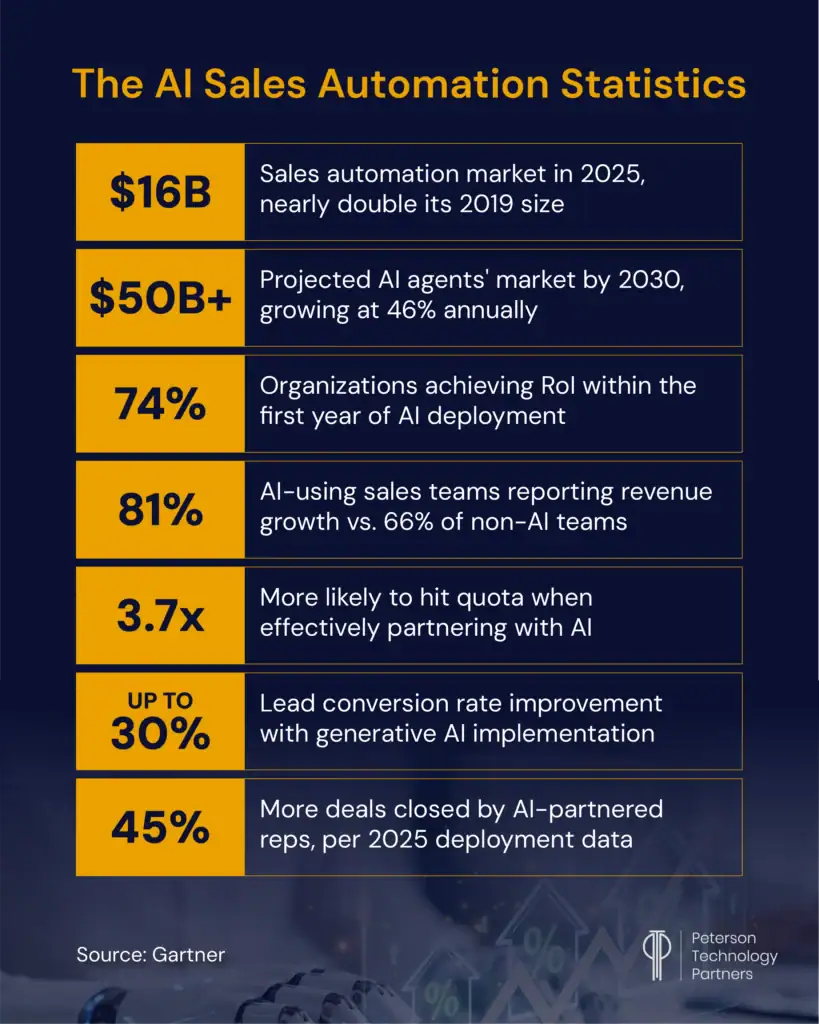
The 17-percentage-point gap between AI-using and non-AI sales teams is probably the most commercially significant number in that list. And it compounds. A team that is 17 points more likely to grow revenue this year is also building better data, better patterns, and better institutional knowledge for next year.
The Top 10 AI Sales Calling Agents and Automation Tools
The list below covers the top 10 AI sales calling agents and automation tools basis capability breadth, deployment maturity, evidence of real-world impact, and whether a tool is genuinely useful.
Pete& Gabi (Olivia AI)
Olivia AI Sales Agent works over voice, which still happens to be one of the highest-conversion outreach channels in B2B sales, particularly in high-volume enterprise markets where a call signals intent in ways a cold email never quite does. Pete & Gabi built Olivia AI Sales Agent to handle outbound calling, lead qualification, and initial prospect engagement at scale without the quality degradation that tends to come with high-volume voice programs run by undertrained reps.
Thoughtly
Thoughtly builds and deploys AI phone agents for both inbound and outbound sales calls, with a no-code drag-and-drop interface that lets non-technical teams get a working AI sales calling agent live in under 20 minutes. The platform connects directly to CRM systems including Salesforce, personalizes conversations using real-time data, logs call outcomes automatically, and includes A/B testing for call scripts, which is a genuinely useful feature that most competitors lack. Pricing starts at approximately $30 per month for the entry plan with 300 minutes included. Enterprise pricing is custom and requires a sales conversation.
Retell AI
Retell is an API-first, developer-oriented platform for building production-grade AI voice agents at scale. Its technical capabilities include sub-800ms latency, interruption handling, support for 30-plus languages, bring-your-own-carrier telephony (Twilio, Vonage, Telnyx), and compatibility with GPT-4, Claude, or custom LLMs. Compliance covers SOC 2, HIPAA, and GDPR support built in. Pricing is modular and pay-as-you-go, starting around $0.07 per minute, though costs stack up as you layer in premium voices, LLM tiers, and advanced features. However, Retell is built for engineering teams. Non-technical sales operations teams will find it heavy. If you have developers, it is extremely capable.
Bland AI
Bland is another developer-first platform, built around the premise that AI voice agents should be programmable for building blocks, not packaged products. Its Conversational Pathways system lets developers define exactly how a call flows, with node-level logic, webhook triggers, and API-driven personalization. The platform can dispatch up to 20,000 calls per hour, which is a genuine differentiator for enterprises running very high-volume outbound campaigns. Pricing sits at $0.09 per minute for connected talk time, with additional charges for outbound minimums, transfers, voicemails, and SMS. User reviews praise the control and scale, but flag customer support as inconsistent. English is the primary supported language; multilingual support requires enterprise negotiation. However, it is not a fit for teams without engineering resources, but for those with them, the programmable depth is significant.
Synthflow
Synthflow is the no-code counterpart to Retell and Bland in this category: accessible, fast to deploy, and meaningfully capable. Its visual flow designer handles outbound prospecting, lead qualification, appointment scheduling, and call routing without requiring a developer. Sub-500ms latency is among the better benchmarks in the category, and the platform supports 50-plus languages with voices capable of conveying emotional nuance rather than flat text-to-speech delivery. Integration with HubSpot, Salesforce, Cal.com, GoHighLevel, Zapier, and WhatsApp is native. Pricing starts at $0.08 per minute with enterprise tiers available. However, one persistent user complaint remains: the platform branding appears on client-facing interfaces even on paid plans, which matters for companies that want white-label output.
Smith.ai
Smith.ai occupies a specific and commercially important niche: the hybrid AI-plus-human model for inbound sales calls and lead capture. Its AI Receptionist handles call answering, lead qualification, intake questions, CRM updates, appointment booking, and spam filtering on a 24/7 basis. When a call exceeds what the AI can handle well, which is any complex, sensitive, or high-stakes conversation, it escalates seamlessly to one of 500-plus trained North American live agents. For small to mid-sized businesses where the inbound call is still the primary sales conversion channel, that safety net has real value. Pricing starts around $95 per month for the AI Receptionist tier, with live agent plans starting around $285 per month. Per-call rather than per-minute billing makes cost prediction straightforward.
Gong
Gong records, transcribes, and analyzes every sales conversation, then tells you what is happening in your pipeline versus what your reps believe is happening. The gap is usually instructive. Its signal detection works across 300 or more data points, which the company claims produce revenue forecasts 20% more accurate than traditional CRM data. More valuable in practice is the coaching layer: Gong surfaces specific behaviors from your top performers and makes them teachable at scale. Meaningful signal starts to emerge around ten or more reps. Below that threshold, the pattern data is thinner than the pitch would suggest.
Salesloft
Salesloft rebranded itself as a revenue orchestration platform a couple of years ago, and unlike most rebrands, it made something real out of the repositioning. Cadences, call coaching, deal inspection, and forecasting sit within a single interface, and its 2023 acquisition of Drift added conversational marketing capabilities across the buyer journey. If your stack is built around Salesforce, you will feel at home here; HubSpot users tend to report more friction in the integration. Best suited to mid-market and enterprise teams with enough deal volume to benefit from the orchestration layer.
Conversica
Conversica’s Revenue Digital Assistants do follow ups particularly well. Via multi-turn email and SMS, they engage leads around the clock, qualifying intent and booking meetings without requiring a rep to intervene until the prospect is ready to talk. Speed-to-contact is one of the most consistently underrated variables in lead conversion, and a 24/7 AI that never has a bad morning solves that problem cleanly. The limitation is that conversational playbooks work best in high-volume, inbound environments. If your deals are complex, relationship-driven, or involve a long list of stakeholders, Conversica can feel generic at exactly the wrong moment.
Clay
Clay pulls from over 100 data sources including LinkedIn, Hunter, and various intent signal providers to build detailed prospect profiles automatically. The manual research that used to happen before a single email was sent, the hour a rep spent building context on a company before calling them; Clay does that. It feeds your engagement platform considerably better data, which tends to raise reply to rates for reasons that should be obvious. Steeper setup learning curves than most tools here; best used by teams with a sales operations resource who can configure it properly.
Infographic 2: Top 10 AI Sales Agents & Automation Tools (2026): Use case, pricing, key differentiator
| # | Tool | Primary Use Case | Tech Requirement | Pricing (Indicative) | Key Differentiator |
| 1 | Olivia AI by Pete & Gabi | High-volume outbound; Lead qualification; Voice-based prospect engagement | No-code | Custom, starting at $1200/month | Live conversational AI for outbound calling with structured qualification and summaries |
| 2 | Thoughtly | Inbound + outbound automation; CRM-connected workflows; Script testing | No-code | Starts ~ $30/month (limited usage tier; enterprise pricing varies) | Fast deployment with experimentation features such as script testing (as per vendor materials) |
| 3 | Retell AI | Developer-built voice agents; Custom workflows; Multilingual support | Dev required | Usage-based (reported ~$0.07/min range) | API-first voice infrastructure with low-latency conversational capabilities (vendor-claimed) |
| 4 | Bland AI | Programmable outbound calling; High-volume automation | Dev required | Usage-based (reported ~$0.09/min range + telephony costs) | Deep API-level control over call flows and logic |
| 5 | Synthflow | SMB outbound; Appointment setting; Multilingual voice agents | No-code | Usage-based (reported ~$0.08/min; varies by plan) | No-code voice agent builder with integrations (e.g., CRM, Zapier) |
| 6 | Smith.ai | Inbound lead capture; Call answering; AI automation with human involvement | No-code | Starts ~$95/mo (AI plans); higher tiers include human agents | Combination of AI automation with optional human agent fallback |
| 7 | Gong | Sales analytics; Call intelligence; Rep assistance | No-code | Custom (seat-based enterprise pricing) | Conversation intelligence and revenue insights from recorded calls and emails |
| 8 | Salesloft | Sales engagement; Outreach; Pipeline management | No-code | Custom enterprise pricing | End-to-end sales workflow platform; includes conversational and engagement tooling |
| 9 | Conversica | Lead follow-up; Inbound qualification; Email/SMS automation | No-code | Custom (volume-based pricing) | Automated multi-step lead engagement via email/SMS with AI assistants |
| 10 | Clay | Prospect research; Data enrichment; Sales ops workflows | Sales ops / technical setup | Credit-based pricing (usage-based) | Aggregates multiple data sources to automate prospect research and enrichment |
What Happens After You Choose an AI Sales Calling Platform?
Choosing the right AI sales calling platform is crucial. Unified implementations, where AI sales tools integrate tightly with CRM, marketing automation, and customer success platforms, outperform isolated deployments by approximately 65%. A tool sitting in its own silo, not feeding the CRM, not receiving data from marketing, not sharing context with the next platform in the chain, captures maybe a third of its potential value. It becomes a line item that gets cut in the next budget cycle.
There are a few patterns in the deployments that compound over time versus the ones that plateau and get quietly unsettled. The first is process clarity before tool selection. If the follow-up workflow is broken before an AI agent arrives, the agent will accelerate the broken workflow. No platform fixes a process that nobody has mapped. The second is genuine rep adoption. The distinction between a tool operations teams love and a tool reps use is a distinction worth making carefully in every evaluation. A demo that impresses a VP is not the same as software that reduces friction for a person making 60 calls a day. The third is measurement. If you cannot define what success looks like in the first 90 days, you will not know whether you have it.
What Impact Do Integrated AI Sales Calling Tools Have Compared to Siloed Deployments?
Eighty-one percent of sales teams using AI calling tools are reporting revenue growth. Sixty-six percent of non-AI teams are reporting the same. Sellers partnering effectively with AI sales voice agents are closing 45% more deals and converting leads at up to 30% higher rates than peers who are not.
There is no single right tool and no universal answer about where to start. A lean team running high-volume outbound has different needs from an enterprise with a 200-person sales organization and a two-year deal cycle. But the floor is rising for everyone. The organizations figuring this out now are building the data infrastructure and the institutional knowledge that will be genuinely difficult to replicate 18 months from now.
The case for acting is not that AI sales voice calling agents are the future. They are the present, and the gap between the teams that understand that and the teams that are still debating it is already measurable in the numbers.
Frequently Asked Questions
What is the actual difference between an AI agent for sales and regular sales automation?
Regular automation is rule-based where a trigger is fired, and an action executes. It is useful, but it cannot handle anything outside the rules it was given.
AI sales call agents interpret context, adjust their behavior based on what they encounter, and can chain together multi-step actions across platforms without a human moving each piece.
In practice, the difference shows up most clearly when something unexpected happens.
Will AI sales calling tools replace sales reps?
No, at least not the ones who focus on the work that genuinely requires human judgment.
What AI sales calling agents handle well is the high-volume, structured, and repeatable tasks such as:
- Prospecting
- Initial outreach
- Data hygiene
- Scheduling
- Routine follow-ups
The work of navigating a complex buying committee, building a real relationship with a CFO who has been burned by a bad vendor before, knowing when to push and when to go quiet still requires a human. What changes is that sales reps who effectively use AI will handle more pipelines with better data and more available time for that kind of work. Reps who do not find they are competing against those who do.
What is the expected ROI after deploying AI sales automation platform?
Seventy-four percent of organizations in recent studies report return on investment within the first year.
The faster-to-value tools, typically those with minimal implementation requirements and no major CRM integration work, tend to show measurable impact in the first quarter:
- Better deliverability
- Faster follow-up
- More meetings booked
Complex platform deployments that require process redesign and deep integration work take longer to show up in the numbers, but they also tend to produce more durable advantages. The question is less how quickly you will see ROI and what you are measuring it against.
What should companies evaluate before picking up an AI sales calling platform?
Three things matter more than the demo.
- First: does it integrate seamlessly with the CRM you already use, not the one in the vendor’s slide.
- Second: will your reps actually use it, which means testing it with actual reps in a real pilot, not just ops and leadership.
- Third: understand the pricing model before you sign anything. Usage-based and per-assistant models look reasonable at launch and can become expensive fast at scale.
The AI sales assistants that deliver compounding value are the ones that earn genuine adoption at the individual rep level, not just executive approval.