


Open-source AI models have entered a new phase of growth.
With Meta’s long-awaited Llama 3.1 release in late July, the company positioned the model as its most advanced open-source AI system yet, claiming it can compete with leading closed models such as GPT-4o and Claude 3.5 Sonnet. Meta CEO Mark Zuckerberg has emphasized that open-source AI represents the future and aims for Meta’s AI assistant to become one of the most widely used by the end of the year.
Meta is not alone in advancing open AI models. Several large open-source models gained attention throughout July and August 2024, including Mistral’s Large 2, Athene-70B, Google’s Gemma 2, AI21’s Jamba, and Yi from 01.AI.
At the same time, major technology companies continue competing to lead AI infrastructure and development. Nvidia remains at the center of the AI boom, with strong revenue growth expectations driven by demand for its AI chips and computing platforms.
In this edition of our bi-monthly AI roundup, we explore the rapid rise of open-source AI models, the ongoing debate around their benefits and risks, the evolving landscape of AI governance, and emerging trends shaping the AI industry in July and August 2024.
Democratizing AI
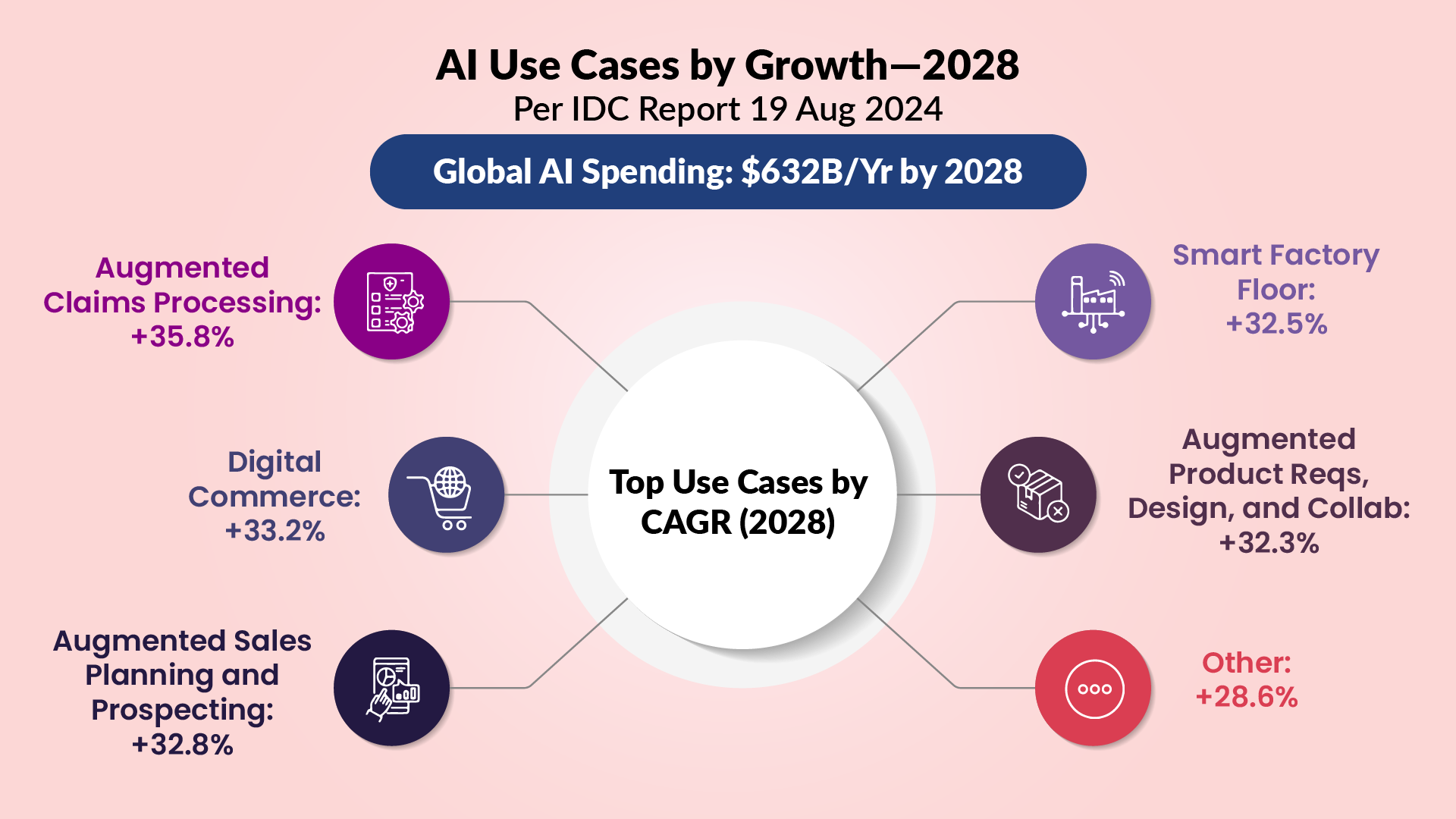
Big AI spending continues to surge, as indicated in the numbers below, with predicted use cases by growth:
The release of new open-source AI models has brought the concept of democratized AI back into the spotlight, beginning with the question of what truly qualifies as open-source.
The Open Source Initiative (OSI) brought together experts from across the AI industry, including representatives from Google, Meta, and Amazon, to define the requirements for open-source AI. According to this framework, a truly open-source AI system should be freely available, usable for any purpose without permission, and allow users to examine its components to understand how it works. Users should also be able to modify the system, adjust outputs, and share it with others.
However, some developers argue that current models, including Meta’s Llama AI models, do not fully meet this definition. Illia Polosukhin, founder of Near.AI and a member of the team behind Google’s Transformer research, has argued that restrictions on usage rights and limited access to training data prevent these models from being considered genuinely open-source.
Supporters of open AI models argue that openness is essential for reducing potential AI risks. They believe broader access can improve transparency, encourage collaboration, and help prevent advanced AI systems from being controlled by a small number of large companies. Some researchers also argue that open development can improve security by allowing more experts to examine systems for vulnerabilities.
However, critics warn that making powerful AI models widely available could also create new security risks. Open access to advanced AI capabilities may provide cybercriminals and other malicious actors with tools that are difficult to control. Without sufficient testing and oversight, widely available AI systems could introduce risks that are not yet fully understood.
At a national security level, concerns about advanced AI tools being accessed by terrorist organizations or authoritarian governments continue to influence policy discussions around how open these technologies should become.
Scary Badness
Concerns around AI continue to grow, particularly among experts who are examining the long-term impact of these technologies.
In July, the term “human washing” gained attention as a way to describe situations where companies present AI systems as more human-like than they actually are. Similar to the concept of “greenwashing,” the term highlights cases where organizations emphasize the human benefits of AI while failing to clearly disclose when users are interacting with a machine.
Without clearer standards and regulations, these practices could create significant challenges. While human-like AI experiences may improve user interactions, transparency remains important so people understand when they are communicating with an AI system rather than a real person.
Concerns have also increased around how AI companies collect and use information. For example, Perplexity has faced criticism over allegations that it used content from online sources without proper attribution when generating responses. These debates highlight the growing need for clearer guidelines around AI transparency, data usage, and responsible development.
Considering where AI can go wrong is the basis behind sites like the AI Incident Database, an AI “repository of problems experienced in the real world” for researchers and developers, and MIT’s AI Risk Repository, which charts potential AI risks in the effort to help industry and academia alike to better understand the full picture.
From their analysis of the findings, they discovered that:
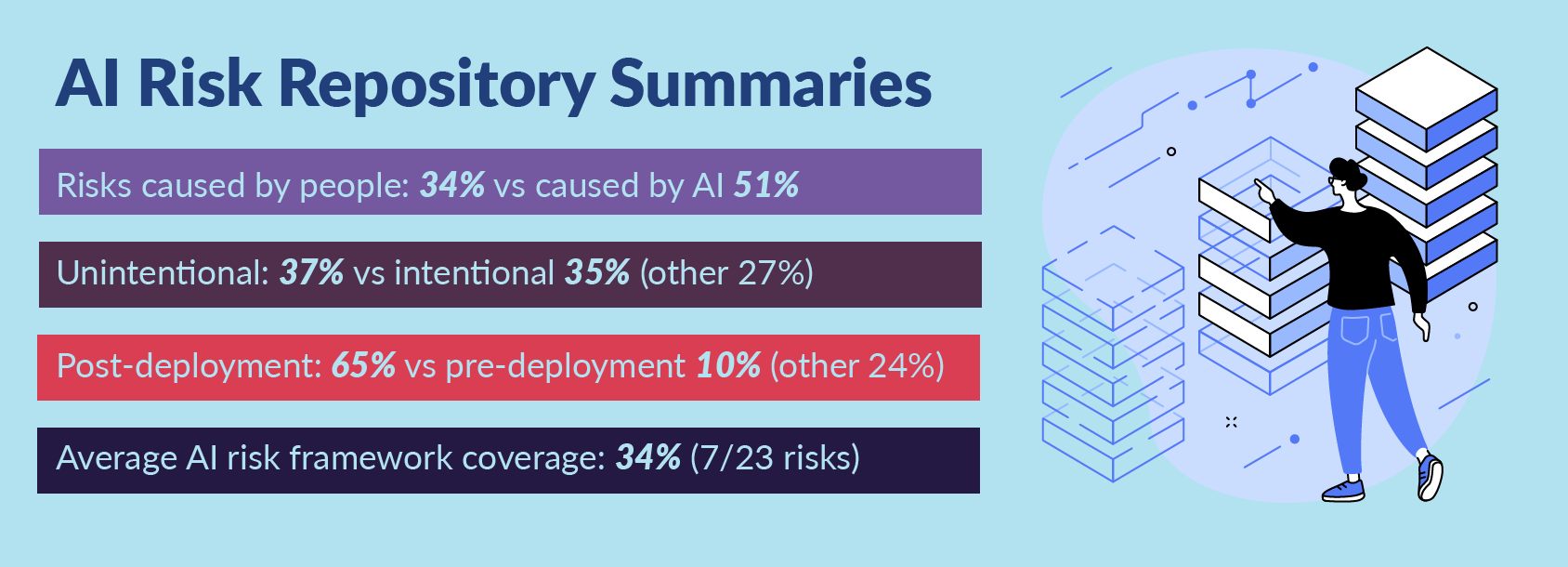
In these cases, the chronicling of AI failures and risks isn’t fearmongering, but instead aimed at uncovering the worst outcomes possible so that systems in the future can be better aligned, and regulators can better address actual risk cases, preventing so-called doomer scenarios from ever coming to fruition.
Governance, Hallucination, and Global Developments
July and August had news on all of these issues, and The PTP Report has you covered on these AI industry updates, with recent articles in depth on:
- The emergence of RAG and current work to curb hallucination
- European attempts to lead with regulating AI as in other areas
- The international scramble for AI relevance, including the US effort to contain Chinese AI development
Additional news here includes:
- A US judge in early August ruled Google maintained an illegal monopoly in search, a decision that is likely to trigger significant impact across Big Tech, as investigations and suits are already underway against Apple, Amazon, Meta, and Nvidia.
- California’s SB-1047 (“Safe and Secure Innovation for Frontier Artificial Intelligence Models Act”) passed the state senate in May, raising concerns across the AI industry. In August, amendments reduced some requirements, including replacing mandatory safety certifications with safety practice disclosures. The state can still pursue legal action after catastrophic events but has limited authority to stop operations beforehand. The updated bill also excludes smaller open-source AI users spending less than $10 million on model tuning and is expected to move toward a final vote soon.
Coming Soon
Search is rapidly becoming AI’s domain, with OpenAI entering the game to challenge Google. One issue here: according to a Goldman Sachs report, ChatGPT searches average 10 times the power use of a conventional web search. Also in their report: AI is now expected to drive a 160% increase in data center power needs.
Still, this change is part of a broader move to AI agents, one of the early AI predictions for systems that go beyond chatbots and actually make decisions to attain a user’s goal.
Eric Schmidt, former Google CEO, (in talking to students at Stanford in a widely shared Youtube video, and via an interview with Noema), includes this in his own AI insights—on the three things he believes will combine to radically change our world in the near term:
- Very long context windows: New techniques allow going from a million words to nearly infinite context windows, which can enable systems to loop back into themselves or other systems.
- Agents that can actually learn things: Ask your agent to learn a skill, for example, and it will soon be able to consume volumes of necessary textbooks and retain this knowledge. Combined with the above, you have radically improved chain of thought reasoning (ala recipes or procedures with thousands or more steps) to achieve what you need, helping an AI take two and three steps on its own.
- Text-to-action: Asking the AI to do something—such as write a program in a certain language that accomplishes a set of requirements, and it will be able to do it, implement, and test the results.
This combination, Schmidt asserts, is not far off (“the next few years,” closer to 5 than 10), transforming AI systems with exponentially more power and use.
OpenAI’s secretive “Strawberry” project, reported on by Reuters in mid-July, is well into development and goes beyond answering user queries, instead performing what OpenAI calls “deep research” by using the internet autonomously, likely some progress on the steps above.
For professionals, a new field is continuing to emerge called LLMOps, focused on the specialized needs of AI models. This can include ensuring optimization, reliability, safety, privacy, and compliance, handling necessary AI testing, and in the short term (as it lasts) prompt writing.
While the field isn’t new, it continues to shift and evolve, entailing different tasks at different companies.
Conclusion
Back on the subject of open-source: Illia Polosukhin’s NEAR promises the arrival user-owned AI, fusing blockchain and AI technological innovations together.
The goal is to help solve what he sees as one of the critical issues of the AI at scale debate—access to quality data—by enabling collaboration and sharing among developers and users. This means that data use can be unveiled, with microtransactions that can potentially allow content creators to be compensated as their work is used.
They currently make use of open-source models, like many smaller players, which took a massive step forward in this period. Of course, progress is surging forward elsewhere, too, meaning the gap between the open and closed models will not remain this close for long.
Catch up on our prior AI news roundups here:
We hope you’ve enjoyed our coverage of the latest breakthroughs in AI technologies for July and August 2024—expect our next edition around Halloween, hopefully devoid of AI-related horror stories.
References
Meta releases the biggest and best open-source AI model yet, The Verge
We finally have a definition for open-source AI, MIT Technology Review
The Blurred Reality of AI’s ‘Human-Washing’, Wired
Forbes presents publisher worries about AI, Editor & Publisher
‘Google Is a Monopolist,’ Judge Rules in Landmark Antitrust Case, The New York Times
Inside the fight over California’s new AI bill, Vox
AI is poised to drive 160% increase in data center power demand, Goldman Sachs
Mapping AI’s Rapid Advance, Noema Magazine
Exclusive: OpenAI working on new reasoning technology under code name ‘Strawberry’, Reuters