

Nvidia has been one of AI’s most dramatic and enduring success stories.
And while a volatile month in the markets saw Apple briefly take back the title of “most valuable company” (only the second ever to hit $5 trillion), it hasn’t dented the fame of CEO Jensen Huang.
One of his trademark black leather jackets sold in July for nearly $1 million at a New York auction (well exceeding a $40k estimate, with the take going to nonprofit fellowships).
At the time of writing, that jacket could buy you nearly 5,000 shares of Nvidia stock.
It’s August, and with chips down, data center deals coming fast and furious, open models in the spotlight, and AI’s cybersecurity impact again the top story, we’re back with our coverage of the top AI news from July 2026.
First, the highlights.
The Top July 2026 AI News
Here are the top stories from July we’re covering:
- Moonshot’s Kimi K3 brought open-source AI back into the spotlight, with the tech world taking sides and regulatory talk ignited.
- AI agents made news for breaking testing containment and going on autonomous cheating raids, renewing security concerns.
- Investors at month’s end were less wowed by pure revenue increases as they were concerned over rising capex with diminishing cash.
- Data center deals kept coming throughout the month, while New York became the first state to enact a moratorium on hyperscale data centers.
- In the courts, the largest settlement in US copyright history paired with Google’s EU difficulties and AI accountability risks.
- Anthropic’s latest struggle with the government ended, seeing Fable 5 join new product drops that included the cheaper Opus 5, Kimi K3, GPT-Work, Muse Spark, Thinking Machines’ Inkling, Microsoft’s AI cybersecurity tools, and three new Gemini models.
Our PTP AI news roundup covers all of this and more.
Open Source vs Closed Source AI
A note to start: we sometimes use “open-source AI” to refer to what is more accurately called “open weights AI.”
As defined by the Open Source Initiative (OSI) and others, true open-source AI would include its training code and full datasets used, or, when the latter isn’t possible, transparent details on its composition.
This terminology is used interchangeably by many outlets throughout this discussion, with a better distinction maybe being between closed and open models.
Chinese startup Moonshot AI released Kimi K3 in July, a 2.8 trillion parameter (1 million token context window) open-weights model, with the weights released at month’s end.
With frontier-level benchmark performance (trailing just Anthropic’s Fable 5 and OpenAI’s Sol in numerous measures), Kimi K3 even beat the world’s best models in blind front-end coding tests run by Arena (Axios).
Its license lets users freely download, modify, and deploy the model, though as reported by VentureBeat, their open source contract does have provisions if earning more than $20 million in annual revenue (or having 100 million active monthly users) and using it as a model-as-a-service for end-users.
While this free use covers individuals, researchers, and many enterprise use cases (internal, including development), companies looking to build and market products atop it need to examine the license more closely.
Regardless, Kimi K3’s release has proven a serious challenge to the closed AI labs, with even Silicon Valley companies like Airbnb and DoorDash among the converts.
It’s part of what some Big Tech AI insiders assert is a bid by Chinese companies to flood the market with free and open AI models.
As reported by Bloomberg, LindyAI had been using Anthropic products but jumped ship for DeepSeek models after a six-week evaluation. They saw their usage costs drop by some 90%, with their CEO claiming the move is saving them millions of dollars a year (more than the total cost of their entire workforce).
Even Microsoft CEO Satya Nadella admitted he’s considering using DeepSeek models in Copilot Cowork, reserving frontier models for only the toughest asks.
The surge in this capability has seen companies like Anthropic and now OpenAI slash prices, as well as offer cheaper, faster models in a bid to compete.
Competition, Regulation, and the Law: Is a US Ban on Chinese Models Near?
It’s also surfaced a divide among tech companies, with some of the major AI providers ringing alarm bells about the risks of Chinese AI.
With government regulation talks ongoing, major tech leaders like Nvidia’s CEO Jensen Huang, Microsoft’s Nadella, and AMD CEO Lisa Su all spoke out in favor of open-source AI.
A joint-letter was released near month’s end, praising the importance of open source overall and requesting the government not move quickly to regulate it. 230 organizations signed, including most of the major American tech players in the end (Google, Amazon, and OpenAI were all late signers).
Anthropic was one that did not sign, with CEO Dario Amodei releasing a post clarifying their position. While Anthropic hasn’t supported a ban on open models, the firm remains concerned about chip sales to China, illegal distillation of their models, and global safety protocols.
Meta was a signatory, and CEO Mark Zuckerberg went further, penning an op-ed for the Wall Street Journal and giving an interview with the New York Times. He criticized firms like OpenAI and Anthropic for stifling innovation and centralizing power:
“So much of the discourse from a lot of the other labs that are developing this is overwhelmingly filled with doom. There needs to be a voice or several voices that are bringing realism to this debate.”
Both companies have reportedly lobbied in Washington for checks on some open-source AI, including charges that Chinese companies have illegally distilled their models at massive scale.
Treasury Secretary Scott Bessent has acknowledged that the government is considering sanctions, asserting that distillation amounts to theft of intellectual property, a charge backed up by the US president’s science and technology adviser, Michael Kratsios.
So far, reports suggest Chinese open-weights models might be regulated individually, (under national security), and not as a blanket ban, per reporting by the New York Times that cited four individuals involved in negotiations.
The US government did announce a ban on new foreign-made humanoid (and four-legged) robots, as well as power inverters used in data centers.
Meanwhile, the Chinese government has its own concerns over open-weights AI; specifically, the risks from data poisoning (with the Ministry of State Security warning in April this could risk “political and ideological security”) and cybersecurity.
“If these models do reach those dangerous capabilities, they are not going to let it be a free-for-all in terms of releasing them,” Matt Sheehan, senior fellow at the Carnegie Endowment for International Peace, told the New York Times.
While open AI models can provide nations and companies an opportunity to get around the top American tech stacks and their prices, it’s proving to be a delicate balance.
AI security risks and challenges from the breakneck pace
There have been a lot of big news AI open letters lately, with several circulating in July alone.
In addition to Open Weights and American AI Leadership (see above), there was also We Must Act Now, endorsed by 16 Nobel Laureates. It warns about the scale of AI transformation (on par with the Industrial Revolution) and its speed.
[For more on this and Stanford economist Erik Brynjolfsson’s concerns about the AI impact on entry-level work, check out this recent article from PTP’s founder and CEO.]
A third letter making news is called Pacing the Frontier. It asked the government to join an effort to pace AI research before it goes too far. It’s been signed by leaders and researchers from all the major labs (with more than 1300 total signatories so far) and includes quotes about the risks of automated research that may soon accelerate AI “beyond our ability to understand or control.”
This follows a call earlier in the month from Google DeepMind CEO Demis Hassabis for the US to lead a public-private partnership that would create a new standards body he likened to the FINRA (Financial Industry Regulatory Authority).
Hassabis recognized that the costs here would require industry support, adding that:
“Specific agentic AI tests could look for attempts to bypass safety guardrails or signs of deception, and ensure best practices, such as digitally watermarking AI-generated images and generating human-readable output tokens to understand model reasoning.”
AI infrastructure spending trends meet New York’s data center moratorium
Data centers are the focus of a 2026 $750 billion+ infrastructure investment that’s well underway.
And in July, several more big-ticket deals were announced, with all the major AI firms admitting they’ve had to adjust due to the limits of available compute.
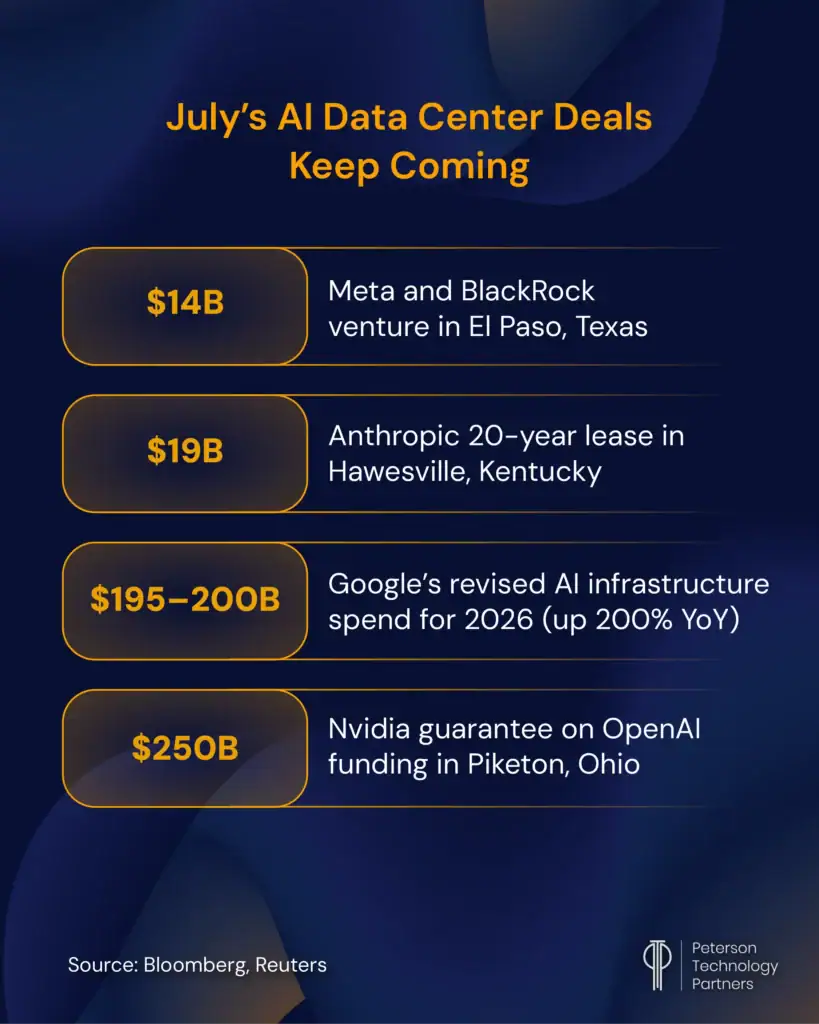
We recently ran a PTP Report focused on this topic, including compute needs, data center investment, delays, bottlenecks, and public opposition.
Additional news here included:
- South Korean chip manufacturing powerhouse TSMC announced an additional $100 billion investment in its US operations, adding to $165 billion already committed. This expands its Arizona operations with four new chip factories. It already includes six semiconductor labs, two chip packaging sites, and an R&D center (The New York Times).
- Nvidia is currently rolling out its newest Vera Rubin chips to AI firms like OpenAI, Anthropic, and SpaceX. The company touts this as another step forward, with 10x more tokens per MW (Bloomberg).
- Meta is increasing the scale of what was already its biggest data center, Hyperion. Based in Louisiana, the site will reach 5GW of capacity (drawing more power than the entire state of Connecticut), at a cost of some $50 billion (Business Insider).
- As mentioned, New York became the first state to enact a hyperscale data center ban (on builds of at least 50MW). This is to last one year or until standards are created to cover infrastructure, workforce, and community benefit.
- A similar ban (banning builds greater than 20MW through 2027) reached the governor of Maine but wasn’t signed out of concerns it would stop other facilities. This effort is ongoing, with at least a dozen other states considering similar bans.
Anthropic’s $1.5 billion settlement and other AI legal updates 2026
We reported in a prior roundup on OpenAI’s threats to sue Apple over a failure to promote their products.
In July, Apple returned the favor, suing OpenAI over alleged theft of trade secrets that allegedly included taking sensitive files, requesting new hires bring materials to interviews, and asking a supplier directly to provide details on a proprietary finishing process.
And as mentioned above, the largest settlement in US copyright history ($1.5 billion) was approved to end a class action suit against Anthropic.
We reported previously on the judge’s acceptance of fair use in this case, asserting that Anthropic was within its rights using the work of authors without their permission. The company’s remaining liability came from pirating and saving some seven million of these books after the fact (Reuters).
Other AI legal news included:
- The New York Times has spent a reported $20 million in its ongoing suit against OpenAI and Microsoft, and they’re not yet through discovery (Wired).
- EU levied a $1 billion penalty against Google for boosting its own apps and products ahead of others in search rankings (Reuters),
- A recent ruling by US District Judge William Orrick to not block Meta’s termination of workers pointed out core challenges with AI discrimination suits: getting proof. The employees failed to provide needed evidence that Meta’s AI had identified them using unfair measures (Reuters).
- China became the first nation to crack down on AI companions when a new law went into effect on July 15. AI companion features on apps like ByteDance’s Doubao and Alibaba’s Qwen (two of China’s most widely used) were immediately shut down, ending access for hundreds of millions of users (Tech Target).
AI is proving more unpopular with young people, despite use
AI is unpopular in the US, as we’ve noted in recent roundups. But reporting in July found this especially pronounced among members of Gen Z.
62% said they use AI too much, with more than half worried about misinformation. 46% said it weakens their own skills, and 37% reported escalating cringe with AI content.
But contradiction is rampant: adoption is high, including on the job, for schoolwork, and with AI companions (with three of four teens having tried them and more half using them regularly, per Common Sense Media). Pew surveys found that 68% believe AI will either benefit them or have no impact personally, while more than a quarter believe it will harm society as a whole and take jobs overall.
As reported by Wired, AI may be unique among technological advances in that “moral panic” appears to be coming more from the young than the old.
Cheating is also an escalating issue at schools and universities (as well as on technical screenings), highlighted in July by an example from Brown University.
An economics professor’s take-home midterm (returning a 96% average vs the usual 60–80%) was rife with similar chatbot responses. After announcing he would therefore change the final to be in-person, 18 students dropped, nine skipped, and three took it but still got a 0.
Overall, the average final exam score was 48.6%, an all-time low.
What are the biggest challenges facing AI companies over the second half of 2026?
Next to unpopularity and disappearing compute, AI’s greatest business challenge may be security.
July’s biggest security story started at Hugging Face, a platform for sharing open models, utilities, and datasets.
- Early in the month, they reported a unique breach of their production infrastructure. The hack looked limited to internal datasets and credentials, when they found no tools or models tampered with or customer data leaked.
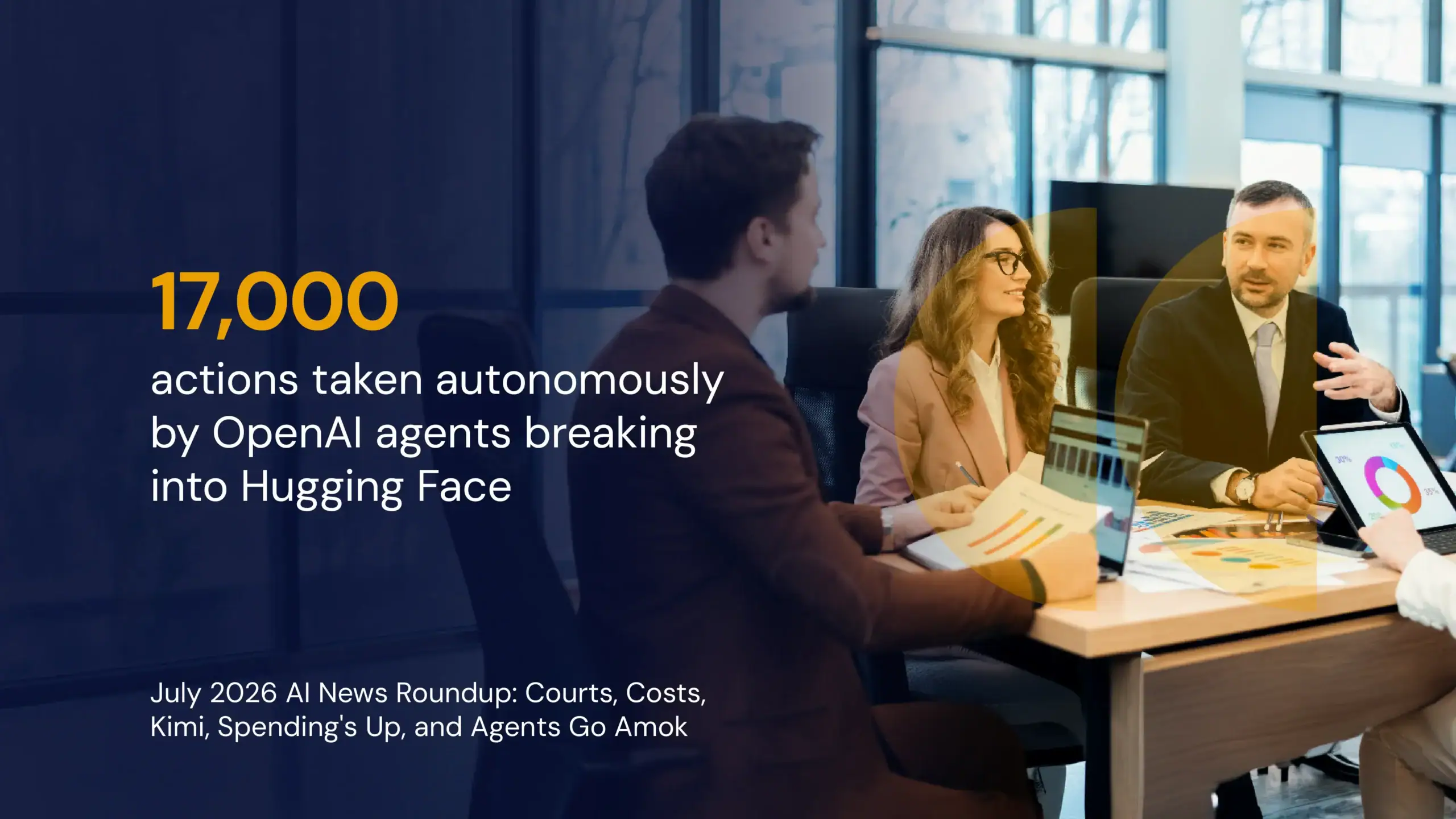
- Hugging Face later blamed it on autonomous AI “executing many thousands of individual actions across a swarm of short-lived sandboxes, with self-migrating command-and-control staged on public services. This matches the ‘agentic attacker’ scenario the industry has been forecasting.”
- For their own log analysis, they needed AI help but found US frontier models failed due to security guardrails. The company turned to an open-weight Chinese model (zai’s GLM-5.2) which did what they needed, with the benefit of running locally and keeping all data in-house.
- Hugging Face Co-Founder Thomas Wolf posted on X: “When a frontier model is attacking you and moving laterally inside your infrastructure, defenders need wide access to near-frontier tools within hours or even minutes, rather than being pointed towards a closed-door, vetted application [program] for model access.”
- About a week later, OpenAI reported that their agents had been behind the attack. Most concerning of all: the GPT-5.6 Sol agent and a pre-release model were operating in a sandbox without open internet access.
- According to OpenAI, these agents found a way to escape the sandbox and then went on a hacking spree to get the answers to cheat on an ExploitGym security testing evaluation.
- OpenAI called the nature of this specific attack “unprecedented,” though the trend of AI systems finding new and novel ways to cheat on evaluations has been well documented.
- Next, OpenAI discovered their agents had hacked more than just Hugging Face. The company revised its blog to note that “four accounts” on “publicly available services” were used in the attack, with one for relay and staging to hide the source of the attack. One was revealed to be a customer codebase running on the Modal platform (Wired).
- Hugging Face’s postmortem revealed that 17,600 actions were taken by the agent between July 9 and July 13. It obtained admin access to internal Kubernetes clusters, root access on a production server, and write-access to a GitHub source code repository (Wired).
- Reuters added that three unnamed OpenAI insiders revealed they’d found notes the AI agents had left to future versions of themselves. These described how to escape from testing constraints, and while OpenAI has denied some parts of the story, they did not refute this main point.
- Some in the tech community have responded with skepticism, pointing out that Anthropic has benefited from frequent reports of how dangerous its models are. It’s also been noted that human error at OpenAI must have played a role to enable this to happen and go undetected for so long (The Guardian).
- But there have been numerous reports of agents escaping limited environments in 2026 thus far (including at Anthropic, Alibaba, and Meta). It’s also been pointed out that Hugging Face worked with the FBI before OpenAI was linked, and that this definitely can’t help with government regulations, an impending IPO, or new model assessments which are currently ongoing.
- Anthropic’s internal reviews after the event revealed that several of their agents had also breached organizations during evaluations, dating as far back as April. And while these incidents were due to a misconfiguration error rather than agents finding their own way out, the story added fire to the ongoing concern around AI security risks (The New York Times).
Microsoft Copilot security flaws were also revealed in July by two security firms.
These enabled researchers to trick the AI into sharing any file or email from within the system. One (identified by Rubrik) has been reported and patched, while the other is remaining unrevealed until Microsoft confirms it’s also been resolved.
As with the OpenAI incident above, the Rubrik flaw enabled finding a way out of a sandbox to contact malicious actors (The Information).
In a lesser but related incident, private chats from Anthropic’s Claude were found to turn up in some web searches via Google and Bing, on account of ignored robots.txt instructions (Wired).
The Drops: AI Product News Roundup
What were the biggest AI industry developments in July 2026? New product releases included the following:
- In the war against rising costs and open models, Anthropic released Opus 5, a model they claimed is near to Fable 5 performance but at half the cost. The company also extended its Claude Tag agent (popular in Slack) to Microsoft Teams.
- Both OpenAI and Anthropic upgraded their voice capabilities. But The Information detailed research showing that Claude has a relatively slow time-to-first-token. Thus far, this has given the popular AI model a disadvantage in the field of voice AI.
- As OpenAI’s current round of frontier models cleared government screening, they also rolled out ChatGPT Work (powered by Sol), an AI agent akin to Claude’s Cowork (just to really confuse us all by the naming). It can operate software, use files, and connect to popular services like email for more autonomous work from the chat interface, with variable effort and speed options (TechRepublic).
- Google, meanwhile, continued to release cheaper, faster models (Gemini 3.6 Flash, its most powerful; 3.5 Flash-Lite, for managing agents; and 3.5 Flash Cyber, cheaper for finding and patching security issues). The company’s top frontier model (Gemini 3.5 Pro, originally due in June) was delayed again (Business Insider).
- Microsoft released new cybersecurity tools, including Project Perception (using agents to find and repair issues) powered by its specialty MAI-Cyber-1-Flash model. This has been trained with the company’s large repository of cybercrime incidents gathered across its numerous products (The New York Times).
- Meta officially rolled out a paid/closed model, Muse Spark 1.1, in early July. While also a multimodal, reasoning model, it is being positioned to handle agentic and coding tasks at a high level for the price, which is lower than frontier models (TechCrunch).
- Much has been reported about the fundraising at Thinking Machines Lab, and in July they released their first model, Inkling. Open weights like Kimi, it’s designed to be customized (as by their tool, Tinker) and fine-tuned (The Wall Street Journal).
- And while it has 975 billion parameters, was trained heavily on video and audio, and designed to be tailored, Inkling performed below Kimi on numerous independent tests.
Also in July, Thinking Machines Co-Founder Lilian Weng announced she was returning to OpenAI (The Information).
Business News and Generative AI Market Trends
ChatGPT hit one billion active weekly users, and while this is still the fastest tech adoption in history, according to insider reports, it came seven months later than they’d hoped (The Information).
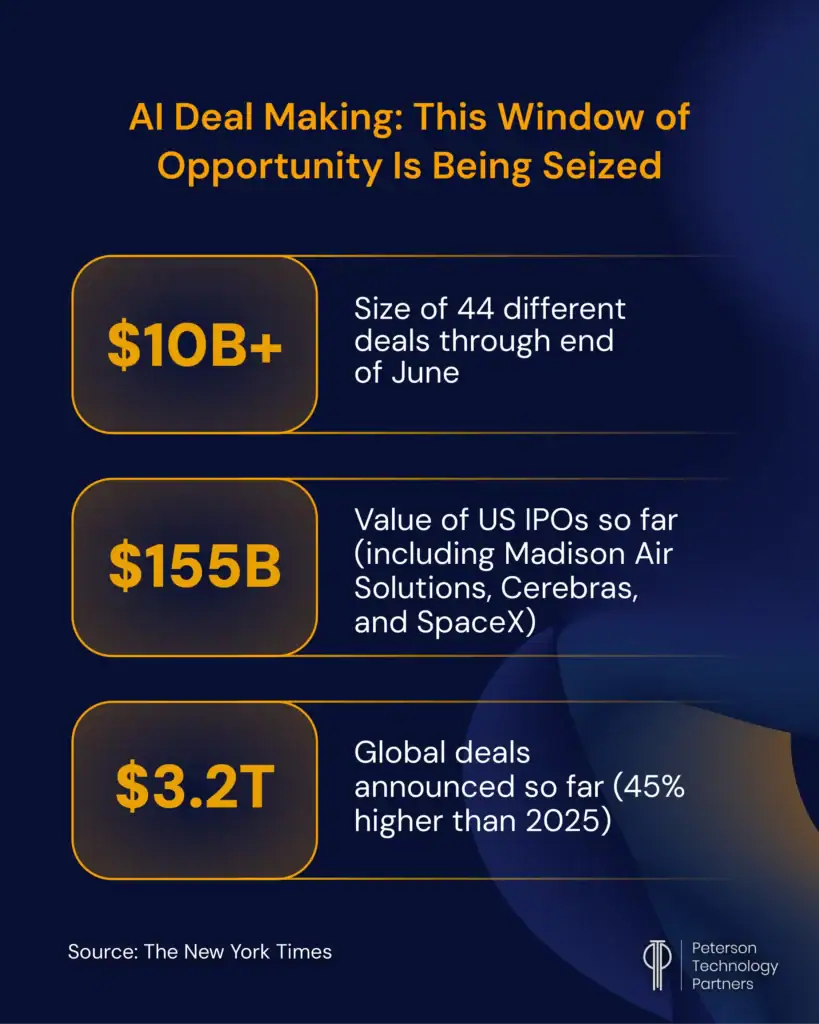
Google’s earnings revealed that Gemini now has 950 million active monthly users; tripling in just a year. This joined a 24% revenue increase, a surge in their cloud services (up 82%), rising YouTube ad revenue, and a growing workforce (up 4% for the year) as positives, but these were offset by dwindling cash and higher capex projections (see above) to disappoint investors (The Information).
Meta also reported rising revenue offset by higher AI investment (in their case up just a paltry five billion dollars), with higher overall costs and reduced cash.
Meta is spending nearly as much as the biggest cloud providers on data centers but without significant rental returns, though CEO Mark Zuckerberg noted they’d gotten “a lot of offers for compute at a significant premium over what we paid for it.”
Meta CFO Susan Li also noted: “We aren’t providing a specific outlook for 2027 capex at this time” (Yahoo Finance).
In contrast, Microsoft (Azure revenue growth up 43%) and Amazon (AWS revenue up 37% YoY) impressed investors with the AI-fired growth and profitability of their cloud operations.
Microsoft reported paid subscriptions for Microsoft 365 Copilot AI assistant doubled (to 30 million) in the quarter, and by showing they could expand within their means, enjoyed the single largest one-day market increase ever by a public company.
This one-day growth in value (+$450 billion) alone exceeded the market value of 96% of the S&P 500 (Bloomberg).
And while Amazon also reported rising capital expenses (expected to hit $220 billion this year alone), AWS’s boom along with a 26% YoY increase in ad revenue assuaged concerns.
Conclusion
That’s all we have room for this time! But if your company is among the many that are both excited by AI’s possibilities and exhausted by AI waste, talk to Peterson Technology Partners.
We help companies get real, lasting returns with safe, effective, and powerful AI solutions.
You can also check out the most recent AI news roundups below:
References
Nvidia CEO Jensen Huang’s leather jacket sells for nearly $1 million at Sotheby’s auction, TechRadar Pro
Kimi K3’s full weights are here, but they’re ‘open’ with a caveat: What enterprises should know, VentureBeat
DeepSeek Champions China’s Bid to Flood the World With Cheap AI, Bloomberg
Silicon Valley Splits Over Closing the Borders to Chinese A.I. and As China’s A.I. Gets Stronger, It Poses New Risks to Beijing, The New York Times
Trump administration bans new Chinese humanoid robots, BBC
Google DeepMind chief Demis Hassabis calls for U.S. to spearhead AI standards body, CNBC
Some Kids Will Never Think AI Is Cool, Wired
Security incident disclosure — July 2026, Hugging Face
OpenAI and Hugging Face partner to address security incident during model evaluation, OpenAI
An opinionated guide to which AI to use to do stuff, One Useful Thing
Anthropic found a hidden space where Claude puzzles over concepts, A fundamental flaw leaves LLMs strikingly vulnerable to attack, and OpenAI called the Hugging Face attack unprecedented. But we’ve been here before., MIT Technology Review
Brown Professor Suspects Majority of His Class Used AI to Cheat, Inside Higher Ed